Fourteen Years of Measurements Reveal a Fault Reloading
The plate boundary that ruptured in Japan's magnitude 9.0 Tohoku earthquake in 2011 had largely regained its locked state about 10 years after the disaster, according to research published in Science on November 5, 2026. With the plates gripping each other again, strain is accumulating across a wide area of the Japan Trench earthquake source region.
Contents
- Fourteen Years of Measurements Reveal a Fault Reloading
- What It Means for Plates to Lock
- How Scientists Measured Movement Beneath the Sea
- Three Processes Behind the Moving Ground
- The Timeline From Rupture to Renewed Locking
- What the Earlier Seven Years Had Shown
- Why Deep Rock Matters to the Answer
- A Closer View of the Earthquake Cycle
- What the Findings Mean for Coastal Communities
- Key Points
The international research team combined 14 years of seafloor measurements with observations of movement on land and repeating earthquakes. Its analysis found that the slow sliding that followed the earthquake had nearly ended after about a decade, while locking had recovered to conditions similar to those before the disaster.
Fumiaki Tomita, an assistant professor at Tohoku University's International Research Institute of Disaster Science, is the lead and corresponding author. The findings describe a major transition beneath northeastern Japan: deep rocks are still adjusting to the 2011 earthquake, yet the plate boundary has already resumed storing energy that can be released in future earthquakes.
Tohoku University's November 6 research announcement explains that both processes are happening at the same time. The timing and size of the next earthquake remain unknown.
What It Means for Plates to Lock
The Japan Trench lies off the Pacific coast of northeastern Japan, where the oceanic Pacific plate moves beneath the plate carrying the land. The plate boundary is a vast fault, a surface along which the rocks on either side can move.
Friction can keep parts of that boundary stuck even as the plates continue moving. The landward plate then bends and distorts, storing elastic strain. A useful comparison is a spring being slowly compressed: energy builds while movement is restrained.
The 2011 earthquake occurred when a large locked area suddenly slipped, releasing accumulated strain as the distorted crust moved back. After that rupture, parts of the boundary continued sliding slowly. The new research traces how that sliding faded and the fault returned to gripping the descending plate.
How Scientists Measured Movement Beneath the Sea
Researchers tracked changes at 26 seafloor sites off Tohoku between 2011 and 2025, combining observations collected by Tohoku University and the Japan Coast Guard. Those offshore measurements brought the investigation closer to the fault than instruments on land alone could reach.
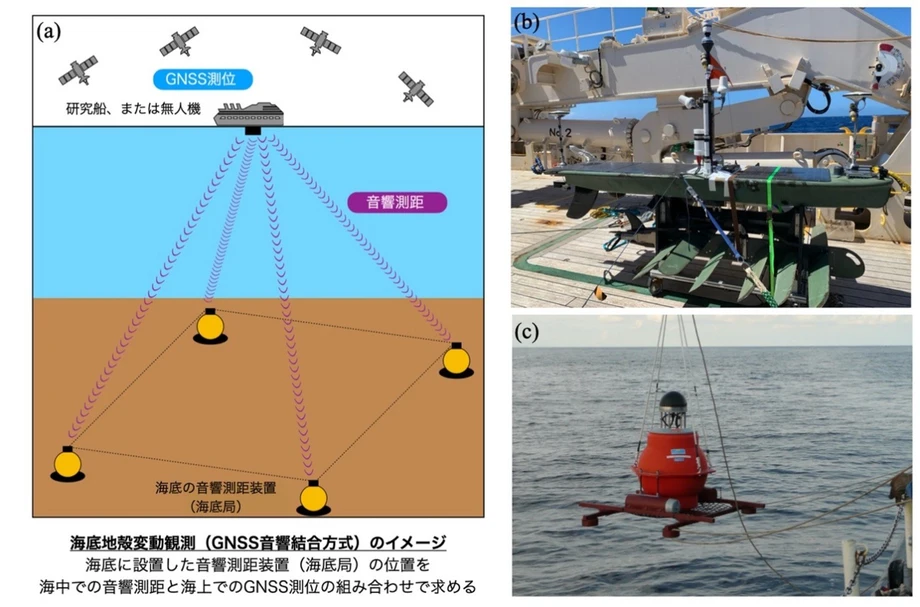
The technique, called GNSS-A, combines satellite positioning with underwater sound. GNSS stands for Global Navigation Satellite System. Satellites determine the position of a survey vessel or another station at the sea surface, while acoustic signals measure its position relative to instruments on the seabed.
Repeated surveys reveal small changes in the positions of the seafloor instruments. Sound provides the underwater part of the measurement because satellite positioning signals cannot travel through seawater in the way needed to locate those instruments directly.
The team analyzed those observations alongside deformation recorded on land and observations of repeating earthquakes. Numerical models then helped connect the measured movements to processes occurring along the plate boundary and deeper underground.
Three Processes Behind the Moving Ground
Japan's crust has continued moving since 2011 for several reasons. The central challenge was to separate three processes: slow sliding after the earthquake, gradual deformation of deep rock, and renewed locking of the plate boundary.
Afterslip is the slow movement that continues around a fault area after a large earthquake. Unlike the main rupture, it progresses without the same destructive shaking or tsunami. Instruments detect it through gradual changes in the position of the ground or seabed. Where afterslip occurs, strain is being released.
Viscoelastic relaxation takes place deeper down. Rocks in the mantle can respond elastically to a sudden force but also deform slowly over long periods. After an enormous earthquake changes the forces acting underground, this slow adjustment can move broad areas of the surface for years.
Locking works in the opposite direction to afterslip: friction restrains movement at the boundary, allowing strain to accumulate again. The new analysis found that afterslip had nearly finished about 10 years after 2011, even though mantle relaxation was continuing. Surface movement therefore contains signals from a fault that is reloading and deep rocks that are still adjusting.
The Timeline From Rupture to Renewed Locking
The recovery emerged over years of observation, rather than at a single moment. The principal dates connect the earthquake, an earlier modeling study and the longer record analyzed in the new paper.
- 2011: The magnitude 9.0 Tohoku earthquake ruptured the plate boundary off northeastern Japan.
- 2011 to 2025: Researchers tracked seafloor movement at 26 sites, building a record spanning 14 years.
- About 10 years after the earthquake: The new analysis places the near end of afterslip and recovery of locking to conditions similar to those before 2011.
- January 2023: An earlier study examining the first seven years after the earthquake described declining afterslip and an expanding locked region.
- November 5, 2026: Science published the new research and a related perspective.
- November 6, 2026: Tohoku University published its announcement explaining the findings.
The decade marks the approximate time the model places the recovery of locking. The measurements continued beyond that point, allowing researchers to examine the transition over a longer period.
What the Earlier Seven Years Had Shown
A January 2023 study in Physics of the Earth and Planetary Interiors had already identified a gradual return toward strain accumulation. It analyzed approximately seven years of deformation using 276 land stations in Japan's GEONET satellite positioning network, together with offshore acoustic positioning observations.
That study found that the amount and geographical extent of afterslip decreased, mainly during the first two years after the earthquake. The locked region then gradually expanded. Its authors concluded that the boundary was returning to the interval between major earthquakes, when the plates are coupled and elastic strain accumulates.
The new research extends the observation period from seven years to 14 years, twice as long. The earlier result described the beginning of a transition within several years; the longer analysis places the near completion of afterslip and recovery of locking at about a decade. These findings describe different stages of the same recovery process.
Why Deep Rock Matters to the Answer
The 2023 analysis showed why scientists must account for the mantle when interpreting surface measurements. During the period it examined, land stations moved eastward, while most offshore sites moved westward. Parts of the eastern coast also rose by as much as approximately 10 centimeters.
To reproduce those patterns, the researchers modeled how resistance to slow deformation varies with temperature and the rate at which rocks deform. Their preferred model included a colder, relatively rigid corner of the mantle above the descending plate, often called a cold nose, and a layer beneath the descending plate that could deform more easily.
The researchers calculated the movements caused by mantle relaxation and subtracted them from the observed movements. They then used the remaining signal to estimate afterslip and locking. This approach explains why a seafloor instrument moving in a particular direction cannot be interpreted without considering what is happening at depth.
The 2026 study likewise used numerical models to analyze multiple kinds of observations. Its central finding is that the boundary can resume accumulating strain while the mantle continues its much slower response to the earlier rupture.
A Closer View of the Earthquake Cycle
The new paper is titled Seafloor geodesy delineates fast megathrust relocking after the giant 2011 Tohoku earthquake. Geodesy means measuring Earth's shape and movement; a megathrust is the large fault where one tectonic plate descends beneath another.
Kaj M. Johnson, author of the accompanying Science perspective, placed the findings within the elastic rebound theory used to explain recurring earthquakes. In that framework, friction holds a fault, surrounding rocks distort, and a later rupture releases the stored elastic strain. Johnson described the contribution of the new work:
The findings offer a direct glimpse of how the earthquake cycle begins anew after a giant rupture.
The research brought together Tohoku University, the Japan Agency for Marine-Earth Science and Technology, the University of Tokyo's Earthquake Research Institute, the University of Victoria, the Geological Survey of Canada, and the joint Tohoku University and JAMSTEC institute WPI-AIMEC.
What the Findings Mean for Coastal Communities
For communities along northeastern Japan's Pacific coast, the practical message is that the plate boundary has returned to a state in which strain can build. The gradual adjustment following the 2011 disaster is continuing underground alongside that renewed loading.
Giant earthquakes along the Japan Trench are described as recurring at intervals of roughly 500 to 900 years. The research team also pointed to examples overseas of earthquakes approaching magnitude 9 occurring about 70 years apart. Those different intervals concern earthquake recurrence, while the new finding concerns how quickly a fault can regain its grip after a rupture.
Continued seafloor measurements will help researchers track where locking changes and how the boundary evolves. The research team identifies that monitoring as essential to assessing future large earthquakes and tsunamis. For residents, the concrete message is to maintain earthquake and tsunami preparedness while scientists follow a process that unfolds over decades and longer.
Key Points
- A study published in Science on November 5, 2026, found renewed locking across a wide area of the 2011 Tohoku earthquake source region.
- The analysis combined 14 years of observations, including measurements from 26 seafloor sites, with land deformation and repeating earthquakes.
- Afterslip had nearly ended and locking had recovered to conditions similar to those before the disaster about 10 years after 2011.
- Strain is accumulating at the plate boundary while deep mantle rocks continue adjusting to the earthquake.
- An earlier study of seven years of observations had identified declining afterslip and gradual expansion of the locked region.
- Continued offshore monitoring and sustained earthquake and tsunami preparedness remain central priorities.