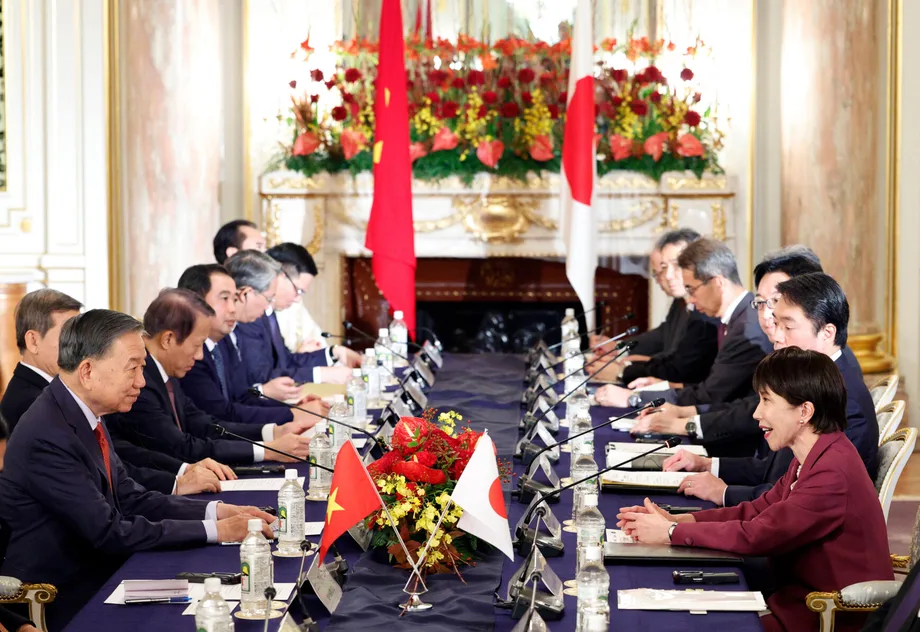
Tokyo agreements target education and electricity supply
Vietnam and Japan exchanged cooperation documents in Tokyo on November 9, 2026, committing more than 43.1 billion yen to Vietnam Japan University and the O Mon III thermal power plant. The agreements connect two practical development needs: training skilled people and supplying electricity for a growing economy, particularly in the Mekong Delta.
Contents
- Tokyo agreements target education and electricity supply
- What the financing package covers
- A university tied to advanced skills
- O Mon III focuses on the Mekong Delta's power needs
- Making grant projects easier to deliver
- Four pillars connect the wider economic plans
- Workers and students give the partnership a human scale
- Cooperation reaches beyond finance and construction
- The dates shaping implementation
- Key Points
Vietnamese General Secretary and State President To Lam and Japanese Prime Minister Takaichi Sanae witnessed the exchange during Lam's official visit to Japan from November 8 to 11. Vietnamese Finance Minister Ngo Van Tuan, Japanese Ambassador to Vietnam Ito Naoki and Japan International Cooperation Agency President Tanaka Akihiko took part.
The three documents handled through the finance cooperation track covered university construction, a framework to make Japanese aid projects easier to carry out, and a loan agreement for O Mon III. Two contain the financial commitments exceeding 43.1 billion yen. The framework agreement addresses the procedures through which aid projects move from approval to implementation.
The exchange formed part of a wider diplomatic package. The leaders witnessed the presentation of nine cooperation documents across several fields and adopted a Joint Vision Statement setting out priorities for their Comprehensive Strategic Partnership, established in 2023.
What the financing package covers
Vietnam Japan University's construction project is supported by an exchange of notes between the two governments. An exchange of notes is a formal agreement recorded through diplomatic correspondence. The O Mon III construction project is covered by a loan agreement between Vietnam's government and the Japan International Cooperation Agency, commonly known as JICA.
The university financing was also described as an official development assistance loan. Official development assistance, or ODA, is government support for development in another country. It can take the form of loans, grants or technical assistance. Loans require repayment, while grants do not.
The combined commitment exceeds 43.1 billion yen, but the allocation between the two projects, loan interest rates, repayment periods and construction or completion dates were not specified in the announcements. Those details will determine how the financing is scheduled and what repayment obligations Vietnam takes on.
The wider agreements also include a separate arrangement concerning Vietnam Japan University's development. That gives the university both a construction financing component and a broader framework for cooperation, linking its physical expansion with its educational purpose.
A university tied to advanced skills
Vietnam Japan University is described in the Joint Vision Statement as a flagship educational cooperation project. Its construction project is intended to develop highly skilled people and strengthen cooperation in teaching, training and scientific research, preparing specialists for Vietnam's development needs.
Lam called for construction of the university and the Cho Ray Hospital project to begin on schedule. His request placed the university alongside another major public service project and made implementation a central part of the talks.
The education agreement sits within a larger effort to build expertise in advanced technology. The joint vision identifies six joint research projects, support for training 250 people to doctoral level in semiconductors, and Vietnam's goal of training 100 artificial intelligence PhDs by 2030. Takaichi affirmed Japan's support for the AI training plan.
Semiconductors are the tiny electronic components that allow computers, phones and industrial equipment to process information. Artificial intelligence involves computer systems performing tasks such as recognising patterns or generating responses. Both fields need researchers and engineers with specialised training, which explains the connection between university development and the leaders' technology priorities.
The leaders also agreed to expand opportunities for doctoral researchers under the NEXUS programme into semiconductors and AI. Lam proposed a network of scientists covering robotics, semiconductor chips, energy technology, biotechnology, high speed rail and quantum technology. Together, these plans connect education with specific areas of research and industrial development.
O Mon III focuses on the Mekong Delta's power needs
The O Mon III thermal power plant is intended to add electricity to Vietnam's national grid, strengthen energy security and meet demand associated with economic and social development. The Mekong Delta is a particular focus of the project.
A thermal power plant produces electricity by using heat to drive generating equipment. Its contribution to households and businesses depends on construction, connection to the grid and operation. The November 9 loan agreement provides financing support for the construction project.
Energy cooperation extended beyond O Mon III. The Joint Vision Statement calls for early implementation of 15 Vietnam Japan energy cooperation projects under the Asia Zero Emission Community initiative, known as AZEC. During the talks, Takaichi also expressed readiness to cooperate on energy security and energy reserves, and to advance projects using liquefied natural gas under the POWERR Asia initiative.
The leaders agreed to implement 14 projects under the Joint Crediting Mechanism, or JCM. This mechanism supports cooperation on projects that reduce greenhouse gas emissions and accounts for the resulting reductions. The 14 JCM projects and the 15 AZEC projects were identified under their respective programmes, each with its own cooperation framework.
A memorandum on nuclear power cooperation was among the wider documents signed during the visit. The energy agenda therefore spans electricity supply, fuel security, nuclear cooperation and emissions reduction, with O Mon III providing one concrete financing commitment within that larger programme.
Making grant projects easier to deliver
The agreement on aid procedures focuses on Japanese grant assistance in Vietnam. Both governments welcomed it in the Joint Vision Statement and called for prompt implementation of new grant projects.
The framework is intended to improve the legal arrangements governing those projects, simplify procedures and shorten the time needed to carry them out. For a public project, financing approval is followed by administrative work before construction, equipment delivery or training can proceed. The agreement targets that part of the process.
Vietnam's Ministry of Finance will coordinate with Japanese authorities and Vietnamese ministries, sectors and local governments to implement the documents. Its stated responsibilities include project progress, quality and effective use of funds.
The three finance documents therefore address different tasks: funding university construction, financing a power plant and improving the procedures for grant projects. Their shared purpose is to help agreed cooperation reach the stage where people can use the resulting facilities and services.
Four pillars connect the wider economic plans
The Joint Vision Statement organises economic cooperation around four pillars: science and technology; education and human resources; production and supply chain links; and finance, investment and development assistance.
The university and power plant illustrate how those pillars connect. Education develops the people needed for research and industry. Electricity supports production and public services. Development financing helps pay for the infrastructure, while links between businesses create opportunities to use the resulting skills and capacity.
Lam and Takaichi set a goal of bringing bilateral trade to $80 billion by 2030. Takaichi said Vietnam plays an important role in Japan's efforts to diversify and upgrade its supply chains, and that Japan would support deeper participation by Vietnamese businesses in Japanese companies' production networks.
Japan is Vietnam's largest ODA donor and largest partner in labour cooperation, its third largest investor, and its fourth largest trade and tourism partner. About 2,000 Japanese businesses operate in Vietnam, with investment concentrated in manufacturing, electricity production and distribution, and real estate.
The leaders also assessed that nearly 80% of bilateral commitments and agreements had been implemented or had made progress. That measure combines completed work with work advancing toward completion, making continued delivery a major theme of the new package.
Workers and students give the partnership a human scale
Nearly 700,000 Vietnamese people live in Japan, according to the Joint Vision Statement, which describes a growing share as having advanced expertise and skills. Labour cooperation figures put the number of Vietnamese workers in Japan at about 310,000.
Those workers account for roughly 44% of the Vietnamese community in Japan, using the figures of 310,000 workers and nearly 700,000 residents. The comparison shows the scale of employment ties within a community that also includes students and other residents.
Nearly 41,000 Vietnamese people went to Japan for work in the first nine months of 2026. They represented about 39.8% of Vietnamese workers going abroad during that period, underlining Japan's importance as an employment destination.
The leaders agreed to work toward completing negotiations on a social insurance agreement. Such agreements coordinate how participating countries handle social insurance for people working across borders. Lam also asked Japan to ease visa conditions for Vietnamese technology engineers, while Takaichi described a government information channel intended to support Vietnamese citizens facing difficulties in Japan.
Education links extend into schools. Vietnam introduced Japanese language teaching at lower secondary level in 2003 and at primary level in 2019. The new university commitments build on that longer history of language learning and educational exchange.
Cooperation reaches beyond finance and construction
The broader package included agreements on AI research and development, maritime and ocean policy, environmental cooperation, and faster examination of intellectual property applications. It also included JICA support for improving the quality and effectiveness of lawmaking and law enforcement in Vietnam during 2027 to 2030.
Those agreements connect research, commercial activity and public administration. AI cooperation concerns the development of technology; intellectual property examination concerns the handling of applications to protect inventions and related rights; legal assistance concerns how laws are drafted and put into practice.
The leaders also agreed to strengthen cooperation in healthcare, care for older people, labour and local government exchanges. A third Vietnam Japan local cooperation forum is planned for 2027, alongside a Vietnam Japan Tourism Year spanning 2027 and 2028.
Security cooperation has a scheduled next step as well. The second consultation bringing together the two countries' deputy foreign and defence ministers will take place in Vietnam in December 2026. The format is known as a 2+2 dialogue because it brings together the two policy areas from each country.
The dates shaping implementation
The November agreements follow the 2023 upgrade in diplomatic relations and set out work extending through the end of the decade. The main dates connect the Tokyo exchange with follow up meetings, technical assistance and training goals.
- 2023: Vietnam and Japan upgraded relations to a Comprehensive Strategic Partnership.
- November 8 to 11, 2026: To Lam's official visit to Japan.
- November 9, 2026: The leaders witnessed the cooperation document exchange and adopted the Joint Vision Statement.
- December 2026: Vietnam will host the second dialogue between deputy foreign and defence ministers.
- 2027: The third local cooperation forum is planned.
- 2027 to 2030: JICA assistance will support work on lawmaking and law enforcement in Vietnam.
- 2030: The bilateral trade target is $80 billion, alongside Vietnam's goal of training 100 AI PhDs.
Vietnam's Ministry of Finance now has a coordinating role in turning the financing documents into project progress. For the university, that means moving construction and educational cooperation forward. For O Mon III, it means advancing a power project intended to serve the national grid and the Mekong Delta.
Key Points
- Two cooperation documents commit more than 43.1 billion yen to Vietnam Japan University and O Mon III.
- A separate framework agreement aims to simplify implementation of Japanese grant projects in Vietnam.
- The university project connects construction with advanced skills, education and research cooperation.
- O Mon III is intended to strengthen electricity supply, particularly for the Mekong Delta.
- The wider agenda includes semiconductor and AI training, energy cooperation and an $80 billion trade goal for 2030.
- Vietnam's Ministry of Finance will coordinate implementation, including project progress, quality and use of funds.