A five year journey for at least 10 grams of another world
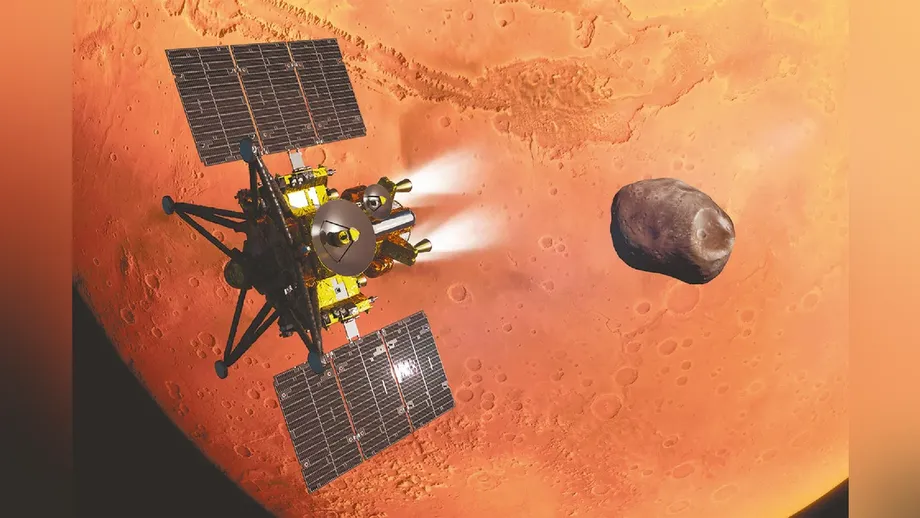
Japan's Martian Moons eXploration spacecraft has launched toward Mars with a small but ambitious target: bring at least 10 grams of material from its moon Phobos back to Earth in 2031. Mixed among those grains could be fragments blasted from Mars itself, giving scientists access to material from a planet whose direct sample return programmes have struggled with cost and engineering problems.
Contents
- A five year journey for at least 10 grams of another world
- What happens between launch and the Australian landing?
- Why are the origins of these moons so difficult to explain?
- What could the grains reveal about water and planetary history?
- Phobos may have collected pieces of Mars
- A rover goes first into exceptionally weak gravity
- Two sampling methods, with little room for error
- How far can the search for ancient life go?
- A different route from the race to return Martian rocks
- Key Points
The mission, known as MMX, lifted off aboard an H3 rocket from Tanegashima Space Center at 4:41 a.m. Japan Standard Time on October 20, corresponding to October 19 in the eastern United States. The spacecraft separated from the rocket about 71 minutes later, established communications and unfolded its solar panels.
Yasuhiro Kawakatsu, the MMX project manager at the Japan Aerospace Exploration Agency, described the spacecraft's condition after separation:
So far, so good.
JAXA's MMX mission overview sets out a journey involving observations of both Martian moons, a rover dispatched ahead of the main spacecraft, sampling on Phobos and recovery of a return capsule in Australia. The agency's target is at least 10 grams in total, rather than a guaranteed amount from each landing.
MMX builds on Japan's Hayabusa missions, which returned material from the asteroids Itokawa and Ryugu in 2010 and 2020. Its destination introduces a new difficulty: working near a small moon while the much larger Mars constantly pulls on the spacecraft.
Hiroshi Yamakawa, JAXA's president, declared the launch successful and described the beginning of the mission:
A long journey of five years has just started.
What happens between launch and the Australian landing?
MMX is expected to reach Mars the following August, then spend roughly three years investigating the planet and its moons. The return journey should take about another year.
JAXA's MMX project page gives the broad schedule in Japanese fiscal years: launch in fiscal 2026, entry into Mars orbit in fiscal 2027 and return in fiscal 2031. Japan's fiscal year begins in April, while the mission's more detailed public itinerary describes an Earth return in calendar 2031.
- October 20, 2026, Japan time: MMX launches from Tanegashima aboard an H3 rocket.
- August 2027: The spacecraft is expected to arrive at Mars and begin its observing campaign.
- Late 2028 or early 2029: Operational projections place deployment of the Idefix rover in this period, followed by possible spacecraft landings in 2029. JAXA's public mission flow groups the detailed observations and sampling activities under 2030.
- 2030: MMX is scheduled to leave Mars, with November identified in launch coverage as the planned departure month.
- 2031: A capsule carrying the samples is expected to land in Australia before the material is taken to Japan.
Deimos, the smaller Martian moon, is also part of the observing programme. MMX plans to study it from a distance and during flybys. The detailed sampling plan targets Phobos; Deimos will be investigated through spacecraft observations.
Why are the origins of these moons so difficult to explain?
Phobos is roughly 22 kilometres across and circles about 6,000 kilometres above the Martian surface, completing about three orbits each day. Deimos is smaller, about 12 kilometres across. Neither resembles Earth's large, rounded Moon.
Two leading explanations compete to account for their presence. Under the capture hypothesis, they began as asteroids that Mars caught with its gravity. Under the giant impact hypothesis, a collision threw material from Mars into space, where some of it gathered into moons.
Their dark surfaces resemble certain primitive asteroids, supporting capture. Their nearly circular paths around the Martian equator fit more comfortably with formation from a ring of collision debris. Mars's relatively weak gravity also makes catching an intact passing asteroid difficult.
Tom Statler, NASA's lead scientist for solar system small bodies, described how MMX will test these explanations:
By going to the Martian moons, studying them up close, and bringing samples back to Earth, we'll be able to determine whether Phobos material is more consistent with an asteroid composition or with debris created by a collision involving Mars.
What could the grains reveal about water and planetary history?
Laboratory measurements could distinguish between material heated during an enormous collision and material preserved inside an ancient asteroid. A giant impact could leave glassy rock, minerals altered by extreme pressure and evidence that easily vaporised substances, including water, were lost.
An asteroid origin could instead produce carbon rich material, clays and organic compounds. Organic compounds are chemicals containing carbon, including many involved in living systems. Scientists will examine their composition and history alongside the surrounding minerals.
Water chemistry could provide another clue. Ordinary hydrogen and its heavier form, deuterium, occur in different proportions in different parts of the solar system. Measuring their ratio in returned material could help researchers identify where that material formed and investigate how water reached rocky planets.
Scientists are also testing variations on the two main origin theories. Jacob Kegerreis, a planetary scientist at Imperial College London, has simulated an asteroid being pulled apart by Mars's gravity, producing a debris disk that could form moons. Matija Cuk, a research scientist at the SETI Institute, has considered repeated cycles in which a moon breaks apart and reforms as a smaller object.
Mineral ages and the effects of exposure to space could help test those histories. Researchers also hope to improve the timeline of impacts around Mars. Dating returned grains could give them a firmer reference than the current practice of adapting a chronology developed from Earth's Moon.
Phobos may have collected pieces of Mars
Asteroid impacts on Mars can throw rock and dust into space. Because Phobos orbits nearby, some of that debris may settle on its surface. MMX could therefore collect a mixture of moon material and grains originating on Mars.
Kiyoshi Kuramoto, a planetary scientist at Hokkaido University who leads the mission's international science team, estimates that Martian material might account for about 1% of a sample. At that proportion, a collection weighing 10 grams would contain around 0.1 gram, or 100 milligrams, from Mars. The actual proportion will become known only after researchers identify and analyse the returned grains.
Some fragments could come from ancient rocks formed when Mars was warmer and wetter. Others could have been excavated from deeper in the crust by later impacts. Researchers may be able to connect some younger material with relatively recent Martian craters.
Identifying those grains will be demanding. They may be extremely small, their original locations may be uncertain, and exposure to radiation on airless Phobos will have changed them. Scientists will need to reconstruct their histories through chemistry, mineral structure and age measurements.
A rover goes first into exceptionally weak gravity
Idefix, a rover contributed by the French and German space agencies, is intended to explore Phobos before the main spacecraft attempts to land. The rover weighs about 25 kilograms and could operate for around 100 days.
MMX will release it from less than 100 metres above the surface. Phobos has less than one thousandth of Earth's surface gravity, so the rover will descend gently. Landing remains awkward because the robot could bounce or tip, and driving requires careful control to keep its wheels in contact with the ground.
Idefix carries cameras and instruments for examining minerals and surface properties. Its observations should help the team judge whether the ground is firm or loose, identify hazards and select places with useful geological information.
The main spacecraft will conduct its own reconnaissance using cameras, lidar and spectrometers among a suite of 13 instruments. Lidar measures distance using laser light, allowing the team to map slopes and surface shapes. Spectrometers examine light or other radiation to identify the substances present.
NASA's contributions include MEGANE, a gamma ray and neutron spectrometer developed by researchers at the Johns Hopkins University Applied Physics Laboratory and Lawrence Livermore National Laboratory. It will measure signals produced when energetic particles strike the surface, helping scientists determine which chemical elements Phobos contains.
Two sampling methods, with little room for error
MMX must approach selected landing sites with an accuracy of about 10 metres. Phobos has uneven terrain, extremely weak gravity and a gravitational environment strongly influenced by Mars. The spacecraft will travel around Mars on a path that keeps it near Phobos, called a quasi satellite orbit, rather than settling into an ordinary stable orbit around the moon.
JAXA plans up to two landings, giving the mission an opportunity to collect material from different terrain. Phobos has regions that appear reddish or bluish through particular filters, potentially reflecting differences in minerals, impacts or exposure to space.
A coring device will reach about two centimetres below the surface. A second sampler, provided by NASA, will release pressurised nitrogen gas to sweep loose grains into a container. Using both methods gives the team access to shallow subsurface material and surface dust.
The spacecraft's time on the ground is expected to be measured in hours. Its landing legs must absorb contact gently enough to avoid tipping or rebounding into space. Engineers also have to manage a communications delay that JAXA says can reach 44 minutes for a signal to travel to the spacecraft and back.
Controllers on Earth therefore cannot respond instantly during a descent. The spacecraft needs onboard navigation and control to follow its planned approach and handle rapid changes.
How far can the search for ancient life go?
Scientists hope possible Martian grains will reveal conditions in which life might once have existed. Minerals associated with water and preserved organic chemistry could help reconstruct environments from the planet's past.
Kuramoto, the mission's science team leader, expressed the more ambitious possibility:
I do think there's a possibility that chemical traces of biological activity might be contained within that sand sample.
Research into survival during impacts helps explain why scientists are considering that possibility. Lily Zhao, a recently graduated doctoral student at Johns Hopkins University, subjected the hardy bacterium Deinococcus radiodurans to shocks designed to resemble aspects of an asteroid collision. Some bacteria survived pressures up to 30 times those at the deepest ocean trench.
The experiment addresses one step in a difficult journey. Any biological material travelling from Mars to Phobos would also face ejection, passage through space, landing and prolonged exposure to radiation. Researchers examining MMX samples would need to investigate that history while carefully controlling contamination from Earth.
Wataru Fujiya, a cosmochemist at Ibaraki University who leads the sample analysis team, expects the grains to be handled in protected laboratory chambers at JAXA's Institute of Space and Astronautical Science in Sagamihara. Vacuum or unreactive nitrogen gas will help preserve the material for study.
A different route from the race to return Martian rocks
NASA's Perseverance rover has collected carefully selected Martian samples since 2021, recording the rocks and surroundings from which they came. The planned retrieval effort has lost congressional funding amid rising costs and concerns about technical feasibility, including launching collected material from the Martian surface.
MMX takes a different route by sampling a moon with much weaker gravity. Martian grains found there would give scientists access to material with a less certain geological history, while the Phobos collection would answer its own questions about moon formation and the movement of material through the solar system.
China's Tianwen-3 mission is scheduled to launch around 2028 and could return samples directly from Mars as early as 2031. Its timetable and MMX's return schedule make the order of arrival uncertain.
Launch estimates put MMX's cost at $578 million, compared with an estimate of $350 million published before launch. Five space agencies are participating, combining Japanese spacecraft and sample return experience with instruments, rover technology and scientific support from international partners.
After recovery in Australia, JAXA plans to sort and catalogue the material before sharing portions for research. NASA's Johnson Space Center is expected to receive 15% of the collection. If MMX returns exactly 10 grams, that share would weigh 1.5 grams.
Japan's previous asteroid missions demonstrated that tiny samples can support extensive laboratory research. MMX now has to complete the harder operational steps: reach Mars, survey unfamiliar ground, land safely, collect material and send it home. Soviet and Russian attempts to investigate Phobos, including the Phobos-Grunt mission launched in 2011, failed before completing their objectives.
Key Points
- MMX launched from Tanegashima on October 20 in Japan, corresponding to October 19 in the eastern United States.
- JAXA aims to return at least 10 grams of Phobos material to Earth in 2031.
- The Idefix rover will scout the surface before up to two spacecraft landings using coring and gas sampling devices.
- Returned grains could help explain how the Martian moons formed and how water and organic material moved through the solar system.
- Scientists estimate Martian debris could make up about 1% of the collection.
- The return capsule is expected to land in Australia, with samples then studied in Japan and shared internationally.