A five year journey to bring home a handful of Phobos
Japan plans to launch its Martian Moons eXploration spacecraft on October 20, 2026, from the Tanegashima Space Center in Kagoshima Prefecture, beginning a mission to bring more than 10 grams of material from Mars's moon Phobos back to Earth. The spacecraft is expected to reach Mars in August 2027 and deliver its sample capsule to Australia in 2031.
Contents
- A five year journey to bring home a handful of Phobos
- What is the launch schedule?
- Why the moons' origins matter
- How Phobos could preserve pieces of Mars
- A large spacecraft built in three parts
- Landing where a rover barely weighs anything
- Two ways to collect a small but valuable sample
- What the instruments will measure before landing
- Bringing the capsule home will require a global team
- Key Points
The Japan Aerospace Exploration Agency, JAXA, is attempting something no mission has completed: returning samples from the Martian system. The small collection of sand, soil and rock could help resolve whether Phobos and its companion moon, Deimos, were once independent asteroids or formed from debris thrown into space by a huge collision with Mars.
NASA's October 8 mission briefing announcement lists launch for October 19 in the eastern United States, corresponding to October 20 in Japan. Japanese launch reporting gives a planned departure at about 4:40 a.m. Japan Standard Time aboard an H3 rocket.
MMX combines an observing spacecraft, a lander, a small rover and a capsule designed to survive the return through Earth's atmosphere. Its development began in 2016, and the spacecraft cost about 55.3 billion yen to build. Japan is drawing on experience from Hayabusa and Hayabusa2, which returned asteroid samples, while taking on the much longer journey to Mars and back.
JAXA project manager Yasuhiro Kawakatsu has described the completed spacecraft as the team's starting line. Launch begins the mission's demanding work: reaching Mars, choosing a safe landing site, collecting material in extremely weak gravity and bringing it home.
What is the launch schedule?
NASA and the European Space Agency both list October 20 in Japan as the planned launch date. JAXA's mission overview gives the broader target of Japanese fiscal year 2026, which runs from April 2026 through March 2027.
An earlier launch plan placed departure in November or December 2026; the October schedule appears in NASA's dated October announcement and ESA's factsheet. MMX reached Tanegashima on March 31, 2026, for launch preparations. Its original departure in 2024 was postponed because of problems with the H3 rocket.
The H3 suffered another failure in December 2025, traced to an anomaly during separation of the payload fairing, the protective covering around the spacecraft. Launch opportunities for an efficient journey to Mars come roughly every 26 months, making the readiness of both spacecraft and rocket especially important.
The main milestones span five years:
- October 20, 2026, Japan time: planned H3 launch from Tanegashima.
- August 2027: expected arrival at Mars, followed by observations of Phobos and Deimos.
- No earlier than December 2028: NASA's stated earliest opportunity for Phobos sampling.
- Early 2029: planned deployment of the Idefix rover.
- 2030: planned departure from Mars.
- 2031: expected delivery of the sample capsule to Australia.
The spacecraft's landing and collection date remains unsettled: NASA gives an earliest date of December 2028, while mission reporting places collection in either 2029 or 2030. JAXA says the time spent near Phobos will depend on observation planning.
Why the moons' origins matter
Phobos is about 20 to 30 kilometres across and orbits roughly 6,000 kilometres above the Martian surface. Despite decades of spacecraft exploration at Mars, neither Phobos nor Deimos has received the sustained close investigation that MMX plans.
Scientists are testing two main explanations for their formation. Under the capture explanation, the moons began as asteroids and were caught by Mars's gravity. Under the impact explanation, a large object struck young Mars, throwing out debris that later gathered into moons.
Rocks retain clues about where they formed. Their chemical ingredients and combinations of minerals can reveal whether they resemble material from Mars or ancient asteroids. MMX will combine measurements of both moons with laboratory analysis of the material collected on Phobos.
Kiyoshi Kuramoto, a Hokkaido University professor and MMX project scientist, explained at a September briefing why he expects samples to distinguish between the two explanations. Speaking in Japanese, he said:
The chemical compositions and combinations of minerals expected from these two processes are completely different, so examining the samples will settle the question definitively.
JAXA also wants to learn how the Martian system changed over time. If the moons formed from a collision, their material could preserve evidence of conditions on young Mars. If they are captured asteroids, they could reveal how substances such as water travelled through the Solar System.
How Phobos could preserve pieces of Mars
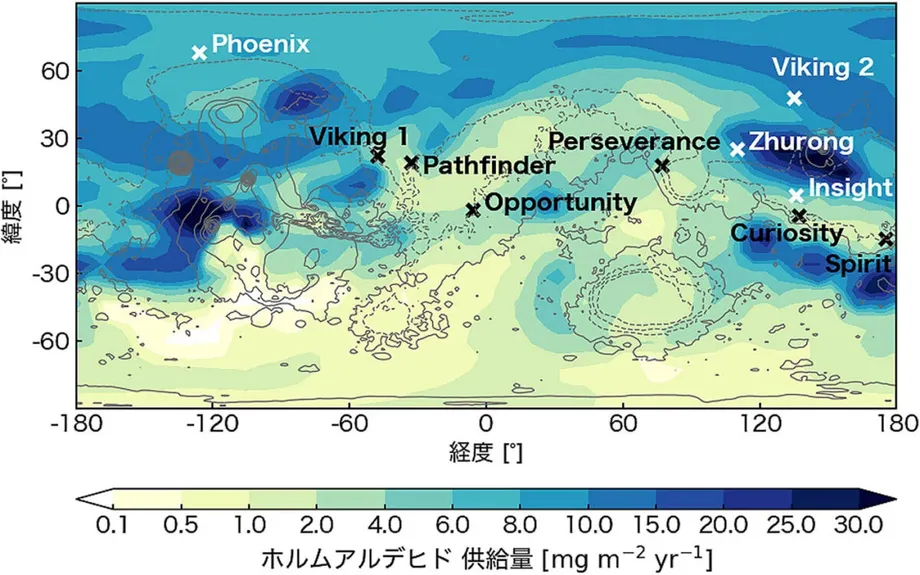
Phobos may hold another scientific prize: grains blasted off Mars by impacts and later deposited on the moon. Calculations based on large Martian craters suggest that about 0.1 percent of the material MMX collects could have come from Mars.
For a collection of 10 grams, that proportion would amount to about 0.01 gram, or 10 milligrams, of Martian material. This is a prediction about the sample's contents; scientists will determine its actual composition after the capsule returns.
Kanako Seki, a University of Tokyo professor who studies the space environment around Mars, has explained that material reaching Phobos could complement samples collected directly on the planet. A rover gathers rocks from particular places. Material thrown into space by impacts could carry clues from a wider range of Martian locations.
The search for samples is also changing elsewhere. The United States government was reported to have cancelled the NASA and ESA Mars sample return plan in January 2026 following rising costs. China plans to launch Tianwen-3 around 2028 and return material collected on Mars around 2031.
MMX's own sampling destination is Phobos. Its scientific value comes from studying that moon's origins and, potentially, examining scattered Martian grains within its surface material. Both questions make even a small collection worth bringing to laboratories on Earth.
A large spacecraft built in three parts
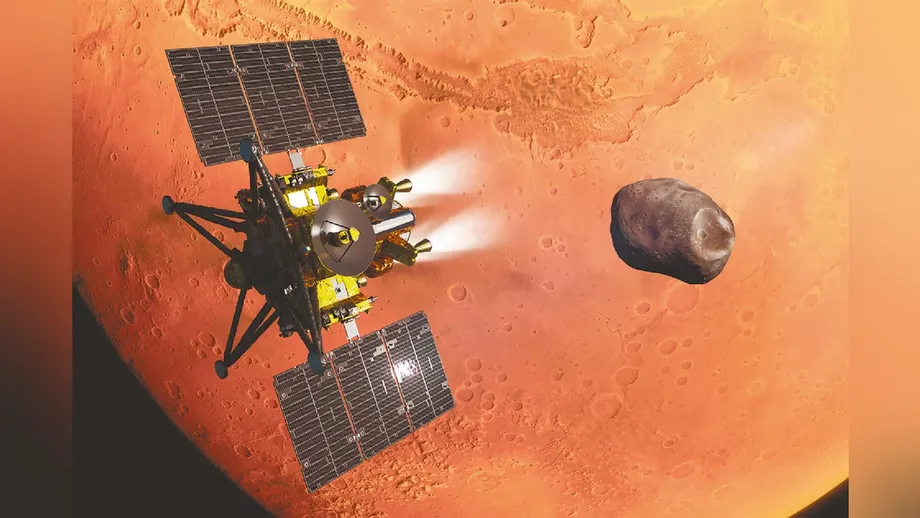
MMX is roughly five metres tall and nine metres wide with its solar wings extended, making it one of JAXA's largest spacecraft. ESA's MMX factsheet gives a mass of around 4,200 kilograms including fuel; Japanese launch reporting gives 4,480 kilograms and says roughly two thirds is fuel.
The spacecraft has three modules, each with a different job. The propulsion module provides the engine and fuel for the outward journey. The exploration module carries the landing legs, scientific instruments and sampling equipment. The return module carries the equipment needed to bring the capsule back to Earth.
MMX will discard modules in stages when their work is finished. Carrying less mass means later manoeuvres require less fuel. The return module has its own propulsion system, solar power and a large antenna for communication with Earth.
Mitsubishi Electric developed the spacecraft with JAXA and formed a dedicated team under the head of its Kamakura Works. The company has also worked on Japan's SLIM lunar lander and a cargo spacecraft for the International Space Station.
Akitsune Uehara, Mitsubishi Electric's project leader, identified the parallel development of the three modules and testing of the landing legs under simulated weak gravity as major engineering challenges. The modules had to work individually and as a single spacecraft during the parts of the journey when they remain connected.
Landing where a rover barely weighs anything
Phobos's gravity is only about one two thousandth of Earth's. That changes the problem of landing: the spacecraft must touch down gently enough to avoid bouncing away from the surface. Four landing legs are designed to absorb the impact and help keep MMX stable.
The 25 kilogram Idefix rover gives a useful illustration. ESA says it will exert about as much weight on Phobos as a 15 gram object does on Earth. Its mass remains 25 kilograms, but the moon's weak gravity pulls on it far less strongly.
France's space agency CNES and the German Aerospace Center, DLR, jointly developed Idefix. The rover will reach the surface before the main spacecraft lands, collecting information about the terrain and surface material to support landing preparations.
Idefix carries cameras, a radiometer and a Raman spectrometer. Its cameras examine the ground and help with navigation. The radiometer measures thermal radiation, while the spectrometer uses light to identify minerals. DLR supplied testing equipment including a drop tower and a simulator for conditions of very weak gravity.
Before landing, MMX will observe Phobos from a quasi satellite orbit. In simple terms, the spacecraft follows a path around Mars that keeps it close to Phobos, allowing repeated observations. ESA plans about three years of operations near the moon, including mapping, rover activity and sample collection.
Two ways to collect a small but valuable sample
MMX carries two sampling systems. A corer will collect material from a depth of about two centimetres. A pneumatic sampler will use pressurised gas to lift loose surface material into a container.
JAXA's collection goal is more than 10 grams; ESA describes its target as at least 10 grams. The two systems give the mission ways to collect material from below the immediate surface and from the loose grains resting on top.
Blue Origin's Honeybee Robotics developed the pneumatic sampler as part of NASA's contribution. Collecting material in weak gravity requires control over both the spacecraft's contact with the ground and the movement of grains into the sampling equipment.
Elliot Sefton-Nash, ESA's MMX project scientist, has explained the advantage of returning samples: some of the most precise laboratory instruments are too large and sensitive to send into space. On Earth, scientists can examine the grains using equipment that a spacecraft cannot carry.
Japan has already demonstrated the scientific value of that approach. Hayabusa brought material from asteroid Itokawa, and Hayabusa2 returned samples from Ryugu in December 2020. MMX extends that experience to a moon of another planet, adding the challenge of an outward and return journey through the Martian system.
What the instruments will measure before landing
NASA's MEGANE instrument will examine Phobos's elemental composition by measuring the energies of neutrons and gamma rays emitted from its surface. Different elements produce different patterns in those measurements, helping scientists identify what the moon is made of.
NASA's MMX mission page identifies Johns Hopkins Applied Physics Laboratory in Maryland as MEGANE's developer, working with Lawrence Livermore National Laboratory in California. Its measurements will help connect the moon's surface chemistry with the question of its origin.
The French MIRS infrared spectrometer will investigate surface composition using infrared light. It is being developed at LESIA at Paris Observatory with four other French laboratories and CNES. Cameras and a laser ranging instrument will also support mapping and the selection of landing areas.
Fraunhofer's Institute for Applied Optics and Precision Engineering in Jena, Germany, is providing a miniaturised laser system. The spacecraft also carries instruments to measure dust, radiation and charged particles in the environment around Mars.
JAXA and NHK jointly developed cameras capable of recording images in 4K and 8K resolution. Alongside the scientific measurements, these will provide detailed views of the mission's surroundings. Kawakatsu has said he is eager to see the images they capture.
MMX will also observe the Martian atmosphere and the surrounding space environment. JAXA wants to trace how atmospheric material circulates and escapes into space, helping explain how Mars changed over long periods.
Bringing the capsule home will require a global team
JAXA leads MMX with NASA, CNES, DLR and ESA as partners. ESA supplied a transponder and power amplifier for communication, and its Estrack ground network will send commands and receive spacecraft status information and scientific data.
NASA's Deep Space Network will provide communication and navigation support. NASA also funds American science team participants through its Discovery Program, managed by Marshall Space Flight Center. The agency scheduled a briefing on its contributions for October 15 at 4 p.m. EDT.
JAXA's Institute of Space and Astronautical Science identifies improved communication through a new deep space ground station as one of the mission's technology goals in its MMX project description. The other goals include making the journey to Mars and back and improving sampling techniques on celestial bodies.
The return journey is expected to take about one year. Near Earth, MMX will release a sample capsule about 60 centimetres across. A heat shield will protect it during atmospheric entry before its planned landing in the Australian desert.
The recovered capsule will then travel to JAXA's Institute of Space and Astronautical Science in Sagamihara, near Tokyo. Staff will open it in a specialised laboratory, extract and catalogue the material, and make samples available for scientific investigation.
Previous attempts to investigate Phobos show how difficult the destination is. The Soviet Phobos 1 and Phobos 2 spacecraft, launched in 1988, lost contact before completing their programmes. Russia's Phobos-Grunt mission failed to leave Earth orbit in 2011.
MMX aims to complete the entire chain: sustained observations, surface exploration, collection and return. Success would give scientists physical material from the Martian system and give Japan practical experience in travelling to Mars and back.
Key Points
- MMX is planned to launch on an H3 rocket from Tanegashima on October 20, 2026, Japan time.
- The spacecraft is expected to reach Mars in August 2027 and return samples to Earth in 2031.
- JAXA aims to collect more than 10 grams from Phobos using a corer and a pneumatic sampler.
- The Idefix rover will explore the surface before the main spacecraft lands.
- Scientists will test whether the Martian moons formed from impact debris or were captured asteroids.
- The samples may include small amounts of material blasted off Mars.
- The return capsule will land in Australia before transfer to JAXA's laboratory in Sagamihara.