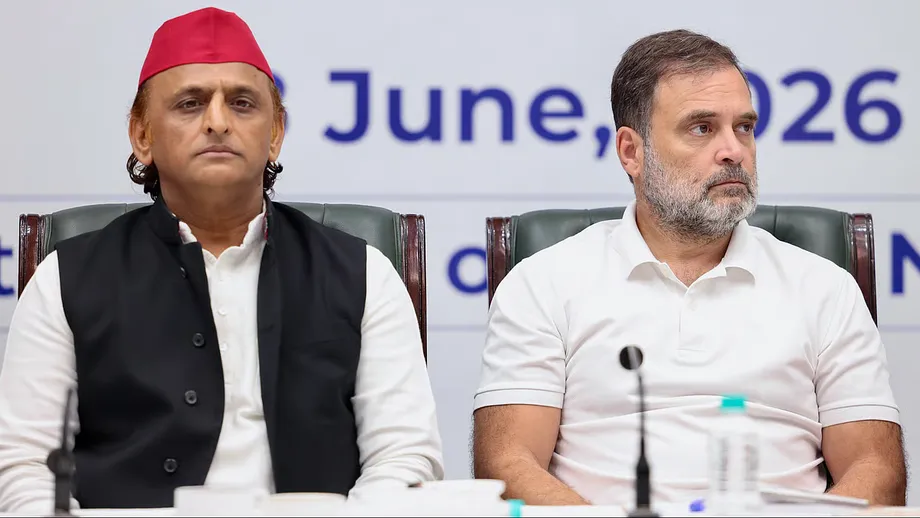
A winning formula claimed, with seat allocations still to come
Samajwadi Party MP Ramashankar Rajbhar 'Vidyarthi' says the INDIA bloc has settled its formula for the 2027 Uttar Pradesh Assembly election, even as Congress seeks 175 to 200 of the state's 403 constituencies and its leaders describe further negotiations ahead.
Contents
- A winning formula claimed, with seat allocations still to come
- Congress asks for a large share of the Assembly
- What does winnability mean in these talks?
- Two elections give the parties different arguments
- Senior leaders hold the final decision
- How the discussions have developed
- Congress links its demands to rebuilding its organisation
- Smaller parties complicate the electoral map
- What the manifesto announcement will add
- Key Points
Rajbhar, who represents Salempur in the Lok Sabha, said each party would contest where it had the strongest chance of winning. He said details would be announced soon and that the Samajwadi Party would release its election manifesto on November 26.
The public positions leave an important decision outstanding: the two parties have not announced an agreed allocation of constituencies. Rajbhar himself said their top leaders would determine the seats, while Congress Uttar Pradesh in-charge Rajendra Pal Gautam said the leaderships would meet to work through the arrangements.
Rajbhar explained the approach in terms of electoral strength rather than a numerical entitlement:
The Samajwadi Party will contest the seats it is capable of winning, and the Congress will contest the seats where it has a strong chance of victory. In this election, the specific number of seats does not matter; what matters is winning.
The negotiations concern both the number of seats Congress receives and which constituencies it can claim. Some on its list already have Samajwadi Party legislators. The SP also wants information about prospective Congress candidates, bringing candidate selection into a discussion that began with competing demands over numbers.
Congress asks for a large share of the Assembly
Gautam said Congress had shared its initial list with Samajwadi Party leaders a couple of days before his remarks on Friday. He described a range rather than a fixed demand:
I can't give you the exact numbers, but we have submitted a list for 175 to 200 seats.
A share of 175 to 200 constituencies would give Congress about 43% to 50% of the Assembly's 403 seats to contest. That would leave 203 to 228 constituencies for the SP and any other partners, making the request a substantial decision about leadership within the Opposition alliance.
Descriptions of the submitted list have also varied. Congress sources put it at around 170 constituencies in some accounts and 180 in another, while Gautam publicly gave the 175 to 200 range. Akhilesh Yadav acknowledged the discussion over 170 seats after voting in a graduate Legislative Council election at a Block Development Officer's office, again stressing the objective of defeating the BJP.
Congress sources have described different possible negotiating positions, too. Some said the party was reluctant to accept fewer than 115 to 120 seats; others suggested a settlement around 80 to 90. Within the SP, sources discussed 50 to 80 seats, including a narrower possibility of 60 to 70. Whether that narrower proposal had been communicated to Congress was unconfirmed.
Those competing preferences explain why a broad commitment to contest together can coexist with difficult bargaining over the map. Congress wants enough room to rebuild its presence; the SP wants to retain constituencies where it believes its candidates are stronger.
What does winnability mean in these talks?
The Samajwadi Party's proposed test is straightforward: give a constituency to the partner best placed to win it. Applying that test requires agreement on candidates, local organisation, previous voting patterns and public support.
Congress has divided its preferred constituencies into categories A, B, C and D, using its assessment of electoral prospects and organisational strength. Party sources described category A as allowing little room for compromise, category B as open to some adjustment, and categories C and D as more negotiable.
The SP has asked Congress to identify prospective candidates for the constituencies it wants. Its leaders argue that a seat allocation should depend partly on who will actually contest. Congress representatives have objected that sharing those names would intrude into their party's selection process.
A further difficulty involves roughly a dozen constituencies on the Congress list that have sitting SP legislators. Congress figures say their party could have a better chance there in 2027, while SP leaders have indicated that surrendering those seats would be particularly difficult.
For an incumbent legislator, an alliance agreement could therefore mean losing the chance to seek re-election under the same party banner. For local Congress workers, it could determine whether years of organising lead to a candidate of their own or a campaign for an ally.
Two elections give the parties different arguments
The 2022 Assembly election gives the SP its strongest numerical argument. Congress contested 399 constituencies independently and won two, with a vote share of 2.33%. The SP won 111 seats and received about 36% of the vote while contesting alongside smaller allies.
Congress had won seven seats in the 2017 Assembly election, when it contested 114 constituencies in an alliance with the SP. Its fall to two seats in 2022 has made SP leaders wary of allocating a large share without a convincing assessment of candidates and local strength.
The 2024 Lok Sabha election gives Congress a more encouraging starting point. It won six parliamentary seats in Uttar Pradesh, while the SP won 37. Their combined tally of 43 exceeded the BJP's 33 by 10 seats.
Congress also reportedly led in 38 Assembly segments and finished second in another 42 during that parliamentary election. An Assembly segment is the part of a parliamentary constituency corresponding to a state Assembly seat. Together, those figures identify 80 areas where Congress points to a lead or second place as grounds for discussion.
Gautam has credited Rahul Gandhi's influence and a stronger Congress organisation for the alliance's parliamentary performance. The SP places greater weight on its much larger Assembly presence. The negotiation therefore turns partly on how much value each party assigns to the 2022 state results and the 2024 parliamentary results when choosing candidates for 2027.
Senior leaders hold the final decision
Akhilesh Yadav has publicly supported strengthening both parties rather than treating their ambitions as incompatible. Speaking to reporters in Lucknow on Friday, the SP president and former Uttar Pradesh chief minister set out the common objective:
The Congress, the Samajwadi Party, and the INDIA bloc must be strengthened. Our collective goal is to see that the BJP is removed. To ensure the ouster of the BJP, we will make people understand, and we will do so. The alliance will move forward effectively to defeat the BJP.
SP Rajya Sabha MP Javed Ali has likewise said the alliance and seat allocation would be decided by the top leadership. SP spokesperson Fakhrul Hasan Chaand has said national leaders remain in contact and that the agreement would be settled in Delhi and Lucknow.
The final bargaining is expected to involve Congress president Mallikarjun Kharge and Rahul Gandhi, alongside Akhilesh Yadav and senior SP leader Ramgopal Yadav. Priyanka Gandhi Vadra has been leading the Congress effort and maintaining contact with its state organisation.
Congress spokesperson Anshu Awasthi has said there are no differences over the question of maintaining the alliance. The sharper exchanges concern its terms. SP MP Shiv Pal Singh Patel has argued that giving Congress even 50 seats could cost potentially winning constituencies, while Congress MP Imran Masood has pressed for a settlement that protects his party's political space.
How the discussions have developed
The negotiations have been accompanied by organisational changes, leadership meetings and increasingly public claims over constituencies. The sequence shows how the debate moved from demands for an early agreement to detailed arguments over seats and candidates.
- September 21: Saharanpur MP Imran Masood publicly urged Akhilesh Yadav to settle the alliance quickly.
- October 2: Congress appointed Masood its Uttar Pradesh working president as part of an organisational reshuffle.
- October 3: Swami Prasad Maurya announced that his Apni Janata Party would join the INDIA bloc after meeting Rahul Gandhi.
- October 13: Priyanka Gandhi Vadra discussed the Congress seat list with SP MP Rajeev Rai.
- October 19: Priyanka met state Congress leaders and urged attention to the quality of constituencies rather than the total alone.
- October 23: Details emerged of Congress's constituency categories and the dispute over prospective candidate names.
- November 26: Rajbhar said the SP would release its election manifesto.
- Early 2027: Uttar Pradesh is due to hold its next Assembly election.
Gautam said on Wednesday that talks had formally begun and described a committee to discuss allocations. On Friday, he spoke about the submitted list and further leadership discussions. Rajbhar's claim on Saturday that the formula was settled came alongside his statement that party leaders would determine the eventual allocation.
Congress had hoped to conclude negotiations by November 15 so candidates would have time to prepare. That was a party target for reaching an agreement, while November 26 was the date Rajbhar gave for the SP manifesto launch.
Congress links its demands to rebuilding its organisation
Congress is using its Sangathan Srijan initiative to strengthen its organisation across all 403 Assembly constituencies. Its categorisation of seats is tied to that work and to feedback gathered locally.
The party is also planning a proposed political march from Ballia to Meerut, covering Purvanchal and Awadh. Congress leaders intend to campaign on the Constitution and social justice, and say they see opportunities among Dalit voters, minorities and Other Backward Classes outside the Yadav community.
Leadership changes form another part of the preparation. Alongside Masood's appointment, Congress replaced state president Ajay Rai with legislator Aradhana Misra Mona. Some party leaders linked that change to efforts to reach an amicable agreement with the SP, citing her relations with its leadership.
Congress is also considering candidates' public standing and ability to finance sustained campaigns. A party functionary said strong candidates from modest backgrounds could receive exceptions to an approach that otherwise places weight on financial resources.
The concern follows accounts that Congress provided some candidates with up to Rs 70 lakh for the 2022 campaign and later received complaints that money had not been fully spent on election activity. For 2027, the party wants candidates who can remain active throughout the contest. That concern overlaps with the SP's demand for evidence that Congress can field competitive nominees.
Smaller parties complicate the electoral map
The BJP enters the contest at the head of the National Democratic Alliance, with Chief Minister Yogi Adityanath seeking another term after the party took power in Uttar Pradesh in 2017. Its partners include the Rashtriya Lok Dal, Apna Dal (S), the Nishad Party and the Suheldev Bharatiya Samaj Party.
Two of those parties, the Rashtriya Lok Dal and the Suheldev Bharatiya Samaj Party, contested the 2022 Assembly election alongside the SP before moving to the NDA. Their changed alignment gives the 2027 negotiations a different setting from the previous state election.
The SP has maintained contacts with Aam Aadmi Party leader Sanjay Singh and Nishad Party chief Sanjay Nishad. AAP is outside the INDIA bloc, while the Nishad Party remains an NDA partner. Sanjay Nishad and Suheldev Bharatiya Samaj Party leader Om Prakash Rajbhar have not indicated that they are leaving the ruling alliance.
Swami Prasad Maurya's announcement that his Apni Janata Party would join INDIA adds another prospective participant to Opposition discussions. The Bahujan Samaj Party remains a separate electoral factor.
Every additional partner adds another claim on a finite number of constituencies. A Congress demand approaching half the Assembly would leave the SP balancing its own candidates with any commitments to smaller parties. The decisions will shape which local leaders stand, which step aside and how united the Opposition campaign is in each constituency.
What the manifesto announcement will add
Rajbhar said preparations for the SP manifesto were complete and that it would address pressing public issues. He announced November 26 as its release date, without setting out specific promises in his remarks.
The manifesto would move the campaign beyond the allocation of constituencies to the commitments voters are being asked to support. At present, the public discussion is dominated by the alliance's structure: Congress's eventual share, the constituencies it receives, candidate selection and competing claims over seats held by SP legislators.
The next substantial development will be a leadership announcement naming the agreed constituencies or explaining the negotiation process. That would give candidates and local party organisations a practical basis for preparing for the election, alongside the policy platform Rajbhar says the SP is ready to present.
Key Points
- SP MP Ramashankar Rajbhar says the INDIA bloc's formula is settled, with each party to contest where it has the best chance of winning.
- Congress leader Rajendra Pal Gautam says the party submitted a list covering 175 to 200 of Uttar Pradesh's 403 Assembly constituencies.
- The parties have not announced an agreed allocation, and senior leaders retain the final decision.
- Negotiations involve candidate names, constituency categories and roughly a dozen seats held by SP legislators.
- Congress won two Assembly seats in 2022; the SP won 111. Together, they won 43 Uttar Pradesh parliamentary seats in 2024.
- Rajbhar announced November 26 for the SP manifesto release. The Assembly election is due in early 2027.