A breakthrough nearly 6,000 meters below the Pacific
Japan recovered rare earth mud continuously from a depth of 5,569 meters near Minamitorishima in February 2026, advancing a government project that aims to test extraction at 350 metric tons a day by February 2027 and begin industrial development from 2028. The achievement, described as the first continuous recovery of this kind at such depths, brings a difficult question closer: can Japan turn an engineering success into an affordable source of minerals without causing lasting damage to the ocean?
Contents
- A breakthrough nearly 6,000 meters below the Pacific
- Why Japan wants the mud
- The schedule and the scale of the challenge
- What monitoring can measure
- What decades of seabed disturbance reveal
- Why more countries want a pause
- International rules and Japan's own waters
- The cost of staying in position
- Security and technology drive the investment
- Key Points
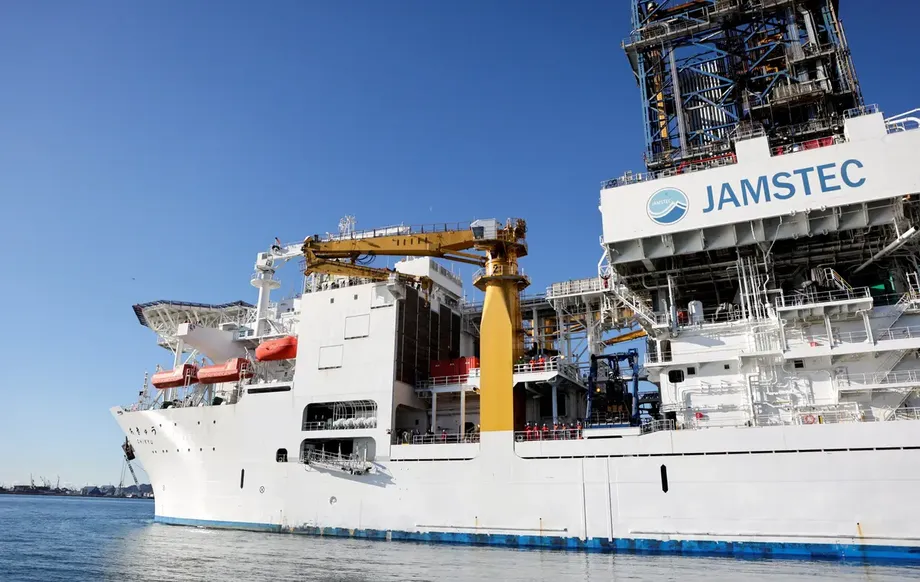
The operation took place near Japan's easternmost island, almost 2,000 kilometers from the mainland, using the research vessel Chikyu. Researchers brought sediment containing rare earth elements from the seabed to the ship. Those elements are used in technologies ranging from smartphones to electric vehicles and wind turbines.
The Cabinet Office presents the project as a way to reduce dependence on a single supplier. China supplies approximately 90 percent of Japan's rare earth imports, according to the figures cited for the project. Yet the schedule faces objections from within the research effort: an environmental assessment of commercial operations has not been completed, and a scientist involved in monitoring says the planned extraction rate is beyond what the current work can deliver.
Japan is pressing ahead while 46 countries call for a moratorium or suspension of deep sea mining. More than 77 companies and financial institutions have pledged not to source seabed minerals. The debate now connects three separate challenges: securing materials, making extraction pay and deciding how much disturbance the deep ocean can bear.
Why Japan wants the mud
Minamitorishima's deposits lie within Japan's exclusive economic zone, or EEZ, where the country has rights to explore and use marine resources. The research belongs to the Cabinet Office's Strategic Innovation Promotion Program, known as SIP, under its initiative to establish a maritime security platform. The Japan Agency for Marine-Earth Science and Technology, or JAMSTEC, carries out field operations including exploration and mining trials.
Rare earth elements are a group of metals valued for properties that help magnets, electronics and other equipment work. Japan is particularly interested in the medium and heavy rare earths found in the mud because their supply is heavily concentrated in China. Extracting them at home would give manufacturers another potential source when trade or diplomatic relations become strained.
Yasuhiro Kato, a University of Tokyo professor associated with the discovery of the deposits, sees development as an answer to that vulnerability. Describing the industrial interest in the resource, he said:
If we can develop the resources we've found, such problems [surrounding rare earths] will disappear. I believe this has truly become a hot issue in the industrial sector.
The commercial task extends beyond bringing mud aboard a ship. Japan would also need to separate the useful minerals, refine them into usable materials and deliver them at a price customers can sustain. A large deposit offers a potential resource; a dependable supply requires that entire chain to work repeatedly.
The schedule and the scale of the challenge
The February recovery followed operations conducted between January and February 2026. The mining system was adapted from oil and gas drilling technology and designed to limit the spread of disturbed sediment. The next proposed step is a much larger demonstration.
- January to February 2026: researchers conducted recovery operations and environmental monitoring near Minamitorishima.
- February 2026: Japan achieved continuous recovery of rare earth mud from 5,569 meters below the surface.
- By February 2027: the project aims to demonstrate extraction at 350 metric tons of mud a day.
- From 2028: the project targets the start of industrial development, while commercial production around 2030 also features in the wider debate.
The 350 metric tons refers to mud, not finished rare earth material. Only part of each load would become useful minerals. That makes the concentration of the elements, the efficiency of processing and the cost of handling the remaining sediment central to the project's economics.
Hiroyuki Yamamoto, who leads a project team developing systems to assess the environmental effects of marine resource development, disputes the practicality of the extraction ambition under the current research approach. He said:
What SIP is doing in its surveys isn't suited for commercialization. Extraction of 350 metric tons a day is simply impossible. Even if it were possible, whether it would be commercially viable is a separate issue. I think it will take time.
What monitoring can measure
JAMSTEC and SIP have developed methods to observe the seabed before extraction and detect changes during operations. Methods developed through SIP Ocean have become international standards under the International Organization for Standardization, or ISO. During the Minamitorishima trials, researchers used monitoring alongside the recovery equipment.
Monitoring can help track sediment plumes, the clouds of particles stirred into the water by machinery. It can also document conditions against which later changes are measured. An assessment of commercial mining has a wider job: estimating what happens when machinery operates repeatedly over a larger area and for much longer.
Yamamoto, who observed the operations, said the research program had developed monitoring technology rather than completed that commercial assessment. He explained:
SIP hasn't done an impact assessment. Developing monitoring technology and conducting an impact assessment are two different things. Once you say you're going to mine on a commercial basis, you have to run the calculations at that scale – and that hasn't been done yet.
The missing assessment matters to the development timetable. Commercial plans would need to specify the operating area, duration, extraction rate and handling of sediment before researchers could calculate their effects at that scale. A program to monitor the seabed's recovery over the long term is also absent from the current project.
What decades of seabed disturbance reveal
A study published in Nature in March 2025 examined a test mining site in the Clarion-Clipperton Zone of the Pacific, where machinery had removed mineral nodules decades earlier. Researchers returned after 44 years and found that furrows, originally spaced eight meters apart, remained visible. Some organisms had returned, while large animals attached to the seabed, including corals and sponges, showed little recovery.
Nodules are hardened lumps containing metals that lie on the ocean floor. Japan's project instead extracts mineral bearing sediment. Removing mud changes the seabed in a different way, and research specifically addressing that process is much more limited than the decades of work on nodule collection.
Jeffrey Drazen, a University of Hawai'i professor who coauthored a November 2025 Nature Communications paper on the ecological effects of deep sea mining, warned that damage may take time to become apparent. He described the difficulty of recovery:
The natural environment of the deep sea recovers slowly, and in some cases, recovery may be impossible.
Kato takes a more reassuring view of earlier mining experiments. Referring to research on manganese nodule extraction, the University of Tokyo professor said:
Those who have actually carried out such tests have a sense that the impact is, in reality, quite limited.
The Minamitorishima sediment layer formed approximately 34.5 million years ago. Its age, the slow growth of many deep ocean organisms and the limited experience with mud extraction make the duration of any disturbance a central concern.
Why more countries want a pause
Forty-six countries across Europe, the Pacific and Africa support a moratorium or suspension of deep sea mining. A moratorium means a pause, allowing governments to seek more scientific evidence and agree on safeguards before commercial activity proceeds. The proposals vary, and much of the international debate concerns seabed resources beyond national jurisdiction.
Portugal enacted a prohibition in March 2025 that runs until 2050. Norway, which had approved opening areas for commercial seabed mineral activity, subsequently suspended its mining plans until 2029. Those national decisions extend the debate beyond the international seabed to waters under national authority.
At the 2025 United Nations Ocean Conference, French President Emmanuel Macron called a moratorium internationally essential. Google, Samsung, Volvo and BMW are among the more than 77 companies and financial institutions that have pledged not to source minerals from the seabed. Such commitments could limit the pool of potential customers and financial backers for future projects.
Japan, South Korea and China have not supported a moratorium. Japan's position places its resource security ambitions alongside an international movement seeking more time to investigate sediment plumes, noise and the recovery of marine ecosystems.
International rules and Japan's own waters
The International Seabed Authority, or ISA, manages mineral activities on the seabed beyond national jurisdiction under the United Nations Convention on the Law of the Sea. It has issued more than 30 exploration contracts. Negotiations over commercial exploitation rules, often called the Mining Code, concern matters including environmental standards and the sharing of financial benefits.
An ISA gathering involving 85 countries in Jamaica in July 2026 ended without agreement on environmental standards and benefit sharing. China had also blocked discussion of a moratorium at the authority's 2023 assembly. The prolonged negotiations show how differently governments weigh mineral access, environmental protection and the distribution of income from shared resources.
Minamitorishima sits within Japan's EEZ, placing its resource project under a different jurisdiction from mining on the international seabed. Japan must address its own responsibilities to protect the marine environment while also participating in international negotiations as an ISA member. Domestic regulation and international rulemaking therefore affect different parts of the same policy debate.
Ogasawara village, which administers Minamitorishima, also faces other national initiatives: a document review concerning a possible radioactive waste disposal site and missile firing exercises planned to begin in 2027. These projects place resource development within a wider set of decisions about the use of Japan's remote islands.
The cost of staying in position
Chikyu's distance from the mainland and the depth of the deposit make ordinary operating tasks expensive. The recent recovery trial lasted only a few days, while commercial mining would require a vessel to remain at the site for months. Supplies, maintenance, transport and continuous operation would all affect the price of the recovered material.
Yamamoto put daily vessel costs above 10 million yen, or more than $65,000. Explaining why expenses continue even without visible movement, he said:
Even while the ship sits still, the thrusters run constantly, to hold it in position.
At more than 10 million yen a day, 30 days of operation would exceed 300 million yen at that daily rate. That calculation covers the stated vessel expense, while a commercial operation would also need processing and other infrastructure. The amount of usable rare earth material recovered from each load would determine how those costs translate into a price per unit of product.
Environmental concerns also have an economic dimension for Japan. The country consumes roughly a quarter of the world's tuna and accounts for about 80 percent of Pacific bluefin tuna catch and consumption, according to the figures cited in the debate. Potential effects on marine food webs therefore matter to a country seeking minerals from the same ocean. Scientists also warn that disturbing sediment could mobilize carbon stored for thousands to millions of years; the scale and fate of any release would depend on conditions at the mining site.
Security and technology drive the investment
Japan's investment carries strategic value beyond the sale of minerals. Julie Klinger, a University of Wisconsin–Madison researcher who studies rare earth supply chains, connects it to supply security, relations with the United States and the value of Japanese engineering.
Klinger pointed to the October 2025 U.S.–Japan Framework for Securing the Supply of Critical Minerals and Rare Earths, saying:
The instability of dependence on China is real. There is also the matter of alliance management. The October 2025 U.S.–Japan Framework for Securing the Supply of Critical Minerals and Rare Earths explicitly links Japanese mining investment with U.S. defense supply chains.
The Trump administration had already identified marine mineral resources as a core national security interest in an April 2025 executive order. That approach adds urgency to a Pacific resource competition in which governments are seeking alternatives to Chinese supplies.
Japan's ability to operate equipment at extreme depth may also produce scientific knowledge, diplomatic influence and technology that could be sold abroad. Those benefits help explain continued investment even as commercial feasibility remains contested. The immediate decisions concern how far to expand trials, what environmental assessment expansion requires and whether the proposed timetable can match the capabilities demonstrated at sea.
Key Points
- Japan continuously recovered rare earth mud from 5,569 meters near Minamitorishima in February 2026.
- The project targets a demonstration rate of 350 metric tons of mud a day by February 2027 and industrial development from 2028.
- A scientist involved in environmental monitoring says a commercial impact assessment has not been completed and disputes the extraction target.
- A Pacific study found mining tracks still visible after 44 years, with limited recovery among some large seabed animals.
- Forty-six countries support a moratorium or suspension, while Japan, South Korea and China have not joined them.
- High operating costs, dependence on Chinese supplies and cooperation with the United States all shape Japan's next steps.