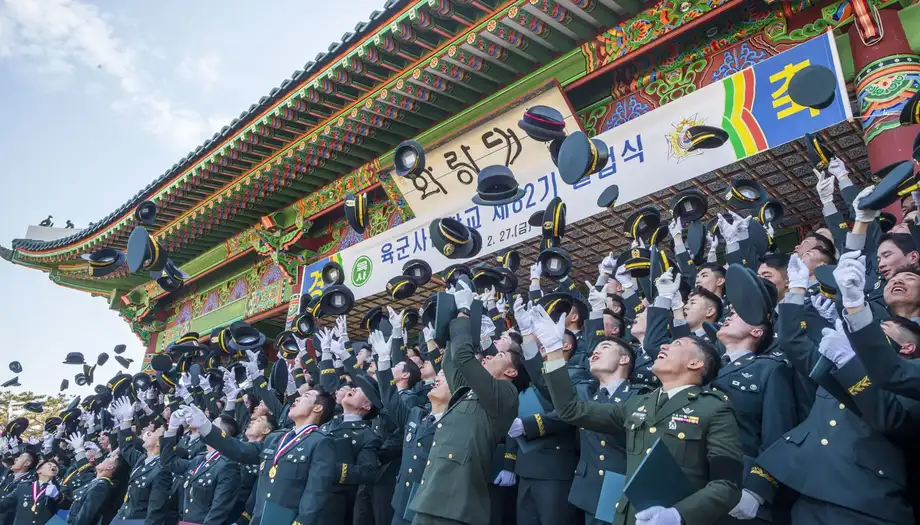
A December launch despite deep cadet reservations
South Korea will assign about 20 officials to a task force beginning work on Wednesday, Dec. 2, 2026, to create one Armed Forces Academy for the Army, Navy and Air Force. Its main campus is planned for the Jaundae military complex in Daejeon, where the government wants future officers to share education and training before completing much of their specialist instruction on separate service campuses.
Contents
- A December launch despite deep cadet reservations
- What the cadet survey actually asked
- One institution, but education spread across several campuses
- Why the ministry wants joint education in Daejeon
- The bill that would replace three schools with one
- Why cadets and alumni say professional expertise is at risk
- Jinhae is fighting over status, not just buildings
- Cadets want changes to curriculum, facilities and campus planning
- The dates that decide the transition
- Key Points
The Ministry of National Defense announced the date on Friday, Nov. 27, alongside a cadet survey dominated by requests to preserve each service's character, examine whether integration is justified and keep the existing academies. The task force will include military and defense personnel together with officials from the Ministry of Education and the Ministry of Land, Infrastructure and Transport.
The new body expands a preparatory team that had operated inside the Defense Ministry into an organization spanning several parts of government. Three groups will handle policy and institutional planning, education development and educational infrastructure. Their work covers the curriculum, the legal and administrative structure, and the campuses needed for the new institution.
The launch moves the project into implementation while the necessary legislation is still before the National Assembly. It also sets up a direct test between the ministry's timetable and the resistance expressed by cadets, alumni and communities that host the existing schools.
What the cadet survey actually asked
The online survey approached 2,526 cadets from Nov. 13 to 17 and received 2,240 responses, a participation rate of 88.6 percent. The respondents comprised 1,059 Army cadets, 502 Navy cadets and 679 Air Force cadets. Their respective school participation rates were 94.9 percent, 83.6 percent and 83.7 percent.
Participation varied sharply within some schools. Only 90 of 210 second year cadets at the Air Force Academy responded, or 42.8 percent, while 84 of 139 fourth year Naval Academy cadets responded, or 60.4 percent. Every first year cadet at the Army and Navy academies took part.
The questionnaire contained four questions requiring free written answers. Cadets were asked about improvements to education, elements needed to preserve traditions and professional expertise, interest in a graduate school, and matters the ministry should consider when establishing the integrated academy. There was no question asking them directly to approve or reject integration. The ministry published categorized totals rather than the complete written answers.
The final question produced 3,961 categorized responses because cadets could give more than one answer. The largest groups were:
- 802 responses, or 20.2 percent, called for preserving the life, culture, symbols and other characteristics of each service.
- 708 responses, or 17.9 percent, sought to keep the separate Army, Navy and Air Force academies.
- 685 responses, or 17.3 percent, asked for the policy's purpose and validity to be examined.
- 521 responses, or 13.2 percent, requested wider consultation and public disclosure of how opinions were reflected in policy.
Those percentages describe shares of the 3,961 answers, not shares of the 2,240 participating cadets. Other written answers raised concerns about an analysis of costs and benefits, disruption to education during relocation, excessive concentration on one service, morale among current cadets and media exposure.
Kim Se-jin, a civilian special adviser appointed to discuss the academy, accused the ministry of dividing similar answers into categories without objective standards. He calculated that 96.8 percent of participants, excluding answers he treated as nonresponses, expressed opposition or concern. His figure combines answers that he classes as resistant or worried; the questionnaire itself contained no direct vote.
Kim delivered a much sharper accusation against the government's handling of cadet opinion.
The voices of Army, Navy, and Air Force cadets are being ignored and suppressed. The Lee Jae Myung government is trying to hide these figures and public sentiment.
The ministry said the open format was intended to hear from cadets who could not attend a Nov. 10 roundtable with the defense minister. It said student identification numbers were collected only to confirm enrollment. The Korea Institute for Defense Analyses, known as KIDA, compiled and verified the results, deleted the numbers and then supplied the data to the ministry to protect anonymity.
An earlier KIDA study conducted for the ministry provides a more direct measure of opinion. In March, 91.3 percent of respondents in a survey covering 1,791 cadets at the three academies said they opposed integration.
One institution, but education spread across several campuses
The revised blueprint announced on Nov. 18 uses what the government calls a network model. The three academies would become parts of one Armed Forces Academy rather than continue as independent institutions belonging to their respective services. The design is described as 1+2+1 because of how cadets would move during their four years.
First and fourth year cadets would receive integrated education at the main campus at Jaundae in Daejeon. Second and third year cadets would study specialist subjects on their service campuses, where summer military training would also be connected to the curriculum. The Navy campus would remain at Jinhae in South Gyeongsang Province, while the Air Force campus would remain at Cheongju in North Chungcheong Province.
The Korea Military Academy would leave its present site at Taereung in Seoul for the central Chungcheong region. Earlier discussions had included Jangseong County in the Jeolla region as a possible destination. The finalized revision instead places the integrated headquarters in Daejeon and links the Army move to that broader Chungcheong plan.
The ministry has also retreated from parts of the earlier educational concept. That version envisaged unified admissions, a common curriculum during the first two years at Jaundae and other facilities, selection of a service branch in the third year, and two years of specialist training. Cadets had asked how graduates could be protected from assignment to a branch they did not want and whether too many would seek the Air Force. The revised plan retains selection by service.
New entrants from the 2029 academic year would belong to the integrated organization. The ministry intends to call its first entrants Armed Forces Academy Class 1 and stop using the Korea Military Academy, Naval Academy and Air Force Academy names for new cohorts. Existing campuses would therefore retain important educational functions without retaining their present legal status.
The first integrated class is expected to enter in March 2029. Its initial common education is planned for the current Army academy site at Taereung because the Daejeon facilities will not yet be complete. Draft legislation allows temporary operation at locations established by presidential decree until construction is finished.
Why the ministry wants joint education in Daejeon
Defense Minister Ahn Gyu-back presented the earlier concept as preparation for a military in which land, sea and air operations must be coordinated with activity in space, cyberspace and the electromagnetic spectrum. He also connected officer education to the planned transition of wartime operational control, or OPCON, within the combined defense arrangement between South Korea and the United States.
Ahn explained the kind of officers and facilities he believed the project required.
We aim to nurture military officers who possess creative minds, interdisciplinary thinking, professional expertise and high technological literacy. The officers trained in the upcoming academy must lead the ROK-U.S. combined defense post-OPCON transition. To educate them for the future security environment, we need a new curriculum, elite faculty and advanced educational facilities.
OPCON is the authority to direct forces during war. Preparing South Korean officers for greater responsibility after its transition is central to the ministry's argument that separate school traditions must be combined with stronger joint planning and technological expertise. The proposed curriculum would use artificial intelligence and prepare officers to operate across several domains rather than treating land, sea and air as separate educational worlds.
Daejeon's research base is the main reason given for choosing Jaundae. Ahn cited the Korea Advanced Institute of Science and Technology, the Agency for Defense Development, the Korea Aerospace Research Institute, the Korea Astronomy and Space Science Institute, the Electronics and Telecommunications Research Institute and the Korea Atomic Energy Research Institute. The government expects the academy to work with these institutions on science, engineering and defense research.
Staffing provides a separate efficiency argument. The three academies currently have seven generals, including three superintendents with three stars, and approximately 3,000 support staff for about 2,900 cadets. Each school enrolls only 700 to 1,000 students. Ahn compared that enrollment with a single department at an ordinary university and argued that maintaining roughly one support staff member for every cadet showed a need for structural reform.
His longer term ambition was a national defense education center that could eventually bring together the Armed Forces Nursing Academy, advanced defense technology institutions, the Reserve Officers' Training Corps and officer candidate training. The bill now before parliament is narrower. The Nursing Academy and the Army Third Academy have separate establishment laws and are not covered by this proposal.
Reform advocates also point to declining applications and difficulty adapting the schools to new military technology. Choi Young Jin, a political science professor at Chung-Ang University, said integration had appeared repeatedly as a campaign pledge from both conservative and liberal presidential candidates, including during the administrations of former Presidents Lee Myung-bak and Park Geun-hye. The current dispute concerns the speed and structure of the reform as much as the principle of closer cooperation.
The bill that would replace three schools with one
Jin Sung-joon, the Democratic Party lawmaker who chairs the National Assembly's National Defense Committee, led submission of the Act on the Establishment and Operation of the Armed Forces Academy on Nov. 20. Hwang Myeong-seon, Park Sun-won, Kim Byung-joo and other lawmakers joined the proposal. It must pass committee examination and the legislative process before the government can use its planned timetable.
The bill would repeal the existing Military Academy Installation Act and remove the three schools from the command structures of their individual services. One academy would instead operate directly under the defense minister. Daejeon is written into the bill as its location, but a separate clause permits some facilities to be placed elsewhere through a presidential decree.
The academic program would remain four years, divided between military studies and general academic education. The defense minister would determine military studies and set general education in consultation with the education minister. Graduates would be commissioned as second lieutenants in their services. A new education committee would review the school's development plan, coordination with service training and changes to academic rules.
The school's leader would be called a president rather than a superintendent. Candidates would need at least 15 years of experience in defense or education, and a committee of internal and external members would recommend nominees. The defense minister would nominate the chosen candidate for appointment by the president of South Korea. The position would be a specially appointed public office with pay and treatment equivalent to a vice minister, a term of two years and permission for one renewal. A civilian could hold the post.
Entrance rules would also widen. Current law requires applicants to be at least 17 but younger than 21 and unmarried. The bill raises the upper limit to 23, allowing applicants aged 17 to 22, and omits the marriage requirement. Preparatory education before admission would remain compulsory.
Protection for current students extends to cadets on leave and to those entering the separate academies in 2028. They would remain under existing school rules through Feb. 28, 2032. Those graduating by that date would receive diplomas and degrees bearing their current academies' names. Anyone still studying afterward would transfer to the Armed Forces Academy.
Staff, facilities and property belonging to the existing institutions would pass to the new academy when the law takes effect. Civilian instructors already teaching cadets could move through special appointments until Dec. 31, 2029. Civilian professors would receive public official status, with pay, job protection and discipline generally following the law governing education officials. Faculty members would be barred from joining political parties or taking part in political activity.
Why cadets and alumni say professional expertise is at risk
Ahn met cadets at the Korea Military Academy on May 27, the Naval Academy on June 10 and the Air Force Academy on June 15. The ministry described active communication and candid opinions but initially released few details. Participants subsequently raised concerns about weakened service identities, competition among branches, the curriculum and the possibility that relocation would discourage strong applicants.
The ministry later told the office of opposition lawmaker Lim Jong-deuk that it had not formally explained its proposal to each academy. The restructuring had not been finalized during Ahn's meetings, but cadets were already being asked to react to a reorganization that would directly determine where and how they studied.
Opposition then moved onto the grounds of the National Assembly. On July 8, the alumni associations of the three academies held their first joint protest on the outdoor staircase of the parliament's main building in Seoul. Organizers estimated attendance at about 2,000 people, including parents of cadets and veterans.
Because demonstrations are generally prohibited on Assembly grounds, the gathering took the form of a press conference led by lawmakers. People Power Party Representatives Han Ki-ho and Lim Jong-deuk, both graduates of the Korea Military Academy, attended alongside former academy principals and retired generals. The alumni groups demanded an objective review, public agreement and a halt to what they described as a rushed experiment.
Their joint statement connected the school dispute to national security.
National security must never become the subject of policy experiments or political interests. The government is rushing ahead with the merger and relocation of the military academies under the guise of defense reform.
Park Pan-jun, head of the Korea Military Academy Alumni Association, rejected the argument that the new structure would improve recruitment or cooperation among the services.
The policy would do little to attract outstanding cadets or meaningfully strengthen jointness within the military.
Park later described the revised campus model as closure of the academies rather than integration. Former Army Chief of Staff Kim Yo-hwan argued that creating conditions in which talented young people want to enter military service was more urgent than combining the schools. Naval alumni warned of damage to the identity and professionalism of naval officers, while Air Force alumni said the plan could weaken education for air and space operations.
The opposition also has a financial dimension. Construction would extend beyond classrooms to dormitories, faculty offices, housing and even a new uniform. The ministry's announcements have not supplied a total price for those requirements or for the disruption involved in moving students and staff.
Jinhae is fighting over status, not just buildings
Jinhae, now part of Changwon, has developed around the naval base and its educational institutions for roughly 80 years. The government's promise to retain second and third year naval education there has therefore failed to calm local opposition. Residents and local politicians fear that an independent Naval Academy will be replaced by facilities administered from Daejeon.
Lee Hae-ryeon, chair of the Changwon Special City Council, focused on the difference between statutory protection and an administrative promise. The bill names Daejeon but does not expressly guarantee the Naval Academy's name, independent status or four years of education in Jinhae. It also does not write the promised second and third year naval curriculum into law. Because a presidential decree can be changed without legislation, she called for the revision to be reconsidered and for Jinhae's educational role to receive legal protection.
Choi Chi-gwang, who leads a civic committee opposing the integration and relocation, said that preserving buildings merely to demonstrate a continuing presence would amount to an empty shell. His committee also questioned the scale of investment required to combine institutions that could instead receive new facilities and organizational reforms while remaining separate.
Local councilors plan to pursue a national petition against establishment of the integrated academy. The civic committee scheduled its fourth rally for Nov. 28. Naval and Air Force alumni have raised a related practical objection: an inland center cannot reproduce ready access to the sea for naval training or a runway and open flying environment for air force education. The government answers that the regional campuses and summer training are intended to preserve exactly those experiences.
Cadets want changes to curriculum, facilities and campus planning
The survey gives the task force a detailed list of educational demands beyond the argument over integration. When asked what was essential to preserve traditions and professional expertise, 34.5 percent of respondents called for education tailored to each service and stronger links between academic subjects, practical duties and training. Another 21.7 percent wanted service cultures and daily customs respected, including salutes, uniforms, songs, ceremonies and historical symbols.
On that question, 19.5 percent favored keeping the present system of three academies. A further 9.2 percent identified location and training infrastructure, citing such examples as the Navy's need for the sea and the Air Force's need for a runway.
Asked how education could improve, cadets gave these answers:
- 28.3 percent requested more elective subjects, deeper study within majors and broader curriculum reform.
- 20.3 percent sought better lecture halls, research facilities and living conditions.
- 17 percent wanted improvements while retaining the existing academy system.
- 13.4 percent called for stronger education connected to the duties of each service.
A proposed graduate school drew little interest in its current concept. Of the respondents, 1,490 cadets, or 66.3 percent, said they would not apply. They cited the difficulty of combining graduate study with military duties and a preference for outside institutions, including civilian programs commissioned by the military. Another 613 cadets, or 27.3 percent, expressed interest.
Among those interested, 14.4 percent favored artificial intelligence, computing or cyber studies, while 14.2 percent chose military strategy, security or military history. Engineering fields including machinery, shipbuilding, construction and the environment attracted 12.6 percent, and international relations, North Korean studies or regional studies attracted 11.8 percent.
The Defense Ministry said it would work with experts inside and outside the military to revise courses for future warfare and advanced science and technology. It promised to connect common education with summer training and service instruction so that joint capability and the character of each branch could develop together. It also said a graduate school should reflect cadet interests and reach the standard of leading universities.
The dates that decide the transition
The administrative plan stretches from the first protest after the survey announcement to the final transfer of students who do not finish under the old rules.
- Nov. 28, 2026: The Jinhae civic committee plans its fourth rally against the integration and relocation.
- Dec. 2, 2026: The government task force begins work with about 20 personnel.
- April 2027: The ministry plans to publish the admissions implementation plan for the 2029 academic year.
- Jan. 1, 2028: The new law would take effect and the existing academy law would be repealed if parliament passes the bill.
- 2028 academic year: This would be the last separate intake for students eligible to graduate under the Army, Navy and Air Force academy names.
- March 2029: The first integrated cohort is scheduled to enter as Armed Forces Academy Class 1.
- Feb. 28, 2032: Protection under the old school rules ends, and cadets who have not graduated transfer to the new academy.
The government aims to complete the new system, including the Army academy's move from Seoul, by 2032. No date has been announced for a parliamentary vote. The construction timetable and total budget also remain unstated, leaving the temporary Taereung arrangement and the future Daejeon campus as central issues for the task force.
Key Points
- A task force of about 20 officials launches on Dec. 2 to prepare an Armed Forces Academy headquartered at Jaundae in Daejeon.
- Of 2,526 cadets approached, 2,240 responded to a survey containing written questions but no direct vote for or against integration.
- The largest response category on government considerations was preservation of service characteristics, with 802 of 3,961 multiple answers.
- The revised 1+2+1 model places years one and four in Daejeon and years two and three on service campuses, beginning with the 2029 intake.
- Legislation submitted on Nov. 20 would replace the three academies with one institution under the defense minister, but it has not yet passed.
- Current cadets and entrants through 2028 can graduate under existing school names until Feb. 28, 2032.
- Alumni, cadets and Jinhae residents continue to challenge the effects on service expertise, institutional identity, recruitment and access to essential training environments.