A curious cub celebrates at Taman Safari
Satrio Wiratama, the giant panda cub known as Rio, celebrated his first birthday on Friday, November 27, 2026, with a special appearance at Taman Safari Indonesia in Bogor Regency, West Java. Born on November 27, 2025, he is the first giant panda born in Indonesia. He now weighs 35.6 kilograms, and his birthday brought together the two sides of his young public life: a playful animal exploring his enclosure and a living result of conservation work between Indonesia and China.
Contents
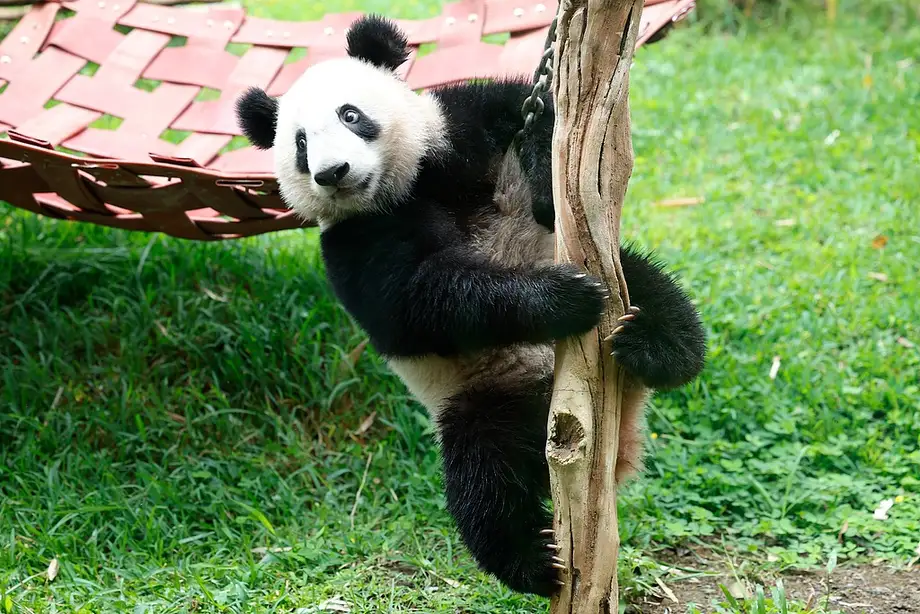
The celebration was held in the Outdoor Exhibit at Istana Panda in Cisarua. Rio played with his mother, Hu Chun, in their enclosure while visitors took photographs. The cub has become more curious and adventurous as he has grown, climbing and investigating his surroundings. Those ordinary moments of play help explain his popularity, but the date also marked a serious first for Indonesia's efforts to care for and breed giant pandas under human care.
An expanded habitat and a name with meaning
The birthday program included a ceremony marking an expansion of Rio's habitat. For a cub becoming more mobile, the living space is part of his development, not just a backdrop for visitors. The enclosure must support his daily activity while allowing the park's team to look after him and his mother. No size or completion date was given for the expansion, so the public details remain focused on the ceremony itself.
Rio's scientific species name is Ailuropoda melanoleuca, but his individual name carries a local story. Indonesian President Prabowo Subianto named him Satrio Wiratama, meaning brave and noble warrior. The shorter Rio is the familiar name used at the park. The formal name connects the cub to Indonesia, while his parentage connects him to the pair that came from China years before his birth.
From a partnership begun in 2017 to a birth in 2025
Hu Chun and Cai Tao arrived in Indonesia from China in 2017 under a conservation cooperation program between the two countries. Their transfer was part of a partnership lasting 10 years. Rio's birth in 2025 followed years of effort by experts from both countries and was achieved through artificial insemination. That makes his first birthday a visible marker of work that began long before visitors saw him climbing in the outdoor exhibit.
Artificial insemination is a medical technique in which sperm is placed in the female's reproductive tract so that fertilization can occur without mating. In this case, it was one part of a broader program of expertise and care. The pregnancy and birth required scientific work, while Rio's survival and growth through his first year depended on the doctors, specialists and attendants later thanked at the celebration. The technique is also central to Ahmad Munawir's description of the birth as a technological achievement for Indonesia.
- 2017: Hu Chun and Cai Tao arrived in Indonesia from China under the conservation cooperation program.
- November 27, 2025: Rio was born in Indonesia after a pregnancy achieved through artificial insemination.
- November 27, 2026: Rio celebrated his first birthday with Hu Chun at Taman Safari Indonesia. His weight was given as 35.6 kilograms, and the celebration included the habitat expansion ceremony.
The description locally born refers to Rio's birthplace. Both parents came from China, while the reproductive work, birth and first year of care took place within the program in Indonesia. His story is therefore national in its setting and international in the expertise and animals that made it possible.
The doctors, experts and carers behind the first year
Jansen Manansang, founder of Taman Safari Indonesia, used the celebration to thank the doctors, experts and care staff involved in Rio's first year. He said the cub's growth reflected their dedication and offered his highest appreciation to the people who had ensured that he was looked after.
Rio's journey over the past year is the result of hard work. I give my highest appreciation to those who have dedicated themselves to ensuring that Rio grows and is cared for until now.
Jansen also named Conservation Wildlife China (CWC) and the China Conservation and Research Center for the Giant Panda (CCRCGP) as partners that shared knowledge and expertise in giant panda care. That credit gives a practical meaning to the phrase international cooperation. It involves exchanges between institutions and specialists responsible for decisions about the animals, alongside the formal agreement between the two countries.
He said the relationship could support collaboration in industry, tourism, culture and education as well as conservation. Rio's birthday shows how those areas can meet at one site. A park visit can introduce the public to conservation, while the cub's story gives educators a direct example for discussing science and animal care. Jansen placed that educational and cultural value beside the central task of keeping Rio healthy.
The birthday scenes showed play, while Jansen's remarks described the continuous work behind it. Rio's climbing and exploration may look like spontaneous activity, but his first year also represents daily decisions by the team caring for him and Hu Chun. The founder's tribute kept attention on those people and on the Chinese partners helping them build their expertise.
Why Rio matters beyond the panda enclosure
Ahmad Munawir, Director of Biodiversity and Genetic Conservation at KSDAE, gave Rio three meanings at the celebration. He described the cub as a symbol of harmonious relations between Indonesia and China, a milestone in conservation outside an animal's natural habitat, and proof that Indonesia can apply assisted reproduction technology, often shortened to ART.
Ex situ conservation means protecting or breeding a species away from its native habitat, in a managed setting such as a conservation institution. For Munawir, Rio's healthy development shows what that kind of institution can achieve through good animal management. His third point reaches beyond the park's boundaries: the skills used in the birth can build confidence in Indonesia's wider use of technology for conservation.
Munawir connected that confidence directly to Rio's arrival and urged Indonesians to view their technical capacity positively.
Let us be confident and positive that we can now enter the field of technology, and this is indeed the age of technology. Rio's birth proves that.
He said he hoped Rio would grow healthy and become a conservation ambassador, bringing messages about wildlife protection to Indonesians and the world. He also hoped the achievement would motivate other conservation efforts and encourage better management and welfare for animals. In that vision, Rio's public appeal is useful because it can carry a message beyond the people who visit Istana Panda.
The first birthday leaves several practical measures of progress: a cub weighing 35.6 kilograms, a care team that has supported his first year, and a ceremony marking an expansion of his habitat. No timetable was given for further habitat work. The priorities stated at the event were to sustain Rio's care, share expertise and use his story to spread conservation messages.
Key Points
- Rio, whose full name is Satrio Wiratama, celebrated his first birthday on November 27, 2026, at Taman Safari Indonesia in Cisarua, Bogor.
- The first giant panda born in Indonesia weighed 35.6 kilograms and played with his mother, Hu Chun, as visitors photographed them.
- His parents, Hu Chun and Cai Tao, arrived from China in 2017. Rio was born through artificial insemination after years of joint conservation work.
- President Prabowo Subianto gave him a name meaning brave and noble warrior.
- The celebration included a ceremony for an expansion of his habitat, although no dimensions or completion date were given.
- Park founder Jansen Manansang credited Indonesian and Chinese experts and carers, while Ahmad Munawir described Rio as a symbol of international harmony, conservation outside native habitat and Indonesian use of reproductive technology.