Indonesia's biggest palm oil customer is itself
Indonesia used or processed 24.6 million metric tons of palm oil domestically in 2024, about 53% of its record production of 47 million tons. That domestic market carried 629,000 hectares of historical deforestation exposure, according to Trase, the research initiative that maps commodity supply chains. The figure represented 67% of the sector's total exposure and was almost nine times the 71,400 hectares associated with exports to India, Indonesia's largest foreign buyer.
Contents
- Indonesia's biggest palm oil customer is itself
- What the forest exposure figure measures
- Domestic demand includes processing for exports
- A growing market with weaker public scrutiny
- Export markets are changing too
- Forest clearing has fallen, but the causes are debated
- Papua and peatlands carry continuing risks
- B50 adds pressure to the land equation
- Degraded land pledges need rules
- Replanting offers an alternative, with costs for farmers
- A new system aims to connect plantations and buyers
- Key Points
The findings put Indonesian food manufacturers, processors and fuel producers at the center of a sustainability challenge often discussed mainly in terms of foreign buyers. Domestic demand is growing while environmental commitments and public information about sourcing remain less extensive than in some export markets.
Trase's 2026 supply chain analysis links domestic demand to food consumption, industrial processing, biodiesel requirements and the Domestic Market Obligation. That government policy requires producers to reserve some palm oil for the domestic market before exporting.
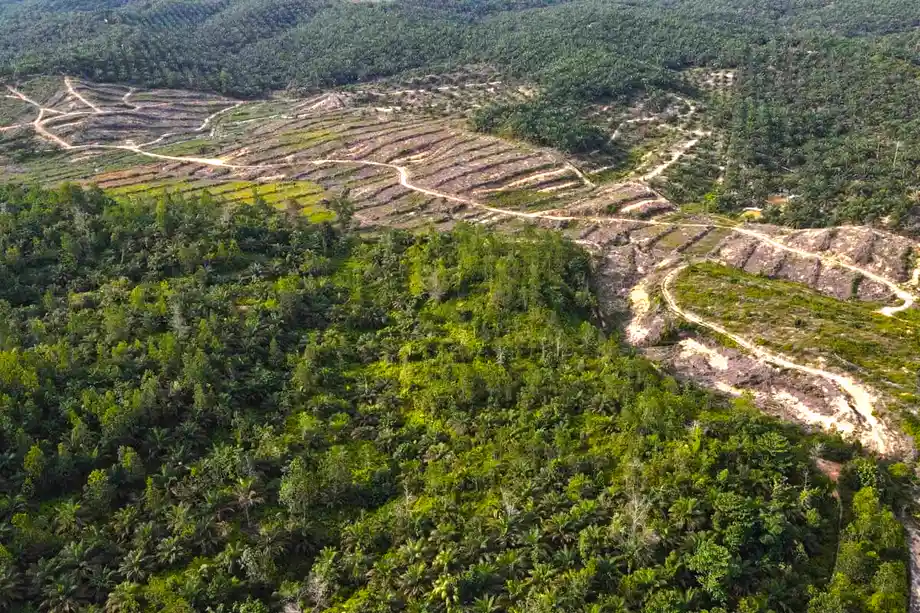
The 629,000 hectares measure clearing associated with production over a historical attribution period of 10 years. Actual new forest clearing for palm oil totaled 32,000 hectares in 2024, more than 81% below the annual average of 166,544 hectares during 2008–2015. Indonesia is producing more palm oil with much less new forest conversion than in that earlier period, while its largest market still draws heavily from regions with a history of clearing.
Adelina Chandra, a Trase data scientist, identified the combination of rising demand and domestic sourcing risks as a central concern.
One of the most important issues is the sharp increase in domestic demand, while the domestic market remains highly exposed to deforestation,
What the forest exposure figure measures
Trase combines satellite observations of forest loss with maps showing where oil palm grows. It then assigns historical clearing to buyers according to the volumes they source from producing regions. If a buyer purchases 80% of the palm oil from a region assigned 50 hectares of clearing, that buyer receives 40 hectares of exposure.
Trase's historical deforestation dataset, updated on October 9, 2026, explains the timing. The calculation allows three years between clearing and the first harvest, then attributes clearing across the first 10 years of production. Oil palms can continue producing for around 30 years.
The dataset shows historical exposure falling from about 1.66 million hectares in 2017 to 1.11 million hectares in 2023. Those totals describe the legacy of forest conversion associated with production in each year. The annual clearing figure answers a different practical question: how much additional forest was converted that year.
Domestic sourcing in 2024 carried an estimated 25 hectares of exposure per 1,000 tons of crude palm oil. China had the highest intensity among export destinations, at 20.3 hectares per 1,000 tons. Indonesia's domestic figure was therefore about 23% higher, using those two estimates.
Domestic demand includes processing for exports
Indonesia's domestic market category includes more than products ultimately consumed inside the country. Trase's earlier methods document, version 1.2.2, explains that domestic demand was estimated by subtracting recorded crude and refined palm oil exports from total production.
The remainder includes local consumption and further processing into biodiesel and oleochemicals, ingredients used in products such as detergents and cosmetics. Some of those processed products are subsequently exported. The domestic category therefore captures an important stage of industrial activity within Indonesia, as well as final consumption.
The same document describes substantial uncertainty about domestic sourcing locations. Where reliable links were missing, the model distributed volumes evenly across mills with production left unassigned after traceable exports were allocated. More complete buyer records would allow researchers to locate domestic supply chains more precisely.
The 2026 analysis uses the newer dataset, version 1.2.5. The earlier methods remain useful for understanding why domestic processing statistics and public sourcing information matter: buyers can purchase large quantities within Indonesia while the path back to particular mills and plantations remains difficult to map.
A growing market with weaker public scrutiny
Domestic consumption and processing rose from 32% of Indonesian production in 2018 to about 44% in 2022, according to Global Canopy's 2024 sector assessment. The latest estimate of about 53% in 2024 extends that shift toward processing and use at home.
More than half of domestic use in 2022 went into biodiesel and oleochemicals, according to industry figures cited in that assessment. Cooking oil is a familiar product, but industrial and energy policies also shape demand for the crop.
Corporate commitments to avoid deforestation covered almost 93% of observed Indonesian palm oil exports in 2024. In the European Union market, 88% of palm oil was covered by policies known as NDPE, meaning no deforestation, no peat development and no exploitation. Another 1% was covered by commitments against deforestation alone.
Domestic supply chains have less extensive coverage. Chandra called for better reporting by Indonesian buyers and public access to sourcing information so their environmental commitments can be checked.
Dedi, an official in the Agriculture Ministry's directorate responsible for oil palm plantations, said the government collects plantation information through SIPERIBUN, its plantation licensing information system. He also described efforts to improve geographic mapping rather than relying only on tables of plantation records.
Export markets are changing too
India remained Indonesia's largest foreign market in 2024, buying 4.37 million tons, although shipments fell 21% from 2023. Pakistan's purchases increased 20% to 3.15 million tons, taking it above China as the second largest export destination. China's imports fell 44%, from 4.47 million to 2.48 million tons, as buyers substituted cheaper domestic soybean oil.
European Union purchases fell from 3.78 million tons in 2018 to 1.9 million tons in 2024. Trase connects that decline to tighter corporate sustainability commitments and the EU's Renewable Energy Directive, which phases out palm oil based biofuels because of deforestation concerns.
Royal Golden Eagle became Indonesia's largest exporter in 2024, with a 15.5% share. It operates alongside Sinar Mas, Musim Mas and Wilmar in a market dominated by a small number of corporate groups.
Missing shipment records are making that market harder to track. Export volumes classified by Trase as unknown rose from less than 1% in 2018 to almost 17% in 2024. The figure of 93% coverage by corporate forest commitments applies to observed exports, with missing trade records excluded from that calculation.
Forest clearing has fallen, but the causes are debated
A study covering 47 tropical countries estimated that conversion of old growth rainforest to oil palm averaged 343,000 hectares annually during 2001–2015, falling to 80,000 hectares during 2016–2024. That is a reduction of about 77%. Oil palm conversion's share of tropical rainforest loss fell from 12.2% to 2.2%. The study had not yet been peer reviewed.
David Gaveau, a remote sensing scientist, founder of TheTreeMap and a study coauthor, attributed part of the decline to corporate forest commitments. Major traders and buyers increasingly check sourcing areas and face commercial and reputational costs when purchasing from recently cleared land.
Another study examined Indonesian oil palm concessions during 2018–2020. Forest loss was very low in concessions both with and without corporate commitments, and the researchers found no additional reduction associated with having a commitment.
Robert Heilmayr, a University of California associate professor of environmental and ecological economics and a coauthor of that study, suggested that corporate policies may influence practices across the sector, including suppliers without their own pledges.
Gaveau also pointed to falling forest conversion despite palm oil prices rising from about $600 per ton in 2015 to nearly $1,500 in recent years. Earlier research for 2001–2019 associated a 1% annual price increase with a 1.08% increase in industrial plantation expansion and a 0.68% increase in forest loss. Forest protections, less suitable land and the need to replace ageing trees may also help explain the newer pattern.
Papua and peatlands carry continuing risks
Papua's palm oil related forest clearing rose from approximately 3,600 hectares in 2024 to more than 7,300 hectares in 2025. Kalimantan, the Indonesian part of Borneo, accounted for 56% of national palm oil clearing in 2025.
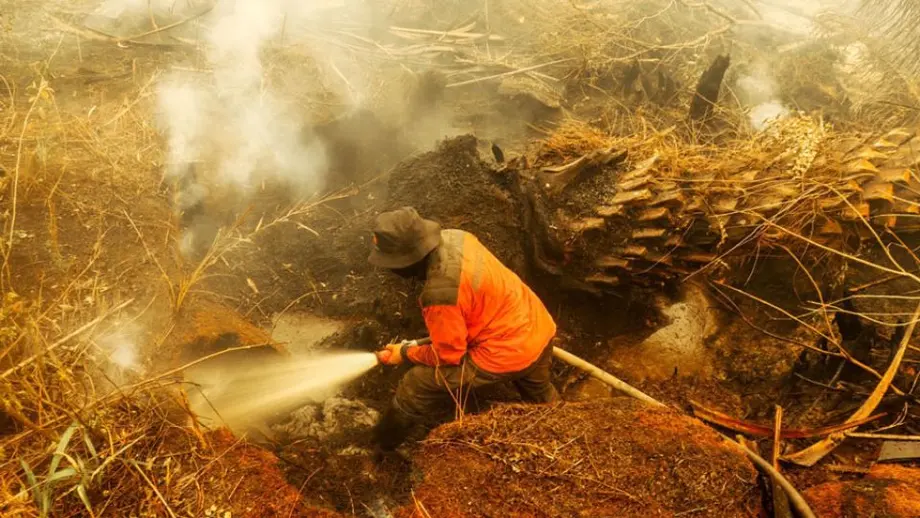
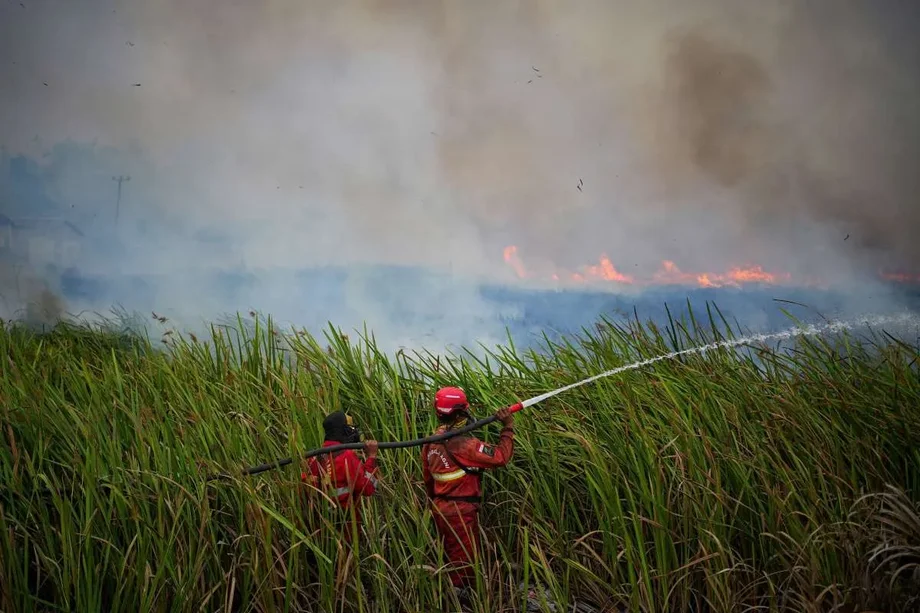
Peatlands create another continuing problem. Peat is a thick layer of partly decomposed plant material that stores carbon while wet. Draining it for plantations exposes that material to air, allowing it to break down, release carbon and sink. Dry peat also burns readily.
Trase estimated that peat subsidence associated with oil palm plantations released almost 148 million tons of carbon dioxide equivalent in 2024. That unit combines different greenhouse gases according to their warming effect. Subsidence and peat fires together accounted for nearly 85% of the sector emissions assessed by Trase, covering land use change, peat subsidence and peat burning.
Productive oil palm plantations on peat increased from about 1.28 million hectares in 2015 to 1.64 million hectares in 2024, a rise of 28%. Those existing plantations continue generating emissions even as new forest conversion declines. Trase calls for stronger peat protection, restoration and rewetting, alongside preventing further expansion onto peat.
B50 adds pressure to the land equation
Indonesia announced an expansion to B50 in June 2026 and began implementing it in July. B50 requires diesel fuel to contain 50% biodiesel, produced principally from palm oil. The policy aims to strengthen energy security by replacing part of the petroleum fuel supply.
Donald Siahaan, a senior researcher at the Palm Oil Research Center, estimated that moving from B40 to B50 would raise annual palm oil demand for energy from about 15 million to 18 million tons, an increase of 20%. Speaking in Medan in November 2026, he recommended keeping the blend at B40 to balance food and energy needs.
Environmental organization Madani Berkelanjutan and three partners assessed Indonesia's environmentally supportable oil palm area at 18.15 million hectares. Their estimate of 17.8 million hectares already planted in 2024 leaves a gap of just 350,000 hectares, about 2% of that assessed ceiling. The ceiling is an NGO assessment rather than a binding government limit.
The main developments span several years:
- 2024: Domestic palm oil use and processing reached 24.6 million tons, while new forest clearing totaled 32,000 hectares.
- 2025: Palm oil related clearing in Papua rose to more than 7,300 hectares.
- June and July 2026: Indonesia announced the B50 expansion and began implementation.
- December 30, 2026: The government expects its new traceability platform to be operating before the stated EU deforestation compliance date.
- 2029: Indonesia aims to integrate nearly all palm oil stakeholder data into that platform.
Degraded land pledges need rules
Mari Pangestu, Indonesia's presidential special envoy, said at a sustainability forum in Jakarta that the country has more than 12 million hectares of degraded land. The government has pledged to direct future food and biofuel development toward such areas.
The government has yet to clarify how degraded land will be defined or how the pledge will become binding rules. Madani wants those protections to cover energy projects as well as food production. Riza Egi Arizona, the organization's community energy transition program lead, warned against sacrificing natural forests, peatlands, savannas and customary territories to fuel targets.
Madani has also raised concerns about plans for approximately 2 million hectares of new sugarcane plantations to support E20, a target for gasoline containing 20% ethanol. Sugarcane supplies ethanol, while palm oil supplies biodiesel. Each crop requires its own assessment of land availability, ecosystems and community rights, particularly in Papua.
Replanting offers an alternative, with costs for farmers
Madani estimates that about 7 million hectares of ageing oil palm plantations could benefit from replanting. Replacing old trees with better seedlings could increase production on existing farmland, but farmers must pay for the work and manage a period without income while new palms mature.
Smallholders produce 35% of Indonesia's palm oil, according to Trase. Its analysis identifies insecure or undocumented land rights, overlaps with legally designated forest areas and the income gap during replanting as major barriers to government support.
The Peremajaan Sawit Rakyat replanting program, launched in 2017, doubled its grant to 60 million rupiah per hectare in 2024. Nevertheless, it achieved only 41% of its target of 120,000 hectares that year and 31% in 2025. The annual target was reduced to 50,000 hectares in 2026, with 20,229 hectares completed by August.
Those results make farmer support a practical part of forest protection. Higher yields depend on suitable seedlings, access to grants, secure land rights and a way for households to meet daily expenses during the transition.
A new system aims to connect plantations and buyers
Indonesia is preparing SI-ISPO, an information platform intended to track palm oil from plantations through processing and sales. Dida Gardera, an expert staff member to the Coordinating Minister for Economic Affairs, said it would serve domestic producers and international buyers, with operation expected before December 30, 2026.
Presidential Regulation Number 16 of 2025 expanded the Indonesian Sustainable Palm Oil certification framework to downstream industries and businesses producing palm oil based bioenergy. The framework requires traceability and provides for smallholder certification costs to be covered through the Plantation Fund Management Agency, the state budget or other authorized sources.
The government aims to integrate nearly 100% of stakeholder data into SI-ISPO by 2029. Connecting domestic fuel producers and manufacturers to verifiable plantation records would address a central weakness identified by Trase: demand is increasingly concentrated inside Indonesia, while detailed public information about domestic sourcing remains limited.
Key Points
- Indonesia used or processed 24.6 million tons of palm oil domestically in 2024, about 53% of production.
- Domestic sourcing carried 629,000 hectares of historical deforestation exposure, calculated over a period of 10 years.
- New palm oil related forest clearing totaled 32,000 hectares in 2024, more than 81% below the 2008–2015 average.
- Papua's clearing more than doubled in 2025, while drained peatlands remained a major emissions source.
- B50 increases domestic demand, making plantation productivity, farmer support and sourcing transparency more urgent.
- Indonesia plans a national traceability platform and aims for nearly complete stakeholder data coverage by 2029.