Old Homes Emerge From a Shrinking Reservoir
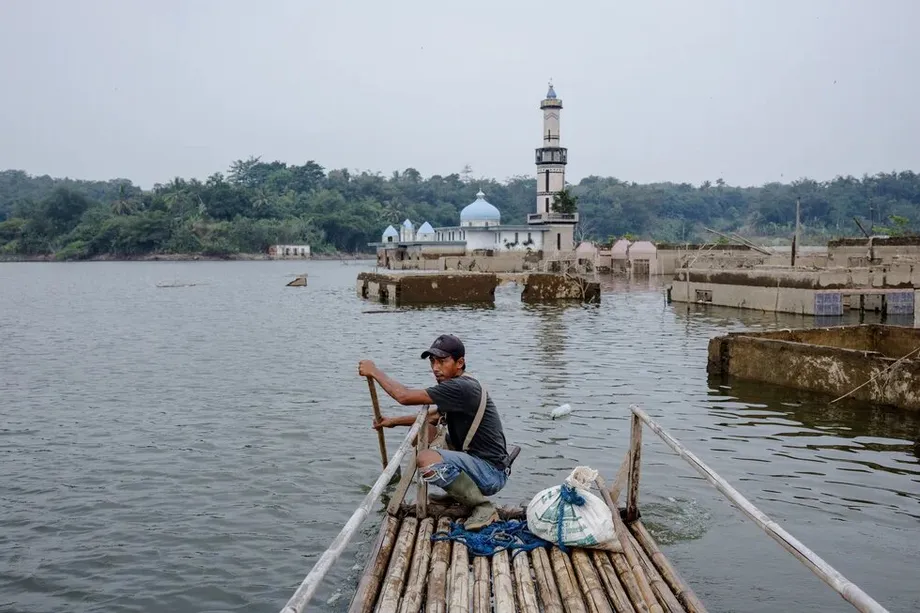
The remains of Kampung Somang in Lebak, Banten, have emerged from Indonesia's Karian reservoir as prolonged drought exposes walls, foundations and the ground where families once lived. Water levels fell by one to three metres during July 2026, bringing more of the submerged settlement back into view. By October, land around the village was dry and cracked.
Contents
- Old Homes Emerge From a Shrinking Reservoir
- A Ferryman Returns to His Former Home
- How the Villages Disappeared
- Schools, Graves and Public Services Were Moved
- What Karian Was Built to Deliver
- The Pipes Matter as Much as the Dam
- Dry Wells and Delayed Rain
- A Village That Also Became a Film Set
- From Construction to the Village's Return
- Key Points
Somang was among the communities cleared for the Rp 2.2 trillion Karian Dam, inaugurated by then President Joko Widodo on January 8, 2024. The reservoir covers 1,773 hectares and has a storage capacity of 315 million cubic metres. Its intended benefits reach across Banten, western Jakarta and part of West Java.
For former residents, the falling water has exposed something more personal than the scale of a drought: the places where their kitchens stood, their children played and their neighbours lived. Some now return by boat to see the remains. Others face difficulty finding clean water in the communities where they settled after leaving.
The reservoir has also changed everyday travel. Former Somang residents living nearby must cross the water to reach neighbouring communities quickly or take a long detour along damaged roads. A project designed to supply water to a wide region has left some of the people displaced by it struggling with both water access and transport.
A Ferryman Returns to His Former Home
Hussein, a former Somang resident, has spent two years working as a ferryman, charging visitors Rp 5,000 to Rp 10,000 for trips across the reservoir. Some passengers are former villagers returning to look at what remains of their homes.
In a Heinrich Böll Stiftung account published in September, Hussein described the experience of seeing his village emerge:
It's like looking at a graveyard of our memories.
The falling water has allowed Hussein to walk across exposed ground and visit the site of his former house. He described recognising the layout of a home that had disappeared beneath the reservoir:
I can still see exactly where my kitchen used to be. It breaks my heart, but I couldn't stop myself from coming back to see it.
Boat trips now connect his livelihood with the loss of his community. The same water that covered Somang became his workplace, while its retreat has brought former residents back to familiar places that can no longer function as a village.
How the Villages Disappeared
Somang was once a densely settled community, with houses standing close together. Residents began leaving in 2023 as the area was prepared for flooding. People from Kampung Karian had started moving earlier, in 2021. Kampung Susukan and Kampung Cibolang were also submerged for the project.
The September account published by Heinrich Böll Stiftung says the reservoir flooded 11 villages across four subdistricts: Sajira, Cimarga, Maja and Rangkasbitung. Former Somang residents dispersed to different places, although many remained in settlements near the reservoir.
Families salvaged what they could before the water arrived. Residents dismantled parts of their houses and recovered doors, windows, glass, roof tiles and structural timber for reuse or sale. Compensation for land and buildings helped people buy land in their new communities.
The surviving remains vary from place to place. Some buildings were left standing when the area was flooded; others had already been stripped of useful materials. The exposed village now includes walls without roofs, brick foundations and pillars. Those remnants explain why the reservoir floor can still look recognisably like a settlement when water levels fall.
Schools, Graves and Public Services Were Moved
Land acquisition for Karian covered 2,266.44 hectares, extending beyond the reservoir's 1,773 hectares. The difference is 493.44 hectares, showing that the project's land requirements reached beyond the area intended to hold water.
By 2023, relocation work had covered 37 public facilities, including schools, mosques, Islamic schools, other places of worship, village offices, village maternity facilities and community health posts. Moving a village meant replacing the places residents used for education, administration, worship and basic care, as well as their houses.
The relocation also involved 54 public cemetery and sacred burial sites containing 13,017 graves. Another 29 electricity tower sites were affected, along with land owned by the government or state enterprises.
These figures help explain the emotional force of Somang's reappearance. The communities lost more than buildings. Homes, burial grounds and shared institutions had tied generations to the same places. Their relocation scattered those connections across new settlements.
What Karian Was Built to Deliver
Karian is a National Strategic Project, a designation used by Indonesia for developments the government considers a priority. Construction began in 2015, with the reservoir being filled in late 2023 before its inauguration in January 2024.
At the inauguration, Joko Widodo said the dam would provide irrigation for 22,000 hectares of rice fields and meet raw water needs of 10.6 cubic metres per second. Raw water means water taken from a river or reservoir before treatment makes it suitable for household supply. The stated flow is equivalent to 10,600 litres every second.
The intended supply area includes Serang regency, Serang city, Cilegon, Lebak, Tangerang regency, South Tangerang and Tangerang city in Banten, as well as western Jakarta and Bogor regency in West Java.
Karian was also designed to help control flooding in Serang regency and Rangkasbitung in Lebak, and to generate 1.8 megawatts of electricity through a small hydropower installation. Its planned role therefore spans farming, urban water supply, flood management and electricity generation.
The drought has brought the project's regional purpose into sharp focus alongside the needs of nearby residents. Water stored for a large service area must still reach households through treatment plants and distribution networks, while families around the reservoir need dependable local supplies of their own.
The Pipes Matter as Much as the Dam
At the January 2024 inauguration, I Ketut Jayada, head of the Cidanau-Ciujung-Cidurian River Basin Agency, said land acquisition was still under way for 59 kilometres of transmission pipeline. Those pipes were needed to make fuller use of the reservoir.
Bob Arthur Lombogia, then director general of water resources, identified two intake capacities: 5.5 cubic metres per second at Karian and 9.1 cubic metres per second at Ciuyah. An intake is the point where water is drawn into a supply system. These figures describe particular infrastructure, while the president's 10.6 cubic metres per second described the dam's stated raw water supply benefit.
Joko Widodo also inaugurated the Sitanala Water Treatment Plant in Tangerang city, with a capacity of 500 litres per second, on the same day. The dam, intakes, pipelines and treatment facilities perform different jobs in the journey from stored water to a usable supply.
There is no current reservoir volume or confirmed 2026 operating status for the 59 kilometres of pipeline in the published accounts. The inauguration figures describe the project's intended capacity; the present experience around Somang is one of receding water, dry wells and difficult journeys.
Dry Wells and Delayed Rain
Some residents around Somang have reported difficulty obtaining clean water during the prolonged dry season. The September account describes people washing clothes at the retreating edge of the reservoir after village wells dried up.
Indonesian officials said dry season conditions had affected 80.7% of the country's territory by the middle of September. Teuku Faisal Fathani, head of the Meteorology, Climatology and Geophysical Agency, known as BMKG, said 61% of Indonesia's land area would experience a delayed start to the rainy season.
The two percentages describe different conditions: the first concerns the spread of the dry season, while the second concerns when seasonal rains are expected to begin. For communities waiting for wells and local water sources to recover, the timing of rain matters as much as the arrival of occasional showers.
El Niño is a warming of part of the tropical Pacific Ocean that can alter rainfall patterns far beyond the ocean itself. In Indonesia, it can contribute to drier conditions. The drought affecting Karian has been linked to an intense El Niño event.
Erma Yulihastin, a climate researcher at Indonesia's National Research and Innovation Agency, or BRIN, warned that the event could remain extremely strong into February 2027. She described its expected strength in these words:
Even February 2027 will still classify as super.
Her warning extends the period of concern beyond the usual expectation of rains around October. For displaced families living near Karian, a delayed wet season means a longer wait for relief from the conditions exposing their former homes.
A Village That Also Became a Film Set
Somang had already attracted visitors for another reason before the latest drought. Around late 2024 or early 2025, the partly submerged village served as a location for the horror film Jembatan Shiratal Mustaqim.
Some houses were already under water during filming. A resident said the reservoir level was lowered slightly for the production. Residents of the surrounding Sajira area worked as extras and technical crew.
The film production brought temporary work to a place transformed by relocation. The present visits have a different focus: former residents are returning to recognise the remains of their own streets and homes as more ground becomes exposed.
From Construction to the Village's Return
Karian's development and Somang's reappearance span more than a decade. The main dates show how construction, relocation and drought have successively changed the area:
- 2015: Construction of Karian Dam began.
- 2021: Residents of Kampung Karian began moving away.
- 2023: Somang residents began leaving, and the reservoir was filled late in the year.
- January 8, 2024: Joko Widodo inaugurated the dam.
- Late 2024 or early 2025: Partly submerged Somang was used for filming Jembatan Shiratal Mustaqim.
- July 2026: Falling reservoir levels exposed more village remains, with a decline of one to three metres during the month.
- August and September 2026: Former residents returned to see the exposed settlement as drought continued.
- October 2026: Ground around Somang was visibly dry and cracked.
- February 2027: BRIN researcher Erma Yulihastin warned that El Niño could still be extremely strong.
For the families displaced by Karian, the return of familiar walls has brought memories back into view without restoring the community that once surrounded them. Their immediate needs remain concrete: clean water, practical routes to neighbouring settlements and reliable services where they now live.
Key Points
- Somang's remains have reappeared as drought lowers the Karian reservoir in Lebak, Banten.
- Water levels fell by one to three metres during July 2026.
- The Rp 2.2 trillion dam was inaugurated on January 8, 2024, with a storage capacity of 315 million cubic metres.
- The reservoir flooded 11 villages across four subdistricts, according to the account published by Heinrich Böll Stiftung.
- Relocation included 37 public facilities and 13,017 graves across 54 burial sites.
- Former residents face dry wells and difficult travel despite the dam's intended regional water supply benefits.
- Delayed seasonal rains and a potentially prolonged El Niño threaten to extend the dry conditions.