A message that took 63 minutes
Seven letters took 63 minutes to travel less than a meter, but the message crossed a solid brick wall without radio, light or a cable. At the University of Queensland's Parnell Building in Brisbane, physicists transmitted the word Gravity by moving an elevator counterweight and measuring its faint gravitational pull from an adjacent men's bathroom. The receiver recovered every letter without error.
Contents
- A message that took 63 minutes
- Inside the elevator transmitter
- Why a brick wall does not stop the signal
- The project began with trucks, not text
- The speed problem, measured against Voyager 1
- How the team separated the message from noise
- What better sensors could change
- The experiments that came before
- Where a gravity telegraph might fit
- Key Points
The counterweight had a mass of about 1.8 metric tons, or nearly 4,000 pounds. Its center came within 0.68 meters of the sensor at the closest point, the distance the researchers use as the demonstrated range. The experiment ran at one bit per minute. A bit is a single binary digit, either 0 or 1, so sending even a short word required considerable patience.
Andrew J. Groszek led the work with Charles W. Woffinden, Michael D. Harvey, Andrew G. White and Matthew J. Davis. Their paper, Unblockable communication with gravity, appeared in Science Advances on 18 November 2026. The journal citation lists volume 12, issue 47, and DOI 10.1126/sciadv.aee0802. The authors are associated with the university's School of Mathematics and Physics and the Australian Research Council Centre of Excellence for Engineered Quantum Systems.
The researchers describe the method as a practically unblockable wireless communication scheme, not as a replacement for phones or internet networks. Its importance lies in showing that deliberate changes in an ordinary gravitational field can carry digital information through material that stops or weakens many conventional signals.
Inside the elevator transmitter
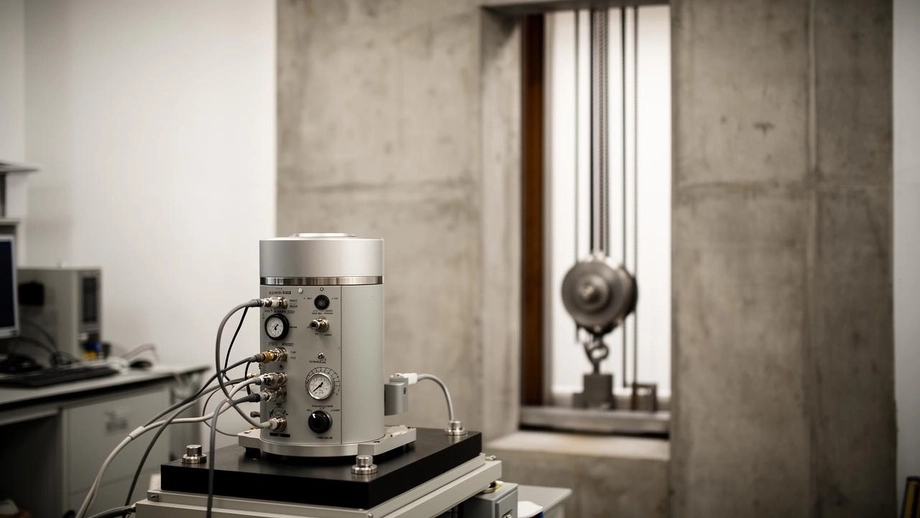
The Parnell Building's 1950s elevator supplied the moving mass. Its counterweight offsets the weight of the elevator car, reducing the force needed to raise and lower it. The team ran the elevator between two levels and assigned the counterweight's lower position a value of 0 and its upper position a value of 1.
A commercially available LaCoste and Romberg Model D spring gravimeter served as the receiver. Small enough to sit on the bathroom floor, it used a mass suspended from a spring to measure minute changes in vertical gravitational acceleration. The paper estimates the counterweight at 1,800 kilograms, with an uncertainty of 200 kilograms. After about 30 seconds of averaging, the instrument could reach a sensitivity of roughly 2 nanometers per second squared.
Each counterweight movement changed the acceleration at the sensor by about 50 nanometers per second squared, written as 0.00000005 meters per second squared. Compared with Earth's surface gravity of approximately 9.8 meters per second squared, that is about five billionths of the normal pull, or roughly one two-hundred-millionth.
ASCII encoding, a standard way for computers to represent characters, turned Gravity into 49 binary digits, seven for each letter:
1000111 1110010 1100001 1110110 1101001 1110100 1111001
- The counterweight had 25 seconds to move to its new position.
- The machinery then had 10 seconds to settle.
- The researchers spent another 25 seconds gathering and averaging readings.
Those steps gave every bit a full minute. An alternating sequence, 1010101, marked each end of the message. The 49 digits spelling Gravity and the 14 marker digits therefore occupied 63 transmission slots, explaining the full 63 minute run.
Why a brick wall does not stop the signal
Mobile phones, Wi-Fi and Bluetooth communicate with electromagnetic waves. Metal, concrete, rock and water can absorb, reflect or weaken those waves. A Faraday cage, for example, uses conductive material to screen its interior from external electric fields. Anyone whose phone has lost reception inside a tunnel or elevator has experienced a version of the problem.
Gravity behaves differently because every object with mass attracts every other mass. No known ordinary material can simply screen out that attraction. Dr Charles Woffinden of Queensland's School of Mathematics and Physics explained the attraction of a communication channel with that property:
Unlike the electromagnetic signals used in modern wireless communication, a gravitational signal cannot simply be screened out by placing ordinary material in its path. Anyone who has lost phone reception in a tunnel or struggled with Wi-Fi through a solid wall will understand the appeal.
While the present system is far from practical, it demonstrates the possibility of communicating using a method that ordinary physical barriers cannot block.
The experiment did not generate gravitational waves, the ripples in space and time associated with events such as collisions between black holes or neutron stars. Producing measurable artificial gravitational waves remains extremely difficult. Instead, the elevator changed the strength and direction of its ordinary gravitational field at a nearby detector.
A signal that cannot be screened out can still be obscured. Its pull becomes weaker with distance, while vibrations and other moving masses can produce confusing readings. A brick wall does not stop the gravitational message, but a noisy environment can make that message harder to recognize.
The project began with trucks, not text
Groszek's team had originally been working on a contactless weighbridge, a system for determining the mass of trucks and other large vehicles without making them drive onto a scale. The proposed system would detect the tiny gravitational attraction produced by a passing vehicle. Quantum sensors were part of that longer term plan.
Newton's law of universal gravitation supplies the basic principle: the attraction grows stronger when masses increase and when the distance between them decreases. If a detector can measure how a truck changes the nearby field, it can also detect a heavy object deliberately moved between two known positions.
Groszek described the moment when the measurement project became a communication experiment:
We were aiming to determine the mass of trucks and other large vehicles by measuring their tiny gravitational pull. Once we had shown that the idea worked, we realized the same physics could be used to encode and transmit information.
The elevator therefore did more than provide a convenient mass. It turned a sensing exercise into a controlled transmitter, with each position carrying an agreed digital meaning.
The speed problem, measured against Voyager 1
The elevator's machinery set an immediate limit. Moving a massive counterweight quickly enough for rapid data transmission would require much faster equipment, while the receiver still needs time to separate a tiny signal from background variation. The paper calculates a channel capacity of roughly 2.4 bits per minute for the demonstrated parameters, so even an ideal version of the same setup would remain exceptionally slow.
Professor Andrew White identified the age of the lift as a major constraint and set out the three factors that govern performance:
Our lift was snail-paced - it's from the 1950s - so our experiment transmitted just 1 bit per minute, meaning it took an hour to send a single word.
The speed of gravity communication would come down to how big the mass is, how fast you can move it, and the sensitivity of the detector.
Professor Matthew Davis offered a striking comparison. He said NASA's Voyager 1 spacecraft could communicate with Earth at a faster data rate than the gravity concept. Voyager 1 had just reached a distance that light takes a day to cross after 49 years of travel.
White nevertheless placed the demonstration within the longer history of communication technology:
It took more than 100 years to go from the first telegraph system to the mobile phone, so while gravity communication is not practical today, it could be in the future.
How the team separated the message from noise
The decoded word depended on careful background measurements as well as elevator movements. The researchers recorded about 25 minutes of background data before the transmission and about 20 minutes afterward, holding the counterweight at the position representing 0. They then accounted for Earth tides and gradual drift in the gravimeter before decoding the message.
The raw error rate for individual measurements was about 0.01, or roughly one error in every 100 measurements before averaging. Controlled timing, repeated readings and the corrections allowed the team to recover all 49 digits of Gravity along with the sequences marking its beginning and end.
Ground vibrations and unrelated movements remain serious obstacles outside that controlled procedure. A passing vehicle or another shifting mass could add a gravitational change of its own. Future systems would need to distinguish the intended pattern from those disturbances rather than simply detect that gravity had changed.
What better sensors could change
Davis, the study's corresponding author, said the central achievement was experimental: information was deliberately placed in a gravitational field and recovered elsewhere. He also described the team's projections for more advanced equipment, stressing the assumptions behind them:
It's not often that you get to demonstrate an entirely new way of communicating. We have shown experimentally that information can be encoded in the gravitational field and recovered at the other end.
Our experiment used a classical gravity sensor, but our modeling indicates that quantum sensors could, with rather ambitious assumptions, support ranges of up to about 500 meters and data rates of around 15 bits per minute.
Those figures do not describe a machine that has already been built. One detailed speed estimate paired a modern elevator with a more sensitive Scintrex CG-6 gravimeter and calculated about 15 bits per minute. At that rate, the same 63 transmission slots would take approximately 4.2 minutes, rather than 63.
A separate range calculation considered a mass of 75 metric tons, a much more sensitive detector, and an improved shape and placement for the moving object. It also allowed a noisier received signal. Under those conditions, the researchers calculated a range of roughly 500 meters, more than 700 times the demonstrated distance of 0.68 meters.
Quantum gravity sensors could use clouds of atoms to make exceptionally precise measurements. Related instruments are being developed for navigation without GPS, but the sensitivity required outside a laboratory remains a major challenge. The researchers have given no date for constructing or testing the modeled 500 meter system.
The experiments that came before
The Queensland demonstration joins a much longer effort to measure weak attraction and send information through difficult material:
- In 1798, Henry Cavendish reported how large lead spheres attracted smaller spheres and twisted a suspended wire, work that allowed him to calculate Earth's density.
- In 2012, a Fermilab team sent the word neutrino through about 790 feet, or 240 meters, of earth at six bits per minute.
- In 2022, researchers used clouds of cold atoms to detect the gravitational signature of a tunnel buried about three feet underground.
- Earlier in 2026, another research approach used optical fiber to measure changes in gravity.
- On 18 November 2026, the Queensland paper reported the elevator transmission and its error free decoding.
Neutrinos are particles that can pass through enormous amounts of matter because they rarely interact with it. The Fermilab demonstration needed a particle accelerator and a detector weighing several metric tons. Queensland's system was slower, but its transmitter was an existing elevator and its receiver was a commercial instrument on a bathroom floor.
The result also has a modest fictional echo. In the 2014 film Interstellar, Cooper uses gravity to move a watch's second hand and send information in Morse code. The university experiment crossed about 70 centimeters into the next room, rather than crossing dimensions, but it similarly treated gravity as a carrier of coded information.
Where a gravity telegraph might fit
The paper suggests specialised settings where very low data rates could still be useful. These include links to sealed nuclear bunkers, short messages from secure facilities, and communication in places where radio waves and light cannot penetrate. Underground and deep underwater environments are among the possible settings discussed by the researchers. Gravity measurements could also support industrial weighing, exploration and structural monitoring.
The authors included an intentionally extreme example to illustrate the unusual advantage of a channel that ordinary shielding cannot stop:
Should the reader ever experience prolonged entrapment in a soundproofed, Faraday-caged elevator with a malfunctioning phone, the present method offers an experimentally verified means of signaling for aid.
Davis has been candid about the current limits, saying it is very hard to imagine how the method could be practically useful at present. The demonstration used one elevator, one classical sensor and one controlled location. No outdoor trial, independent repetition or practical deployment date has been announced.
The next substantial step would require a heavier mass that can be moved faster, a detector with much greater sensitivity, and reliable decoding in the presence of vibration and unrelated movement. Progress in quantum sensing will shape whether those requirements can be met beyond the Parnell Building. For now, the experiment establishes a narrow but concrete fact: a changed gravitational pull can carry a recoverable digital message through a wall.
Key Points
- University of Queensland physicists sent the word Gravity through a brick wall without a decoding error.
- A 1.8 metric ton elevator counterweight represented binary 0 and 1, while a commercial gravimeter received the signal in a nearby bathroom.
- The message traveled about 0.68 meters and changed gravitational acceleration at the sensor by only 0.00000005 meters per second squared.
- The 49 letter digits and 14 marker digits took 63 minutes to transmit at one bit per minute.
- Gravity cannot simply be screened out by ordinary material, although noise, vibration and distance can obscure the signal.
- Modeling suggests possible rates of 15 bits per minute and ranges near 500 meters with much better equipment, but those capabilities have not been demonstrated.
- The work is a proof of principle for specialised communication and sensing, not a practical alternative to existing wireless networks.