A Baby at the Dispatch Box
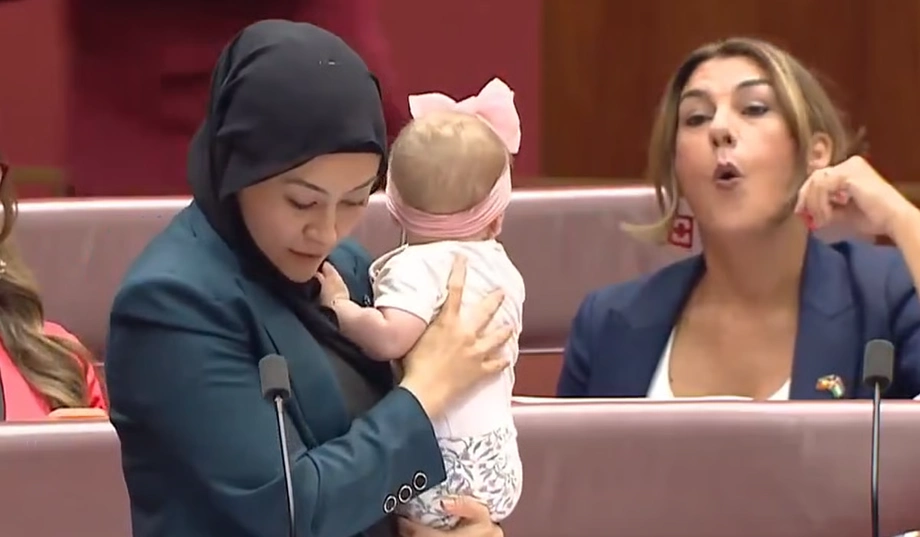
Fatima Payman stood at the dispatch box in Australia's Senate on 25 November 2026 and carried on with her job. Cradled against her chest was her daughter, Aaliyah, who is six months old.
Contents
The senator from Western Australia was speaking in the debate on the Online Safety Amendment Digital Duty of Care Bill 2026 and moving requests on it. Seated directly behind her, fellow independent senator Lidia Thorpe made faces at the baby and played a game of peek-a-boo while Payman talked.
Footage from the sitting spread quickly online on 25 November, the same day the Senate passed the bill. Formal procedure and a baby's game shared the same frame for several minutes, and the clip became one of the most watched pieces of video to come out of Parliament this year.
The scene rested on a rule change made a decade ago. Australia's Senate allows senators to care for and briefly feed their infants in the chamber while taking part in proceedings, an arrangement that let Payman speak, hold her daughter and stay in the debate at the same time.
What the Senate Was Debating
The bill before the chamber, the Online Safety Amendment Digital Duty of Care Bill 2026, is built to make major technology platforms more accountable for harm that happens on their services, with particular attention on protecting users and children.
Payman treated the vote as a starting point rather than a finish line. In a social media post she described the passage of the bill as a first step toward challenging what she called Big Tech's "profit-before-people" business model. Her argument is that platforms earn money from attention while the damage that comes with it is carried by users and their families.
The Senate passed the legislation during a sitting that ran across 24 and 25 November 2026. No start date for the new duties has been announced.
A Moment That Travelled Beyond the Chamber
Senator Thorpe's timing did much of the work. As Payman moved her requests and made her case, Thorpe leaned in from the row behind to keep Aaliyah entertained, and the exchange turned a dry procedural debate into something viewers stopped scrolling for.
Reaction online focused less on the bill than on the sight of a working mother doing two jobs at once. Comments praised the ease with which Payman held her daughter while running through parliamentary business, and the clip was shared widely beyond Australia.
The moment also put a spotlight on the chamber itself. Australia's Senate sits fewer hours than many comparable legislatures and its rules on infants are unusual among national parliaments, which often require a member to leave the floor to attend to a newborn.
Payman's own framing of the day was about the law, not the picture. She presented the vote as a test of whether Parliament would put people ahead of platform profits, and she used the visibility of the moment to say so.
How Parliament's Rules Changed for Parents
For decades, Australian parliamentary convention handled new mothers with a substitute rather than a seat. Senators who had just given birth were typically granted proxy votes, meaning another member cast their vote for them while they stayed away from the chamber.
That changed in 2016, when the rules were amended to let senators bring infants into the chamber for feeding and care. The intention was practical: parents could keep up their parliamentary duties without being separated from a very young child.
Before that change, a senator in Payman's position would have had a choice between voting through someone else and staying with her daughter. Under the current rules she can do both, and the arrangement is written into the standing practice of the Senate rather than granted as a favour to one member.
The rules remain narrow in scope. They cover care and feeding of infants during proceedings, not the general presence of children in the chamber.
Who Is Fatima Payman
Payman is 30 years old and was born in Afghanistan. Her family fled Taliban rule, spent time in Pakistan and settled in Perth, and she arrived in Australia as a refugee at the age of eight.
She entered the Senate in 2022 as a member of the Australian Labor Party, becoming the first woman to wear a hijab elected to the federal parliament and one of the youngest senators in the country's history. In 2024 she quit Labor over its position on Palestine and the war on Gaza, a split that drew international coverage.
She then launched her own party, Australia's Voice, and now sits as a prominent crossbench voice, leading a party of one in a chamber where the balance of power is decided vote by vote.
Payman made history again in 2026 as the first senator from Western Australia to give birth while serving in office. Since Aaliyah arrived she has spoken publicly about motherhood, postpartum recovery and what returning to work after childbirth actually involves.
- 2016: Senate rules are amended to allow infants into the chamber for feeding and care
- 2022: Payman is elected to the Senate for Western Australia with Labor
- 2024: She leaves Labor over its position on Palestine and the war in Gaza
- 2026: She becomes the first serving Western Australian senator to give birth in office
- 24 and 25 November 2026: She speaks in the chamber with Aaliyah in her arms, and the Senate passes the digital duty of care bill
The Working Parent Question
Australia has the highest proportion of women among its parliamentarians of any country in the Commonwealth, which makes the practical questions of childcare and sitting hours harder to avoid.
Dr. Priya Sharma, a political scientist, said the sight of a senator at work with a baby in her arms fits a broader shift in how public institutions are staffed.
Balancing parental responsibilities with public duties is increasingly common, and such moments humanize leaders.
The visibility has a second effect. Commentators described Payman's approach as a challenge to the unspoken expectation that women in power leave their family lives at the chamber door, and the clip gave that argument a picture to go with it.
Payman's work in the Senate has centred on the costs that press on households: affordable childcare, housing and more support for working families. Bringing her daughter into the chamber places those arguments in her own working life, where a sitting day can stretch across two dates and votes can be called without warning.
A Muslim Woman as Leader and Mother
Payman's presence in the chamber carried a second weight. She is the first woman to wear a hijab elected to the federal parliament, and her public role as both a mother and a national political figure is unusual on any parliamentary floor.
Her path to the Senate ran through refugee settlement in Perth, a Labor seat she won in 2022 and a break with that party two years later over foreign policy. Australia's Voice, the party she founded afterwards, gives her a platform outside the major parties and a reason to court attention on her own terms.
Bringing Aaliyah into a debate about online safety tied the two threads of her public argument together. A law written to protect children online is, in her telling, part of the same question as a workplace built to accommodate the parents raising them.
The bill's passage gives her a legislative result to point to. The image of Thorpe playing peek-a-boo behind her gives the argument something rarer in politics, a moment that travels without a press release.
Key Points
- Senator Fatima Payman held her daughter Aaliyah, who is six months old, while speaking and moving requests in the Senate on 25 November 2026
- Fellow independent senator Lidia Thorpe played peek-a-boo with the baby from the seat behind her during the debate
- The Senate passed the Online Safety Amendment Digital Duty of Care Bill 2026 during the sitting of 24 and 25 November
- Payman called the bill's passage a first step toward challenging what she described as Big Tech's "profit-before-people" business model
- Senate rules were amended in 2016 to let senators care for and briefly feed infants in the chamber, replacing the proxy vote arrangement for new mothers
- Payman, 30, arrived in Australia as a refugee at eight, was elected for Western Australia in 2022, left Labor in 2024 and now leads Australia's Voice
- She is the first senator from Western Australia to give birth while serving in Parliament
- No start date has been announced for the new duties on technology platforms