A private exchange interrupts Australia's investment pitch
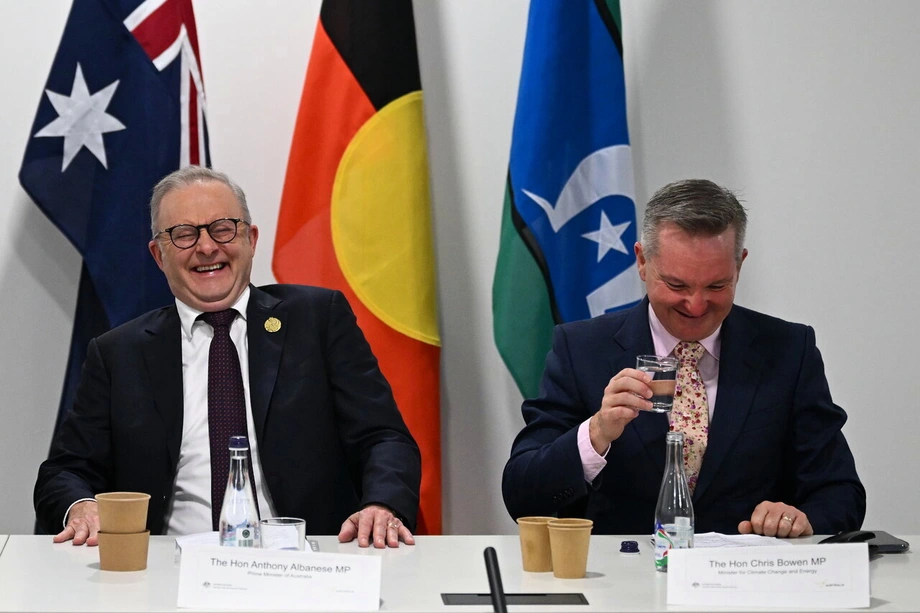
Australian Prime Minister Anthony Albanese and Climate Change and Energy Minister Chris Bowen were recorded making a crude joke about mobile phones and their genitals on November 13, while waiting for a business investment roundtable at the COP31 climate summit in Antalya, Türkiye.
Contents
A microphone preparing to capture the event's opening remarks picked up their conversation. Channel 7 later broadcast the exchange after it was noticed during production, turning a moment before a meeting about renewable energy investment into a political controversy.
Liberal deputy leader Jane Hume criticised the pair's conduct and questioned the government's presentation of Australia overseas. Albanese's office said the two men were joking between meetings, a response echoed by Labor frontbencher Murray Watt.
The conversation also brought attention to a health claim. Albanese suggested that keeping a phone close to the heart could interfere with its rhythm. Australia's radiation protection agency says current research does not indicate that mobile phone use is associated with harmful health effects.
What the microphone recorded
Albanese and Bowen were waiting for the roundtable to begin on Friday evening. During their conversation about where to keep a mobile phone, Albanese gestured towards Bowen's left breast pocket and warned against carrying a device near the heart.
The prime minister said he had heard that a phone in that position could interfere with the heart's rhythm. Bowen jokingly asked whether that was because the device was a little radioactive. The discussion then shifted from jacket pockets to trouser pockets.
Bowen said he had become more conscious of putting his phone in his trousers. Albanese, Australia's prime minister, responded with a direct question:
Because of your dick?
Bowen, the minister responsible for climate change and energy, replied:
Because of my dick. That's rather important, arguably more important than the heart
The two men laughed. People elsewhere in the room did not appear to hear their conversation, but the microphone captured it clearly enough for broadcast. A microphone that is recording when a speaker treats a conversation as private is commonly described as a hot mic.
The recording came from a news camera microphone ahead of the business roundtable, which began overnight on Friday. Production staff noticed the exchange before Channel 7 broadcast it.
How Labor and the opposition responded
Albanese's office presented the exchange as informal banter during a break in a demanding diplomatic schedule. A spokesperson for the prime minister said:
They were having a joke in between meetings.
Hume, the Liberal Party's deputy leader, described the incident as "weird and gross" and accused the pair of behaving like "14-year-old schoolboys". Her criticism focused on the contrast between the government's stated purpose for attending the summit and the conversation that reached television audiences.
Hume said almost 200 Australian bureaucrats had travelled to Türkiye at a cost of more than $2 million. Those figures were part of her criticism of the delegation's expense. She argued that the government had justified the trip as an opportunity to attract overseas investment, then exposed Australia to ridicule.
Making those claims on Sunday, Hume said:
"It's bad enough that these guys sent almost 200 bureaucrats to Türkiye at a cost of more than $2 million and spent $36,000 [sic] of your taxpayer money on a coffee cart so that Greta Thunberg could have a free latte, but they justified it on the basis they were 'selling Australia to the world', 'attracting investment from overseas'," she said.
The official delegation comprised 193 representatives from at least 20 government departments and agencies. Contracts disclosed through AusTender committed $2.26 million to support the delegation, including $1.079 million for the Australian pavilion, $873,000 for hotels and $32,000 for coffee. The coffee contract figure differed from the $36,000 cited by Hume.
Watt, a Labor frontbencher, defended both the conversation and Australia's participation in the summit. He described the comments as a joke and said taking part in, and leading, the climate discussions served Australia's national interest.
The political disagreement therefore extended beyond the language itself. Hume challenged the value and professionalism of the government's presence, while Labor defended the purpose of its diplomatic and investment work.
The meeting behind the controversy
The roundtable was intended to promote opportunities for businesses to invest in Australia's transition to cleaner energy. During the formal proceedings, Albanese pointed to the country's renewable resources, critical minerals and stable investment environment as reasons to commit money.
Albanese, addressing international investors at the meeting, made his pitch in direct terms:
If you're an investor, there's nowhere you'd rather be than Australia,
The prime minister described the energy transition as an industry worth trillions of dollars. His argument was that Australia could attract investment by combining resources used to generate renewable electricity with minerals needed for energy technologies.
For businesses, that pitch concerns decisions about where to build projects and commit capital. For the government, the roundtable provided a setting to present Australia as a destination for that spending. The recorded conversation diverted public attention from those arguments to the conduct of the two officials making them.
No investment total or new business agreement was announced in connection with the roundtable in the accounts of the incident. The concrete purpose described was to promote opportunities, while Bowen's wider summit responsibilities concerned the climate negotiations.
From the Antalya roundtable to Manila
Albanese and Bowen had different schedules after the meeting. The prime minister left Türkiye shortly after the roundtable to travel to Manila, in the Philippines, for the Association of Southeast Asian Nations summit. Bowen remained in Antalya as co-president of the COP31 negotiations.
The sequence places the recorded exchange within a wider series of meetings rather than during a formal climate speech:
- November 13, Friday evening: Albanese and Bowen spoke before the investment roundtable in Antalya, and a microphone captured their conversation.
- Friday evening: Channel 7 first broadcast a clip of the exchange.
- After the roundtable: Albanese departed for the ASEAN summit in Manila, while Bowen stayed for the climate negotiations.
- Sunday: Hume criticised the incident and challenged the government's justification for the delegation's expense.
Bowen's continuing role matters because the summit involved negotiations as well as public events. COP is the name used for the United Nations climate conference, where governments meet to discuss their response to climate change. In Antalya, Australia's activities included both those discussions and efforts to attract business investment.
What the health evidence says about phones
The joke began with an everyday concern: whether carrying a mobile phone close to an organ can harm it. The Australian Radiation Protection and Nuclear Safety Agency, known as ARPANSA, says current research does not indicate that using a mobile phone is associated with harmful health effects.
Its Mobile phones and health page states:
It is the assessment of ARPANSA and other national and international health authorities, including the World Health Organization (WHO), that there is no established scientific evidence that the use of mobile phones causes any health effects.
The page also notes that some studies have shown an association between heavy mobile and cordless phone use and brain cancer, and that the International Agency for Research on Cancer classified radiofrequency fields as possibly carcinogenic to humans based largely on that limited evidence.
In a 4 September 2024 statement, ARPANSA said a World Health Organization-commissioned systematic review found no association between mobile phone use and head cancers. Led by ARPANSA Associate Professor Ken Karipidis, the review considered more than 5,000 studies published between 1994 and 2022, with 63 included in the final analysis.
Mobile phones emit radiofrequency electromagnetic fields, a form of non-ionising radiation. In simple terms, that radiation has less energy than the ionising radiation used in X-rays and does not have enough energy to directly damage DNA.
A study published in 2024 and led by the International Agency for Research on Cancer examined data from more than 250,000 mobile phone users. It found no association between mobile phone use and the risk of developing brain tumours.
Researchers have also examined reproductive health and cardiac activity. Some studies have suggested possible links involving testosterone levels, sperm movement or heart activity, but the evidence remains uncertain. Most studies examining electromagnetic radiation and human organs have found little evidence of a direct relationship.
The heart research also requires a distinction between exposure to a phone's emissions and the habits that come with using it. A large UK study that followed people over time found an association between longer weekly mobile phone use and greater cardiovascular disease risk.
Sleep patterns, psychological distress and a personality trait described as neuroticism accounted for between 2.25 and 11.5 per cent of that association. Researchers suggested that how people use their phones could help explain the relationship. Poor sleep and chronic stress are established risk factors for cardiovascular disease.
Late use, interrupted sleep and constant notifications offer a practical explanation of how phone habits can affect wellbeing. The research described a relationship between use and health outcomes, with several possible contributing factors; its findings concerned much more than the location of a pocket.
Earlier jokes had already attracted scrutiny
Albanese had faced criticism over sexual humour before the Antalya recording. Earlier in the year, he made a comment during a podcast interview about wanting to have sex with singer Kylie Minogue.
Another controversy concerned his remarks in August about melons given to him by Japanese Prime Minister Sanae Takaichi during a visit to Australia. His description of the two melons drew criticism for sexual innuendo. Albanese denied that he had intended a sexual joke.
The Antalya exchange added a different setting to that scrutiny: an international climate meeting where the prime minister and his energy minister were about to address business representatives. The language was recorded before the formal discussion, then reached a much larger audience through television and online circulation.
Labor's response remained focused on the immediate circumstances, describing two colleagues joking between meetings. Hume treated the moment as part of a broader challenge to the government's overseas presentation and spending. Those competing responses explain why a brief conversation became a dispute about public conduct as well as crude language.
Key Points
- Anthony Albanese and Chris Bowen were recorded making a crude joke before a COP31 investment roundtable in Antalya on November 13.
- Channel 7 broadcast the conversation after a microphone intended for opening remarks captured it.
- Albanese's office said the pair were joking between meetings. Liberal deputy leader Jane Hume criticised their conduct and the delegation's expense.
- The formal meeting promoted investment in Australia's clean energy transition, renewable resources and critical minerals.
- Albanese travelled on to Manila, while Bowen remained in Antalya as co-president of the climate negotiations.
- ARPANSA says current research does not indicate that mobile phone use is associated with harmful health effects.