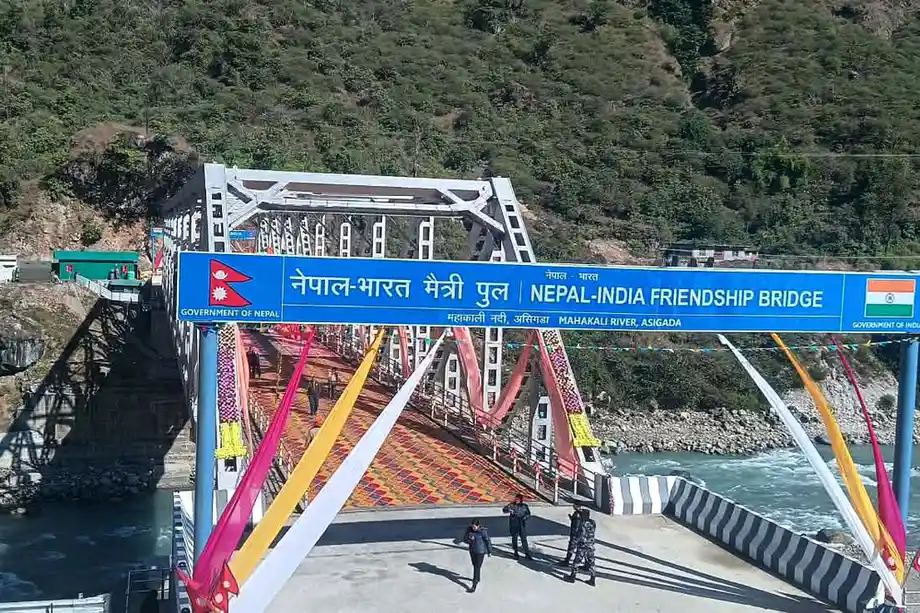
A Road Replaces Cables and Inner Tubes
Vehicles began crossing the Mahakali river between Nepal and India on Tuesday, November 24, 2026, a day after Prime Minister Balendra Shah and Indian Prime Minister Narendra Modi virtually inaugurated the new bridge. For communities in Darchula and Dharchula, the opening replaces years of dangerous journeys on cable crossings and floats made from inner tubes with a road that motorcycles, cars and goods vehicles can use.
Contents
- A Road Replaces Cables and Inner Tubes
- Why a Finished Bridge Waited for Traffic
- What Are the Rules for Crossing?
- Security Posts Are Temporary and Traffic Remains Light
- Trade, Medical Travel and Tourism Could Gain
- The Stalled Jhulaghat Project Offers a Contrast
- The Bridge Was One Part of a Much Larger Delhi Package
- Delivery Will Determine the Value of the Agreements
- Key Points
The bridge measures 110 metres and has two lanes. It connects Asigada in ward 8 of Mahakali Municipality, Darchula, with Chharchhum in Dharchula tehsil of Pithoragarh district, Uttarakhand. Also known as the Chharchhum International Friendship Motor Bridge, it is the first motorable crossing between the two countries in Pithoragarh and the second motor bridge on Uttarakhand's border with Nepal after Banbasa.
The inauguration took place on November 23, or Mangsir 7 in the Nepali calendar, following talks between the two prime ministers at Hyderabad House in New Delhi. Shah was undertaking a state visit to India on November 22 and 23. India paid the entire construction cost of 329.8 million Indian rupees, approximately ₹33 crore.
Mahesh Karki, a resident of Dattu in Mahakali Municipality, said the crossing had been awaited for years and would remove the need for hazardous daily journeys.
We had been waiting for this bridge for years. Without a motorable crossing, we had to travel on foot or use cable crossings to meet our daily needs. That will no longer be necessary.
For journeys around Dharchula that previously required a detour through Banbasa, the direct connection could remove about 200 kilometres of travel. That saving applies particularly to travellers and traders who had to reach the earlier crossing before turning back toward the border areas now served directly.
Why a Finished Bridge Waited for Traffic
The Public Works Department managed the project with Indian government funding, while P&R Infraproject Limited of Punjab undertook the construction work. The structure is 10.5 metres wide, including a carriageway measuring 7.5 metres and a footpath for pedestrians.
The project passed through several stages before vehicles could use it:
- January 2022: India's central government approved the project.
- February 1, 2022: India and Nepal signed a memorandum of understanding for its construction.
- August 2022: Construction began.
- September 2022: Uttarakhand Chief Minister Pushkar Singh Dhami and Dilendra Prasad Badu, then Nepal's Minister for Industry, Commerce and Supplies, took part in foundation ceremonies in their respective countries.
- 2024: The main structure was completed.
- November 2026: Final construction was completed, followed by the formal inauguration and the start of vehicle movement.
The foundation ceremony carries two dates in public project descriptions. The Indian timeline gives September 19, 2022, while the Nepali date attached to the inauguration was 3 Asoj 2080 in the Bikram Sambat calendar, which falls in September 2023.
The long interval between structural completion and opening resulted from unfinished approach roads and border arrangements. An approach road has since connected the Indian end with the National Highway. On the Nepali side, work was also underway to improve a stretch of road measuring 150 metres leading toward the bridge.
What Are the Rules for Crossing?
The bridge currently operates from 6 am to 6 pm. Indian officials described these as the summer hours. Crossing after 6 pm is permitted only in an emergency, despite requests from residents for access around the clock.
Darchula Chief District Officer Bartaraj Paudel confirmed the restriction and the emergency exception.
The bridge remains closed after 6pm, except in emergencies.
Karki argued that continuous access would better serve people whose families, trade and daily needs extend across the river. Gagan Singh Dhami, a businessman from Malikarjun, welcomed the opening while urging the authorities to review rules that could restrict its usefulness. No decision to extend the operating hours has been announced.
Vehicle rules also differ according to distance and destination. Nepali vehicles may travel as far as 15 kilometres into India without a special permit. Drivers wishing to go farther must obtain a pass from the Indian Embassy. Indian vehicles entering Nepal can reach nearby markets without paying a fee.
Nepali authorities record vehicles travelling from the Asigada bridge toward Khalanga, Darchula's district headquarters, and issue receipts. Paudel said vehicles from both countries are allowed to visit nearby markets on the opposite side, giving residents a legal road route for ordinary shopping and local commerce.
These details matter because a bridge alone does not determine how freely people can travel. Operating hours, permits, customs checks and road connections will shape whether a short crossing becomes a practical daily service, particularly for patients, workers and traders travelling early in the morning or after dark.
Security Posts Are Temporary and Traffic Remains Light
Customs and security facilities have been assembled on both sides of the crossing. The Sashastra Seema Bal, or SSB, the Indian force responsible for guarding the border with Nepal, has temporary posts near the bridge and has installed a luggage scanner. Nepal Police has established a check post on the Nepali side, while preparations continue for facilities for the Armed Police Force and customs authorities.
Ashish Joshi, Dharchula's SDM and an official responsible for local administration, explained how the Indian arrangements are expected to develop.
Customs and Sashastra Seema Bal (SSB) have constructed temporary posts there, and after land transfer, they will build permanent structures.
No date was given for the land transfer or the permanent buildings. These facilities are separate from the bridge structure but essential to inspecting luggage, recording vehicle movements and managing customs formalities.
Initial vehicle traffic has been relatively light. Paudel said the principal users so far are residents of settlements near the river crossings, Asigada and other parts of Darchula. The main market areas lie some distance uphill from the bridge, limiting immediate traffic. He expects numbers to rise gradually as more people learn that the crossing is operational.
Kamal Joshi, a Darchula resident who rode his motorcycle to Dharchula on the first day of vehicle movement, described crossing the river by road as thrilling. Other residents had already used the route to enter India, providing an early indication of demand even before the approach roads and border offices reach their final form.
Trade, Medical Travel and Tourism Could Gain
The river is called Mahakali in Nepal and Kali in India, but the communities along its banks have long shared family relationships, markets and religious journeys. Officials expect the road to make those connections less expensive and to create a route for agricultural produce and other local goods.
Paudel said the crossing could eventually become an important commercial centre by helping Nepali products find buyers.
In future, it will develop into a big trade point. We hope local products of the Nepalese area will get a market after this connectivity.
Health care is another anticipated use. Pithoragarh District Magistrate Ashish Bhatgain said easier travel would particularly help Nepali citizens coming to India for treatment.
This bridge will greatly benefit the people, particularly those coming to India for medical assistance. Additionally, trade between the two countries will also get a boost through this bridge.
From Dharchula, travellers can continue toward New Delhi through Pithoragarh, Haldwani and Tanakpur. On the Nepali side, the crossing is expected to serve residents of Darchula, Baitadi and Bajhang. Indian visitors will also have easier access to Malikarjun Dham in Darchula and to Api Nampa and Tripura Sundari in Baitadi.
Hotels, taxi operators, transport companies and shops could benefit if visitor numbers increase. The bridge forms one part of a broader transport programme that Nepal's tourism associations later welcomed, arguing that the rail and air deals reached during Shah's visit could help double Indian tourist arrivals.
The Stalled Jhulaghat Project Offers a Contrast
Progress at Asigada has not been matched at Jhulaghat in Baitadi, where another motor bridge across the border has been discussed with Indian investment. An agreement between former prime minister Pushpa Kamal Dahal, widely known as Prachanda, and Modi has not been followed by construction.
During the last federal elections, KP Sharma Oli, Sher Bahadur Deuba and Prachanda all promised rapid development of the Jhulaghat crossing. Indian journalist Surendra Arya said an Indian inspection took place three years ago, but no further teams had visited to advance the work.
No construction date has been announced. The contrast shows why residents at Asigada place such weight on operating hours, approach roads and customs facilities: completing a structure and reaching political agreement do not by themselves produce a functioning border route.
The Bridge Was One Part of a Much Larger Delhi Package
The inauguration formed part of a wider development package announced during Shah's visit. India committed ₹15,000 crore, equivalent to 150 billion Indian rupees and approximately NPR 24,000 crore. The package contains ₹3,500 crore in grants for reconstruction after disasters and new infrastructure, together with ₹11,500 crore in credit intended primarily for energy projects.
A line of credit is loan funding made available for agreed projects rather than a single cash transfer. The grants make up less than one quarter of the total, while specific projects and implementation arrangements are to be settled through consultations. The announcement followed destructive floods in Nepal's Rasuwa-Bhotekoshi basin and other areas in August 2026.
The two governments also adopted a Joint Vision document with 10 pillars, titled Viksit Bharat and Samunnat Nepal: Re-imagining the Partnership. Its subjects include trade, physical and digital connections, energy, water resources, education, health, agriculture, climate resilience, technology and cultural exchanges.
Other transport measures included the virtual launch of the Sarayu-Kamala Express between Ayodhya and Janakpur, completion of the Field Location Survey for the proposed Raxaul-Kathmandu electrified railway using broad gauge, and a new transit trade route for Nepal through Deendayal Port at Kandla. Access to Paradip Port will follow once the necessary infrastructure is ready. The existing B345 air route linking Kathmandu, Bhairahawa and Lucknow is to operate in both directions, subject to technical consultations.
The leaders also advanced work on integrated check posts, facilities that bring customs, immigration and security checks together at a border crossing. Banbasa was included in the same ceremony, while work at Bhairahawa, Sunauli and Dodhara Chandani is to be taken forward. Shah promised to accelerate the Dodhara Chandani project.
Energy announcements included the virtual foundation ceremony for the 669 MW Lower Arun Hydroelectric Project and a call to expedite the Pancheshwar Multipurpose Project. The package also covered petroleum infrastructure, agricultural development, an agro industrial park in Chitwan and an offshore Indian Institute of Technology campus in Nepal. Eight memoranda of understanding addressed subjects ranging from police training and forensic research to satellite communication, traditional medicine, health care and fisheries.
Delivery Will Determine the Value of the Agreements
Suresh K Goel, a former Indian diplomat, welcomed India's emphasis on youth, economic growth and connectivity. He said access to Kandla and Paradip would give Nepali exports additional routes to international markets, but argued that execution mattered more than the headline financial figure.
The most important point in this case would be not just the amount but timely delivery in terms of development of the project and development of the infrastructure.
Govinda Raj Pokharel, a former vice chairman of Nepal's National Planning Commission, said the visit supported Nepal's priorities in infrastructure, energy and investment. He identified electricity as one of Nepal's few major exportable products and argued that policy reforms would be needed to make Indian private investors feel welcome.
The visit has also prompted demands for accountability in Kathmandu. Nepali Congress General Secretary Pradeep Poudel sought full disclosure of the deals, including an itemised public account of meetings, agreements and financial terms.
A High Level Monitoring Group is to oversee implementation, meet at least once every six months and report its findings to the India-Nepal Joint Commission. At Asigada, the immediate tests are more local: completing permanent border facilities, improving the approach road, increasing public awareness and deciding whether residents can cross outside the present 12 hour schedule.
Key Points
- Vehicles began using the Mahakali bridge on November 24, 2026, one day after Shah and Modi virtually inaugurated it.
- The 110 metre crossing links Asigada in Darchula with Chharchhum in Dharchula, Uttarakhand.
- India funded the full cost of 329.8 million Indian rupees, approximately ₹33 crore.
- The bridge replaces risky cable and inner tube crossings and can remove a detour of about 200 kilometres for journeys previously made through Banbasa.
- Crossing is currently allowed from 6 am to 6 pm, with later passage only for emergencies.
- Residents want access around the clock, but no extension has been announced.
- Temporary customs and security posts are operating, while permanent Indian facilities await a land transfer.
- The inauguration accompanied an Indian assistance package worth ₹15,000 crore for Nepal.
- The separate Jhulaghat bridge project in Baitadi remains stalled without a construction date.