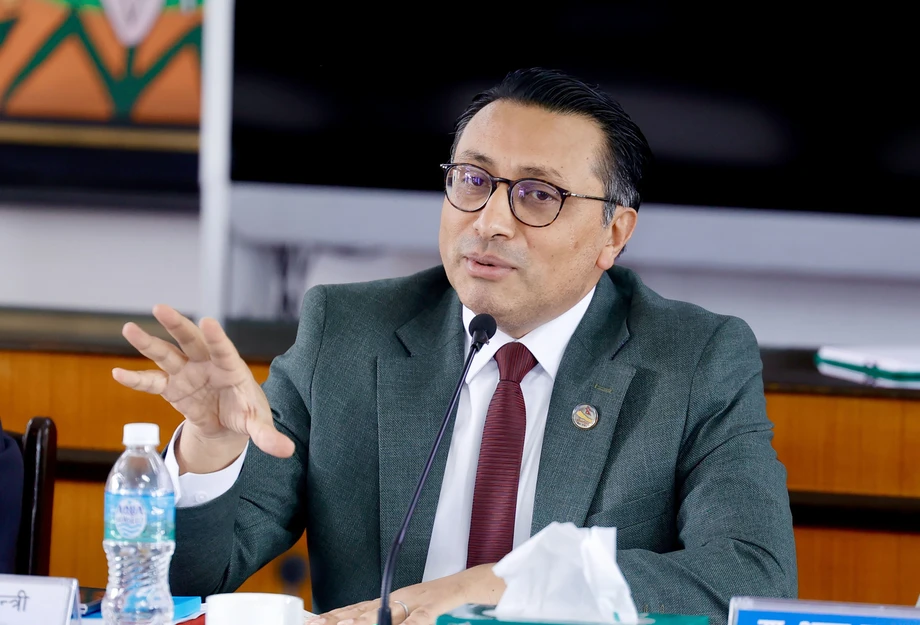
Nepali Congress Wants Answers, Not a Communique
Nepali Congress General Secretary Pradeep Poudel used a press briefing at the party headquarters in Sanepa on Wednesday to press the government on the one thing it has not produced since Prime Minister Balendra Shah returned from New Delhi: a public, itemised account of what was actually agreed. Poudel said the visit, which ran from 22 to 23 November 2026, did not deliver what Nepalis had been led to expect, and that the government now owes the country a full disclosure.
Contents
- Nepali Congress Wants Answers, Not a Communique
- How Big Is the Package, and What Is In It
- Eight Agreements and Nineteen Outcomes
- The Border Dispute That Left the Agenda
- A Border Row in Six Dates
- From Mayor to Prime Minister
- The Government Says Old Treaties Can Now Be Reopened
- Average, Say the Parties Outside Government
- What Is Not Settled Yet
- Key Points
His questions were blunt and specific, covering meetings, discussions, signed papers and money.
"What did the Prime Minister do in India? Who did he meet? What was discussed? What agreements were signed? What processes have moved forward? Is the assistance that was announced a loan or a grant? The Prime Minister must tell the Nepali people all of these things officially," Poudel said.
The Congress leader framed the demand as a matter of constitutional duty rather than partisan complaint. Shah travelled as the head of government, representing the country and not himself, Poudel said, so the achievements and understandings reached in Delhi belong to the public and must be placed on the record. He also rejected the idea that the visit had met expectations. Nepalis believed the Prime Minister would force long pending disputes to a conclusion and state Nepal's position clearly on contested questions, he said, and that faith was betrayed.
"The biggest thing is that trust was broken here. He did not appear to state a clear position on any old or new issue," Poudel said.
Poudel added that the government has to explain whether the money India announced is a loan or a grant, a question that sits at the centre of the week's debate because the package is described in both terms at once. He also criticised the absence of consultation before departure, saying no briefing was given to the President, to Parliament or to the opposition parties, breaking a practice of informing all parties about agreements made in the national interest.
How Big Is the Package, and What Is In It
Indian Prime Minister Narendra Modi announced development assistance worth Rs 15,000 crore, which Nepal's government records as roughly NPR 24,000 crore, after talks with Shah at Hyderabad House. India has described it as the largest assistance package Nepal has received from any single country. The money is not a single lump sum handed over: it splits into about Rs 3,500 crore in grants and about Rs 11,500 crore in concessional credit, meaning loans offered on softer terms than commercial borrowing, usually through lower interest rates and longer repayment periods.
The stated purpose is reconstruction in districts devastated by recent floods, which puts a rebuilding and recovery frame around a package that also touches connectivity, energy and institutional training. The figure appeared in Modi's own remarks, in the joint press statement issued after the leaders spoke and in a shared vision document titled "Developed India, Prosperous Nepal", giving the number three separate official anchors.
The political difficulty starts with that structure. Grants and concessional loans are different instruments with different consequences for Nepal's debt position, and the public breakdown has not been set out in Kathmandu in the form Poudel is demanding. Concessional credit is still credit: it must be repaid, it arrives tied to projects and procurement arrangements, and it enters the budget as borrowing rather than as revenue.
Eight Agreements and Nineteen Outcomes
The visit produced eight signed agreements, part of a list of 19 outcomes recorded from the meeting between the two leaders. The memorandums of understanding span space technology, security training, civil service capacity building, health, traditional medicine, sustainable urban development and agriculture, and were exchanged after delegation level talks.
- The Indian Space Research Organisation and Nepal's Ministry of Information and Communication agreed to set up a satellite communication network using the South Asia Satellite.
- Two policing and forensic agreements were signed: one between the National Forensic Sciences University in Gandhinagar and the Crime Investigation Department of Nepal Police, and one between Rashtriya Raksha University and Nepal's National Police Academy.
- The National Centre for Good Governance, under India's Department of Administrative Reforms and Public Grievances, paired with the Nepal Administrative Staff College for a training programme for Nepali civil servants.
- India's Ministry of Health and Family Welfare signed a cooperation agreement with Nepal's Ministry of Health and Food Safety, alongside an agreement between the two governments on Ayurveda and other traditional systems of medicine.
Beyond the paperwork, the two leaders virtually laid the foundation stone for several India assisted projects in Nepal and flagged off a passenger rail link between Ayodhya in Uttar Pradesh and Janakpur Dham. Shah's delegation also returned with additional air and port connectivity, movement on the Raxaul to Kathmandu railway, and a policy level understanding on air routes that Nepal had sought for years without success.
The Border Dispute That Left the Agenda
Point 15 of the joint press statement directed the foreign secretaries of both countries to work on outstanding boundary issues, after the two leaders noted progress in the maintenance and repair of boundary pillars. That sentence is the only formal trace of a dispute that has dominated Nepal's relations with India for six years, covering Kalapani, Lipulekh and Limpiyadhura in the far west and Susta on the Bihar border.
What happened to the rest of it is the sharpest point of contention. Officials in Nepal's Foreign Ministry had built the diplomatic preparation around the boundary question, with substantial groundwork completed. On the morning of 22 November, as the Prime Minister was preparing to leave for Delhi, they found the territorial dispute was no longer on the agenda. A senior source in the Prime Minister's Office was cited as saying Shah himself ordered contentious items removed before departure, fearing the border row would put the entire visit at risk.
India's Foreign Secretary Vikram Misri confirmed after the visit that Nepal's objection to India-China trade through the Lipulekh pass was not raised at all.
"It wasn't discussed between the two sides," Misri said.
Critics inside Nepal read the omission as a concession given away for nothing. CPN-UML leader and former minister Gokul Baskota attacked Shah for sidelining the border dispute, while Nepali Congress senior vice-president Bishwaprakash Sharma questioned the failure to consult opposition parties before the trip. Former Nepali ambassador to India Nilambar Acharya said suppressing the issue helps nobody. Indian diplomat Suresh K Goel took the opposite view, calling the visit a deliberate break with the diplomatic habits of the past.
"The visit was a clear indication that we are breaking with the past of the relationship, and we want to chart a new pathway," Goel said.
A Border Row in Six Dates
The dispute Shah set aside is well documented, and its recent history explains why his silence drew such a reaction at home.
- 2020: India's defence minister inaugurated a road to Lipulekh Pass, and the government of then prime minister K P Sharma Oli responded with a revised political map showing Kalapani, Lipulekh and Limpiyadhura inside Nepal. India rejected the map as a unilateral act not based on historical facts and evidence.
- June 2023: as mayor of Kathmandu, Shah displayed a "Greater Nepal" map in his office, depicting territory Nepal ceded to the British under the Treaty of Sugauli of 1816, after a row over a mural in India's new Parliament building.
- August 2025: Shah accused India and China of infringing on Nepal's sovereignty by agreeing to resume trade through Lipulekh Pass.
- May 2026: a planned visit to Kathmandu by Indian Foreign Secretary Vikram Misri was called off after Shah reportedly declined to meet him, citing a rule against receiving foreign officials below ministerial rank.
- 31 May 2026: speaking in Parliament, Shah acknowledged allegations of encroachment on both sides of the border and backed a joint examination of the claims and a negotiated settlement.
- June 2026: Kathmandu sent diplomatic notes to Delhi and Beijing after India moved to allow Kailash Mansarovar pilgrims to travel through Lipulekh.
The legal core of the argument is a single river. Article 5 of the 1816 Treaty of Sugauli required Nepal to renounce claims west of the Kali River, also called the Mahakali. Nepal holds that the river begins at Limpiyadhura, which would place the three disputed patches of mountain inside its territory. India locates the source in springs below the Lipulekh area and points to administrative and revenue records linking Kalapani to Pithoragarh district in Uttarakhand, where Indian security forces are stationed. The treaty does not name Limpiyadhura as the source, and no jointly authenticated map settling the question is known to have accompanied it.
From Mayor to Prime Minister
Shah entered office in March 2026 with a reputation built on territorial assertiveness. The Delhi visit presented a different figure: a prime minister who talked about railways, air routes, satellite networks and flood reconstruction, and left the map in the drawer. His government also took over a negotiating file with two separate tracks, one political and one technical, and a long list of unfinished business that had prompted public calls to restart border talks before he boarded the plane.
That file includes 182 boundary maps prepared jointly by the two sides that are still awaiting endorsement, a political negotiating mechanism agreed in 2014 that has never met, and joint technical teams that resumed collecting boundary records only after a long interruption. None of those processes advanced publicly during the visit.
Former Nepali ambassador Nilambar Acharya, who is also a member of the Eminent Persons' Group set up to review bilateral relations, wanted the trip to produce an explicit commitment to dialogue. He said some problems cannot be solved overnight, but the border question should not be left pending, and the Prime Minister needed to state plainly that talks should begin.
The Government Says Old Treaties Can Now Be Reopened
Foreign Minister Shishir Khanal met reporters at Tribhuvan International Airport on Monday evening as the delegation returned and described the visit as a reset that pulled relations back into a positive and promising rhythm. His most concrete claim was about the legal architecture of the relationship, including the Treaty of Peace and Friendship of 1950, which governs much of the two countries' dealings and which Nepali governments have wanted to revise for decades.
"There is now an open path to amend our older treaties, agreements and understandings if that is needed to carry forward cooperation on new subjects," Khanal said.
Khanal argued that the shared vision document on a developed India and a prosperous Nepal had opened a door to a new dimension in the relationship, and that the joint statement issued after both prime ministers spoke was itself proof that the visit produced results. The claim places the government's case on future process rather than present deliverables, which is precisely the ground on which the opposition has chosen to fight.
Average, Say the Parties Outside Government
CPN-UML secretary Rajan Bhattarai, who follows foreign affairs closely, graded the visit as middling. His assessment separated the file into three parts: items that moved forward, items that merely continued, and items that were entered for the first time, with the border left out entirely.
"Some things are positive, some are continuity, and there is entry into some new areas. But some issues that should have been raised were left out. Looked at this way, the visit can be considered average," Bhattarai said.
He counted the air route understanding, the economic assistance, the expansion of Indian Institutes of Information Technology, support for the border economy, a cricket stadium and academy cooperation among the gains, and called the air route the standout because Nepal had asked for it for years while India resisted. His caution was about delivery rather than principle: whether the two sides will settle the technical details needed for flights to actually operate remains open. Integrated checkpoints, dry ports, railways, pipelines, bridges and the Arun III hydropower project he classed as continuity. On the border, he said the government appeared unwilling even to enter the discussion, and that the language in the joint statement about talking was extremely general.
Nepal Communist Party spokesperson Prakash Jwala took a similar line, arguing that the main problem is the border dispute and that a sensitive issue, made more sensitive by the Prime Minister's own past statements, needed some conclusion. He also pointed to style, saying the posture Shah adopted had narrowed the credit the visit could claim, while accepting that a prime ministerial meeting with his Indian counterpart is worth something in itself.
Poudel returned to the same theme from the Congress side, noting that understandings reached with India have a history of being announced easily and implemented weakly.
"There has been mutual understanding, and there is a record of weak implementation alongside it. There must be a reliable basis for implementing what has been agreed. That remains to be seen," Poudel said.
Indian diplomat S D Muni, writing on social media on Tuesday, put the same verdict more briefly: the visit was excellent in its promises and its presentation, but produced no breakthrough.
What Is Not Settled Yet
No date has been announced for the foreign secretary level talks that point 15 of the joint statement calls for, and no schedule has been published for turning the eight agreements into operating programmes. The air route understanding is at the policy stage, with technical negotiations still to come. Parliament has not yet debated the package, and the government has not released a full list of the 19 outcomes in Kathmandu, which is what the Congress demand is aimed at. Whether the Rs 11,500 crore credit tranche will be signed project by project, and on what terms, will determine how much of the headline number arrives as spending.
Key Points
- Nepali Congress General Secretary Pradeep Poudel demanded on Wednesday that the government officially publish the agreements, understandings and achievements of Prime Minister Balendra Shah's India visit.
- India announced a package worth Rs 15,000 crore, recorded in Nepal as about NPR 24,000 crore, made up of roughly Rs 3,500 crore in grants and Rs 11,500 crore in concessional credit.
- Eight agreements were signed and 19 outcomes recorded, covering satellites, policing and forensics, civil service training, health, Ayurveda, urban development and agriculture.
- An Ayodhya to Janakpur passenger rail link was flagged off, and Nepal gained additional air and port connectivity plus movement on the Raxaul to Kathmandu railway.
- The territorial dispute over Kalapani, Lipulekh, Limpiyadhura and Susta was removed from the agenda before departure and handed to the foreign secretaries in a single line of the joint statement.
- Foreign Secretary Vikram Misri said Nepal's objection to trade through Lipulekh was not discussed.
- Foreign Minister Shishir Khanal said the visit opened the way to amending older treaties, including the 1950 treaty, while UML secretary Rajan Bhattarai and other opposition figures called the visit average.
- No date has been set for the foreign secretary talks or for implementing the signed agreements.