A national appeal built on stark numbers
Nepal opened the 16 Days of Activism against Gender-Based Violence on November 25, 2026, with figures that show how common violence is and how rarely survivors seek help. The Nepal Demographic and Health Survey 2022 found that 23 percent of women aged 15 to 49 had experienced physical violence since turning 15. The joint appeal from the government and the United Nations puts the figure for sexual violence at 8 percent. Minister Sita Badi was also quoted at the launch giving 5 percent for sexual violence. Both figures sit beside another finding on which every statement at the launch agreed: 58 percent of women who experienced physical or sexual violence neither sought help nor told anyone what had happened.
Contents
- A national appeal built on stark numbers
- Why so many survivors stay silent
- The economic cost extends far beyond lost wages
- Equal justice, from rural villages to digital spaces
- Five changes proposed for the sexual violence bill
- What police figures reveal about victims and suspects
- Punishment, constitutional limits and the bill in parliament
- The prime minister calls for zero tolerance in practice
- How November 25 became a global day of action
- What must happen after December 10
- The Bottom Line
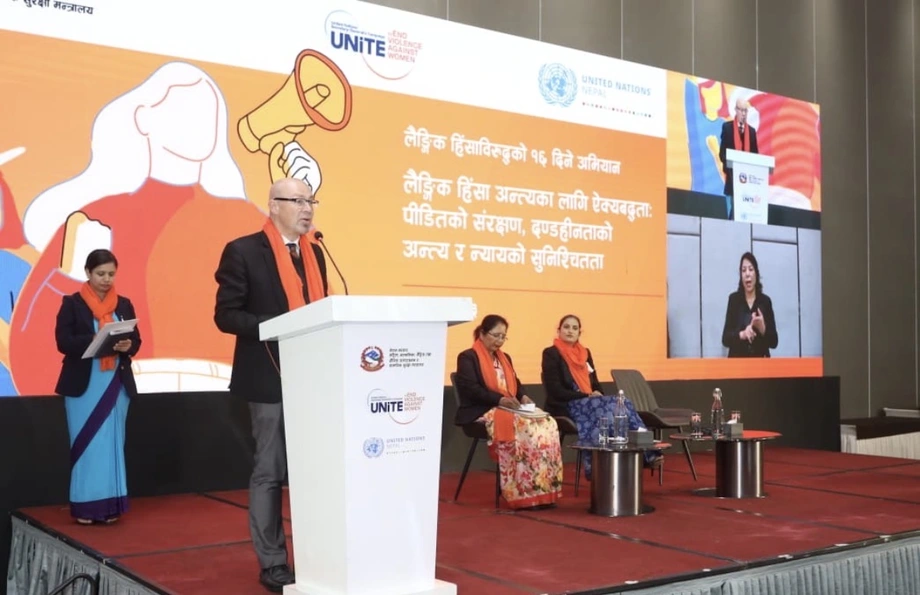
The Ministry of Women, Children, Gender and Sexual Minorities and Social Security and the United Nations in Nepal used the International Day for the Elimination of Violence against Women to demand urgent action, accessible justice and meaningful support for survivors. Preliminary estimates presented with the appeal put Nepal's annual loss from violence disrupting paid work at around Rs 3.6 billion. In Kathmandu, the ministry, the Ministry of Law, Justice and Parliamentary Affairs and the United Nations also convened a national dialogue titled The Cost of Inaction: Access to Justice and Accountability for Ending Gender-Based Violence in Nepal.
Badi, the minister responsible for women, children, gender and sexual minorities and social security, said the country had built important legal and institutional protections but now had to make them work in daily life.
Every woman and girl has the right to live free from violence and fear. Nepal has made important progress in establishing legal and institutional protections. Our priority is to ensure that these commitments translate into accessible justice, effective protection and meaningful support for every survivor.
Her argument connected three issues that are often handled separately: whether a survivor can safely report violence, whether she can afford to pursue a case, and whether the state can provide protection while that case proceeds.
Why so many survivors stay silent
Badi identified social stigma, fear of retaliation, a lack of legal assistance, high judicial costs and economic dependence as barriers to justice. She called for a system that is accessible, swift, efficient and affordable. For a survivor who depends on a spouse or another household member for income, reporting violence can also mean risking housing, food and school costs for children. Repeated travel, legal fees and delays can add to that pressure even where a law formally guarantees protection.
Tirtha Man Tamang, a programme analyst at UNFPA, presented a similarly stark picture of the path from violence to a police complaint. He said 58 percent of women tell no one about the violence, 28 percent discuss the problem, and only 2 percent go to the police in pursuit of justice. Those figures explain why a helpline, a shelter or a free lawyer can matter as much as the punishment written into legislation.
Kamala Parajuli, chairperson of the National Women Commission, said survivor protection and impunity were central challenges. She called for free legal assistance, safe shelters, psychosocial counselling, rehabilitation and opportunities for economic independence, together with budgeting that responds to the different needs of women and men.
Laws only matter when they work for survivors - we must ensure timely justice and real accountability.
Parajuli said men were directly involved in more than 75 percent of violence cases. She also said activists, lawyers and journalists had approached the commission about threats they received after speaking in support of survivors. That makes protection relevant not only to the person filing a complaint, but also to those helping her document it or keeping public attention on the case.
The government says it has prepared a national action plan against gender-based violence and is expanding rescue, protection and rehabilitation programmes. Other services include free legal aid, safe shelters and crisis management centres that bring several forms of assistance together. In practical terms, a centre offering medical care, counselling and help with legal procedures in one place can reduce travel and limit how often a survivor must repeat a painful account.
The economic cost extends far beyond lost wages
Badi said violence can interrupt education and employment, reduce productivity and cut income while creating new expenses for healthcare, legal procedures, counselling and rehabilitation. She argued that money spent on ending violence and securing justice should be understood as an investment in economic development rather than simply as welfare spending.
Tamang presented a broader estimate at the launch. He said about 1.96 million women are affected by various forms of violence each year and that direct and indirect losses cost the Nepali economy at least Rs 8 billion annually. That figure is a little over twice the preliminary Rs 3.6 billion estimate, but the two calculations cover different ground. The smaller estimate concerns disruptions to paid work, while Tamang's figure includes direct and indirect losses.
The distinction matters for policy. Medical treatment and counselling carry immediate costs. Lost schooling or a prolonged absence from work can affect earnings years later, while children and other family members may also feel the consequences. Badi therefore linked access to justice with economic empowerment and called for coordination among federal, provincial and local governments, as well as cooperation from businesses and other institutions.
She also called for effective implementation of gender-responsive budgeting. This means examining how public spending affects women and men differently and allocating money accordingly, rather than assuming that identical provision produces equal access. Funding legal aid, rural transport to services, safe accommodation and counselling are examples of how such a budget can address obstacles identified by survivors.
Equal justice, from rural villages to digital spaces
At an interaction organised by the National Women Commission on November 24, the eve of the campaign, Badi said violence should not be treated as merely a personal or family matter. She connected it to constitutional guarantees and the equal application of criminal law.
It is an issue of national concern relating to the human rights, social justice, equity, and right to life with dignity as guaranteed by the Constitution.
Badi said the law must apply equally to every violator, regardless of official position, social prestige, economic status or political access. She criticised a situation in which survivors are sent from place to place, forced to narrate their suffering repeatedly and left waiting years for justice. She also asked that a survivor fighting for justice be recognised as a citizen showing courage.
Girls and women encounter violence at home, at work, in public places and schools, during foreign employment and in digital life, she said. Dalit women, women with disabilities, rural women, single women and women from economically and socially excluded communities face greater vulnerability. Child marriage, dowry, menstrual discrimination, caste discrimination, domestic violence, sexual violence and cyber violence were described as products of social attitudes and structural inequality.
The minister listed psychosocial counselling, safe housing, lasting rehabilitation, economic empowerment and anti-trafficking work among government programmes. She also included air rescue for expectant and new mothers with health complications among the ministry's protection activities. Schools, media organisations, social activists, families and individual citizens all have a role in changing the conditions in which violence is excused or concealed, she said.
Two telephone services form a more immediate part of that response. Badi pledged cooperation with governments at every level to expand the National Women Commission's 1145 helpline and the child helpline 1098 into rural areas. For someone living far from a district office, a functioning helpline can provide an initial route to advice, referral and protection without first requiring a long and expensive journey.
Five changes proposed for the sexual violence bill
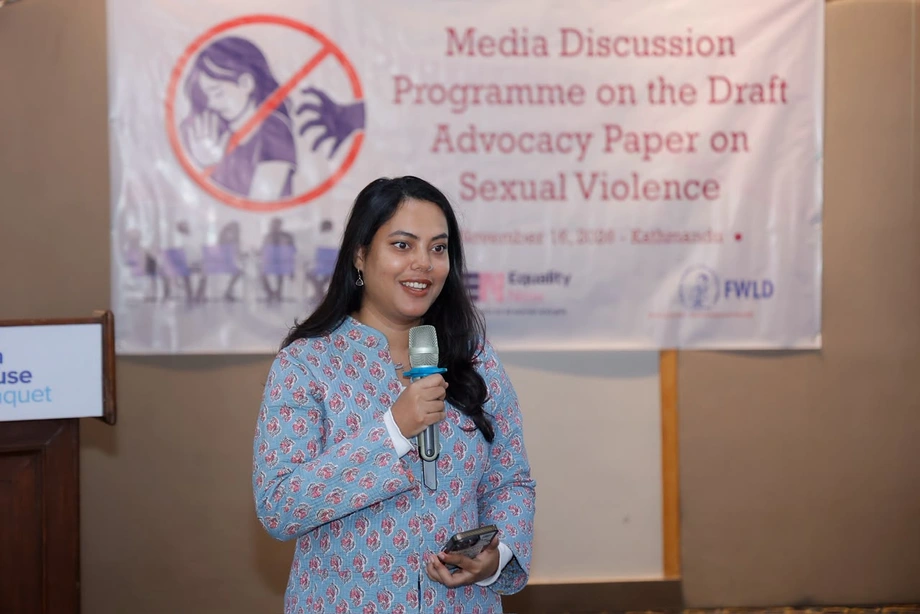
Legal reform formed a second major part of the campaign's opening day. At an interaction with House of Representatives lawmakers organised by the Forum for Women, Law and Development and Equality Now, executive director and advocate Sabin Shrestha presented five proposed changes to the government's sexual violence bill.
- Define rape to cover all sexual penetration without consent, regardless of the gender or sexual identity of either the victim or the perpetrator.
- Define consent as voluntary and freely given. Silence, failure to resist, sexual history, occupation or a relationship with the accused should not be treated as consent. The proposals would also replace the ambiguous phrase "not in one's senses" with clearer language covering unconsciousness, sleep and an inability to consent because of alcohol or drugs.
- Exclude consensual sexual relations between adolescents from criminalisation when both are at least 14 and their age difference is no more than two years. Coercion, threats, exploitation and abuse of power would remain punishable.
- Provide equal punishment for marital rape and other forms of rape. The draft described at the interaction proposes three to five years in prison when a husband rapes his wife.
- Remove the statute of limitations for rape cases completely. This is the legal time limit for starting a case, and its removal would allow survivors to seek prosecution without a filing deadline.
Lawmakers also raised cases in which adolescents had been sent to correctional homes after consensual relations with peers of similar ages. Their concern gives the proposed age provision a concrete purpose: distinguishing consensual relationships between peers from exploitation and abuse, while preserving penalties where force or an imbalance of power is present.
What police figures reveal about victims and suspects
Nepal Police data presented at the legislative discussion show the scale of cases entering the criminal justice system. Gender-based violence accounted for 29 percent of all reported crimes in fiscal year 2024/25. In sexual violence cases, 78.5 percent of suspects were known to their victims, while girls accounted for 62.4 percent of victims.
The police figures describe cases reaching the reporting system, while the health survey records experiences among women aged 15 to 49. Read together, they show both the demand placed on police and the substantial number of experiences that never become complaints.
The high proportion of suspects known to victims also helps explain the emphasis on protection from retaliation and access to independent housing or income. A complaint can disrupt a family, school, workplace or community relationship rather than end contact with a stranger. With girls forming nearly two thirds of victims in the sexual violence figures, Badi's call for schools to participate in prevention and support becomes a direct child protection issue as well.
Punishment, constitutional limits and the bill in parliament
Lawmakers at the interaction agreed on the need for stronger action against sexual and gender-based violence, while setting out limits on the punishments Nepal can adopt. CPN-UML parliamentary whip Nita Ghatani called for strict punishment for perpetrators. Rastriya Prajatantra Party lawmaker Saraswati Lama said Nepal could not introduce the death penalty because of its international treaties and agreements, but she sought special and harsher punishment for sexual violence.
CPN lawmaker Balawati Sharma pointed to Article 16 of the Constitution, which guarantees the right to live with dignity and prohibits capital punishment. She also called for stringent punishment. The debate therefore centred less on whether penalties should be severe than on how to write clear offences, fair consent provisions and punishments that remain within constitutional and international obligations.
Binod Chandra Devkota, an advocate and information officer at the Forum for Women, Law and Development, said the Ministry of Law had prepared a draft that had passed between the law and women ministries. He argued for further consultation rather than rapid enactment.
The bill is expected to be tabled in the upcoming session of the Federal Parliament. It should undergo extensive consultation before the government moves ahead with the legislative process.
Devkota said the bill needed further reform before becoming law. No date was given for the next parliamentary session or for the bill's introduction, leaving consultation and the final contents of the legislation still to be settled.
The prime minister calls for zero tolerance in practice
Prime Minister Balendra Shah used a message marking the campaign's opening to appeal for implementation of a zero-tolerance policy, protection for victims, an end to impunity and guaranteed justice. He described gender-based violence as a serious human rights violation and a major obstacle to building an equal society.
Shah said women, children, gender and sexual minorities and marginalised communities were disproportionately affected. He singled out violence through digital media as an additional challenge in a changing environment. His priorities included stronger legal and institutional arrangements, women's empowerment, education for girls, survivor protection and rehabilitation.
Disasters require particular attention, he said, citing damage caused by the Bhotekoshi flood during the Nepali month of Bhadra and warning that the risk of gender-based violence can rise at such times. Displacement, damaged housing and interrupted public services can make safe accommodation and accessible reporting channels especially important.
The prime minister called for coordination among all three tiers of government and participation by civil society, businesses, media, political parties, activists and citizens. The United Nations slogan for the campaign is Unite to End Violence Against Women and Girls: Ensure Justice, Protect Survivors, End Impunity. Nepal's national theme similarly links solidarity with survivor protection, accountability and justice.
How November 25 became a global day of action
The campaign joins a much longer international effort. Its opening date honours three Dominican political activists, the Mirabal sisters, who were killed in 1960 on the order of dictator Rafael Trujillo. Women's rights activists began marking November 25 as a day against gender-based violence in 1981, and formal international recognition followed later.
- 1960: The Mirabal sisters were killed in the Dominican Republic on Rafael Trujillo's order.
- 1981: Women's rights activists began observing November 25 as a day against gender-based violence.
- December 20, 1993: The UN General Assembly adopted the Declaration on the Elimination of Violence Against Women through resolution 48/104.
- February 7, 2000: The General Assembly formally recognised November 25 as the International Day for the Elimination of Violence against Women.
- November 24, 2026: Badi addressed the National Women Commission interaction on constitutional rights, equal justice and rural services.
- November 25, 2026: Nepal launched the campaign, held the Kathmandu dialogue and opened parliamentary discussions on proposed sexual violence reforms.
- December 10, 2026: The 16 Days of Activism are scheduled to conclude.
This year's Nepali campaign slogan can be rendered as Ensure Justice, Protect Survivors, End Impunity. Those three demands also provide a practical way to measure the campaign after its public events end: whether more survivors can reach services, whether complaints move through institutions without unsafe delays, and whether offenders face equal treatment under the law.
What must happen after December 10
The ministry and the United Nations say their cooperation will continue beyond the campaign, with concrete commitments, stronger partnerships and measurable progress. Jaco du Toit, the United Nations resident coordinator in Nepal, set out priorities covering legislation, institutions, workplaces and social attitudes.
Accelerating the implementation of Nepal's CEDAW Roadmap, strengthening justice institutions and expanding access to legal aid and survivor-centred services are critical. We must also ensure safe workplaces, invest in the leadership of women's rights organizations and challenge the social norms that perpetuate violence. No woman should have to choose between her safety and her livelihood.
CEDAW is the Convention on the Elimination of All Forms of Discrimination against Women. Nepal's roadmap turns the obligations arising from that treaty into a plan for domestic action. Du Toit also argued that responsibility is shared by society. Before asking why women remained silent, he said, people should ask what they had done to create an environment in which speaking was safe.
The commitments made during the launch have clear practical tests. A rural survivor should be able to reach the 1145 service, obtain free legal help and find safe accommodation without surrendering her income or safety. Children should have access to 1098 and protection at school. Workplaces should prevent retaliation, while police, courts and local governments should avoid making survivors repeat the same account across disconnected offices.
The proposed bill adds another test for parliament: whether consultation produces clearer consent rules, fair treatment of adolescents, equal punishment for marital rape and a decision on removing the rape filing deadline. The campaign's final date is fixed, but the timetable for those legal and institutional changes remains open.
The Bottom Line
- Nepal launched the 16 Days of Activism on November 25, 2026, with justice, survivor protection and an end to impunity as its central demands.
- The 2022 health survey found physical violence among 23 percent of women aged 15 to 49; the joint appeal cites 8 percent for sexual violence, while Badi was also quoted giving 5 percent.
- Fifty-eight percent of affected women neither sought help nor disclosed their experiences, and UNFPA analyst Tirtha Man Tamang said only 2 percent went to police for justice.
- Estimates put annual losses at about Rs 3.6 billion from disrupted paid work and at least Rs 8 billion when broader direct and indirect losses are counted.
- The government promised wider legal aid, shelters, counselling, rehabilitation and rural access to helplines 1145 and 1098.
- Five proposed legal reforms cover rape and consent, adolescents close in age, marital rape, capacity to consent and the statute of limitations.
- Nepal Police data show that 78.5 percent of suspects in sexual violence cases were known to victims and that girls made up 62.4 percent of victims.
- The bill is expected in the upcoming Federal Parliament session, but no introduction date has been announced; the campaign ends on December 10.