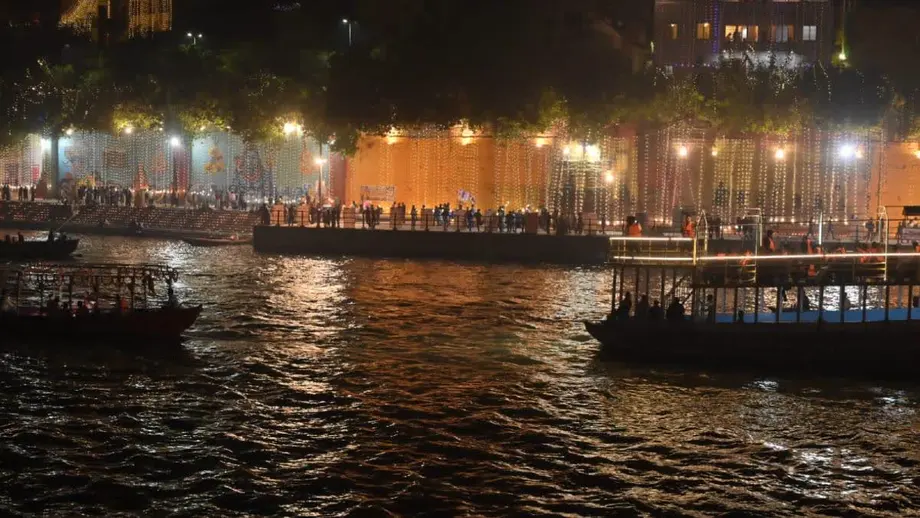
A Digital Guide for 84 Ghats
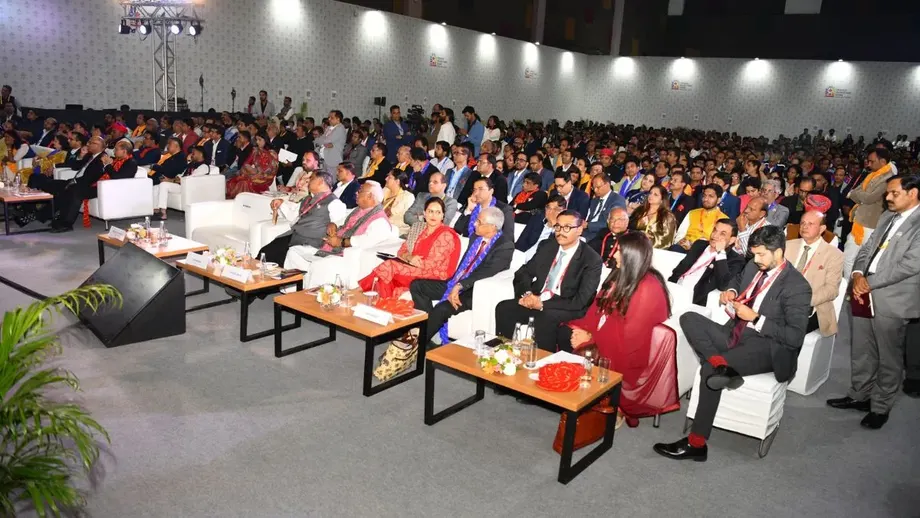
Uttar Pradesh Tourism and Culture Minister Jaiveer Singh launched the Varanasi 84 Ghats Audiobook Audio Tour at Namo Ghat on 24 November 2026, the night of Dev Deepawali, with lakhs of lamps already burning along the river. The service puts a recorded chapter on each of Kashi's 84 ghats on a visitor's phone and plays the chapter that belongs to the steps in front of them.
Contents
- A Digital Guide for 84 Ghats
- What Happens When You Reach a Ghat
- Fifteen Languages for Pilgrims and Foreign Visitors
- How to Start the Tour
- Dev Deepawali: 21 Lakh Lamps and a Drone Show
- The Business Behind the Lights
- Watching a Crowd of 15 Lakh
- Voices on the Riverfront
- A City That Keeps Adding Screens
- Key Points
The tourism department built the tour around the Global Positioning System, the satellite network a phone uses to fix its location. Every ghat has its own audio chapter covering its history, its religious and mythological associations and its place in the city's culture, the state government said in a statement. The tour runs from the official UP Tourism app on Android and iOS and from the department's website, and it asks for no account and no login.
Singh described the content in detail at the launch:
The digital audio tour features separate audio chapters for all 84 ghats of Kashi. Each chapter highlights the historical, cultural, religious and mythological significance of the respective ghat.
He said the platform gives pilgrims, travellers, students and anyone drawn to culture a new way to read the riverfront: "This initiative connects Kashi's rich cultural and spiritual heritage with modern technology."
A visitor can take the tour in three ways. Walking along the ghats, the phone recognises the ghat the visitor has reached and starts that chapter, which covers the beliefs attached to that particular stretch of steps. From a boat, the narration follows the riverfront landmarks passing by and the traditions tied to them. From anywhere in India or abroad, the tour can be played as a remote recording, a feature the department says will serve people who cannot travel to Varanasi at all.
What Happens When You Reach a Ghat
Location tracking is the part that separates this tour from an ordinary playlist. A visitor with the app open arrives at a ghat, the phone detects the position and the matching chapter begins. Move away and the audio pauses; return and it resumes.
Any ghat can also be picked by hand from a list inside the app, so a visitor can build a route around the ones that interest them or listen to a chapter before setting out. Along with the narration, each chapter carries photographs of the ghat, a written description and an interactive map.
The app keeps a record of the ghats a visitor has covered, a small detail that matters on a riverfront of 84 separate landings where few people see everything in one trip. A tour abandoned halfway can be restarted on a later visit from the exact point where it stopped, and the audio can be paused, restarted or skipped forward to the next ghat at will.
Because the chapters can be downloaded before the trip, the tour keeps working where the mobile signal thins out along the river. The download option also lets a family in another state or another country listen to the same chapters at home, turning the riverfront into something closer to a recorded museum that can be visited without a ticket to Varanasi.
Fifteen Languages for Pilgrims and Foreign Visitors
Besides Hindi and English, the state government lists Marathi, Tamil, Telugu, Gujarati, Kannada, Odia, Malayalam, Urdu, French, German, Spanish, Japanese and Korean. A launch report listed Chinese in place of French. Both the walking and the boat versions exist in all 15 languages.
The list follows the map of who comes to Kashi. Tamil Nadu, Telangana, Andhra Pradesh, Karnataka, Gujarat, Odisha, Kerala and Maharashtra appear through their languages, and Japan, Korea, Germany, Spain and France through theirs. Urdu is on the list as well, alongside Hindi.
For a city where a licensed guide may speak two or three of those languages at most, the practical change is that a family from Seoul or a pilgrim from Madurai can hear the same story about the same ghat in the language they think in. The department's stated aim is to remove the language barrier that keeps visitors from understanding what they are looking at once the evening lamps are lit and the priests begin their chanting.
The narration is not only devotional in tone. Chapters cover the history of the structures, the myths attached to them and the everyday life of the riverfront, which is why the department expects the tour to serve students and researchers as well as pilgrims.
How to Start the Tour
The department has set out a short sequence for anyone who wants to use the service:
- Open the official UP Tourism app on an Android or iOS phone, or the department's website.
- Select the Varanasi 84 Ghats Audiobook Audio Tour.
- Choose one of the 15 languages.
- Choose either the walking tour or the boat tour.
- At the ghats, tap Start Tour at Location to switch on the narration that follows the visitor's position.
- To listen without a steady connection, or from outside Varanasi, tap Enable Offline/Remote Tour and download the chapters in advance.
No sign up, account or login is needed at any step, a design choice that matters for older pilgrims and for foreign visitors who may not want to enter personal details on a state app on the first evening of a festival.
Dev Deepawali: 21 Lakh Lamps and a Drone Show
The launch came wrapped in the biggest night of the Varanasi calendar. Dev Deepawali falls on Kartik Purnima, and the state count for the evening was 21 lakh diyas, of which 11 lakh were lit as part of the organised deepdaan across the ghats, the sandy bank opposite the city, kunds and other designated spots; a lower count that night put the total at nearly 11 lakh. About one lakh of the lamps were made from cow dung, adding an environmental angle to a festival built on fire and clay.
For 10 minutes, 2,100 drones made in India flew in 15 formations over the sandy bank opposite Chet Singh Ghat, forming images of Lord Shiva, the Maheshwar Sutras, the Shiv Tandav and the Ganga Avtaran, along with the Kashi Vishwanath Temple, Maa Vishalakshi and Baba Kaal Bhairav. The display also carried images of Prime Minister Narendra Modi and Chief Minister Yogi Adityanath, and a tribute to the Chief Minister's mother.
At Chet Singh Fort, a presentation called Kashi Katha used 3D projection mapping, anamorphic LED imagery, music and narration for 17 minutes to tell stories linked to Lord Ganesha, the wedding of Lord Shiva and Goddess Parvati, Lord Vishnu, Chakra Pushkarini Kund and the Ganga. A laser show that ran eight minutes followed, and musical green fireworks opposite Lalita Ghat closed the aerial part of the evening, with patterns timed to devotional songs about Lord Shiva.
At Dashashwamedh Ghat, the Maha Aarti was performed by 21 priests and 42 young women representing Riddhi and Siddhi, in a ceremony organised by Ganga Seva Nidhi with conch shells and damru drums. It was dedicated to the martyrs of the Kargil War and included a replica of the Amar Jawan Jyoti, and three soldiers were honoured after their deaths with the Bhagirath Shaurya Samman. Devotees were asked to pledge to keep the Ganga clean. Deepdaan ceremonies were also held at Markandey Mahadev Temple at the Ganga and Gomti confluence and at Shastri Ghat on the Varuna, and the stretch from Namo Ghat to Assi Ghat was lit with decorative lights and floodlight towers.
The Business Behind the Lights
Amrit Abhijat, Additional Chief Secretary for Tourism, Culture and Religious Affairs, put expected footfall at around 15 lakh devotees and tourists and estimated local business at ₹400 crore to ₹500 crore over the festival period, a range that covers hospitality, transport, river tourism, handicrafts and small trade.
Many visitors planned stays of at least three days, creating demand for accommodation, transport, food, saris and handicrafts. Full bookings across six operating cruises also reflect the demand for river experiences.
Abhijat said the spending would reach boatmen, guides, drivers, weavers, artisans and small vendors, which ties the festival economy directly to households along the river rather than only to hotels and cruise operators. The audio tour sits inside that arithmetic: a visitor who understands what each ghat holds tends to stay longer on the riverfront and to walk further along it.
Singh, after launching the tour, boarded a cruise to watch the Ganga Aarti and the illumination of the old riverfront, a route the new app is designed to narrate for anyone who follows it.
Watching a Crowd of 15 Lakh
Varanasi was declared a no fly zone for the night and drone flights without prior permission were prohibited. Four tethered drones went up for aerial surveillance, an anti drone system was installed to detect unauthorised flights, and the Trinetra surveillance network ran continuous monitoring.
The ghats on both banks and the main event venues were split into eight zones, 16 sectors and 32 sub sectors, with the river area divided separately into seven sectors. CCTV cameras, drones and watchtowers fed a plan that covered traffic regulation, parking, emergency response, rapid action teams and the handling of entry and exit points.
Boat traffic got its own arrangements. Separate lanes were marked for vessels moving in opposite directions, a floating water rescue station was set up at Chet Singh Ghat, and personnel from the National Disaster Response Force and the water police were deployed with motorboats and modern rescue equipment. Medical teams and water ambulances stood by for devotees and tourists on the water.
At Shri Kashi Vishwanath Dham, special arrangements were made for smooth darshan, security and essential facilities in view of the crowds, while the temple complex was decorated with flowers, electric lights and floral rangolis.
Voices on the Riverfront
Pawan, a pilgrim from Patna who took part in the Kartik Purnima snan, said a holy dip in Kashi is believed to bring the blessings of all gods and goddesses, the belief that draws lakhs to the steps on this one night of the year.
Georgia, an Italian tourist on her first visit to India, had spent the earlier part of the day at Sarnath before joining the celebrations by the river. She said the warmth of local residents and their willingness to explain what temple and ghat rituals mean had impressed her most, the kind of explanation the new audio chapters now put into 15 languages.
A City That Keeps Adding Screens
The audio tour joins a run of digital projects in Varanasi, among them a road safety partnership involving Varanasi Smart City, a 3D digital twin of the city and a startup scheme run by UP Tourism. The pattern is consistent: heritage sites presented through software that a visitor can carry in a pocket.
What the state has not said is whether the model will be repeated at other temple towns in Uttar Pradesh, how often the chapters will be revised as ghats are repaired or renamed, and whether the narration will later be expanded beyond the current 15 languages. No date has been given for any of that.
The ghats themselves carry a mix of religious tradition, architecture, historical memory and ordinary daily life along the Ganga, in a city counted among the oldest continuously inhabited in the world. Putting those stories into a phone does not replace a priest explaining a ritual or a boatman naming a landing, but it does mean the explanation no longer depends on whether the two of them share a language.
Key Points
- Uttar Pradesh Tourism launched the Varanasi 84 Ghats Audiobook Audio Tour at Namo Ghat on 24 November 2026, the night of Dev Deepawali.
- Tourism and Culture Minister Jaiveer Singh opened the service, which has a separate audio chapter for each of the 84 ghats.
- The tour is available on the official UP Tourism app for Android and iOS and on the department's website, with no account or login.
- Narration comes in 15 languages, including Hindi, English, Marathi, Tamil, Telugu, Gujarati, Kannada, Odia, Malayalam, Urdu, French, German, Spanish, Japanese and Korean.
- Walking and boat tours are both offered in all 15 languages, with photographs, written descriptions and interactive maps for each ghat.
- Chapters can be downloaded in advance through the Enable Offline/Remote Tour option and played from outside Varanasi.
- The app tracks the ghats a visitor has covered, so an unfinished tour can resume later from where it stopped.
- Officials expected around 15 lakh visitors and put festival business at ₹400 crore to ₹500 crore, according to Additional Chief Secretary Amrit Abhijat.
- The night included 21 lakh diyas in the state count, a drone show with 2,100 drones in 15 formations and a 17 minute projection mapping show at Chet Singh Fort.
- Varanasi was a no fly zone for the festival, with the ghats split into eight zones, 16 sectors and 32 sub sectors and the river into seven sectors.