A forecast for a much larger market backstop
South Korea's securities market stabilization fund could grow from 10.76 trillion won to as much as 40 trillion won, Citibank Korea economist Kim Jin-wook forecast on November 27, 2026. He placed the possible range at 20 trillion to 40 trillion won and said financial regulators could announce an expansion plan in early December. Because new commitments would need internal approvals, he expects an initial 1 trillion to 2 trillion won from existing pledges to be invested first, potentially during December.
Contents
- A forecast for a much larger market backstop
- Why does 10.76 trillion won suddenly look small?
- How would a promise become actual stock purchases?
- The market slide and the meetings that followed
- Why banks say their room is limited
- The costs could spread to brokerages and funding markets
- How much buying power would be enough?
- History shows that preparation rarely becomes deployment
- What the wider response means for investors
- Key Points
The forecast goes beyond the public government position. A Ministry of Finance and Economy official said the government would first check whether the fund can operate at its current size and then decide whether a larger amount is needed, adding that there had been no discussion at all yet about expansion. A senior government official separately acknowledged that the current amount would be insufficient if authorities decided it was time to use the fund, while calling for more discussion about timing and whether market conditions justified deployment. No deployment date or purchase amount has been set.
Why does 10.76 trillion won suddenly look small?
The existing fund, worth about $7.71 billion, consists of 10 trillion won pledged by financial institutions and 760 billion won from the Korea Exchange and other securities-related bodies. Citibank's more detailed breakdown assigns 8 trillion won to private financial institutions, including the five largest financial groups, 2 trillion won to Korea Development Bank (KDB), and 760 billion won to other institutions. KDB is now checking 25 participating banks, brokerages and other financial companies to see whether they can pay their existing pledges promptly and contribute more.
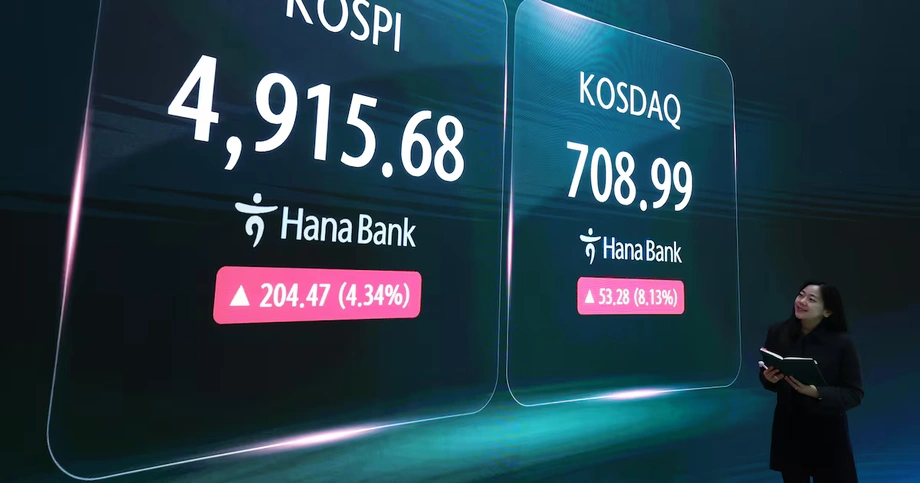
The market has grown much faster than the fund. The KOSPI's market capitalization has risen from 1,083 trillion won when the fund was created in March 2020 to about 3,848 trillion won, roughly 3.6 times the earlier figure. The current commitment therefore equals just 0.28 percent of KOSPI market value. Measured against the combined KOSPI and KOSDAQ capitalization of 4,219 trillion won on November 25, Citibank's proposed range would equal 0.47 percent to 0.95 percent. Commitments represented about 0.94 percent of the two markets when the fund was established, so the upper end would restore approximately the same proportion rather than create an unprecedented backstop.
Recent selling has made that arithmetic more urgent. Foreign investors net sold 15.8 trillion won of Korean shares during the month through the previous trading day, approximately $11.3 billion. That is nearly 1.5 times the fund's entire 10.76 trillion won commitment. KB Securities analyst Lim Jae-kyun and Kiwoom Securities analyst Han Ji-young both said the pledged amount has room to rise because the domestic market is so much larger than it was in 2020.
How would a promise become actual stock purchases?
The fund does not hold 10.76 trillion won in a cash account. It operates through a capital call, meaning that participating institutions transfer money up to their pledged amounts when the Financial Services Commission (FSC) activates the mechanism. The money can then be used to buy shares and exchange traded funds, including products tracking benchmarks such as the KOSPI 200. Those purchases add demand and liquidity when sell orders overwhelm the market.
Several steps still stand between preparation and intervention. An investment management committee made up of representatives from contributing institutions and public interest members must revise operating guidelines covering activation conditions, intervention triggers and the amounts to be deployed at different KOSPI levels. Calling money within existing commitments would not require a separate general meeting of participating firms. New commitments are slower: private institutions must complete risk management reviews and secure board approvals, a process Kim expects to take one to two months.
Unlike arrangements in Taiwan and China, where government resources can be used to purchase shares directly, Korea's fund relies on financial companies and related institutions. Those contributors also bear investment losses if prices continue falling after purchases. Kim argued that the announcement itself could influence trading before the full amount is raised.
If the stock market stabilization fund is reactivated, it could send a signal that eases market volatility to some extent. The larger the commitments and the sooner the money is deployed, the stronger that signal could be.
The market slide and the meetings that followed
The latest preparations followed steep declines in Korean and American shares and growing anxiety about artificial intelligence. Officials cited uncertainty over AI industry profitability and financing, alongside policy risks involving American data center regulation and tighter semiconductor export controls. They also warned against panic selling, noting that expectations for the industry's longer term growth remained.
- November 20: The KOSPI fell more than 5 percent, while the Nasdaq dropped 5.28 percent.
- November 22: Deputy Prime Minister and Finance Minister Lee Hyung-il, Bank of Korea Governor Shin Hyun-song, FSC Chairman Lee Eog-weon and Financial Supervisory Service Governor Lee Chan-jin held an emergency F4 meeting and agreed to prepare the fund for immediate activation if conditions worsened.
- November 23 and 24: Financial institutions received KDB correspondence asking whether existing pledges could be paid immediately and whether additional contributions were possible.
- November 25: The KOSPI fell more than 6 percent and closed at 4,697.51, its lowest close since January 13.
- November 27: Lee reviewed implementation of the November 22 measures, while Citibank published its expansion forecast. A capital market reform task force meeting scheduled for that evening was also being watched for possible stabilization measures.
- November 29: The fund's investment management committee was scheduled to review activation conditions, operating guidelines and deployment amounts.
- November 30: The FSC was scheduled to hold an emergency market stability meeting chaired by Lee Eog-weon at Government Complex Seoul.
The November 30 session was expected to bring together the Financial Supervisory Service, the chairmen of KB, Shinhan, Hana, Woori and NH NongHyup financial holding companies, KDB's chairman and financial association leaders. The Korea Federation of Banks and Korea Financial Investment Association were also expected to participate. The agenda included market conditions, activation preparations and a possible expansion of the fund.
Why banks say their room is limited
The five major financial holding companies supplied 4.7 trillion won of the roughly 10.7 trillion won created in 2020, close to half of the total. One proposal under discussion would double contributions, led by KDB and those groups, to push the fund beyond 20 trillion won. Individual banks have said that providing more than 1 trillion won each in additional capital would be difficult, particularly while they are managing capital ratios near the end of the year.
Regulatory capital rules explain much of that reluctance. Equity funds would ordinarily carry a 250 percent risk weight, but this fund's policy purpose means money actually contributed carries a 100 percent weight and uncalled commitments carry 40 to 50 percent. Consequently, even pledged money that has not left a bank increases the assets against which it must hold capital. At the end of September, the five holding companies' common equity Tier 1 ratios ranged from 13.05 percent to 13.83 percent. This measure compares their core capital with assets weighted for risk, and their ratios were only slightly above the 13 percent threshold associated with expanded shareholder returns.
Boards must also consider investment losses, shareholder returns and the 2025 revision to the Commercial Act, which extended directors' fiduciary duty to shareholders. Financial officials say that change makes it harder to direct large sums into market support without exposing boards to shareholder challenges. Any further increase in contributions requires board approval.
Several institutions connected to the expected contributors are also absorbing a record 1.6 trillion won in Fair Trade Commission fines for bid rigging in treasury bond auctions. The penalties include 332.2 billion won for KB Securities, 242.8 billion won for NH Investment and Securities, 147.3 billion won for Shinhan Securities and 214.8 billion won for Mirae Asset Securities. These penalties add to the capital management pressure surrounding requests for fresh market support.
The costs could spread to brokerages and funding markets
Brokerages would probably make additional contributions through principal investment (PI), meaning investments made with their own capital. Their trading and investment earnings had already weakened from the third quarter as trading income contracted and valuations of investment assets fell. Mirae Asset Securities recorded a separate pretax loss of about 380 billion won in its PI division during the third quarter. If share prices keep falling after the fund buys, valuation losses could affect fourth quarter results, while participating firms would have limited freedom to choose when to enter or exit.
Citibank also warned that activation could pressure markets for short term funding. Institutions might redeem money market funds, which invest in short term debt, or raise money through additional bank bonds and certificates of deposit. Heavy issuance could disturb the bond market while authorities are trying to calm equities. Kim expects the Bank of Korea to manage liquidity around the end of the year.
KDB faces its own constraint because its capital adequacy ratio declines as its contributions rise. Its capital was replenished through a supplementary budget when the fund was created in 2020. Kim suggested that the government could proactively increase KDB's capital again so that a larger stabilization commitment would not erode its capacity to perform other policy finance duties.
How much buying power would be enough?
Some market figures want substantially more than Citibank's upper estimate. Mirae Asset Group Chairman Park Hyun-joo argued in a media interview on November 25 that the fund needed a far larger commitment to have a decisive effect.
The stabilization fund needs to be at least about 100 trillion won to be effective.
Citibank said the stabilizing effect would be greater if fund purchases coincided with domestic stock buying by the National Pension Service (NPS). Assuming NPS maintains its target allocation of 20.8 percent to domestic stocks at the end of the year, Citibank estimated that it would have room to buy 17 trillion won if the KOSPI reached 4,500 points, 39 trillion won at 4,000 points and 62 trillion won at 3,500 points. The capacity rises in these scenarios because falling prices reduce the value of domestic holdings relative to the target. These are calculations based on that allocation assumption, not announced NPS purchase orders.
History shows that preparation rarely becomes deployment
Versions of the fund have been established five times since 1990, but money was deployed only three times: in 1990, 2003 and 2008. During the most recent intervention, 515 billion won was injected between November 2008 and March 2009. The fund created during the COVID-19 crisis in 2020 was never used, and its commitments were renewed in 2022. Activation was also considered during the market plunge in the second half of 2022 and the martial law crisis in December 2024, without any purchases. Activation now would therefore mark the first actual intervention in 18 years.
Before the latest slump, FSC Chairman Lee Eog-weon had already argued for a demanding test. Speaking at a November 13 capital market policy roundtable chaired by President Lee Jae Myung, he distinguished ordinary volatility from a threat to the market system.
We need to discuss whether the fund should step in simply because there is volatility, or whether it should act only when it reaches the level of a market system risk. The stabilization fund is something extremely urgent, temporary, or exceptional.
What the wider response means for investors
The fund is one part of a broader package. For three months beginning November 24, authorities eased limits on listed companies' stock buyback orders, allowing companies to purchase more of their own shares and absorb some selling pressure. The Financial Supervisory Service and Korea Exchange also began three months of intensive monitoring for illegal short selling. They are watching margin trading, credit transactions and forced liquidations, with stronger guidance for investors before forced sales occur. Exchange surveillance tools include designating overheated short selling stocks and applying the uptick rule, which restricts the prices at which short sales can be executed.
Retail investors have responded with frustration as well as relief. Online stock communities complained that officials spent the decline preparing and discussing measures, then acted after foreign selling had deepened individual losses. Han Ji-young of Kiwoom Securities nevertheless said that preparations alone had helped sentiment by showing that the government would not ignore a sharp plunge.
Buying Korean shares and ETFs can cushion a selloff, but it cannot resolve questions about AI profitability, data center financing or semiconductor policy. If weakness in American AI and semiconductor stocks persists, the effect of domestic purchases could fade. The immediate tests are whether the investment committee agrees on workable triggers, how much additional capital bank boards approve, and whether KDB confirms that existing pledges can be paid quickly enough to support the initial 1 trillion to 2 trillion won deployment envisioned by Citibank.
Key Points
- Citibank Korea forecasts that commitments could rise from 10.76 trillion won to between 20 trillion and 40 trillion won.
- An initial 1 trillion to 2 trillion won could come from existing pledges in December, while new commitments may take one to two months to approve.
- The current fund equals only 0.28 percent of KOSPI market value, while foreign investors recently sold 15.8 trillion won of shares.
- Banks face regulatory capital constraints, brokerages face possible investment losses, and KDB may need additional government capital.
- Citibank estimates that NPS could have room to buy between 17 trillion and 62 trillion won under different KOSPI scenarios.
- The fund has been deployed only three times, most recently with a 515 billion won injection during the 2008 financial crisis.
- Activation guidelines, financial sector contributions and deployment amounts remain under review, with key meetings scheduled for November 29 and 30.