A Harvest With Too Few Buyers
On November 26, 2026, at the Hingurakdamana LPO 21 paddy field in Gal Amuna, Polonnaruwa, Sri Lanka's agriculture minister delivered two messages that can seem contradictory. He wanted farmers to produce much more rice on selected fields, with a challenge to pass 10 metric tonnes per hectare. He also wanted at least one third of the country's paddy land taken out of rice production because unsold stocks and weak demand are already squeezing producers.
Contents
- A Harvest With Too Few Buyers
- Why the Granary Argument Now Includes Other Crops
- What the 2027 Budget Pays For
- Inside the Ten Plus Field Challenge
- How Collective Yaya Tracts Are Meant to Help
- Why Water Decides Which Fields Can Change Crops
- Keeping Land Rights While Joining Small Plots
- The Dates and Decisions That Now Matter
- Key Points
K.D. Lal Kantha, the Minister of Agriculture, Livestock, Land and Irrigation, said the approaching Maha harvest could worsen the surplus. Maha is the main, wetter cultivation season. Paddy is rice before it is milled, and Lal Kantha warned that releasing stocks held by the state Paddy Marketing Board would push both paddy and rice prices lower. He said prices could not be driven down indefinitely if farming was to remain viable.
The minister told farmers that continued cultivation would not help them when their produce had no buyer.
It is true that you are cultivating, but there is no place in Sri Lanka to sell it. Already stocks are piled up. Already there is enough and more. Therefore, we must move to other crops.
During a journey from Minneriya to Hingurakgoda, Lal Kantha said, he saw farmers cultivating and wondered who would buy their harvests. He called for at least one third of paddy land to be reduced quickly and proposed moving half of paddy fields towards supplementary and alternative crops. He gave no total acreage for the reduction, no list of districts and no detailed timetable beyond saying that the change had to happen soon.
Why the Granary Argument Now Includes Other Crops
Polonnaruwa supplied a historical stage for that argument. Lal Kantha invoked King Parakramabahu and Sri Lanka's old reputation as the Granary of the East. His point was that grain means more than paddy. The country produces enough rice, he said, yet imports almost all other grain commodities used for food. In his assessment, generations of rice cultivation had not delivered the broader farming prosperity implied by the historic title.
The proposed alternative is a much wider food basket. Farmers would be encouraged to grow other grains, legumes, tubers, onions and chillies, reducing import bills and keeping more foreign exchange within Sri Lanka. Legumes are crops such as mung beans, black gram and cowpeas. The plans also include finger millet, maize, potatoes, peanuts, sesame and soybeans, giving farmers several options rather than replacing paddy with a single new crop.
The November 18 meeting at Govijana Mandiraya in Colombo showed how broad the production plan has become. Lal Kantha met leaders representing 13 crops: paddy, chillies, big onions, red onions, mung beans, black gram, cowpeas, finger millet, maize, potatoes, peanuts, sesame and soybeans. They discussed the 2027 production plan, obstacles facing growers and the large sums spent on importing additional crops during 2026.
Crop leaders were given responsibility for carrying out programmes across the country and were reminded to spend budget allocations within their specified periods. Lal Kantha said paddy cultivation had offered farmers limited opportunities to escape poverty and earn a profit. He presented additional crops as a route towards commercial agriculture and better farmer incomes. A programme promoting finger millet had already been launched before the Polonnaruwa event.
What the 2027 Budget Pays For
President Anura Kumara Dissanayake presented the 2027 budget on November 12. It allocated 400 million rupees to replace isolated cultivation with the collective Yaya tract production model. Under this arrangement, farmers with small holdings can buy inputs in bulk, coordinate water and pest management and work together to counter market monopolies.
The largest allocation described at the launch was 44 billion rupees to extend the fertiliser subsidy of 30,000 rupees for each hectare. At present associated with paddy, the support would also cover other food crops cultivated in paddy fields from the 2026/27 Maha season. For a farmer considering a switch, this changes the economics: choosing another eligible food crop would no longer mean losing access to the fertiliser support simply because the field was previously used for rice.
Another 1.55 billion rupees was earmarked to convert uncultivated paddy land, or land producing poor yields, into alternative and perennial crops. Perennial plants remain in the ground for several years, unlike crops planted and harvested within one season. The three allocations serve different tasks: organising collective paddy production, supporting additional food crops and converting land that is idle or unproductive. The launch did not say how many hectares the conversion fund would cover.
Inside the Ten Plus Field Challenge
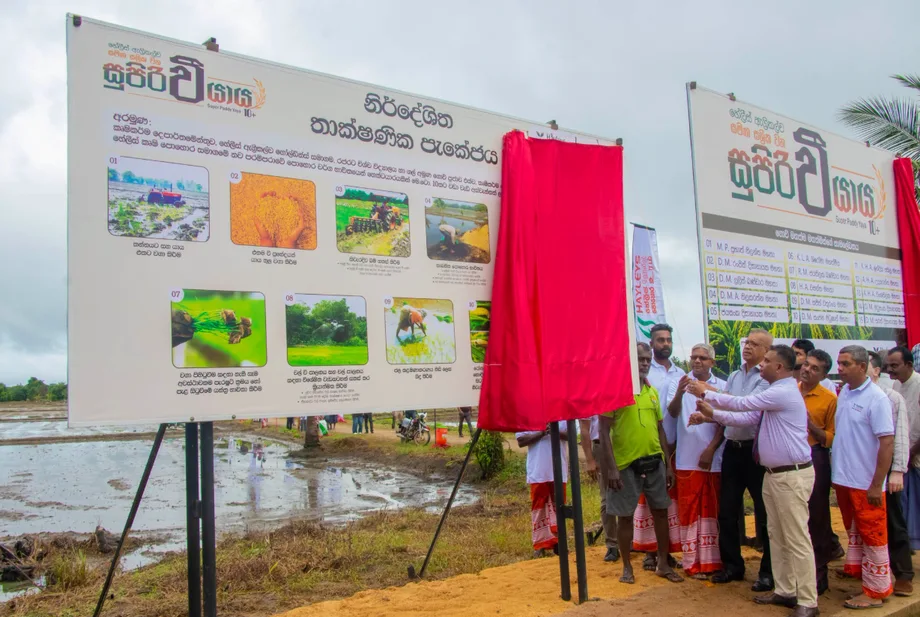
The Department of Agriculture's Super Paddy Yaya - Ten Plus Rice Cultivation Programme will concentrate on the land that remains under rice. Its launch challenge is to produce more than 10 metric tonnes of paddy per hectare, using 10 tonnes as the benchmark for the wider Super Paddy Tract tests. A technical package of 11 scientifically recommended cultivation practices will cover the crop cycle, including land preparation, crop establishment, nutrient management and harvesting.
Ten private fertiliser companies will manage 11 selected tracts across the island. Their work will include modern cultivation technology, advanced fertilisers, agrochemicals, cost studies and soil nutrition measures such as poultry manure. Farmers, university agriculture faculties, the Department of Agriculture, the Department of Agrarian Development and other agricultural participants are also involved. Cost studies matter because a higher harvest would need to be assessed alongside the spending required to obtain it.
Lal Kantha, addressing the launch as agriculture minister, told the companies that the contest placed them under direct pressure and that farmers must not bear the cost of a failed experiment.
At this point, the companies actually have a greater challenge than we do. They cannot afford to fail.
At the same time, we have made it clear that if farmers suffer a reduction in yield because of the work carried out under this programme, those companies must compensate the farmers. The farmers must be compensated. We cannot allow farmers to suffer any losses.
The launch did not provide a starting yield for each tract, explain how the eleventh field would be allocated among the 10 firms or publish a formula for calculating compensation. Those details will determine how easily a farmer can demonstrate that a company's work caused a loss.
How Collective Yaya Tracts Are Meant to Help
The Yaya model treats adjoining paddy plots as a shared production tract. Bulk purchasing can give participating farmers greater buying power, while joint water and pest decisions replace disconnected action on individual plots. The approach is intended to improve paddy yields without requiring every small producer to negotiate separately for inputs and services.
At the November 18 meeting, Lal Kantha said the Yaya programme was already operating in major irrigation areas and Mahaweli zones. He had then previewed the November 26 event as Supiri Yaya in Hingurakgoda. He also described the fertiliser subsidy extension as a message that some paddy fields in minor irrigation areas should grow additional crops instead of rice. Minor irrigation schemes managed by the Department of Agrarian Development are being considered for that expansion.
Coordination will involve more than the agriculture ministry. The meeting identified possible institutional difficulties when working with the Mahaweli Authority, interprovincial authorities and provincial councils. Anuradhapura District parliamentarian Susantha Kumara Nawarathna and Ministry Secretary D.P. Wickramasinghe attended. Their presence reflected the number of organisations involved in water, land and local administration as the cultivation plans move into the field.
Why Water Decides Which Fields Can Change Crops
Professor Buddhi Marambe of the University of Peradeniya's Crop Science department supports extending fertiliser support because it can stop fields lying unused during dry periods. His caution concerns drainage. Many Sri Lankan paddy fields are flat and hold water, making them suitable for rice but dangerous for crops whose roots cannot tolerate saturated soil.
That makes the drier Yala season generally more suitable for diversification than the wetter Maha season. The Agrarian Development Act provides legal room for seasonal food crops on paddy land for up to three consecutive years. Permission to plant, however, does not change the physical condition of a field. A farmer who switches crops merely to obtain a subsidy could lose the harvest if water cannot drain away.
Marambe explained the difference between rice and every other food crop in the plan in stark terms.
Paddy is the only food crop grown in Sri Lanka that can withstand waterlogged conditions for at least two weeks. No other crop will survive.
He advised choosing slightly higher plots away from reservoir sluice gates, the structures that control water released from a reservoir. His support for diversification therefore comes with two field requirements: suitable water management and careful plot selection. These conditions are especially relevant when officials decide which minor irrigation areas should move away from rice and which should remain under paddy.
Keeping Land Rights While Joining Small Plots
Sri Lanka's small holdings and strict land laws make formal consolidation difficult, according to Marambe. Combining legal ownership can also complicate later transfers if farmland is used for purposes such as construction. His alternative is plot consolidation, which changes the working layout without changing who legally owns each piece of land.
Under his proposal, 20 to 30 farmers would retain their ownership rights while removing internal bunds across a Yaya tract of roughly 50 acres, or about 20 hectares. Bunds are the low earth ridges that separate paddy plots and help retain water. Marambe estimates that they occupy 15 to 20 percent of farmland. On a tract of 50 acres, that share equals 7.5 to 10 acres.
The University of Peradeniya crop scientist described the distinction between consolidating land titles and consolidating the cultivated plot.
Rather than consolidating legal land rights, you maintain those rights and consolidate the plot by removing bunds, which take up 15 to 20 percent of farmland.
The approach creates a larger working tract for shared cultivation while preserving the underlying ownership structure. Marambe described recent policy decisions as positive, but said incremental agricultural growth also requires wider reforms, stronger farmer education and immediate execution in the field.
The Dates and Decisions That Now Matter
Four dates connect the budget, the production meetings and the coming cultivation seasons.
- November 12, 2026: President Dissanayake presented the 2027 budget, including the Yaya, fertiliser and land conversion allocations.
- November 18, 2026: Lal Kantha met leaders representing 13 crops at Govijana Mandiraya and discussed the 2027 production plan.
- November 26, 2026: The Ten Plus programme was launched in Gal Amuna, and the minister called for at least one third of paddy land to be reduced.
- From the 2026/27 Maha season: The fertiliser subsidy is scheduled to extend to other food crops grown in paddy fields.
- During 2027: Crop leaders are expected to carry out the production plan intended to increase local supply and reduce imports.
The nearest pressure point is the approaching Maha harvest. The government is exploring exports before that rice arrives, while avoiding a release of Paddy Marketing Board stocks that could deepen the price fall. No export buyer, quantity or shipment date was announced, and Lal Kantha did not say how much paddy the board holds. No exact harvest date or publication date for the Ten Plus results was given either.
The immediate work is to find outlets for accumulated stocks, select land with suitable drainage and turn budget allocations into functioning field programmes. For farmers, the difference between managed diversification and another price slump will depend on those practical steps, alongside the yield contest on the remaining rice land.
Key Points
- Agriculture Minister K.D. Lal Kantha called on November 26 for at least one third of Sri Lanka's paddy land to be reduced and for half of paddy fields to move towards other crops.
- Unsold paddy and weak demand are troubling farmers before the Maha harvest, while releasing state stocks could push prices lower.
- The 2027 budget provides 400 million rupees for collective Yaya production, 44 billion rupees for wider fertiliser support and 1.55 billion rupees for land conversion.
- Ten private companies will work on 11 Super Paddy tracts, with a field challenge to exceed 10 metric tonnes per hectare and compensation promised for losses caused by their work.
- The 2027 plan covers crops including onions, chillies, pulses, maize, finger millet, potatoes, peanuts, sesame and soybeans.
- Professor Buddhi Marambe says diversification suits well drained land and generally the drier Yala season, since crops other than paddy cannot survive prolonged waterlogging.
- Plot consolidation would let 20 to 30 farmers keep legal ownership while removing bunds that occupy an estimated 15 to 20 percent of farmland.
- Export arrangements, state stock volumes, the acreage reduction schedule and detailed compensation rules remain undisclosed.