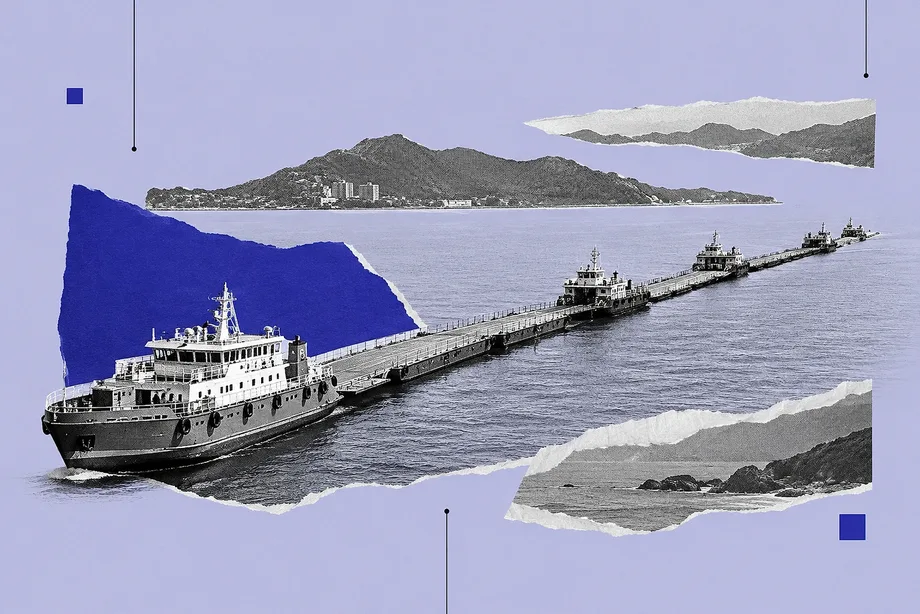
An 800 Metre Bridge Assembled From Civilian Hulls
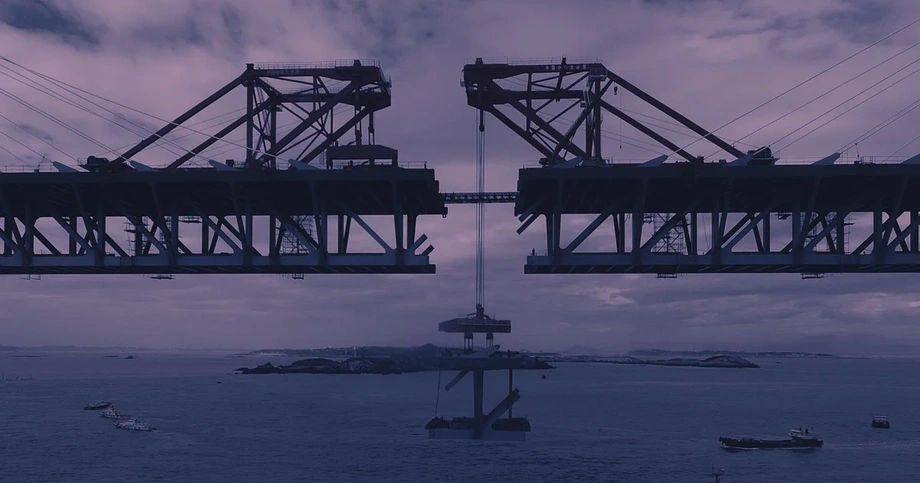
Eight civilian vessels and four landing craft repeatedly assembled and then took apart a floating bridge about 800 metres (2,600 feet) long in Dacheng Bay, a stretch of water in southeastern Fujian province that looks across the Taiwan Strait toward Taiwan's main island, roughly 280 kilometres (175 miles) away. Satellite imagery analysed by the geospatial data company ingeniSPACE showed the work starting on November 1 and continuing through at least November 16, with the same movements visible in pictures from commercial providers Vantor and Planet Labs.
Contents
- An 800 Metre Bridge Assembled From Civilian Hulls
- Why a Bridge of Ships Matters in a Landing
- Jamming Signs in a Blurry Radar Image
- Taipei Says It Is Watching, Beijing Says Training Is Legitimate
- A Bay With History, From 1953 to a Presidential Visit
- 2023, 2024 and the Guangdong Precedent
- The First Island Chain and the Swift Seizure of Small Islands
- Innovation and Fantasy: the Limits of a Barge Bridge
- Key Points
A senior security official briefed on the exercise confirmed those details and said the drill was still under way on Friday, November 27. The flotilla was made up of four barges, two semi-submersible vessels and two powered ships, joined by four landing craft, smaller support vessels and Chinese navy ships nearby. No bridging equipment built for military use appeared in the images, which points to the People's Liberation Army practising with the civilian fleet the country already owns.
A floating bridge of this kind is a chain of linked pontoons or vessel decks that lets vehicles drive from a ship waiting in deeper water onto dry land. Armies use the idea when a port is wrecked, too shallow or simply unavailable, because it turns open water into a road.
Jason Wang, ingeniSPACE's chief operating officer, described what his company's analysts believed they were watching. He said the PLA looked to be rehearsing methods that leave a low signature, meaning activity that is hard to detect, while rehearsing ways to keep forces supplied in a scenario built around the first island chain.
The People's Liberation Army appeared to be rehearsing low-signature methods to provide logistical support to forces that could be involved in a first island chain invasion scenario.
China's government views democratically governed Taiwan as its own territory. Taipei rejects Beijing's claim to sovereignty, and Beijing has never renounced the use of force to bring the island under its control.
Why a Bridge of Ships Matters in a Landing
Military planners treat the moment after the first troops reach a beach as the hardest part of any amphibious operation. Soldiers can be carried across water in landing craft, but tanks, fuel, artillery shells and fresh units have to keep arriving for days, and that flow normally depends on a captured port with working cranes and deep berths. Taiwan's coast offers few of those, and an invading force would expect them to be damaged or blocked.
Wang said linking civilian ships together could solve part of that problem by moving heavy equipment and supplies from deeper water to different points along the coastline, widening the number of places where a landing could be supplied.
Using civilian ships to enable bridging of heavy equipment and materiel from deeper waters creates additional locations they can use along the Taiwan coastline.
The vessels in Dacheng Bay are ordinary commercial craft. Barges carry cargo on flat decks and are usually towed or pushed. Semi-submersible vessels flood their ballast tanks so that a heavy load, such as a vehicle or a large piece of equipment, can be floated on or off, and they are widely used in the offshore oil and construction trades. The absence of purpose-made military bridging gear in the imagery suggests the drill was about improvising with what shipyards and shipping companies already operate.
For readers outside the region, the geography helps explain the attention. The Taiwan Strait is wide and exposed to rough weather for part of the year, so any crossing would be a large and slow undertaking visible to satellites, ships and aircraft long before it reached a beach. Exercises that shorten the time between ship and shore, or that allow unloading away from obvious landing spots, address that exposure directly.
Jamming Signs in a Blurry Radar Image
Wang also said his company saw signs of interference in the area of the drill, based on a synthetic aperture radar image that was unclear. Synthetic aperture radar is a satellite sensor that bounces radio waves off the surface and builds a picture from the echoes, which lets it see through cloud and darkness. Interference from electronic jamming can leave streaks or noise across such an image, which is one reason analysts pair radar pictures with ordinary optical photographs.
The blurry image left the extent of any jamming unclear, and no side has given details of what was transmitted or how long it lasted. Taiwan's government has not commented on that part of the analysis.
Military attaches based in Asia said China appears to be constantly refining its coastal drills, a sign of how large the task of landing across the strait would be. Rival militaries, Taiwan's included, are known to study such activity closely.
Taipei Says It Is Watching, Beijing Says Training Is Legitimate
Taiwan's defence ministry said it was aware of Chinese military activity in Dacheng Bay, including the use of civilian vessels in exercises, and that it was weighing what the activity means for security in the Taiwan Strait and for peace in the region. The ministry did not say what assessment it had reached.
China's defence ministry did not answer a request for comment about the Dacheng Bay exercise. Asked on Thursday, November 26, about recent PLA drills in the region, it described the training as entirely legitimate and reasonable.
The drill ran through the eve of Taiwan's local elections, held on Saturday, November 28. The senior security official who confirmed the exercise made no direct link between the two, and China's ties with the island were not the central issue in the campaigns. Beijing has repeatedly denounced the ruling party's candidate for Taipei mayor, calling him a separatist.
What the images do not show is equally part of the story. No announcement has been made about the drill's results, no timetable for a follow-up exercise has been given, and neither ingeniSPACE nor the officials who confirmed the findings said how many troops or vehicles, if any, moved across the improvised bridge.
A Bay With History, From 1953 to a Presidential Visit
The water off Dacheng Bay sits beside Dongshan Island, a place with a long military record. In 1953, PLA forces fought off an attempted invasion by Republic of China troops, who had withdrawn to Taiwan in 1949 at the end of the civil war with Mao Zedong's communists. Chinese President Xi Jinping visited Dongshan Island in 2024, a stop that gave the area added political weight.
That history gives the current drill a symbolic layer on top of its practical purpose. A bay used for rehearsing landings in one era is being used again, this time with satellites from commercial companies counting the hulls lined up in the water.
2023, 2024 and the Guangdong Precedent
This is not the first time Dacheng Bay has hosted this kind of training. Taiwan has previously disclosed Chinese amphibious landing drills there in 2023 and 2024 using roll-on/roll-off freighters, the ships that carry trucks and cars and let vehicles drive on and off through a stern or bow ramp. Both of those exercises took place in September, earlier in the year than this one.
Similar drills were documented off the southern coast of Guangdong in August last year, again showing China rehearsing the use of civilian shipping to supplement any operation against Taiwan. The pattern that emerges across those dates is steady repetition in familiar waters, with each round adding a piece of equipment or a technique.
- September 2023: landing drills in Dacheng Bay using roll-on/roll-off freighters.
- September 2024: a second round in the same bay with the same type of ship.
- August 2025: comparable civilian shipping drills off southern Guangdong.
- November 1 to at least November 16, 2026: eight civilian vessels and four landing craft forming an 800 metre floating bridge in Dacheng Bay.
The First Island Chain and the Swift Seizure of Small Islands
The official briefed on the exercise said the drill was designed to practise the swift seizure of small islands and was very targeted at contingencies along the first island chain. That term describes the arc of islands running from Japan through Taiwan to the Philippines, a line that has shaped military planning in the western Pacific for decades.
The same official said the exercise appeared to be part of this year's All-Military Strategic Exercise, the PLA's annual programme of large training activity, and that it was routine but held later than in previous years. Those details place the drill inside a scheduled calendar of training rather than presenting it as an emergency response to any single event.
The activity also indicated that China's military is increasingly focused on operations involving groups of islands, the official said. Small islands matter in a conflict because they can host radars, missiles or supply depots, and because taking one quickly can change what ships and aircraft can safely do nearby.
Innovation and Fantasy: the Limits of a Barge Bridge
The same official who confirmed the findings warned against overstating the battlefield value of what the images show. Barges and powered civilian ships would be live targets in wartime, the official said, and the gap between a clever idea and a working capability is wide.
There is still some distance between innovation and fantasy.
That caution sits alongside the analytical reading from ingeniSPACE. A bridge of civilian hulls would be slow to build, tied to calm water and easy to spot from the air, and it would need protection from missiles, aircraft and submarines. What the drill demonstrates is a rehearsal of logistics, not a guarantee that supplies would get through.
For the people living around Dacheng Bay and on Dongshan Island, the visible change is a bay busy with barges for weeks at a time and foreign satellites taking pictures of it. For Taiwan's defence planners, the change is a new item on a list of techniques to track, one that tries to make the shoreline itself more flexible.
Key Points
- Satellite imagery analysed by ingeniSPACE showed eight civilian vessels and four landing craft forming and dismantling a floating bridge about 800 metres long in Dacheng Bay, Fujian, from November 1 to at least November 16.
- The flotilla comprised four barges, two semi-submersible vessels and two powered ships, with smaller support craft and Chinese navy ships nearby.
- No bridging equipment built for military use was seen, suggesting a rehearsal with existing civilian maritime resources.
- Dacheng Bay lies about 280 kilometres (175 miles) from Taiwan's main island.
- Jason Wang, ingeniSPACE's chief operating officer, said the PLA appeared to be rehearsing methods with a low signature to supply forces in a first island chain scenario.
- A senior security official said the drill practised the swift seizure of small islands, was part of the All-Military Strategic Exercise and was still running on November 27.
- Signs of jamming were seen in an unclear synthetic aperture radar image of the area.
- Taiwan's defence ministry said it was weighing what the activity means for security in the strait; China's defence ministry called its regional training entirely legitimate and reasonable.
- The same official cautioned that barges would be live targets and that there is still some distance between innovation and fantasy.
- Dacheng Bay hosted similar drills in September 2023 and September 2024 with roll-on/roll-off freighters, and comparable drills took place off southern Guangdong in August 2025.