A new income ladder for care premiums
Japan's Ministry of Health, Labour and Welfare is considering higher care insurance premiums for some people aged 65 and over whose total income is at least 1.2 million yen a year. The ministry presented its direction to the Social Security Council's care insurance subcommittee on November 26, 2026, with fiscal 2027 as the intended starting point. That fiscal year begins in April 2027.
Contents
- A new income ladder for care premiums
- Who falls within the group being examined?
- How the monthly premium is calculated
- How the ladder could grow from 13 tiers to 22
- Why rising pensions can produce a sudden premium jump
- Why the ministry wants ability to pay to carry more weight
- Why some payers call it a tax increase by another name
- What happens between now and fiscal 2027?
- Key Points
The proposal would make the income ladder used to calculate premiums much more detailed. There are 13 standard tiers today, while a working example in the ministry's review increases the number to 22. Higher payments would apply to selected tiers rather than to everyone above the 1.2 million yen line. Some older people with lower incomes could pay less.
Subcommittee members broadly accepted the direction, but the meeting did not settle final income boundaries, multipliers or premiums. The income ladder proposal would divide the existing seventh tier, covering total income from 1.2 million yen to less than 2.1 million yen, and continue subdividing brackets through the thirteenth tier, which covers income of 7.2 million yen and above.
About 30% of people aged 65 and over are estimated to have total income at or above 1.2 million yen under the present framework. That describes the broad group being examined, not the share certain to receive an increase. The review is aimed at the tenth care insurance planning period, covering fiscal 2027 through 2029.
Who falls within the group being examined?
The threshold concerns total income after deductions, not annual salary, annual pension payments or the money deposited into a bank account. The calculation starts with income and subtracts amounts such as the public pension deduction and the employment income deduction. A person receiving a pension can therefore have total income well below the pension's face value.
A retiree receiving approximately 2.3 million to 2.4 million yen a year in public pension payments can fall within the broad target group. The same is true of someone whose pension and other income amount to roughly 190,000 yen a month. Earnings from work can also enter the calculation, which matters for older people who continue working alongside their pensions.
A ministry official described the people likely to face an increase in narrower terms than the income threshold alone suggests.
The people targeted by this increase are households that pay resident tax, and their incomes are relatively high among older people.
Resident tax is a local income tax levied by prefectures and municipalities. Both the individual's circumstances and the tax status of the household can affect the premium category. This is why two pensioners with similar cash receipts can be treated differently after deductions and household conditions are taken into account.
How the monthly premium is calculated
Every premium begins with a base amount set by the municipality. Local governments review that amount every three years, taking expected demand for care services and other costs into account. The national average base amount is 6,225 yen a month. The national government then supplies standard income tiers and multipliers as a guide, while municipalities determine the actual premiums charged locally.
A multiplier adjusts the base amount according to ability to pay. People with lower incomes can pay less than the base amount, while people with higher incomes pay more. The standard multipliers currently run from 0.455 at the bottom to 2.4 at the top. With a base amount of 6,000 yen and a multiplier of 1.2, for example, the monthly premium would be 7,200 yen.
The possible seventh tier change provides a simple illustration. Its current multiplier is 1.3. If that rose to 1.4, the extra charge at the national average base amount would be 6,225 yen multiplied by 0.1, or 622.5 yen a month. The ministry's illustration rounds that to an increase of about 620 yen a month. It is an example, not a announced rate.
Local figures will produce different results. Applying the current maximum multiplier of 2.4 to the national average base gives 14,940 yen a month, but a municipality with a different base amount would produce a different bill. The ministry has also indicated that actual amounts may move differently from place to place.
How the ladder could grow from 13 tiers to 22
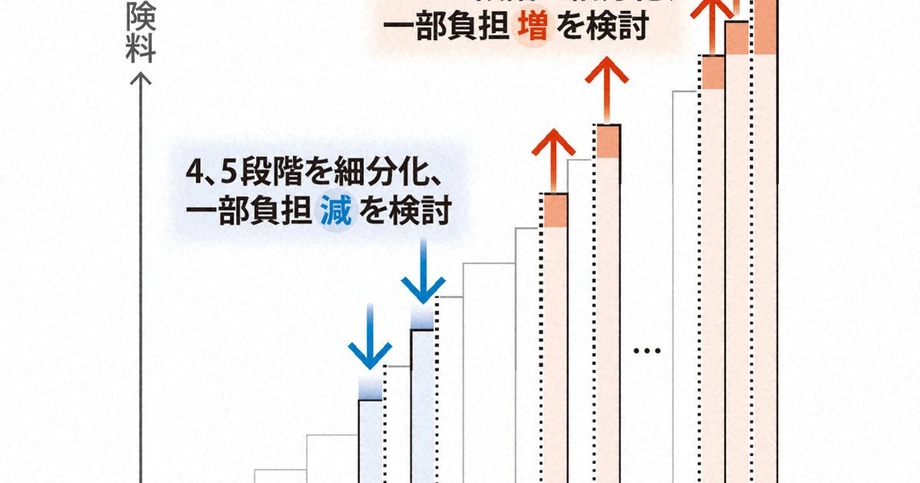
The working example would split each of tiers 7 through 13 into two. That adds seven tiers in the upper part of the ladder. Tiers 4 and 5 would also each be divided in two, adding another two tiers. Nine additional tiers would bring the total from 13 to 22.
Eight of the 14 upper tiers produced by that exercise would carry a higher rate under the illustration. The ministry is also considering whether the maximum standard multiplier should rise above its present level of 2.4. Any such increase would concentrate additional costs at the highest income levels, but no new maximum has been decided.
The lower end of the ladder moves in the other direction. Tiers 4 and 5 cover people who are personally exempt from resident tax but live in a household containing someone who is liable for it. Subdividing these tiers would allow some of those people to receive a premium reduction.
The result is a redistribution within the premium structure rather than a uniform increase for every older person. Descriptions of the plan as creating more than 20 tiers and the example containing 22 tiers both concern a structure that remains open to adjustment. The final number could still change.
Why rising pensions can produce a sudden premium jump
Inflation can increase the cash value of pension payments without giving a retiree the same increase in purchasing power. Those higher nominal payments can nevertheless move someone across an income or tax boundary used in the premium calculation. The ministry wants to prevent that technical movement from producing an abrupt jump in costs.
One relief proposal concerns people who move from a household exempt from resident tax to a taxable household as pension payments rise. Their premium increase would be held to half of the full amount for one year. The household would then have time to adjust before the complete new burden applied.
This temporary measure is separate from the proposed reductions within tiers 4 and 5. One addresses a sudden change in tax status, while the other would alter the underlying income ladder. The detailed eligibility rules and amounts for both measures remain unfinished.
Why the ministry wants ability to pay to carry more weight
Care benefit expenditure has continued to increase as Japan's population ages. The ministry has repeatedly argued that premiums should reflect ability to pay more closely. Asking people with greater financial capacity to contribute more creates room to ease charges for selected people with lower incomes, rather than relying entirely on increases spread across the system.
Care insurance covers everyone aged 40 and over, although the income ladder in this review concerns premiums paid from age 65. Those premiums are usually deducted directly from pension payments. The insurance helps pay for services such as home help, day care and visiting nursing. Users generally pay between 10% and 30% of the service cost, with the insurance covering the remainder.
For an older person, a higher monthly deduction would leave less pension income available for food, housing, utilities and other expenses. For a person receiving a reduction, even a smaller monthly bill could provide some room in a constrained household budget. The exact effect will depend on the final multiplier and the municipality's base amount.
For working relatives, the services financed by the system can reduce the amount of daily care that families must provide themselves. That connection is central to defenses of care insurance as support for households across generations, rather than simply a deduction from an older person's pension.
Why some payers call it a tax increase by another name
The proposal prompted competing reactions on 5ch, Japan's large anonymous forum network. Critics described the increase as a tax rise under another name. Defenders pointed to a system that supports older people through care services and reduces the care burden placed on family members who are still working.
The criticism reflects the way care and health insurance premiums operate. They do not create personal future benefits in direct proportion to the amount each person pays. Someone charged a higher care premium does not receive a correspondingly larger individual care entitlement. The money is pooled to finance services under the system's eligibility and cost sharing rules.
The discussion also referred to older people who continue earning, including income connected with Silver Human Resource Centers, which help older people find short jobs. That widens the practical debate beyond pensioners living entirely on a pension. It also reinforces the importance of the after deduction income calculation, since the 1.2 million yen figure is not a simple test of whether someone is retired or how much cash enters their account.
What happens between now and fiscal 2027?
The review has moved from preparatory committee work to a stated policy direction, but several decisions still stand between that direction and a revised bill.
- September 18, 2026: Material for the 136th care insurance subcommittee meeting formed part of the review leading to the proposal.
- November 26, 2026: The health ministry presented its revision direction to the Social Security Council's care insurance subcommittee, including an example with 22 tiers.
- April 2027: Fiscal 2027 begins. This is the intended starting point for the changes under consideration.
- Fiscal 2027 through 2029: The tenth planning period would run for three years, with municipalities revising their care finances and premium settings for that period.
No date was given for a final decision on the tier count, income boundaries or multipliers. The proposed increase above the maximum multiplier of 2.4 also has no settled figure. Until those choices are made and municipalities set their base amounts, an individual cannot calculate a firm 2027 premium from the national average alone.
The figures that will matter on future notices are total income after the relevant deductions, household resident tax status, the applicable multiplier and the local base amount. Those elements will determine whether a household pays more, qualifies for a reduction or receives temporary relief from a sharp increase.
Key Points
- The health ministry presented its proposal on November 26, 2026, with fiscal 2027 as the intended start.
- Some people aged 65 and over with total income of at least 1.2 million yen after deductions would pay more.
- About 30% of older people are above that broad income line, but not all of them would receive an increase.
- A working example expands 13 income tiers to 22, with eight of 14 upper tiers carrying higher rates.
- A hypothetical seventh tier change would add about 620 yen a month at the national average base amount.
- The maximum standard multiplier could rise above 2.4, while selected people in tiers 4 and 5 could pay less.
- Temporary relief would halve certain premium increases for one year after a household becomes taxable.
- Final tiers, rates and local premiums have not been decided.