Bangladesh opens its campaign with a focus on enforcement
An agreement among three ministries, a European Union pledge of about €10 million and calls to treat online abuse as a human rights issue marked the launch of Bangladesh's 16 Days of Activism against Gender-Based Violence on 25 November 2026. At a national dialogue at the Aloki Community Centre in Tejgaon, Dhaka, government officials, diplomats and rights advocates called for stronger laws, effective enforcement and better protection for survivors.
Contents
- Bangladesh opens its campaign with a focus on enforcement
- What the agreement among three ministries promises
- Why speakers say laws alone will not be enough
- Two panels put digital safety beside child marriage
- Government data and development finance show the wider stakes
- The climate connection and the projects already underway
- Rights groups turn the campaign into 10 practical demands
- The campaign calendar and the decisions still to come
- Key Points
The UN in Bangladesh, the Ministry of Women and Children Affairs and the Local Consultative Group on Women's Advancement and Gender Equality jointly organised the dialogue. Its title was Strengthening the Legal Framework to Ensure Safety, Justice and End of Impunity. Impunity means that offenders escape consequences, while accountability requires both perpetrators and the institutions handling cases to answer for their actions.
Government officials, judicial representatives, law enforcement personnel, development partners, academics, technology sector representatives, young people and civil society members took part. The campaign's theme for the year was a call to ensure justice, protect people subjected to abuse and end impunity.
Women and Children Affairs and Social Welfare Minister Professor Dr AZM Zahid Hossain attended as chief guest. He reaffirmed the government's commitment to protecting women and children and called for effective action in homes, workplaces, educational institutions and public spaces. He also said that preventing violence would require participation from every part of society, rather than government action alone.
What the agreement among three ministries promises
The minister said a memorandum of understanding had already been signed among the Ministry of Social Welfare, the Ministry of Women and Children Affairs, and the Ministry of Law, Justice and Parliamentary Affairs. Its purpose is to provide prompt legal assistance and other services for women and children facing abuse under one umbrella.
In practical terms, the arrangement is intended to let survivors obtain necessary help from a single place instead of having to arrange each service separately. That approach matches a wider demand at the dialogue for services centred on survivors, meaning support designed around their safety, dignity, privacy and choices. The minister did not give the date of the agreement, and no timetable or locations for the combined services were announced.
Zahid Hossain said women make up more than 50% of Bangladesh's population. He said the government under Prime Minister Tarique Rahman wanted to build an inclusive and humane country where nobody feels deprived and women receive the respect they deserve.
Other speakers called for existing laws on violence against women to be updated so that they reflect current needs. They also pressed for greater participation by women in workplaces and politics. Ministry Secretary Dr Rowshan Ara Begum chaired the programme, and Joint Secretary Mohammad Iftekhar Hossain delivered the welcome address.
Why speakers say laws alone will not be enough
Carol Flore-Smereczniak, the acting UN resident coordinator in Bangladesh, delivered one of the dialogue's clearest warnings against treating legislation as the finish line.
Laws alone will not be enough.
She called for effective law enforcement, accountability, reliable and comparable data, adequate funding for justice systems designed around survivors, and changes to harmful social norms and attitudes. Comparable data means information collected consistently enough for different places and periods to be measured on the same basis. Without that consistency, authorities cannot reliably assess whether services are reaching survivors or whether violence is rising or falling.
European Union Ambassador Michael Miller described sexual violence and violence based on gender as manifestations of structural inequality. He said achieving equality required sustained efforts by people of all genders. He also identified discriminatory laws, barriers to obtaining services and sexual harassment as problems requiring more work.
Miller referred to an EU commitment of roughly €10 million for initiatives in Bangladesh to prevent violence and respond to it. The dialogue did not provide a breakdown of that amount or a schedule for individual projects. UN Women Representative Gitanjali Singh and International Labour Organization Country Director Max Tuñón called for stronger partnerships among government, development partners, civil society and the public. They said prevention, service delivery and accountability all needed sustained investment.
Two panels put digital safety beside child marriage
The first panel examined the effective implementation of laws and policies, coordination among institutions and lasting political commitment. Its discussion also covered child marriage, violence carried out through technology and the need for more inclusive action against harmful social practices.
The second panel concentrated on abuse committed through digital tools, women's safety online and the accountability of digital platforms. The practical concerns extend beyond offensive messages. A separate campaign launch in Dhaka identified cyberstalking, online sexual harassment, blackmail and the circulation of intimate images or videos without consent as forms of abuse requiring accessible complaint and remedy systems.
Australian High Commissioner Susan Ryle said violence committed through technology should be treated as a broader human rights issue rather than merely a cybersecurity concern. A cybersecurity response can concentrate on accounts, devices and platforms. A human rights response also considers the survivor's safety, privacy, access to justice, health needs and freedom to take part in work, education and public life.
UNFPA Deputy Representative Garik Hayrapetyan said the dialogue's recommendations needed to become real action. He called for closer cooperation among government, development partners and service providers, along with more effective collaboration with technology companies. That connects the national conversation to a concrete question raised during the campaign: how quickly a platform, police unit or service provider responds when a survivor seeks help.
Government data and development finance show the wider stakes
A separate gathering on the same day examined violence as a barrier to Bangladesh's economic and social development. The French Development Agency, known as AFD, brought around 100 participants to the Alliance Française de Dhaka for dialogue, art and peer learning. They represented 10 partner organisations, government institutions, development partners, civil society and artistic communities. The programme formed part of French Week, an initiative of the French Embassy in Bangladesh.
Development partners cited government data showing that 76% of women in Bangladesh who have ever been married had experienced intimate partner violence during their lifetime. The figure concerns lifetime experience within that specific group. It is not a count of all Bangladeshi women or a measure limited to the previous year.
French Ambassador Jean-Marc Séré-Charlet connected women's safety and autonomy to the country's wider prospects.
Our conviction is simple: there can be no development, no peace and no justice without women's autonomy - physical, economic and political.
AFD said it allocates an average of 55% of its project financing to initiatives where gender equality is a significant or principal objective. France's feminist foreign policy supports efforts to eliminate violence against women by 2030, in line with Sustainable Development Goal 5. AFD Country Director Cynthia Mela said the agency's approach supports physical, economic and political autonomy for women and girls under France's international strategy covering 2025 to 2030.
The climate connection and the projects already underway
The 2024 Violence Against Women Survey, conducted by the Bangladesh Bureau of Statistics in collaboration with UNFPA, also connected violence with the climate crisis. It found that women living in areas exposed to disasters faced a higher prevalence of violence by people other than partners. Disasters, displacement and shortages of resources can deepen inequality and increase women's vulnerability.
Organisations at the AFD programme described how those pressures appear in daily life. Families facing economic hardship connected to climate impacts may resort to child marriage. Women and girls have also reported feeling unsafe in shelters during cyclones, showing why the design and management of emergency facilities can affect personal safety.
Ten projects financed by AFD were presented during the event. They included work by UN Women and the Local Government Engineering Department under the Bangladesh Climate Change and Gender Action Plan, along with initiatives involving CREA, CARE, Jago Nari, the Dhaka Women Chamber of Commerce and Industry and Friendship. An exhibition organised by CCDB presented survivors' stories, including women who had found employment and others whose opinions had been heard in their communities for the first time. CARE and CREA also led workshops on gender roles and feminist allyship.
Navanita Sinha, deputy country representative of UN Women, called for the gap between legal promises and implementation to be bridged. She also urged investment in changing unequal power relations and support for the movements leading that change. Bipasha Hossain, country representative of IUCN, said participation by women in projects was insufficient unless they also felt safe and could influence decisions.
Rights groups turn the campaign into 10 practical demands
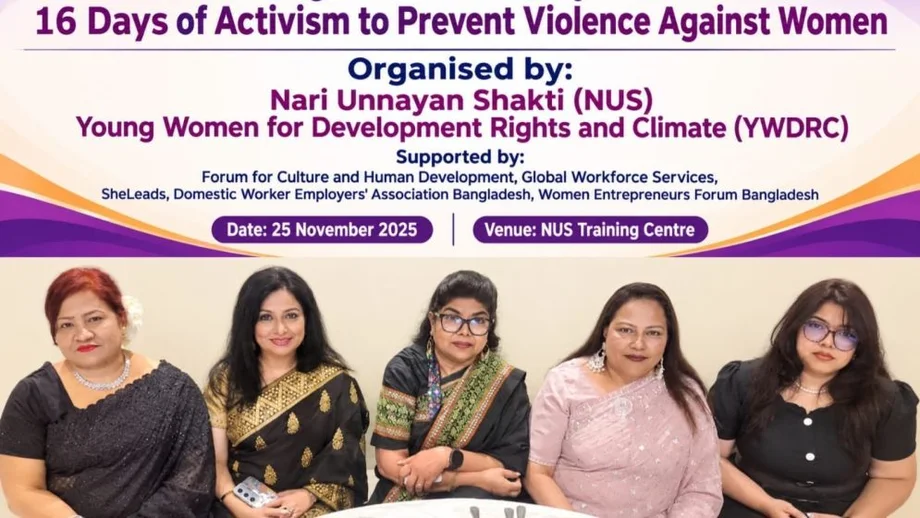
Another launch event at the NUS Training Centre in Dhaka produced the campaign's most detailed list of proposed government action. Nari Unnayan Shakti and Young Women for Development Rights and Climate organised it with support from the Forum for Culture and Human Development, Global Workforce Services, SheLeads, the Domestic Worker Employers' Association Bangladesh and the Women Entrepreneurs Forum Bangladesh.
Dr Afroja Pravin, executive director of Nari Unnayan Shakti, chaired the event. Nusrat Sultana Afroj delivered a keynote presentation on the current situation of violence against women in Bangladesh and routes towards prevention and redress. Speakers included Selina Akhter, music artiste Sompi Zaman, Dr Sultan Muhammad Razzak and Abdul Momin. Their discussion covered rape, sexual harassment, domestic violence, child marriage, dowry related violence, trafficking, workplace abuse and digital violence.
The organisers addressed 10 recommendations to the government:
- Register every complaint promptly and investigate it impartially, without negligence, harassment or reluctance from law enforcement personnel.
- Accelerate rape and sexual violence investigations by promptly collecting medical examinations, DNA results and other forensic evidence, while reducing delays throughout the judicial process.
- Provide integrated protection through safe shelters, medical care, legal assistance, mental health support, psychosocial care and rehabilitation.
- Monitor investigations, the submission of charge sheets, court proceedings and judgments, with special action on cases that have remained unresolved for long periods.
- Train law enforcement and judicial officials to handle cases professionally and respect survivors' dignity, privacy and safety, without blaming victims or discriminating against them.
- Expand public awareness of National Helpline 109 and other support services so that women and girls in rural and urban areas know where and how to seek assistance.
- Establish working complaint, investigation and remedy mechanisms in workplaces, educational institutions, public transport and public spaces.
- Create effective ways to report and remedy cyberstalking, online sexual harassment, blackmail and the circulation of intimate material without consent.
- Run lasting social and educational programmes on child marriage, dowry, discrimination and harmful norms, involving schools, families, religious and community institutions, men and boys.
- Build strong coordination among government, civil society and women's organisations for data collection, monitoring, service referrals, policy advocacy and accountability.
Together, the recommendations follow the path a survivor may travel, from making the first complaint to receiving shelter and medical care, seeing a case reach court and returning to a secure life. They also place prevention beside prosecution, asking schools, families, workplaces and technology platforms to act before abuse becomes another unresolved case.
The campaign calendar and the decisions still to come
The national dialogue launched a programme of advocacy, public engagement and activities to raise awareness across Bangladesh. Those activities are scheduled to continue until 10 December 2026. The separate AFD and NUS events show how the campaign is being taken up by development agencies, women's organisations and community groups as well as ministries and UN bodies.
- In 2024, the Bangladesh Bureau of Statistics and UNFPA conducted the Violence Against Women Survey that identified connections between violence, disasters and displacement.
- On 25 November 2026, the Aloki dialogue, the AFD programme and the NUS Training Centre launch marked the International Day for the Elimination of Violence against Women and opened campaign activities in Dhaka.
- From 25 November to 10 December 2026, advocacy and public engagement activities are due to take place across Bangladesh.
- By 2030, France aims to support the elimination of violence based on gender through its feminist foreign policy and development financing, in line with Sustainable Development Goal 5.
Participants in the national dialogue called for legal updates, but no draft amendment or date for new legislation was announced. The clearest immediate commitments are the agreement among the three ministries, the EU funding pledge and the nationwide campaign calendar. The detailed recommendations from rights groups provide a public checklist against which future complaint handling, services, investigations and institutional coordination can be assessed.
Key Points
- Bangladesh launched its 16 Days of Activism against Gender-Based Violence on 25 November 2026, with activities scheduled through 10 December.
- Three ministries have signed an agreement intended to provide legal assistance and related services for abused women and children from a single place.
- UN officials called for enforcement, accountability, comparable data, adequate funding and changes to harmful social norms.
- The EU ambassador cited about €10 million for prevention and response initiatives in Bangladesh.
- Speakers demanded that digital abuse be addressed as a human rights issue, including platform accountability and cooperation with technology companies.
- Government data cited by development partners put lifetime intimate partner violence at 76% among Bangladeshi women who have ever been married.
- The 2024 national survey connected greater vulnerability to violence with disasters, displacement and resource scarcity.
- Rights groups issued 10 recommendations covering complaints, forensic evidence, shelters, Helpline 109, case monitoring, workplace safety, digital remedies and institutional coordination.