A verdict in days, a backlog measured in years
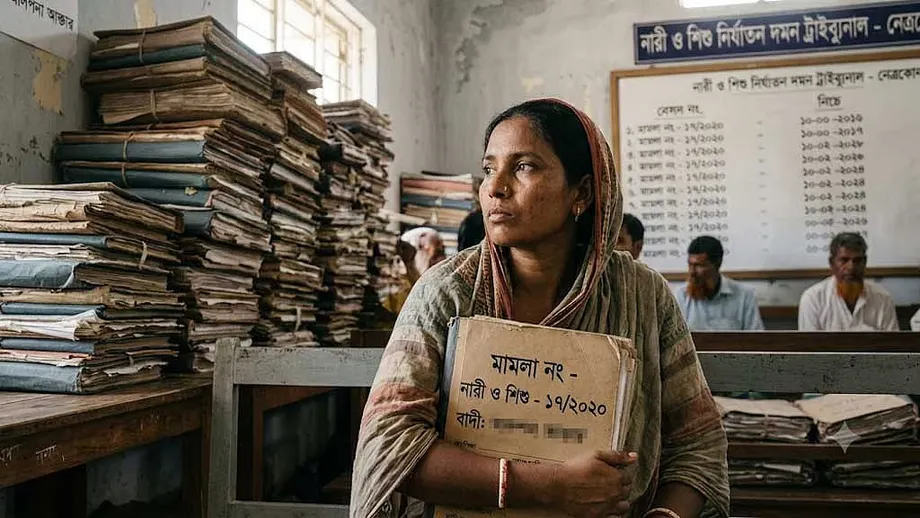
Bangladesh's High Court upheld Sohel Rana's death sentence for the rape and murder of Ramisa Akhter on November 17, 2026, while acquitting his wife, Swapna Khatun. The ruling followed a trial completed in five working days. Across the country's 101 Women and Children Repression Prevention Tribunals, however, 116,392 cases were pending as of June 30, including 26,249 unresolved for more than five years, according to Supreme Court figures.
Contents
- A verdict in days, a backlog measured in years
- Why the High Court reached different decisions
- How Ramisa's case moved through the courts
- What 4,040 completed cases reveal
- The backlog has fallen, but older cases persist
- Short deadlines meet slow medical evidence
- A monitoring order left unfulfilled
- Families pay for every additional year
- A death sentence starts another queue
- Speed needs judges, evidence and accountability
- Key Points
The contrast reaches beyond the speed of one verdict. A joint Supreme Court and BRAC study of 4,040 completed cases found that proceedings lasted an average of three years and seven months, with 22 hearing dates per case. Only 3% ended in convictions, about 70% in acquittals and 13% in settlements.
Ramisa's case also brought a warning from the High Court itself. The bench questioned the recording of testimony from 16 witnesses in a single day and said trials should finish within a reasonable time without being rushed. Its decision changed the outcome for one of the two people sentenced to death by the trial court.
For families waiting elsewhere, the obstacles are often practical and repeated: medical reports that take months to arrive, witnesses who move away, court journeys that consume wages, threats to withdraw complaints and too few judges to clear the queue. A monitoring mechanism ordered by the High Court in 2016 had still not been established a decade later.
Why the High Court reached different decisions
Justices Bhishmadev Chakrabortty and KM Rasheduzzaman Raja upheld Sohel's sentence after considering his confession, witness testimony, the autopsy report and medical evidence. The court found that he had raped and murdered Ramisa and considered the brutality of the crime grounds to retain the death penalty.
Swapna's position was different. The High Court found that Sohel's confession did not describe her as helping him commit the rape or murder. Other testimony also failed to establish the active involvement needed to convict her of assisting those offences under Sections 30 and 9(2) of the Women and Children Repression Prevention Act, 2000.
Attorney General Ruhul Quddus Kazal said witness testimony indicated that Swapna had helped Sohel escape by cutting a window grille. The court nevertheless found no legal basis for her convictions for participation in the principal crimes or under Section 201 of the Penal Code, concerning the concealment of evidence. It ordered her release unless she was required in another case.
Deputy Attorney General Ijaz Kabir attributed the rapid investigation and trial to the quick identification and arrest of the accused, a confession and strong evidence. He also said the Attorney General's Office had sought faster proceedings on Prime Minister Tarique Rahman's instructions.
How Ramisa's case moved through the courts
Police recovered Ramisa's body from a neighbour's flat in Pallabi, Dhaka, on May 19. Her father, Abdul Hannan Molla, filed a case against Sohel and Swapna. Police arrested Swapna at the flat and Sohel later in Fatullah, Narayanganj.
The case then passed through investigation, trial and High Court review within six months:
- May 19, 2026: Police recovered Ramisa's body and arrested the two accused.
- May 24: Police submitted the charge sheet, setting out the accusations and evidence for trial.
- June 1: The tribunal formally framed charges.
- June 2: The tribunal recorded testimony from 16 prosecution witnesses.
- June 7: Judge Masrur Salekin sentenced both defendants to death, with fines of Tk500,000 for Sohel and Tk200,000 for Swapna.
- November 16: The High Court began hearing the death references and appeals.
- November 17: The High Court upheld Sohel's death sentence and acquitted Swapna.
The trial court directed that the fines be paid to Ramisa's legal heirs. Her father expressed satisfaction with the swift disposal but said he would consult the attorney general before deciding his next steps.
The attorney general said the accused and Ramisa's father could seek review by the Appellate Division. Whether a further appeal would be filed, and when any such hearing would take place, had not been announced.
What 4,040 completed cases reveal
Retired district and sessions judge Umme Kulsum led the Supreme Court and BRAC research, which examined cases completed between January and June 2025 in 42 tribunals across 32 districts. Researchers reviewed court records and registers covering hearing dates, adjournments, witnesses, accused people, forensic examinations and outcomes.
The average duration of three years and seven months shows how far ordinary proceedings stretch beyond the intended timetable. The study identified absent complainants and witnesses, repeated requests for more time, slow investigations, weak evidence and inadequate witness protection as major causes.
The finding that 3% of cases ended in conviction sits alongside about 70% ending in acquittal and 13% in settlement. The published breakdown did not specify the remaining outcomes. These figures concern completed cases in the study sample, giving a direct view of what happened when those proceedings finally ended.
Police Headquarters figures provide another view of the workload. During the first eight months of 2025, police recorded 2,698 cases involving children and 10,475 involving women, while 14 child cases and 273 women cases ended in conviction during that period. Police presented the corresponding ratios as 0.52% and 2.61%. Those figures compare filings and convictions within a period; the joint study instead followed the outcomes of completed cases.
Legal Aid Department Director General Md Manjurul Hossain described the pressures behind families abandoning proceedings. Social stigma, fear, attempts to negotiate settlements and pressure from accused people can make it difficult to continue. Violence inside a home also leaves prosecutors with fewer outside witnesses.
The backlog has fallen, but older cases persist
Supreme Court figures show that the tribunal backlog declined from 142,575 cases on September 30, 2025, to 116,392 on June 30, 2026. That is a reduction of 26,183 cases, or about 18.4%, over nine months.
The number pending for more than five years also fell, from 30,623 to 26,249. Even after that reduction, cases older than five years represented roughly 22.6% of the June backlog, more than one in five.
The June total included 11,879 cases still at the inquiry or investigation stage. Excluding those left 104,513 in the remaining pending caseload. Another 1,609 cases were subject to stays ordered by higher courts, meaning proceedings had been paused.
One case in Dhaka's Khilgaon shows how long a proceeding can outlast a child's early years. Charges concerning the alleged rape of a girl aged five were framed on May 18, 2004. On July 21, 2025, the tribunal acquitted the accused because of insufficient evidence. The survivor was then an adult.
Md Sazzad Hossain, public prosecutor at Women and Children Repression Prevention Tribunal-3, described what happens to evidence during such waits:
Witnesses move away, forget details, or stop showing up when a case drags on for eight or 10 years. Doctors retire, complainants remarry, and families no longer want to revisit the past. Defence lawyers then argue there is no ground for conviction, and the court is left with no option but to acquit.
Short deadlines meet slow medical evidence
The Women and Children Repression Prevention Act, as amended in 2026, sets an investigation deadline of 15 working days from a suspect's arrest. The trial deadline is described in the 2016 High Court monitoring directive as 180 days after charges are framed; presentations of the joint research describe it as 180 working days.
Investigators identify medical and forensic evidence as a major obstacle to meeting short deadlines. DNA results can take more than a year. Inspector Tanvir Ahmed said medical reports can also take that long, while shortages of personnel add to the delay.
Tanvir investigated a child rape case in Chattogram's Bakalia in which Monir Hossain received life imprisonment within 13 days. The inspector submitted the charge sheet in five working days because the case received priority and medical and DNA reports arrived quickly.
Tanvir explained the difference in treatment:
The case was given priority, you could say. The case was sensational. As a result, the medical and DNA reports came quickly.
The amended law's Section 32A allows an investigating officer to seek permission from a tribunal or competent magistrate for DNA testing when necessary. If testing is omitted, the officer must explain why in the investigation report. Samples sent for testing in rape cases are to receive priority. Amendments introduced after the Magura case in 2025 also allowed courts, where they considered it appropriate, to proceed on medical certificates without DNA testing.
A monitoring order left unfulfilled
On December 5, 2016, a High Court bench led by Justice M Enayetur Rahim directed the Supreme Court registrar general to establish a monitoring cell for tribunal deadlines. The proposed body was to include representatives of the home and law ministries and be headed by the registrar general or High Court registrar.
The cell was supposed to report periodically to the Supreme Court and government so that unexplained delays could be addressed. The law also requires the tribunal judge, public prosecutor and investigating officer to submit separate explanations when a trial exceeds its deadline.
By October 2026, High Court special officer Mazharul Haque confirmed that no such cell existed under the registrar general. Nationwide information tracking compliance with the deadline was consequently unavailable.
A Habiganj case illustrated the problem. On June 9, 2026, the High Court summoned tribunal judge Syeda Minhaj Um Munira over a trial concerning the alleged rape and murder of a girl aged 17 in December 2021. The proceeding had remained pending for more than four years.
Appearing on June 23, the judge explained that she had joined the tribunal only in September 2025 and had since recorded six witnesses. Repeated attempts to bring other witnesses to court had failed. The High Court accepted her explanation, excused further personal appearances and directed her to complete the trial promptly.
Families pay for every additional year
Alpana Akter, the mother of Panna Akter in Netrokona, financed court travel through work in shops and a brick kiln. The case, filed in 2017 over the alleged rape of Panna, aged 14, and allegations that she was driven to suicide, reached a death sentence verdict in 2025, nearly eight years later. Alpana described her pursuit of justice as lasting nine years.
Alpana explained the financial burden:
I spent a lot of money pursuing the case. I worked at a brick kiln and in shops to keep it going. There was the cost of transport to and from court, food and many other expenses. I pursued the case for nine years.
She also alleged that people offered money to withdraw the case, assaulted her when she refused and set fire to her home with kerosene. Neighbours extinguished the flames, she said.
Mahmud-ul Alam Chowdhury Maruf, a state lawyer at two Chattogram tribunals, said changes of address prevent summons from reaching complainants and witnesses. A summons is the formal notice requiring someone to attend court. He also alleged that accused people sometimes manipulate the process to make notices disappear.
Human rights lawyer Salma Ali, an adviser to the Bangladesh National Women Lawyers' Association, called for law ministry oversight and home ministry coordination. Manjurul Hossain proposed coordination among the law, home and health ministries and the judiciary to speed up testimony and proceedings.
A death sentence starts another queue
A tribunal's death sentence must go to the High Court for confirmation through a death reference. Judges examine the evidence and legal findings before the sentence can proceed. Appeals may be heard alongside that review.
The process requires a paperbook, a compiled record containing the complaint, charges, testimony, trial judgment and related documents. Workloads at the government printing press can delay preparation, while limited High Court benches restrict the number of hearings.
Retired Supreme Court judge Krishna Debnath estimated that a death reference typically takes at least a week to hear. Judges read the record, hear prosecution and defence arguments and question the lawyers. Allowing for court vacations, she estimated capacity at about 36 cases annually for one bench or 72 for two.
A senior High Court official said ordinary death references were being heard from the 2018 queue, while prominent cases could receive earlier hearings. At that pace, a sentence delivered in 2026 could wait until about 2034 for disposal, an estimate based on the current queue rather than a scheduled hearing date.
The chief justice formed a special bench on June 10 to expedite death references and appeals under the women and children law. Supreme Court figures recorded more than 22 references disposed of after its formation. Death sentences in Panna's case and the Magura child rape and murder case, decided within 14 working days, were still awaiting execution.
Speed needs judges, evidence and accountability
The High Court's concern about hearing 16 witnesses in one day reflects the need to give each case enough attention. Debnath also opposed verdicts delivered within five or six working days and called for more courts and judges, while warning that judicial experience takes time to develop.
Law Minister Md Asaduzzaman pointed to funding and staffing constraints at the research consultation. He put the judiciary's allocation at about Tk22 billion, compared with about Tk25 billion for Bangladesh Television. The figures were the minister's comparison, covering a judiciary budget that must support salaries, administration and infrastructure.
BRAC Executive Director Asif Saleh argued that funding must be accompanied by accountability and shared responsibility among police, doctors and justice officials. The study's findings support that practical focus: a shorter legal deadline still depends on a laboratory producing results, a witness reaching court and a judge having time to hear the evidence.
Ramisa's case moved quickly through those stages. For families elsewhere, the test is whether ordinary cases can receive reliable evidence, protected witnesses, regular hearings and timely review without needing national attention.
Key Points
- The High Court upheld Sohel Rana's death sentence on November 17, 2026, and acquitted Swapna Khatun.
- A Supreme Court and BRAC study found an average case duration of three years and seven months, with 22 hearing dates.
- Of 116,392 pending tribunal cases in June 2026, 26,249 were more than five years old.
- A monitoring cell ordered by the High Court in 2016 had not been established by October 2026.
- Delayed medical evidence, missing witnesses, family pressures and limited judicial capacity prolong proceedings.
- Death sentences require High Court confirmation, adding another stage where cases can wait for years.