A Kremlin declaration turns warm ties into a formal partnership
Russia and Brunei raised their relationship to a strategic partnership on 25 November 2026, following Kremlin talks between President Vladimir Putin and Sultan Hassanal Bolkiah. Putin projected that bilateral trade would exceed $1 billion for the year, while the two leaders presented plans covering energy, food exports, finance, defense, education and the digital economy.
Contents
- A Kremlin declaration turns warm ties into a formal partnership
- Two meetings that turned an anniversary into a formal partnership
- What the declaration actually sets out
- Trade, national currencies and a longer export list
- Oil technology and the possibility of floating nuclear plants
- Navy visits and a wider Asian diplomatic push
- Visas, tourism and the next presidential visit
- Why a small sultanate matters to both leaders
- Key Points
The declaration concluded a state visit on 24 and 25 November, the sultan's first state visit to Russia since 2005. His program included laying flowers at the Tomb of the Unknown Soldier. At the Kremlin, the national anthems were played and the delegations were introduced before talks in narrower and expanded formats. The meeting took place in the Malachite Foyer of the Grand Kremlin Palace.
After the talks, the sultan said the new status would preserve the principles that had guided the relationship.
We decided to raise relations to the level of strategic partnership, which will continue to be based on our long-term friendship, strengthening partnership and mutual consideration of interests.
Putin described the declaration as a broad program rather than a single commercial agreement. He said it set ambitious tasks and plans for the long term across all major areas of cooperation. The sultan separately called the discussions productive and said they had covered the bilateral agenda.
Two meetings that turned an anniversary into a formal partnership
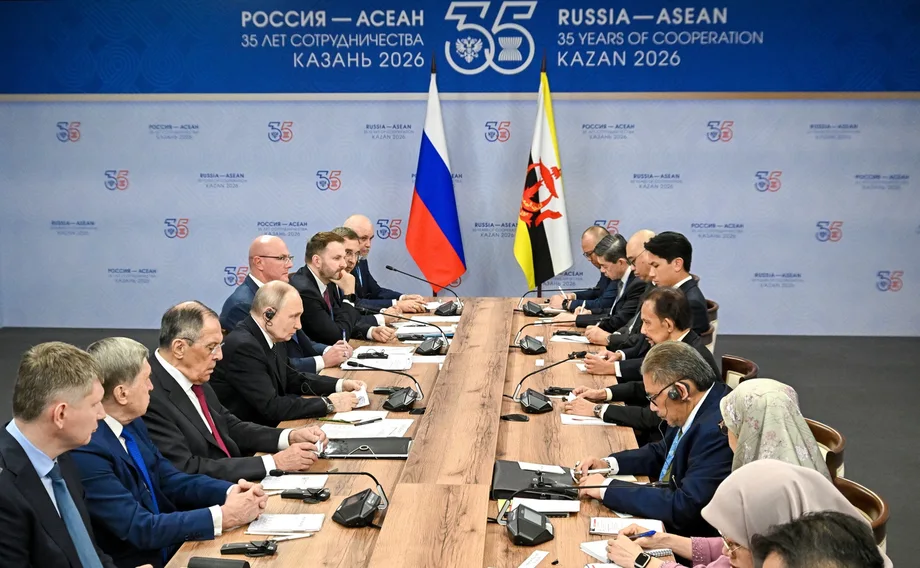
The November announcement built on talks held in Kazan on 17 June 2026, one day before a summit marking 35 years of relations between Russia and the Association of Southeast Asian Nations (ASEAN). In the Kremlin meeting transcript, Putin welcomed the sultan to the capital of Tatarstan and noted that Russia and Brunei were also celebrating 35 years of diplomatic relations.
Trade was already close to the threshold that Putin later expected it to cross.
Our bilateral trade is showing positive momentum and is now approaching the billion-dollar threshold.
At that June meeting, Putin proposed a bilateral intergovernmental commission, a standing mechanism through which ministers and officials could coordinate work on energy and other sectors. He also praised Brunei's balanced international position and highlighted tourism and direct contacts between citizens. The sultan thanked Russia for hosting the ASEAN summit, recalled welcoming Putin to Brunei for APEC in 2000 and mentioned Putin's extensive virtual participation in regional summits during Brunei's ASEAN chairmanship in 2021.
The leaders met again on the sidelines of the APEC summit in Shenzhen, China, shortly before the Moscow visit. The November program therefore combined frequent personal contact with the ceremonial weight of a state visit.
- 1 October 1991: Russia and Brunei established diplomatic relations.
- 1998: Brunei opened its embassy in Moscow.
- 2005: The sultan made his previous state visit to Russia.
- 2010: Russia opened its embassy in Brunei.
- 2019: The sides signed a memorandum on mutual understanding and bilateral consultations on security.
- 17 June 2026: Talks in Kazan addressed trade, energy, visas and a possible intergovernmental commission.
- 24 and 25 November 2026: The sultan's state visit ended with the strategic partnership declaration.
What the declaration actually sets out
A strategic partnership is a diplomatic framework for closer and more regular cooperation. In this declaration, the leaders committed to build on existing areas of collaboration, identify new subjects of mutual interest and encourage closer interaction for the benefit of both countries and their populations. Trade, defense and security, education, humanitarian contacts, energy and the digital economy were all included in the discussions.
Putin said the relationship rested on friendship, mutual respect, consideration of interests, equality and mutual benefit. He also described regular political dialogue between foreign ministries and security councils, alongside cultural and educational exchanges.
Speaking after the adoption of the document, Putin said neither government intended to treat the announcement as a finishing point.
Both the Russian and Brunei sides do not intend to stop at what has been achieved, and are determined to jointly raise bilateral ties to a new, even more advanced level.
The declaration did not itself supply a launch date for the commission proposed in Kazan. Its practical importance will depend on whether the broad agenda produces named projects, contracts and a continuing schedule of official meetings.
Trade, national currencies and a longer export list
Putin acknowledged that commerce remained modest in absolute terms even as he forecast more than $1 billion in turnover for 2026. The sequence matters: trade was approaching $1 billion in June, while the November statement was a projection for the full year. A final customs total was not supplied with the announcement.
The two sides agreed to expand settlements in their national currencies. That means more transactions could be paid for in Russian rubles and Brunei dollars instead of passing through a third currency. For businesses, such arrangements can reduce conversion steps and dependence on external payment channels, although no target for their share of bilateral trade was announced.
Putin connected these financial plans with what he described as similar Russian and Brunei positions on many global and regional questions.
This makes it possible to reliably protect mutual trade and investment from the negative influence of the world political situation and volatility in global markets.
The proposed economic exchange extends well beyond energy. Russia wants to increase supplies of petrochemical products, mineral fertilizers and food, including grain and meat prepared according to Islamic halal rules. For Brunei, those talks concern potential supplies of food and agricultural inputs. For Russia, they create additional outlets for industrial and farm exports while supporting the goal of crossing the $1 billion mark.
Oil technology and the possibility of floating nuclear plants
Energy was described as the traditional leading sector in the relationship. Putin said Russia could help Brunei obtain more output from oil and gas fields already in production and develop reserves that are difficult to extract. The techniques under discussion are intended to recover a larger share of the resources underground, rather than simply drilling more conventional wells.
Putin said Russian companies had experience and technical solutions that could be transferred to Brunei.
We could share with our Brunei friends unique Russian experience, expertise and highly effective technical solutions in this area.
The leaders also discussed renewable and atomic energy. Separately, Rosatom, Russia's state nuclear corporation, may offer Brunei small floating nuclear power plants. Such plants place reactors and generating equipment on floating platforms that can supply electricity to coastal areas. The public statements did not provide a plant capacity, location, price or construction schedule, so the nuclear proposal remains a possible area of cooperation rather than a dated construction project.
The sultan added a wider technology agenda. He said Brunei wanted to include the digital economy, artificial intelligence and energy in future work, citing Russia's experience. He also welcomed exchanges between business communities, giving smaller companies a place in a relationship often presented through meetings between heads of state.
Navy visits and a wider Asian diplomatic push
Putin thanked the sultan for cooperation on defense and security, including support for visits by Russian Navy ships to Brunei ports. Those port calls give the partnership a visible maritime dimension. They sit alongside the 2019 security memorandum and continuing contacts between foreign ministries and security councils.
During the Kazan talks, Putin also connected the bilateral relationship to his proposal for a broad regional security system, describing it as an idea pioneered by Russia and Brunei.
The Russia-ASEAN strategic partnership stands as an important stabilising factor in the Asia-Pacific region.
The November talks extended that diplomacy. Russia and Brunei expressed readiness to strengthen ASEAN's partnerships with the Eurasian Economic Union, a trade bloc, and the Shanghai Cooperation Organisation, a regional political and security grouping. They also confirmed their intention to cooperate through the United Nations and APEC, the Asia-Pacific Economic Cooperation forum.
The Kazan program showed how Moscow was using the ASEAN summit for a series of separate relationships. Putin held bilateral meetings with leaders of the Philippines and Malaysia as well as the sultan. Kremlin aide Yuri Ushakov also said Turkish Foreign Minister Hakan Fidan had requested a meeting with Putin, one day after Fidan met Russian Foreign Minister Sergei Lavrov in Moscow.
Visas, tourism and the next presidential visit
Travel rules provide one of the most immediate effects for ordinary citizens. Putin said the existing regime allowed visa free visits lasting up to two weeks, and he thanked Brunei for admitting Russian visitors without visas. He argued that easier entry increased both tourism and direct contact between citizens.
The sultan said he hoped more Russian tourists would visit Brunei in 2027. Both leaders also supported exchanges in science, education, health, sport and culture, including contacts between youth and religious organisations.
Hassanal Bolkiah invited Putin to make a state visit to Brunei and said such a visit would be very important for his country. No date was announced. Other near term checkpoints include the final trade figure for 2026, a decision on the proposed intergovernmental commission and any contracts arising from the energy discussions.
Why a small sultanate matters to both leaders
Brunei has only around half a million people, but it ranks among the wealthiest countries when economic output is measured per person. Oil and natural gas exports underpin that prosperity. This gives the sultanate financial weight, while also creating an interest in maintaining production and preparing for limits on its own reserves.
International political scientist Elena Suponina said Brunei could eventually need imported feedstock for its refineries and could seek joint extraction and investment opportunities in Russia. She suggested that projects connected with Russian northern fields might be among the options presented. Her comments identify a possible direction for investment; the visit's announced economic measures focused on technology, supplies and broader trade.
Dmitry Mosyakov, who heads the Southeast Asia, Australia and Oceania centre at the Institute of Oriental Studies of the Russian Academy of Sciences, said Russia could also share geological exploration expertise and help search for new deposits. He described Southeast Asia as one of the engines of global development and said cooperation with Brunei supported Russia's presence in the region.
Mosyakov also noted Brunei's history as a British protectorate and the continuing presence of a British military garrison. His assessment was that British influence was unlikely to obstruct Moscow's plans. He placed considerable weight on personal trust because the sultan also serves as prime minister, finance minister and defense minister, concentrating authority in the leader conducting the dialogue.
For Brunei, closer ties bring access to Russian extraction technology, food supplies, nuclear expertise and tourism. For Russia, the partnership adds trade and diplomatic connections in Southeast Asia as Moscow seeks influence beyond the West. The declaration supplies the political framework; the next stage will be measured by visitor numbers, completed settlements, investment decisions and identifiable energy projects.
Key Points
- Putin and Sultan Hassanal Bolkiah adopted a strategic partnership declaration in the Kremlin on 25 November 2026.
- The state visit on 24 and 25 November was the sultan's first to Russia since 2005.
- Putin projected bilateral trade above $1 billion for 2026, after saying it was approaching that level in June.
- Plans include national currency settlements, oil extraction technology, petrochemicals, fertilizers, grain, halal meat, renewable energy and nuclear cooperation.
- Rosatom may propose small floating nuclear plants, but no capacity, site, price or construction timetable was announced.
- Defense discussions included Russian Navy visits to Brunei ports and continuing security consultations.
- Visa free travel, tourism, education and cultural exchanges form the main direct benefits for citizens.
- The sultan invited Putin to Brunei, but no date was set for the visit.