A 40-Centimeter Gap and a Summit Without a Meeting
Shenzhen Bao'an International Airport, November 18, 2026. Japanese Prime Minister Takaichi Sanae steps out of her government aircraft. The mobile stairs are about 40 centimeters (15 inches) below the door. She grips the door frame and lowers herself to the top step. There is a red carpet and an honor guard, but no music, no cheering crowds, no dancing. She is met by Zhang Qiyue, a 67-year-old former ambassador to Greece who has been out of active government service for five years. Zhang's father, Zhang Shu, was once China's ambassador in Tokyo.
Contents
- A 40-Centimeter Gap and a Summit Without a Meeting
- Why the Stairs Became a Diplomatic Story
- A Banquet Song With an Ironic History
- Two Handshakes and a Cold Nod
- The Taiwan Remark That Started the Freeze
- Economic and Cultural Pressure
- Historical Wounds and a Question of Remorse
- Domestic Politics: A Snub That May Help Takaichi
- A Different Kind of Diplomacy: Putin, Trump, and the Trilateral Meeting
- What Analysts Say Comes Next
- Key Points
Across the tarmac, the contrast is sharp. Chinese President Xi Jinping personally greeted U.S. President Donald Trump at the airport. Russian President Vladimir Putin was met by Cai Qi, a member of the Communist Party's Politburo Standing Committee. Australian Prime Minister Anthony Albanese walked past rows of women in white shirts and pink skirts while People's Liberation Army soldiers stood at attention. Philippine President Ferdinand Marcos Jr. received music, flowers, and dancing despite Manila's disputes with Beijing in the South China Sea. South Korean President Lee Jae-myung and his wife received VIP treatment. Taiwan's APEC representative, Stan Shih, and his wife had a quieter welcome, but children greeted them with flowers.
Takaichi received none of those celebratory touches. It was her first visit to China as prime minister and the first by a sitting Japanese leader in about seven years. Under normal circumstances, the milestone would have commanded considerable ceremony. Instead, it set the tone for a summit that ended without a single formal meeting between Takaichi and Xi.
Why the Stairs Became a Diplomatic Story
Chief Cabinet Secretary Kihara Minoru told reporters that Japanese officials knew about the gap beforehand and took safety precautions.
Since we had received that information in advance at the site, we took appropriate measures to ensure safety,' Kihara said, without specifying whether the Japanese or Chinese side provided the information. 'As a result, Prime Minister Takaichi disembarked from the aircraft safely.
A former Japan Airlines captain who reviewed the footage for Fuji Television said the stairs appeared high enough at first and seemed to be lowered in stages as they were lined up with the aircraft. He described the adjustment as highly unusual. A Fuji Television reporter aboard the same aircraft said there was no noticeable step down at the exit used by the press. It remains unclear whether the gap at Takaichi's exit was created intentionally.
China's Foreign Ministry said its arrangements followed international practice. The greeting by Zhang Qiyue, a former ambassador to Indonesia and consul-general in New York, was a protocol downgrade. Japanese wire services Jiji and Kyodo noted the disparity. Kyodo said the young people who waved red bouquets for other leaders were nowhere in sight when Takaichi's plane landed.
A Banquet Song With an Ironic History
At the welcome dinner on November 18, the hosts played 'Ue o Muite Arukō,' the Sakamoto Kyu hit known abroad as 'Sukiyaki.' Its lyricist, Ei Rokusuke, took part in the 1960 protests against the revision of the U.S.-Japan Security Treaty. That history gave the choice an ironic resonance for a prime minister who has made the alliance central to her diplomacy.
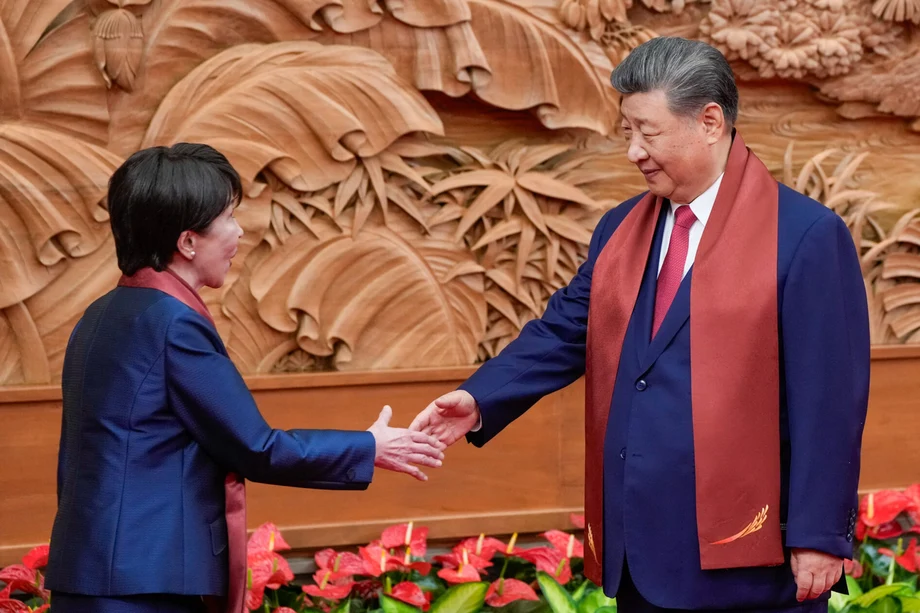
The song choice was not the only signal. Xi and his wife Peng Liyuan welcomed Takaichi and shook hands. Takaichi appeared to say a few words. Xi apparently did not reply. Japanese media reported on November 20 that Xi's reaction at the dinner reception was cold.
Two Handshakes and a Cold Nod
On November 19, Takaichi spoke to Xi for about 10 seconds during their second handshake. He appeared to nod, but it is unclear from the footage whether he actually gave a verbal reply. The two had shaken hands the previous evening as well. At the official group photo, Takaichi stood second from the right in the back row. Xi, Trump, and Putin exchanged handshakes at the front. In the meeting room, Xi sat beside Trump and opposite Lee Jae-myung. Takaichi sat seven seats away near the end of the table.
The contrast with the previous APEC summit in Gyeongju, South Korea, was stark. There, on October 31, 2025, Xi met Takaichi for the first time. The two leaders agreed to work toward stable ties. Less than a fortnight later, Takaichi told Japan's parliament that a Chinese attack on Taiwan could, under certain conditions, qualify as a 'survival-threatening situation' for Japan. That is a legal threshold that can permit the use of force, including collective self-defense.
From Beijing's perspective, the timing made the remarks a personal embarrassment for Xi. He had just met Japan's new prime minister and publicly backed stable ties, only to hear her confirm that Japan might use force in a Taiwan crisis. Beijing demanded a retraction, which was not forthcoming. Ties have been a deep freeze ever since. Takaichi and Xi shook hands at the summit, but the handshake did not break the ice.
The Taiwan Remark That Started the Freeze
Takaichi's statement on November 7, 2025, connected a possible Chinese attack on Taiwan with circumstances in which Japan's Self-Defense Forces could support U.S. forces. Taiwan governs itself, while Beijing claims the island as its territory. The dispute concerns a legal judgment as well as a political message. Takaichi said a crisis involving warships and the use of force could qualify as a situation threatening Japan's survival. Under Japan's security framework, that classification can allow collective self-defense, meaning military action to help defend another country when Japan's own survival is threatened.
Previous Japanese prime ministers had left open how Japan might respond. David Adebahr, a professor of international relations and Asia-Pacific security policy at Kobe University, said Takaichi was merely saying out loud what 'had long been the internal logic of Japanese security planning.' Geography makes the issue concrete. Japan's westernmost inhabited island, Yonaguni, sits roughly 100 kilometers from Taiwan's eastern coast. Any armed conflict in the strait would be within effective range of Japanese territory.
In Shenzhen, Takaichi reaffirmed Japan's position on Taiwan under the 1972 Japan-China joint communiqué. Beijing has made a public retraction of her remarks a precondition for any normalization. Tokyo has declined, with the prime minister insisting the government's stance reflects no departure from established Japanese policy.
Economic and Cultural Pressure
China has raised pressure on Japan across several fronts. Beijing has restricted exports of rare earth minerals critical to Japanese industry, banned imports of Japanese seafood, and told tourists to take Japan off their destination list. Grassroots exchanges have been called off. Chinese releases of Japanese films have been postponed indefinitely. In January, a pair of giant pandas, Xiao Xiao and Lei Lei, departed Ueno Zoo in Tokyo, leaving Japan without one of the animals for the first time since 1972, when Tokyo and Beijing normalized diplomatic ties.
The economic measures carry weight because China is Japan's biggest trading partner. Rare earths are used in everything from cars and computer chips to jet engines. The travel warnings and seafood ban hit specific industries and regions. The dispute has tested businesses on both sides.
Historical Wounds and a Question of Remorse
The dispute has also brought a deeper divide over Japan's wartime past back into view. Beijing still sees Japan's reckoning with its wartime aggression as a foundation of bilateral ties. Takaichi's record on historical issues, including her visits to Yasukuni Shrine, is part of her appeal to conservative supporters.
On March 16, 1995, Takaichi, then a lawmaker, told the lower house Foreign Affairs Committee that she felt no personal remorse over the war and saw no reason to be asked to express it, since her generation had played no part in the war. Then-Foreign Minister Kono Yohei disagreed. These differences make it harder for her and Xi to rebuild trust.
Yamaguchi Natsuo, a former leader of the Komeito party and now a permanent advisor, said on a program distributed on November 23 that the situation was triggered by Takaichi's remarks.
'Only Takaichi's actions can restore it. She should fulfill her responsibility as prime minister,' Yamaguchi said. He also said that the clearly differentiated welcome 'has not produced a favorable result for the Japanese people or international society.' Rather than blaming China, Yamaguchi said, 'our own attitude is questioned.' He urged Tokyo to proactively approach dialogue. 'There is no other way to break through,' he said.
Yamaguchi recalled delivering a personal letter from then-Prime Minister Abe Shinzo to Xi in January 2013, when ties were strained over the nationalization of the Senkaku Islands.
The other side felt the importance of dialogue and opened the door,' he said. 'That was the first step to opening political dialogue.
Domestic Politics: A Snub That May Help Takaichi
Beijing's cold reception may not hurt Takaichi at home. Noriyuki Kawamura, a professor emeritus at Nagoya University of Foreign Studies, said the trip achieved little in terms of Japan-China relations. But he added that the snub could galvanize her conservative base.
'The way they see it, she didn't give in to the snub she got, but shook hands with Xi as many as two times with dignity,' Kawamura said.
Yu Uchiyama, a political science professor at the University of Tokyo, said public support for Takaichi did not wane even after her Taiwan statement a year ago.
'I wouldn't be surprised to see her loyal supporters become upset by the way she was mocked and grow more resentful toward China,' Uchiyama said.
He pointed to a recent surge in distrust toward foreigners, complaints about overtourism, and soaring land prices linked to foreign investment. Takaichi has pushed for tighter control of visa rules, prompting voters skeptical on immigration to coalesce around her policies. On the back of this sentiment 'resembling xenophobia,' Uchiyama said, 'people will start to think, "why is Takaichi treated so badly overseas when she works so hard in her own country?"'
Not all reactions were supportive. Footage circulated widely online of Takaichi approaching Trump after a group photo and patting him on the back, only to be ignored by the U.S. leader, who instead walked away with Xi. That image, coupled with Trump's historic trilateral summit with Xi and Putin, fed social media narratives that she is not taken seriously on the global stage. 'Since when did Japan become such a shameful country? The whole world is laughing at us,' one post on X said. 'It is fatal that Trump, the leader of Japan's ally, ignores her like this,' another said.
A Different Kind of Diplomacy: Putin, Trump, and the Trilateral Meeting
Takaichi's only bilateral meeting at APEC was a 30-minute exchange with Putin. She raised the release of a detained Japanese journalist and protections for Japanese companies after Moscow seized assets of Japan Tobacco International. The aircraft that carried her to China was the one she had promised during her 2025 campaign for the leadership of the ruling Liberal Democratic Party to use at least once a month to bolster Japan's presence on the world stage.
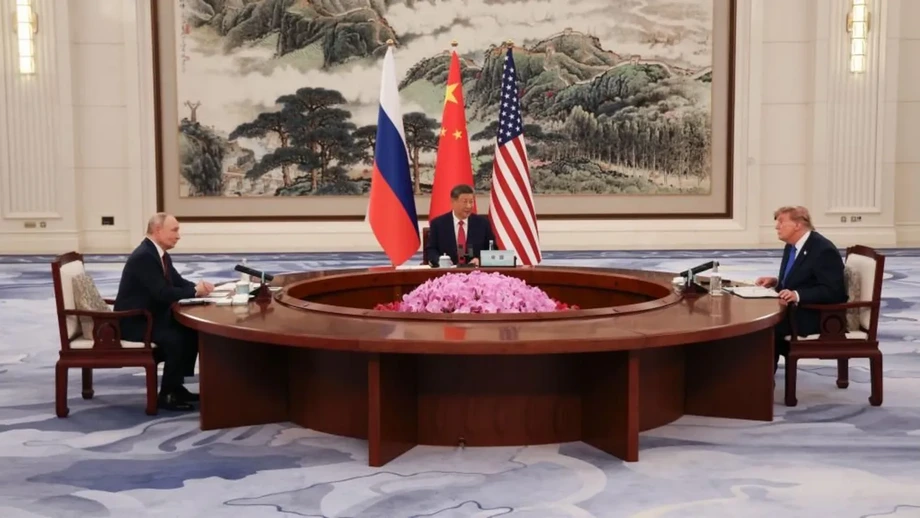
On November 19, Xi, Trump, and Putin held the first formal trilateral summit of the three countries at Kylin Villa in Shenzhen's Nanshan district. The compound covers 38 hectares and offered a private setting for the 70 to 90 minute discussion. The three leaders issued a joint statement focusing on strategic stability, international security, United Nations reform, and nuclear risk. Trump later briefed Takaichi by phone. Japanese officials had been wary that the three-power meeting could redraw existing spheres of influence. The historic trilateral meeting drew comparisons to the 1945 Yalta Conference.
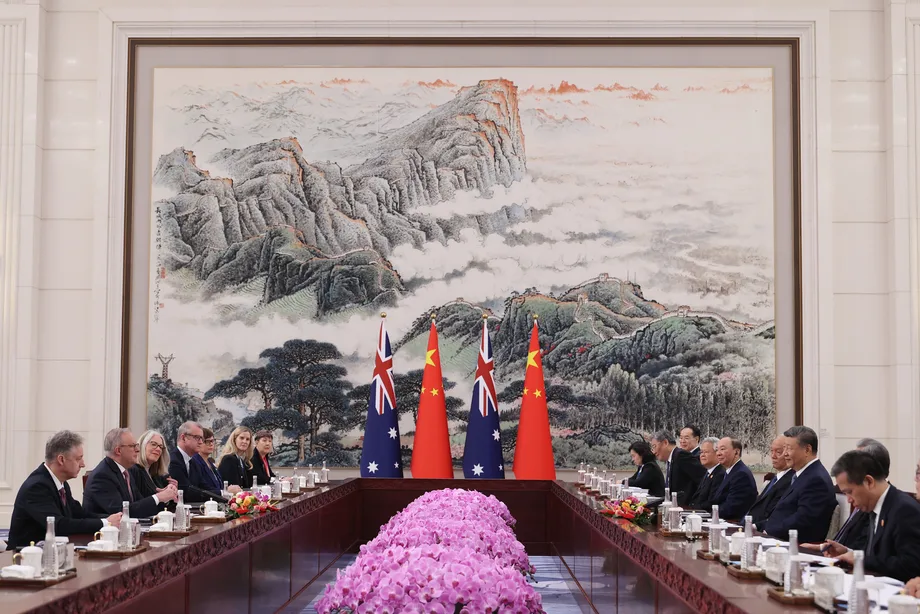
Xi held bilateral meetings with leaders from 14 countries during the four days from November 17 to 20. The Hong Kong newspaper Ming Pao reported that Takaichi and Marcos were the only two visiting neighboring leaders who did not have a meeting with Xi. Marcos did speak with Chinese Foreign Minister Wang Yi at the welcome dinner on November 18 about tensions in the South China Sea. China's Foreign Ministry emphasized the one-China policy in its readouts of bilateral meetings, including one with Albanese on November 20.
At a news conference at the end of the APEC meet, her 10th overseas trip, Takaichi listed 14 national leaders she exchanged views with since her trip began in the Philippines. Xi was not among them. The summit's agenda had focused on AI and trade, but the diplomatic freeze overshadowed the economic discussions for Japan.
What Analysts Say Comes Next
William Yang, a Taiwan-based analyst for the International Crisis Group, said the frostiness was on full display from the moment Takaichi's plane landed.
I cannot think that the issue with the plane steps was anything other than deliberate, and there was a huge contrast between the welcome she received and virtually everyone else,' Yang said. He added that the occasion 'just reflects the state of bilateral relations.
Yang said Takaichi is in a difficult position. As a committed conservative who has talked tough on Beijing's military buildup, she cannot give in to Xi's demands for fear of losing face with her hardline base.
This is a major test of her abilities and wisdom as the nation's leader,' Yang said. 'She is walking a political tightrope between reducing tensions with China but, at the same time, preparing the nation and its allies for a potential contingency over Taiwan.
Yang expects China to maintain its current approach, continuing to step up pressure by limiting targeted exports and amplifying the assertion with Russia and North Korea that Japan is embracing remilitarization. Japan, he said, is likely to seek opportunities to signal goodwill and improve relations 'in return for small-scale compromises.' A reset would depend on how the Trump administration shapes its foreign policy for the remainder of his presidency.
David Adebahr, the Kobe University professor, said Beijing believes it holds more cards than in the past.
'Today, Beijing has considerable leverage: Japan's dependence on Chinese rare earths, an increasingly visible military presence around Japan, sometimes in conjunction with Russia, and a US administration that has urged Tokyo to de-escalate rather than firmly backing it,' Adebahr said. He added that this leaves China with little incentive to offer Takaichi a face-saving compromise. Beijing's reliance on coercion could backfire by prompting Japan to increase defense spending and seek closer ties with other partners.
Adebahr also said full decoupling is unlikely.
'While economic interdependence alone will not be enough to stabilize the relationship, full decoupling is highly unlikely, as transaction costs would be far too high for both sides,' he said. Complex interdependence in trade, technology, and critical minerals will prevent a return to the old pattern of keeping politics and economics separate.
A China-based specialist on China-Japan relations said Beijing regards Taiwan as an internal matter and would continue to push back against Japanese remarks on the issue.
'China will take its time and wait for a turning point,' the specialist said.
Beijing's cold reception may make that turning point harder to reach. If it stirs sympathy for Takaichi in Japan, any move that looks like giving ground becomes more costly for her. In China, a warmer approach risks looking like a retreat on Taiwan.
For now, Trump and Xi are working to stabilize their relationship, and China can afford to wait. As long as Takaichi and Xi remain in office, a lasting thaw in China-Japan ties looks remote. Trump praised Shenzhen after the summit, highlighting the economic opportunities China wants the region to focus on. For Japan, the diplomatic freeze remains the central fact.
Key Points
- Japanese Prime Minister Takaichi Sanae received a low-key welcome at the APEC summit in Shenzhen on November 18-19, 2026, including a 40-centimeter gap at the aircraft door and a greeting from a former ambassador rather than a senior official.
- China gave U.S. President Donald Trump a personal airport welcome from Xi Jinping and laid on music, flowers, and dancing for other leaders, including Philippine President Ferdinand Marcos Jr. and Australian Prime Minister Anthony Albanese.
- Takaichi and Xi shook hands twice but held no formal bilateral meeting. Xi met leaders from 14 countries; Takaichi and Marcos were the only visiting neighboring leaders without a meeting.
- The freeze began after Takaichi told Japan's parliament on November 7, 2025, that a Chinese attack on Taiwan could qualify as a survival-threatening situation for Japan, a legal threshold that can permit the use of force.
- China demanded a retraction, restricted rare earth exports, banned Japanese seafood imports, warned tourists against visiting Japan, and postponed film releases. Giant pandas Xiao Xiao and Lei Lei left Ueno Zoo in January.
- Takaichi reaffirmed Japan's Taiwan position under the 1972 joint communiqué and has not retracted her remarks, despite pressure from Beijing.
- Analysts say the snub could strengthen Takaichi's standing with her conservative base, while critics see it as proof of diminished global standing.
- Takaichi held a 30-minute bilateral meeting with Russian President Vladimir Putin on the sidelines, where she raised a detained Japanese journalist and protections for Japanese companies.
- Xi, Trump, and Putin held the first formal trilateral summit of the three countries on November 19 at Kylin Villa in Shenzhen, issuing a joint statement on strategic stability and nuclear risk.
- Analysts expect ties to remain frosty, but full decoupling is unlikely because trade, technology, and critical minerals create deep interdependence.