U.S. Marines Extend Stay as Philippines Expands Its Marine Corps
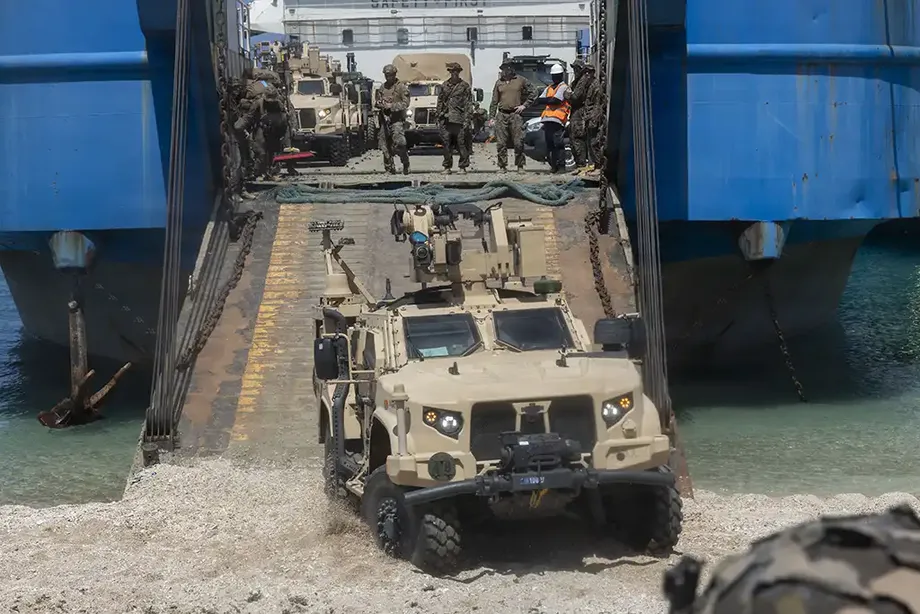
A contingent of U.S. Marines from Camp Pendleton, California, has replaced the outgoing rotation of Marine Rotational Force-Southeast Asia (MRF-SEA), keeping an American military presence in the Philippines for at least another six months. The handover means the two allies can keep building what the U.S. Marine Corps calls interoperability, which is the ability of different militaries to work together smoothly using shared procedures, equipment and communications.
Contents
- U.S. Marines Extend Stay as Philippines Expands Its Marine Corps
- A $2 Billion Defense Package Takes Shape
- Drone Boats and Radar Arrive in the Philippines
- Why Palawan and the Luzon Strait Draw Attention
- The Archipelagic Coastal Defense Continuum, Explained
- Malaysia Watches the Radar Drill with Concern
- What the Philippines Gets and What It Still Needs
- Key Points
U.S. Marine Corps Col. Coby Moran, commander of the new contingent, said his troops are inheriting more than a mission.
We will build on the relationships, lessons and interoperability developed by the Marines and Sailors before us and continue working shoulder-to-shoulder with our Philippine Allies.
Moran added that the Marines and Sailors are inheriting momentum. The outgoing commander, Col. Robert Bunn, described the rotation as a series of opportunities to improve.
Our goal was never simply to be present in the Philippines. Presence has to have purpose. Every exercise, planning session and repetition alongside our Philippine Allies was an opportunity to become more interoperable, responsive and capable together, progressively getting better with each event.
MRF-SEA first deployed in 2022 as a force that rotates every six months. Its command element has been based in the Philippines since April 2026, after previously moving among Southeast Asian countries based on scheduled activities. The current extension comes at Manila's invitation.
A $2 Billion Defense Package Takes Shape
The White House released a fact sheet on Nov. 18 after President Donald Trump's state visit to Manila, announcing a foreign military financing loan package worth more than $2 billion for the Philippines. The loan would let Manila buy defense and security equipment from U.S. suppliers. A separate $400 million in foreign military financing will cover fires that can reach distant targets, command and control systems, critical infrastructure and drones that operate across multiple domains, according to the White House. The $400 million allocation supports 1,500 American jobs, while the loan package supports more than 7,000 U.S. jobs, the fact sheet said.
Other items in the package include a $37 million contract with a U.S. company for technology that supports missions and improves interoperability between the two armed forces. The Philippine Department of National Defense also committed to work with U.S. technology providers on a $63 million upgrade of the military's defense cloud infrastructure. The two countries are exploring an intergovernmental agreement on civilian nuclear technology, which would be the first such U.S. agreement with an Indo-Pacific partner if finalized.
Defense infrastructure announcements include a $40 million fuel storage facility at Subic Bay, a former U.S. Navy base that has been used increasingly by U.S. forces since 2022. The allies also plan to modernize Basco Airport in Batanes province, in the middle of the Luzon Strait, to improve operational access, disaster response and commercial supply chains.
Lockheed Martin has proposed several systems to the Philippines, including M142 High Mobility Rocket Systems, F-16V Viper fighter jets, and an International-class frigate design partnered with Gibbs and Cox. Manila has also expressed interest in Lockheed Martin's Mid-Range Capability, a Mark 41 vertical launching system on the ground that the U.S. Army has had forward deployed in the Philippines since April 2024. U.S. aid packages for Manila's Asymmetric Capabilities Program involve drone firms Maritime Tactical Systems, Inc. and Ocean Aero.
Drone Boats and Radar Arrive in the Philippines
On Nov. 4, the United States transferred two Devil Ray T38 unmanned surface vessels, worth more than $8 million, to the Philippine military at Subic Bay. The handover took place at a newly opened Maritime Tactical Systems Inc. Unmanned Center of Excellence. U.S. Ambassador to the Philippines Lee Lipton delivered the vessels to Brig. Gen. Bayani Curaming, deputy commandant of the Philippine Marine Corps.
These American-made systems show the incredible strength of our Alliance. We are proud of the role that American technology and industry play in helping modernize the AFP and strengthening the Philippines' maritime capabilities.
Curaming said the turnover reflects the growing importance of emerging technologies in maritime security.
This undertaking reflects a longstanding partnership based on mutual respect, shared responsibility, and a common commitment to maritime security.
Army Col. Daniel Oh, chief of the Joint U.S. Military Assistance Group-Philippines, said the Devil Ray can conduct extended surveillance and reconnaissance patrols, deliver supplies, and let Philippine personnel direct missions from a safe distance.
It will strengthen the AFP's growing autonomous fleet, expanding its ability to monitor wider areas of Philippine waters for longer periods at a lower cost than crewed vessels.
The 40-foot boat can travel at more than 50 knots and carry a 4,000-pound payload. The next day, on Nov. 5, U.S. and Philippine Marines set up a Ground Based Maritime Systems-Light radar at Aporawan, Palawan, during a maritime strike targeting drill. The radar is derived from a Furuno system designed for short distances. Depending on the model, these sensors can detect and track vessels from 24 to 96 nautical miles. The activity was part of the Archipelagic Coastal Defense Continuum (ACDC) 26.5.
Why Palawan and the Luzon Strait Draw Attention
Balabac Island, at the southern tip of Palawan province, sits about 50 kilometres from Sabah's Banggi Island in Malaysia. That geography places expanding U.S. and Philippine military cooperation close to Malaysia's northern maritime approaches. The radar activity in Aporawan occurred separately from infrastructure development on Balabac, so it does not mean a permanent radar installation is watching Malaysian territory continuously.
Farther north, Basco Airport in Batanes province lies within 100 miles of Taiwan. The Luzon Strait is a waterway between the Philippines and Taiwan that would be crucial in any conflict across the Taiwan Strait. Since 2025, the U.S. Marine Corps has used Basco Airport to insert maritime sensing teams and Navy-Marine Expeditionary Ship Interdiction Systems, which are missiles designed to hit ships.
These locations are part of what military planners call the First Island Chain, a string of islands that runs from Japan through Taiwan and the Philippines. Controlling or monitoring this chain matters for any potential conflict in the region. U.S. Marines have practiced delivering missile systems and setting up radar nodes across the archipelago. In 2024, a maritime domain awareness team was placed on an island only 88 miles from Taiwan.
The Archipelagic Coastal Defense Continuum, Explained
The Archipelagic Coastal Defense Continuum is a series of small bilateral drills and exchanges between Philippine and U.S. Marines. The goal is to support the modernization of the Philippine Marine Corps and improve the ability of the two forces to operate together. The drills focus on maritime defense, fire support, command and control, sensing, and the use of uncrewed systems.
Under ACDC 26.5, on Nov. 3, Philippine Marines from the 3rd Marine Brigade and U.S. Marines from MRF-SEA held a fire support rehearsal class at Camp Rodolfo. On Nov. 5, the same exercise series included setting up the Ground Based Maritime Systems-Light radar in Aporawan. Earlier phases included ACDC 26.3 in May and June, when U.S. Marines from the Air Naval Gunfire Liaison Company Detachment-North trained with Philippine Marines on fires and effects for maritime defense. In August, ACDC 26.4 included fire support team training and simulated calls for fire. The Marines also tested the mobility of the AN/TPS-80 Ground/Air Task-Oriented Radar, which provides surveillance in all directions and can supply targeting information to other assets.
During a previous MRF-SEA rotation, the Philippines hosted the multinational drills Balikatan 2026 and Kamandag 2026. Those exercises are part of the Archipelagic Coastal Defense Continuum. In August, U.S. and Philippine Marines practiced maritime strike rehearsals with BrahMos missiles against a notional Chinese surface action group in Northern Luzon. The training supports Manila's Comprehensive Archipelagic Defense Concept, a strategic shift from internal security toward territorial and external defense.
Under the 2014 Enhanced Defense Cooperation Agreement, the U.S. maintains access to nine designated Philippine sites for joint training, placing equipment in advance, and building facilities to support operational readiness. During Balikatan 2026 preparations, U.S. Marines oversaw the delivery of vehicles and equipment from the cargo ship USNS Sgt. William W. Seay at the Port of Cagayan de Oro in Mindanao. It was the first time the service performed such an operation at that Philippine port. Joint training also includes maritime domain awareness, aviation, communications, and uncrewed systems.
Malaysia Watches the Radar Drill with Concern
Malaysian Defence Minister Mohamed Khaled Nordin warned that the expanding surveillance network could have consequences beyond the Philippines.
The repercussions could spill over into Malaysia.
He pointed to geographic exposure rather than an established Philippine military threat. The radar featured in ACDC 26.5 connects surveillance training with fire support rehearsals. Activities at Camp Rodolfo and Aporawan involved MRF-SEA personnel and Philippine Marines from the 3rd Marine Brigade. The drill demonstrated practical cooperation around deploying sensors, not a permanent operational radar installation. The specific radar's operating duration, who receives its data, and whether it is integrated with weapons were not disclosed.
For Malaysia, the concern is the potential compression of warning and response time as surveillance activity, rotational deployments, and logistics infrastructure develop across the maritime corridor near Sabah's northern island chain. Balabac Island hosts facilities that could support rotational access, equipment movement, and military sustainment near Malaysia's northern maritime approaches. The radar activity itself was separate from Balabac's infrastructure development, so it does not place a surveillance system directly opposite Malaysian islands. The available information does not establish continuous coverage of Sabah.
What the Philippines Gets and What It Still Needs
The Philippine Marine Corps is expanding. It currently comprises four marine brigades and one service support brigade for a nation of 7,600 islands. Defense Secretary Gilberto Teodoro Jr. said in November 2026 that the Armed Forces of the Philippines must strengthen ties with other forces to develop tactics, technologies and equipment tailored to the country's operational environment.
The Philippines is in the middle of a modernization effort that will take years to deter China. The initiatives bring new capabilities and concepts that Philippine forces are learning from partners such as the U.S., Japan and Australia. One notable instance is MRF-SEA's cooperation with the Philippine Marine Corps Coastal Defense Regiment.
MRF-SEA said its presence in the Philippines supports bilateral training and combined planning.
MRF-SEA provides I Marine Expeditionary Force with a scalable forward command-and-control element. These engagements strengthen interoperability and combined readiness, improving the ability of U.S. and Philippine forces to respond together to natural disasters and other crises.
Chester B. Cabalza, founder and president of International Development and Security Cooperation, said the U.S. defense commitment to the Philippines remains unmatched by Manila's other security partners in the Indo-Pacific region.
Washington wants to strengthen Manila to build a network of allies that are capable of defending their own sovereignty and willing to contribute to regional security.
On relations with Beijing, Cabalza said the defense commitments would not necessarily undermine the Philippines' ties with China.
Now that Manila knows how to navigate an active hedging strategy, this will not hinder our relationship with Beijing.
He added that the Philippines should take advantage of improving relations between Washington and Beijing under the Trump administration. The fact sheet also cited Philippine Airlines' planned $12 billion purchase of as many as 20 Boeing 787 aircraft equipped with GE Aerospace engines. The purchase is a private sector commercial transaction. Trump announced more than $17 billion in commercial deals and strategic investments across Southeast Asia during the summit.
Key Points
- A contingent from Camp Pendleton, California, has replaced the outgoing MRF-SEA rotation, keeping a continuous U.S. Marine presence in the Philippines.
- The White House announced a foreign military financing loan package worth more than $2 billion and $400 million in military financing for the Philippines.
- The U.S. transferred two Devil Ray T38 unmanned surface vessels worth more than $8 million to the Philippine military on Nov. 4 at Subic Bay.
- U.S. and Philippine Marines set up a Ground Based Maritime Systems-Light radar in Aporawan, Palawan, on Nov. 5 under ACDC 26.5.
- The radar system can detect vessels from 24 to 96 nautical miles, depending on the model.
- Malaysian Defence Minister Mohamed Khaled Nordin warned that repercussions could spill over into Malaysia, noting Balabac Island's proximity to Sabah.
- The Archipelagic Coastal Defense Continuum includes fire support rehearsals, radar deployment, and missile training with BrahMos.
- The Philippines is expanding its Marine Corps, which has four marine brigades and one service support brigade for 7,600 islands.