A One-Year Deadline to Fix Indonesia's Police Law
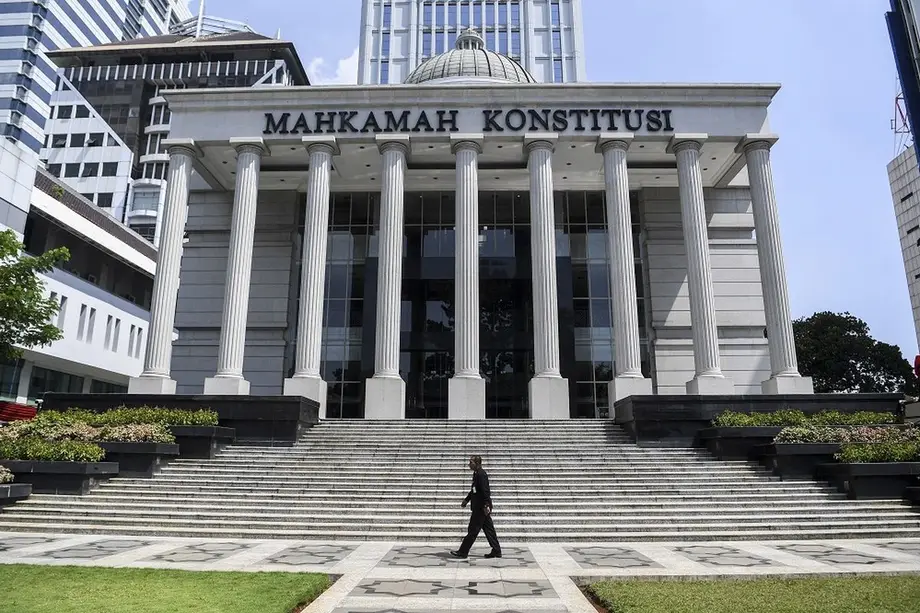
The Constitutional Court of Indonesia (MK) on Monday, November 23, 2026, declared that Law Number 5 of 2026 concerning the Third Amendment to Law Number 2 of 2002 on the Indonesian National Police (Polri) is procedurally flawed (cacat formil). In a ruling delivered at the MK Main Courtroom in Central Jakarta, the court gave the government and the House of Representatives (DPR) a maximum of one year to revise and repair the legislation's drafting process.
Contents
- A One-Year Deadline to Fix Indonesia's Police Law
- How the DPR Bypassed the Legislative Body
- Public Participation and Unheeded Reform Proposals
- A 4-1-4 Split Among the Nine Constitutional Justices
- What the Ruling Means for Civil Society and Police Reform
- Parliament's Response and a Busy Day at the Court
- Timeline of the 2026 Police Law Dispute
- Key Points
Chief Justice Suhartoyo read the verdict for Case Number 251/PUU-XXIV/2026, granting in part the formal review petition filed by Zulfikar Putra Utama, a researcher at the Indonesian Parliamentary Center (IPC), and Muhammad Ezra Suhaeri, the 2026 Chairman of the Student Senate at UIN Syarif Hidayatullah Jakarta. A formal judicial review (uji formil) examines whether lawmakers followed the mandatory rules and constitutional procedures required to create a law, rather than judging the substance of individual articles. In this case, the court determined that lawmakers skipped mandatory legislative steps and failed to ensure proper public participation when enacting the law, which is recorded in the State Gazette of the Republic of Indonesia Year 2026 Number 63 and Additional State Gazette Number 7181.
Chief Justice Suhartoyo announced the court's formal ruling and explained the conditional validity of the statute during the Monday session.
Granting the petition of Petitioner I in part. Declaring that the formation of Law Number 5 of 2026 concerning the Third Amendment to Law Number 2 of 2002 on the Indonesian National Police does not conflict with the 1945 Constitution of the Republic of Indonesia and remains conditionally legally binding, provided that improvements are made within a maximum of one year from the pronouncement of this decision.
Under this conditional status, Law Number 5 of 2026 remains in force while parliament and the president work to repair the legislative process. However, if lawmakers fail to complete the required procedural fixes before the one-year deadline expires on November 23, 2027, the 2026 amendment will become permanently unconstitutional. Should that happen, all articles and provisions revoked or altered by the 2026 law will automatically revert to the original Law Number 2 of 2002 on the Indonesian National Police.
To prevent wide-ranging disruptions while the law remains active over the next 12 months, the court placed strict boundaries on how the police law can be applied. The justices ordered that any strategic execution of Law Number 5 of 2026 having broad public impact must align with the spirit of police reform established in Article 30 of the 1945 Constitution, People's Consultative Assembly Decree (Ketetapan MPR) Number VII/MPR/2000, and Constitutional Court Decision Number 114/PUU-XXIII/2025.
How the DPR Bypassed the Legislative Body
The core procedural violation identified by the court occurred during the transition between parliamentary terms. The DPR serving the 2024 to 2029 term took over the draft police bill (RUU Polri) that had previously been discussed by the 2019 to 2024 parliament and established it as an official DPR initiative bill during a plenary session on May 20, 2026. Lawmakers executed this takeover solely through the Commission III of the DPR, which oversees law and security, without submitting the draft to the DPR Legislative Body (Badan Legislasi, or Baleg) for harmonization.
In Indonesia's lawmaking system, harmonization is a mandatory quality-control step where Baleg reviews a draft bill to ensure its concepts are complete and do not clash with the constitution or existing laws. This requirement is governed by Article 46 paragraph (2) of Law Number 12 of 2011 on the Formation of Legislation (known as UU P3) and Article 129 of DPR Regulation Number 1 of 2020. During the trial, lawmakers argued that the plenary session, as the highest decision-making forum in parliament, had the authority to approve the bill directly, and claimed that harmonization was substantively achieved later during working committee meetings, drafting teams, synchronization teams, and discussions of the Problem Inventory List (Daftar Inventarisasi Masalah, or DIM).
Constitutional Justice Enny Nurbaningsih rejected both arguments while reading the court's legal considerations. She explained that harmonization prepares the foundational concept of a bill before it becomes a parliamentary initiative, whereas DIM discussions occur much later when the DPR and the President jointly debate a bill's contents.
The authority of the Plenary Session to establish a bill as a DPR initiative bill is a legitimate authority. However, that authority does not automatically provide a basis to set aside stages specifically determined by the UU P3. Therefore, alignment activities carried out during DIM discussions cannot automatically be treated as a substitute for the obligation to conduct harmonization that should have been done at the drafting stage.
Enny added that the court also examined how lawmakers used an earlier ruling, Constitutional Court Decision Number 114/PUU-XXIII/2025, as an entry point and justification to fast-track the 2026 police law. While the court did not judge the material articles of the law in this formal review, Enny noted that lawmakers introduced new material into the bill that conflicted with the substance and spirit of Decision Number 114/PUU-XXIII/2025. She clarified a vital constitutional rule: whereas public feedback during lawmaking must be properly considered but is not legally binding, a Constitutional Court ruling evaluates the constitutionality of a norm and must be strictly executed as an inseparable whole according to its verdict and legal considerations. Lawmakers cannot simply reinsert a previously invalidated norm into a newly revised law.
Public Participation and Unheeded Reform Proposals
Beyond internal parliamentary rules, the Constitutional Court faulted lawmakers for failing to uphold the principle of openness and meaningful public participation (meaningful participation), which gives life to Article 22A of the 1945 Constitution. Referencing the legal standards set in Constitutional Court Decision Number 91/PUU-XVIII/2020, the justices reiterated that citizens hold three specific rights during lawmaking: the right to have their opinions heard, the right to have their opinions considered, and the right to receive an explanation or answer regarding the input they provide.
Constitutional Justice Ridwan Mansyur stated that the drafting of the 2026 police law lacked definite, standard, and established legislative methods and failed to follow the principles of lawmaking mandated by Law Number 12 of 2011. He read the court's conclusion on the procedural failures and the consequences of missing the repair window.
The Court is of the opinion that the formation process of Law Number 5 of 2026 did not fulfill the provisions based on the 1945 Constitution, and therefore must be declared procedurally flawed. If within a maximum period of one year improvements are not made to Law Number 5 of 2026, by law it becomes permanently unconstitutional.
The flaws in public engagement were a central pillar of the petition brought by Zulfikar and Ezra, who were represented by a legal team from the Advocacy Team of the Movement for Police Reform (Tim Advokasi Pergerakan untuk Reformasi Polri). The legal team was coordinated by Hijri Ruzbihan Baqli alongside attorneys Muhammad Syarif Kusumojati, A. Fahrur Rozi, and Arya Ramdani SP. During the preliminary examination hearing on Tuesday, July 7, 2026, Hijri presented three primary arguments detailing how the law was rushed through parliament.
First, the petitioners demonstrated that the Public Hearing Meetings (Rapat Dengar Pendapat Umum, or RDPU) held by lawmakers largely invited organizations with affiliations or potential conflicts of interest with lawmakers and the police institution, leaving broader civil society aspirations unaccommodated. Second, lawmakers ignored strategic institutional reform recommendations compiled by the Police Reform Acceleration Commission (Komisi Percepatan Reformasi Polri, or KPRP). Third, Commission III bypassed Baleg entirely prior to the May 20, 2026 plenary vote.
Hijri summarized the fundamental violation before the panel of justices during the July 7 hearing.
The drafting of the Police Bill did not involve Baleg at all to carry out its harmonization function as commanded by Article 46 paragraph 2 of the UU P3 and Article 129 of DPR Regulation Number 1 of 2020. The failure to execute the stages of harmonization, rounding, and solidification of conception by Baleg before establishing the Police Bill as a DPR initiative bill is a procedural defect of a fundamental nature.
A 4-1-4 Split Among the Nine Constitutional Justices
The decision to declare Law Number 5 of 2026 procedurally flawed exposed a sharp division on the nine-member Constitutional Court bench. Only four justices voted together on both the main reasoning and the one-year deadline: Chief Justice Suhartoyo, Deputy Chief Justice Saldi Isra, Enny Nurbaningsih, and Ridwan Mansyur. One justice issued a concurring opinion (alasan berbeda, agreeing with the outcome but for different reasons), while four justices issued dissenting opinions (pendapat berbeda, disagreeing with the verdict).
Constitutional Justice Arsul Sani provided the pivotal fifth vote to grant the petition in part, but wrote a concurring opinion. Arsul argued that the only legally valid complaint in the petition was the absence of the harmonization and synchronization stage in Baleg, rejecting the other arguments regarding KPRP recommendations and public participation. Furthermore, Arsul maintained that consistent with previous Constitutional Court rulings on formal reviews, lawmakers should have been granted a maximum of two years to repair the law rather than one year.
The four dissenting justices split into two distinct camps:
- Constitutional Justices M. Guntur Hamzah and Daniel Yusmic P. Foekh argued that the petition should have been dismissed on procedural grounds. They concluded that the two petitioners lacked legal standing (kedudukan hukum) because they did not possess a direct causal link (kausal verband) to the formation process of Law Number 5 of 2026.
- Constitutional Justices Adies Kadir and Liliek Prisbawono Adi argued on the merits that the legislative process did not violate the 1945 Constitution, noting that lawmakers had utilized harmonization results from the previous DPR term. They stated the court should have rejected the petition entirely and left Law Number 5 of 2026 unconditionally binding.
Chief Justice Suhartoyo read the summary of the dissenting position held by Adies Kadir and Liliek Prisbawono Adi during the session.
Subsequently, the dissenting opinion of Constitutional Justice Adies Kadir and Constitutional Justice Liliek P. Adi essentially states that the formation of the Police Law does not conflict with the 1945 Constitution. Therefore, the Court should reject the Petitioners' petition and Law Number 5 of 2026 should remain legally binding.
What the Ruling Means for Civil Society and Police Reform
For civil society advocates and policing experts, the Constitutional Court's ruling represents a critical check on how security laws are written in Indonesia. Petitioner Zulfikar Putra Utama welcomed the verdict on Monday, explaining that the lawsuit was filed as an exercise of public oversight over state administrators. He pointed out that one of the primary concerns monitored during the drafting of the 2026 police law was the expansion of active police officers being placed into civilian government spaces, a move he said could increasingly crowd out civilian rights if enacted without transparent and participatory procedures.
Zulfikar commented on the validation of their oversight efforts following the court session.
So whenever the process of forming a law does not go through the existing mechanisms, we will certainly test it. That has been proven with the Police Law, which was proven not to have gone through good legislative formation procedures and mechanisms.
Bambang Rukminto, a police observer from the Institute for Security and Strategic Studies (ISESS), described the court's decision as a loud alarm for police reform. Speaking in Jakarta on Monday, November 23, 2026, Bambang warned that the rushed drafting of the police law showed signs of autocratic legalism, a practice where officials use formal legal mechanisms to preserve power for a select group while moving away from democratic values and constitutional mandates.
Bambang urged the government and the DPR not to treat administrative lawmaking rules as mere formalities, warning that a flawed process damages the police force itself.
This MK decision is not merely a correction to a procedural defect in the formation of the Police Law, rather it is a warning that the reform of the police institution must not be built through a legislative process that ignores democratic principles. Do not let a law intended to strengthen the police actually weaken its constitutional legitimacy.
Parliament's Response and a Busy Day at the Court
The Constitutional Court verdict marked a reversal for Commission III of the DPR, which had previously insisted the bill's drafting was flawless. On Wednesday, July 8, 2026, the day after the initial court hearing, Commission III Deputy Chairman Ahmad Sahroni had publicly dismissed the allegations of procedural violations while welcoming the petitioners' right as citizens to file a court challenge.
Sahroni defended the parliament's internal process at the time of the initial hearing.
All mechanisms have been carried out according to the rules existing in the DPR RI. There is nothing procedurally flawed.
Following Monday's ruling, lawmakers adopted a cooperative posture. Commission III member Muhammad Nasir Djamil stated in Jakarta on November 23, 2026, that the DPR respects the Constitutional Court's authority and is institutionally committed to meeting the one-year deadline so the law does not become permanently unconstitutional. Although he noted he had not yet dissected the full text of the verdict, Nasir expressed confidence that DPR leadership would act swiftly and accurately.
To begin the revision process, Nasir stated that parliament is expected to bring in the DPR Expertise Body (Badan Keahlian DPR RI) during the current legislative session to map out the court's legal considerations and guide the upcoming procedural repairs in strict compliance with the UU P3.
It is likely that in this session period the DPR RI will hear input from the DPR RI Expertise Body regarding the MK's legal opinion that formed the basis of that decision. We respect that MK decision and institutionally it will certainly be addressed in accordance with the regulations on the formation of legislation.
Case Number 251/PUU-XXIV/2026 was just one of 12 judicial review rulings pronounced by the Constitutional Court during a major session on Monday, November 23, 2026. Out of the 12 cases decided that day, half (six cases) challenged the Police Law, while the remaining six involved the State Civil Apparatus Law (UU ASN), the General Elections Law (UU Pemilu), the Advocates Law (UU Advokat), the Corruption Eradication Commission Law (UU KPK), and the Criminal Procedure Code (KUHAP), which the court also examined last month in a separate ruling on corporate crime liability.
The five other Police Law petitions read alongside Case 251/PUU-XXIV/2026 were registered under case numbers 258/PUU-XXIV/2026, 355/PUU-XXIV/2026, 362/PUU-XXIV/2026, 394/PUU-XXIV/2026, and 401/PUU-XXIV/2026. Those companion petitions challenged substantive issues within the police legislation, including institutional authority, the retirement age of Polri personnel, the phrase "state government" (pemerintahan negara) in Article 2 of the Police Law, and provisions concerning Decisions of the National Police Chief (Keputusan Kapolri) in Article 34 paragraph (3) and Article 35 paragraph (2) of Law Number 2 of 2002 prior to its amendment.
Timeline of the 2026 Police Law Dispute
- May 20, 2026: The DPR (2024 to 2029 term) holds a plenary session establishing the draft Police Bill, carried over from the 2019 to 2024 term via Commission III, as an official DPR initiative bill without undergoing harmonization in the DPR Legislative Body (Baleg).
- 2026 (prior to July 7): The bill is enacted as Law Number 5 of 2026 concerning the Third Amendment to Law Number 2 of 2002 on the Indonesian National Police (State Gazette Year 2026 Number 63, Additional State Gazette Number 7181).
- July 7, 2026: The Constitutional Court holds its preliminary examination hearing for Case Number 251/PUU-XXIV/2026, filed by Zulfikar Putra Utama and Muhammad Ezra Suhaeri.
- July 8, 2026: DPR Commission III Deputy Chairman Ahmad Sahroni denies any procedural defects, claiming all internal DPR mechanisms were followed.
- November 23, 2026: The Constitutional Court rules in a 5-4 vote (with one concurring opinion) that Law Number 5 of 2026 is procedurally flawed and orders the DPR and the government to repair the legislative process within one year.
- November 23, 2027: The final constitutional deadline for lawmakers to complete the procedural revision, after which Law Number 5 of 2026 will become permanently unconstitutional if left unfixed, reverting policing rules to Law Number 2 of 2002.
Key Points
- The Constitutional Court declared Law Number 5 of 2026 on the Indonesian National Police procedurally flawed in Case Number 251/PUU-XXIV/2026 on Monday, November 23, 2026.
- The primary procedural defect occurred when the 2024 to 2029 DPR took over the bill from the 2019 to 2024 term and passed it in a May 20, 2026 plenary session without mandatory harmonization by the DPR Legislative Body (Baleg), violating Article 46 paragraph (2) of the UU P3 and Article 129 of DPR Regulation Number 1 of 2020.
- The court also ruled that lawmakers failed to guarantee meaningful public participation under Article 22A of the 1945 Constitution and introduced norms that contradicted Constitutional Court Decision Number 114/PUU-XXIII/2025.
- Law Number 5 of 2026 remains conditionally valid for one year; if the DPR and the President fail to repair the law by November 23, 2027, it becomes permanently unconstitutional and Law Number 2 of 2002 returns to full force.
- The nine justices split 4-1-4: Suhartoyo, Saldi Isra, Enny Nurbaningsih, and Ridwan Mansyur voted for the one-year revision order; Arsul Sani concurred on the Baleg defect but favored a two-year deadline; M. Guntur Hamzah, Daniel Yusmic P. Foekh, Adies Kadir, and Liliek Prisbawono Adi dissented.