A border that keeps losing people
Kazakhstan counts 1,374 settlements within 50 kilometres of its state border, and more than 1.7 million people live in them. Deputy Yerlan Saiyr carried those figures into the Kurultai, the national assembly that advises the president and now works through standing committees, on 26 November 2026. The trend he came to describe runs the other way: in the west, the north and the east of the country, the population of those places keeps falling.
Contents
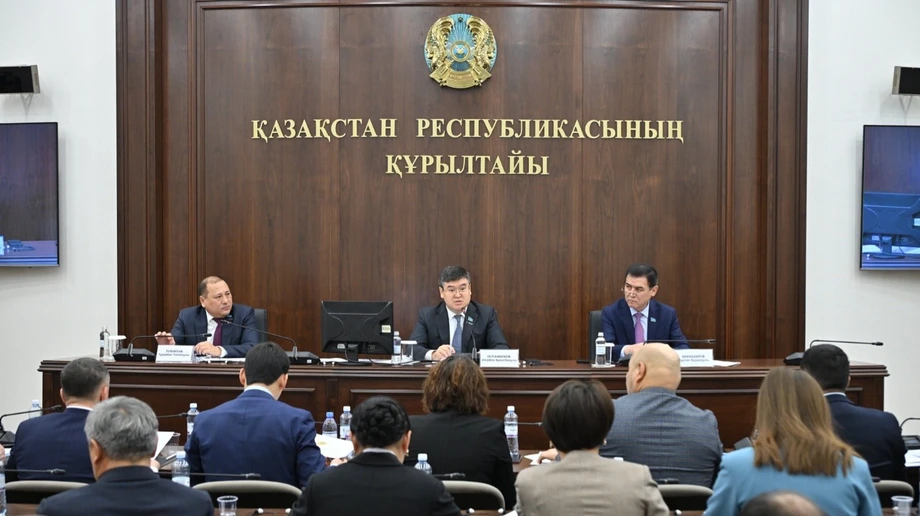
Saiyr presented the draft law "On the development of border territories of the Republic of Kazakhstan" to the Kurultai's Committee on Regional and Infrastructure Development, chaired by Amirbek Ospanbekov. Deputies wrote the document to carry out an instruction from President Kassym-Jomart Tokayev, given at the fourth session of the National Kurultai in March 2025. It would give the border a legal status of its own in a stand-alone law and set up a register that decides where state money goes first.
The deputy was asked which stretch of the border was in the worst condition. He answered with regions rather than with neighbouring countries, and the geography of his own bill explains why: its northern territories border Russia, its eastern ones border China and Russia, its southern ones border Kyrgyzstan, Uzbekistan and Turkmenistan, and its western ones border Russia, Turkmenistan and the Caspian Sea.
Western Kazakhstan, northern Kazakhstan, eastern Kazakhstan: in all of these regions the processes of demographic decline are under way. That is why this law mainly concerns the regions of the west, the north and the east.
Saiyr listed what is missing there. Schools, hospitals and rural health posts are in short supply, and he singled out road construction as decisive for reaching those places at all. Then he named a shortage that rarely appears in infrastructure debates at all.
"On this day it has to be said that more than half of the medical points in border territories do not have even elementary internet," Saiyr said.
A feldsher post is a small rural clinic, often staffed by one nurse or paramedic, and for people far from a district hospital it is the first contact with the health system. Without a connection, the staff of more than half of those posts in the border zone work outside the digital systems that the rest of the health service uses.
What the bill would actually change
The draft introduces the legal category of a border territory, defined as an administrative unit lying within 50 kilometres of the state border. Settlements no more than 25 kilometres from the border are classed as remote, and they would qualify for special policy measures of their own. The authorised body for regional development approves the list and compiles a Register of border territories from proposals submitted by akimats, the local administrations that run districts and regions.
The register is the mechanism that matters in practice. Once a village is on it, state money for roads, schools, hospitals and cultural centres is meant to flow there first, ahead of other claimants on the budget. The bill states that development is to rest on four principles: economic justification, coherence, fairness and security.
The subject of the draft law is the establishment of the legal status of border territories, the definition of the powers of state bodies, and the development of mechanisms for planning, financing and lending. The document also sets out the principles of economic justification, coherence, fairness and security.
Beyond the register, the bill lists a set of support measures: financing for infrastructure projects, loans, interest subsidies and loan guarantees for small business, leasing support, investment support, cooperation between producers, public-private partnership, housing programmes, and standards for how schools and hospitals must operate in remote border settlements. It also names the sectors to be promoted, from industry and agriculture to processing, trade, logistics and tourism.
Saiyr argued that the point is to change the order in which money arrives.
The law allows state investment and funds from the quasi-public sector to be directed to these settlements as a priority, money that today, let us say, arrives there very sluggishly.
The quasi-public sector is the layer of companies owned or controlled by the state and its holding companies, which carry out much of Kazakhstan's large investment. The bill would let the government steer that spending toward the border as well as budget money.
A self-sufficient economy, or buildings without work
Amirbek Ospanbekov, who chairs the committee, framed the bill around incomes rather than construction. He said border areas matter for keeping the country's demographic balance, for steady economic growth and for the wellbeing of citizens, and described the goal in plain terms.
Our main goal is to form a self-sufficient economic environment in such districts. This will allow people not simply to live there, but to have stable work, to open their own business, to start production enterprises and to earn a decent income.
Deputy chairman of the Kurultai Nurlan Beknazarov told the meeting that border territories should be treated as a full part of the country's economic and social space, with potential in trade, logistics, industry and international cooperation. He said development there has to be comprehensive: modern infrastructure, jobs, support for business, specialists willing to come, and a better quality of life.
Deputies raised several practical questions during the discussion, including the criteria for putting a settlement on the list, whether places with social and infrastructure problems could be added to a separate register, and how the tourist potential of border districts should be valued in economic terms.
The sums are missing from the document
What the bill does not contain is money. No guaranteed amounts are written into it. The authorised body is given the power only to "submit proposals" on additional financing, which leaves the size of the programme to be settled later, in the budget cycle. The presentation's expected results were also given without numbers, so there is no target for how far the outflow of residents should slow, and no yardstick for judging afterwards whether the law worked.
The salary measure is similarly bounded. The bill proposes a coefficient of up to 1.5 on the official salaries of civil servants working in socially important fields in remote border settlements, meaning teachers, doctors and other budget employees. It is a ceiling rather than a promise. Local representative councils, the maslikhats, would still take the final decision, and current rules already let them raise the pay of rural specialists by at least 25 percent.
Two limits narrow the reach further. The bonus applies only to budget employees, so a farmer, a lorry driver or a shop owner near the border gains nothing from it. It applies only to settlements within 25 kilometres of the border, leaving the other half of the 50 kilometre band with the register but not the pay supplement.
What the northern resettlement programme taught
Kazakhstan already runs a scheme meant to pull people toward the border. Under the programme of preferential resettlement to the northern regions, 73,900 people have taken part since 2017, and 31,000 of them were placed in permanent jobs through employment measures, according to the ministry responsible. A separate project, "Shyghys shakyrady" ("The East is calling"), has been extended to every district of the East Kazakhstan region.
The record has drawn criticism. Researchers have said the programme ignores social factors, and Maulen Ashimbayev, then speaker of the Senate, called it ineffective in 2024. In 2021 resettlers complained about the housing they were given, and two akims lost their posts over it.
The new bill follows the same sequence the resettlement programme used: infrastructure first, people afterwards. The difference is the emphasis on small business, with microcredit, subsidised rates, leasing and loan guarantees written into the text. Whether a family stays in a village depends less on the school building than on work and income, and those measures arrive without sums attached or dates for when they start.
Where the people go instead
The emptying of the border shows up as crowding somewhere else. Turarbek Tlemisov, the deputy chairing the working group that is preparing the bill, described the link in a report to the same committee's debate on balanced regional development.
Every year thousands of families leave their native villages and move elsewhere. People do not leave because they do not love their native land. It is simply becoming harder to find work with a stable income, to take a child to school when the roads turn to mud in spring and autumn, or to get to a doctor in time.
Astana's population grew by 87,000 more people than it lost in 2025. The country's Concept of Regional Development for 2025 to 2030 records a shortfall of 270,000 school places in the 2024 to 2025 academic year, about 30,000 of them in the capital, and projects that the national gap could reach 1 million places by 2030 at current rates of population growth. More than 1,200 villages still have no road with a hard surface linking them to their district centre, which is what makes an ambulance or a school bus unreliable in rain and mud.
Fourteen of Kazakhstan's 17 regions sit on a border. Tlemisov put the consequence in terms of national geography: while a light burns in the windows of houses on the border, the frontier is not empty, and when the last family leaves, it is not only the village that empties.
The case for bringing back the district
Tlemisov wants something the bill does not propose. He argues that border districts should regain the district status abolished at the end of the 1990s, because restoring a district centre brings the akim, the hospital and state services back within reach, and decisions are made locally rather than hundreds of kilometres away.
Kegen district in the Almaty region is his example. Restored in 2018, it attracted investors, new enterprises and jobs, and tax receipts rose several fold. He adds that status alone will not hold people: housing, steady work and a good road to the district centre have to come with it.
He also wants a minimum share of local budgets locked to rural roads, bridges and water pipes so the money cannot be moved elsewhere, part of the revenue a region generates returned to its villages, and akims judged by whether residents stay rather than by how much budget money they have spent.
Saiyr is looking to a programme that already commands presidential attention. Tokayev's recent address to the nation proposed declaring the coming year a Year of nationwide large-scale construction, with the "People's construction" programme covering every district and settlement, not only the big cities.
We will propose that border settlements also have their own priority area in this very good, well thought out programme.
What happens next
Every proposal from the presentation goes to a working group led by Tlemisov, which will examine the text clause by clause. The meeting drew deputies along with representatives of several ministries, the National Security Committee, the Atameken national chamber of entrepreneurs, and institutes for parliamentarism, legislation and legal information, and economic research. No date has been set for the working group's conclusions or for a first reading, and the bill's financing figures will only appear once the government writes them into a budget.
One piece of border business does have a deadline. Demarcation of the Kazakh-Russian border along the Altai is due to be completed by the end of 2026, and the National Security Committee has said that the final stage, on the summit of Mount Muztau, also known as Belukha, will not cut off access to a popular tourist route.
The bill offers a legal framework and a queue for money. The queue only works if the register is drawn up honestly and the funding reaches the smallest villages rather than stopping at district centres. Kegen shows that status and investment can revive a place; the resettlement programme shows that walls and paint, without work and income, have not been enough.
Key Points
- Kazakhstan has 1,374 settlements within 50 kilometres of its border, home to more than 1.7 million people, and their populations are falling fastest in the west, north and east.
- Deputy Yerlan Saiyr presented the draft law "On the development of border territories of the Republic of Kazakhstan" on 26 November 2026 to the Kurultai's Committee on Regional and Infrastructure Development.
- The bill was written by deputies to carry out President Kassym-Jomart Tokayev's instruction from the National Kurultai session of March 2025.
- Border territories are defined as units within 50 kilometres of the border, remote settlements as those within 25 kilometres, and a Register of border territories will decide which places get state money first.
- Saiyr said more than half of medical points in the border zone have no basic internet, alongside shortages of schools, hospitals and roads.
- No financing sums appear in the draft, and the expected results are stated without figures.
- The salary coefficient of up to 1.5 covers only budget employees within 25 kilometres of the border, and maslikhats take the final decision.
- The existing resettlement programme has involved 73,900 people since 2017 and placed 31,000 in permanent jobs, while drawing criticism for ignoring social conditions.
- Astana gained 87,000 more residents than it lost in 2025, and the country was short of 270,000 school places in 2024 to 2025, a gap that could reach 1 million by 2030.
- A working group led by deputy Turarbek Tlemisov will review the bill, with no date yet set for its conclusions or a first reading.