Thailand clears first gate as membership race quickens
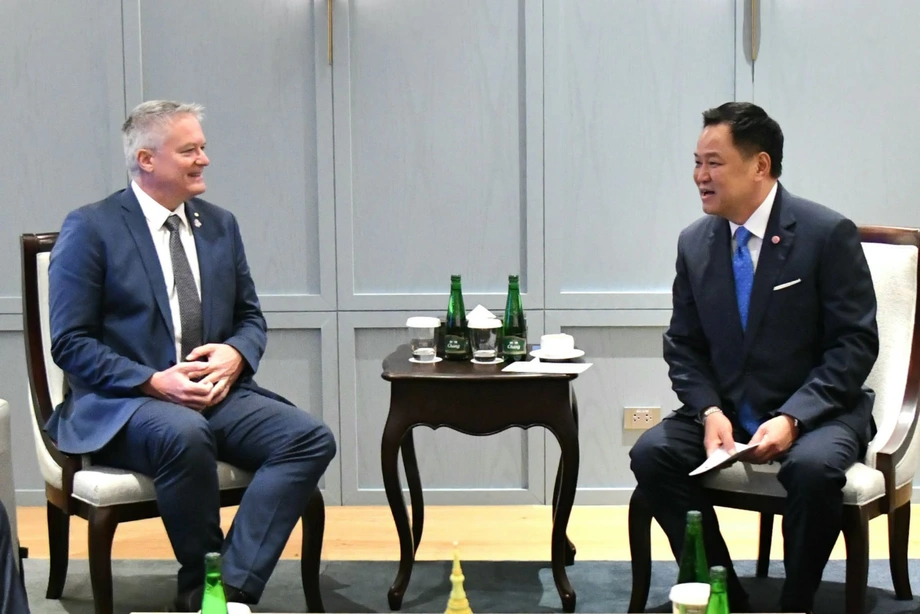
BANGKOK, 23 November 2026. Prime Minister and Interior Minister Anutin Charnvirakul announced at 13:25 at Thai Khu Fah Building, Government House, that Thailand had passed the first assessment in its campaign to join the Organisation for Economic Co-operation and Development (OECD). He spoke after meeting OECD Secretary-General Mathias Cormann and his delegation. Anutin said Cormann confirmed that the review of regulatory requirements passed with no added conditions or questions at this stage, and that formal written confirmation was expected by the end of the year. The government wants full membership in 2028, two years earlier than its previous 2030 target.
Contents
- Thailand clears first gate as membership race quickens
- What the assessment actually checks
- A short timeline of Thailand's OECD bid
- Why Cormann's Bangkok visit carried weight
- Anutin's main message: use membership, not just win it
- The Country Programme model that Bangkok says sped reviews
- What has changed in rules, taxes, skills and energy
- The productivity problem behind the reform push
- How the 2028 target is being managed
- Why some voices urge caution on the 2028 date
- Public buying, AI and the benefits members hope to feel
- What membership could change for investors, workers and ASEAN
- What remains unknown before the 2028 goal
- Key Points
Full membership still requires the remaining stages of accession, which examine Thai laws, public administration and market rules. Anutin described the goal as a national priority tied to reforms, competitiveness and better chances for Thai people. He said state agencies had submitted the required documentation, while government bodies, the private sector and business councils had backed the faster timetable.
What the assessment actually checks
The OECD is a policy forum of 38 member countries that compares rules and presses governments to improve economic and social well-being. Joining is called accession. In simple terms, an applicant shows how its laws and practices match OECD standards, then experts test whether those rules work in daily life. The OECD Regulatory Policy Committee found Thailand's legal framework consistent with OECD recommendations, according to Anutin. A formal letter is expected by the end of December with further recommendations for aligning more closely with those standards.
The formal route began in June 2024, when Thailand became Southeast Asia's second OECD accession candidate, and continued in July 2024 when the OECD Council adopted the Roadmap for the Accession Process of Thailand. The OECD's OECD mission to Thailand media advisory, dated 20 November 2026, said the Roadmap provides for a detailed technical dialogue with 25 OECD technical committees made up of policy experts from member countries and the European Union. Thailand submitted its Initial Memorandum, the document setting out how its laws and policies match OECD standards, in December 2025.
A short timeline of Thailand's OECD bid
The sequence matters because several steps are happening at once: the regulatory assessment, the end of a cooperation programme, and committee reviews that run into 2027. The 23 November announcement from Government House followed a morning of talks, a joint press conference and a seminar marking the end of Phase 2 of the Thailand Country Programme.
- June 2024: Thailand became Southeast Asia's second OECD accession candidate after the OECD agreed to open discussions.
- July 2024: The OECD Council adopted the Roadmap for the Accession Process of Thailand.
- December 2025: Thailand submitted its Initial Memorandum. The National Economic and Social Development Council places the initial assessment in December 2025.
- 13 November 2026: Anutin chaired the first meeting of the steering committee overseeing the bid at Government House.
- 18 to 20 November 2026: OECD representatives held procurement review sessions with Thai officials.
- 23 November 2026: Anutin announced the regulatory assessment result after meeting Cormann.
- 24 November 2026: The Thailand-OECD Parliamentary Forum is scheduled at the Thai Parliament at 09:00 local time.
- By the end of December 2026: Written confirmation is expected.
- 2027: Technical reviews intensify, and Thailand plans to host the OECD Global Roundtable on Equal Access to Justice.
- 2028: The Thai government's target year for full membership.
The calendar shows why officials call 2027 an intense year. Reviews will feed into Thailand's next National Economic and Social Development Plan before the 2028 target arrives.
Why Cormann's Bangkok visit carried weight
Cormann arrived in Bangkok for an official visit on 23 and 24 November. The official advisory said he would join the concluding event of Thailand Country Programme Phase 2 at 14:00 local time on 23 November at Chatrium Hotel Riverside, and the Thailand-OECD Parliamentary Forum at 09:00 local time on 24 November at the Thai Parliament. The programme event drew roughly 200 participants from government, business, civil society, the OECD and member embassies, and was set to be streamed through the National Economic and Social Development Council's Facebook page.
Anutin also thanked Cormann for support shown since their previous meeting during the International Monetary Fund and World Bank annual meetings in Bangkok in October. He said Cormann's visit and public comments showed confidence in Thailand's process. Bangkok has also pointed to expressions of support from the United States as a positive signal.
Anutin's main message: use membership, not just win it
Anutin, the prime minister and interior minister, recounted Cormann's advice after the meeting. He said the OECD secretary general wanted Thailand to think past the ceremony of joining and plan how membership would help ordinary people. Anutin said the government must create concrete opportunities from the accession process, including better governance, stronger institutions, improved business conditions and wider economic chances.
Don't just aim to become an OECD member. Think about what comes next and how to maximise the benefits for Thailand and its people.
At the Country Programme seminar, Anutin gave the same idea in his own words. He said Thailand had created a mechanism chaired by him to push agencies toward the 2028 target and asked public bodies, businesses, academics and civil society to take part.
For Thailand, OECD membership is not an end in itself. It is an opportunity to accelerate reforms and build a stronger foundation for sustainable growth.
The Country Programme model that Bangkok says sped reviews
Thailand's cooperation with the OECD has a name: the Country Programme. Anutin said the OECD praised the way Thai agencies sent information, prepared documents and answered questions through this model. In practice, it works like a single front door. Instead of many ministries sending separate notes to many OECD teams, the programme channels data and clarifications directly, reducing repeated steps.
Phase 2 ran from 2023 to 2026 and built on Phase 1 from 2018 to 2021. It covered 20 initiatives under four pillars: public governance and integrity; competitiveness, productivity and investment; skills and human capital; and the green transition. The OECD worked with more than 21 Thai agencies, and 21 senior Thai officials were seconded to OECD headquarters in Paris. Secondment means officials temporarily work inside another organisation to learn its methods and carry knowledge home.
What has changed in rules, taxes, skills and energy
The governance pillar aimed to make rules easier to see and challenge. Measures included longer public consultation windows for draft laws, a proportionality test for Regulatory Impact Assessments (a check that asks whether a proposed rule is worth the burden it creates), stronger conflict of interest and whistleblower protections, and work toward joining the OECD Anti-Bribery Convention, with the application targeted for December 2025. The convention targets bribes paid to foreign public officials in international business.
On competitiveness, Thailand worked on the state enterprise sector, amendments the Trade Competition Act and the 2024 Top-up Tax Decree, which puts OECD Global Minimum Tax rules into effect for large multinational groups. In education, the programme supported better use of school data and prepared 20 proposals on lifelong learning and links between study and work. Digital skills training is given as 740 teachers and education personnel in programme material, while the programme summary lists 74 educators for that element.
The green pillar included the Clean Energy Finance and Investment Roadmap, produced with the Ministry of Energy in 2024 to draw private money into renewable power and industrial energy efficiency. These changes matter beyond a membership file. They affect how companies win contracts, how schools teach digital skills and how quickly farms, factories and households can use cleaner energy.
The productivity problem behind the reform push
Cormann used the visit to set the first assessment against a longer economic story. He said Thailand's economy has more than doubled in size since 2000 and became a major manufacturing, trade and investment hub. GDP per person rose from about 30 percent of the OECD average in 2000 to more than 40 percent in 2025. Secondary school enrolment climbed from 75 percent in 2000 to near universal levels by 2022. Internet use grew from one in 25 Thais in 2000 to nine in 10 today. Trade reached 136 percent of GDP in 2024, up from 125 percent in 2000, and more than double the OECD average.
Those gains came with a warning. Annual labour productivity growth, which measures how much output each worker produces over time, fell from 4.8 percent between 2010 and 2015 to 2.1 percent between 2015 and 2023. The number of people of working age is projected to decline by 29 percent by 2060. Cormann linked faster productivity to Thailand's goal of reaching higher income status by 2037.
OECD Secretary-General Mathias Cormann said fewer workers would force the economy to produce more from each person. He said that requires more investment, technology and innovation.
With fewer workers, each worker will need to produce more by working smarter.
How the 2028 target is being managed
Thailand's accession drive now has a machinery of committees and reports. Anutin chaired the first steering committee meeting on 13 November at Government House, with Deputy Prime Ministers Ekniti Nitithanprapas, Sihasak Phuangketkaew and Pakorn Nilapraphan among those attending. Senior officials from the Civil Service Commission, the National Economic and Social Development Council and the Council of State also joined. The government named NESDC, the Foreign Ministry and the Office of the Council of State as core agencies.
Assistant Minister of Foreign Affairs Saran Charoensuwan, whose name also appears as Sarun Charoensuwan, was appointed Thailand's OECD Chief Coordinator. Three subcommittees were set up for domestic coordination, international negotiations and legislative reform. Progress reports are due every six months. The scale is large: 25 OECD committees and 27 working parties, also called working groups, 52 bodies in all, will examine Thailand's rules and practices. The first technical opinion report followed a first technical review by the Competition Committee in June 2026, although June 2024 also appears in timetable material for that review. Around 14 technical discussions are expected by the end of 2026, with reviews intensifying in 2027.
Why some voices urge caution on the 2028 date
The 2028 target is faster than previous thinking. Cormann acknowledged Thailand's determination to join in 2028 rather than 2030 and pledged that the OECD would work closely with Thai authorities while keeping its procedures thorough. Final entry still requires the relevant committees to complete their work and all OECD member countries to agree.
Former United States ambassador Pisan Manawapat, who later became a senator, said in comments published on 5 September that people familiar with the process expected Thailand to need at least five to seven years. He raised concerns about political interference in competition policy, weak enforcement of bribery rules and poor coordination between ministries. Those issues sit at the centre of accession because the OECD looks at whether rules are enforced in daily life instead of only in legal texts.
Foreign investment restrictions also remain a live topic. The OECD has recommended reducing barriers, especially in services. Any change would have to pass through Thai lawmaking, and sensitive sectors could retain limits or exceptions.
Public buying, AI and the benefits members hope to feel
From 18 to 20 November, OECD representatives met Thai procurement practitioners in review sessions led by the Comptroller General's Department. Public procurement is the process governments use to buy goods and services, from road works to office equipment. Comptroller General Patricia Mongkolvanich said Thailand's rules matched many of the OECD's 12 guiding principles, with some areas needing improvement. She described the exercise as a way to see where Thailand stands and what needs work.
The process aims to understand Thailand's current context, which parts align with OECD principles and which parts still need improvement to meet the standard.
Thailand Policy Lab, a joint project of NESDC and the United Nations Development Programme, also used the sixth Policy Innovation Exchange to press for faster public sector innovation. Arnault Prêtet, the OECD representative at the forum, said new ideas and digital tools can help governments solve problems. The OECD's principles include leadership, civil service skills, work with citizens and businesses, experiments and evidence, and spreading working practices. Digital tools can improve services, pilot projects need to grow into national results, and foresight means reading early signals before problems arrive. Prêtet said innovation should be judged by results for people and businesses, and that artificial intelligence must be fair, trustworthy and aware of social and environmental effects. NESDC has estimated that OECD membership could add 1.6 percent extra growth in Thailand's first five years inside the group. It has also warned that some businesses will face costs during the transition, so support measures are needed to spread benefits widely.
What membership could change for investors, workers and ASEAN
For companies, OECD membership would signal that Thailand is willing to measure its rules against a demanding international yardstick. Anutin has tied accession to stronger investor confidence, better competitiveness and more opportunities for Thai people. Cormann has said closer OECD ties could help attract investment, improve productivity and raise living standards. For workers, the impact would depend on whether education and training policy can turn new investment into better paid jobs.
Bangkok also wants to present itself as a bridge between the OECD and the Association of Southeast Asian Nations. That would put Southeast Asian views more directly into global economic policy talks. Thailand plans to host the OECD Global Roundtable on Equal Access to Justice in 2027 as part of that wider role.
The regional comparison is close to home. Indonesia's foreign bribery reform became part of its own 2028 OECD membership drive after the corruption commission identified a missing offence for bribing officials of other countries. Indonesia had completed technical reviews in 20 of 24 sectors, with healthcare and other areas still needing work. Both countries show how accession turns broad diplomatic support into specific changes in national law.
What remains unknown before the 2028 goal
The main unknown is the content of the formal OECD letter expected by the end of this year. Anutin's announcement said no conditions or questions were added at this stage. The letter is expected to set out further recommendations for aligning Thai rules with OECD standards. No membership date has been fixed by the OECD, and 2028 remains Thailand's target.
The next dated steps are already on the calendar. The Thailand-OECD Parliamentary Forum takes place on 24 November at the Thai Parliament. Around 14 technical discussions are expected by the end of 2026. Committee reviews are set to continue through 2027, and the Global Roundtable on Equal Access to Justice is due in 2027. Thailand's 2028 goal will depend on how quickly and convincingly those reviews show that national rules work in practice.
Key Points
- Anutin said Thailand passed the first regulatory assessment with no added conditions or questions.
- Written OECD confirmation and further recommendations are expected by the end of December 2026.
- Thailand wants membership in 2028, two years earlier than its previous target.
- The bid now moves through 25 OECD committees and 27 working parties, with reviews continuing into 2027.
- Cormann praised Thailand's cooperation but urged the government to plan how membership benefits people.
- Productivity growth and an ageing workforce are central challenges behind the reform push.