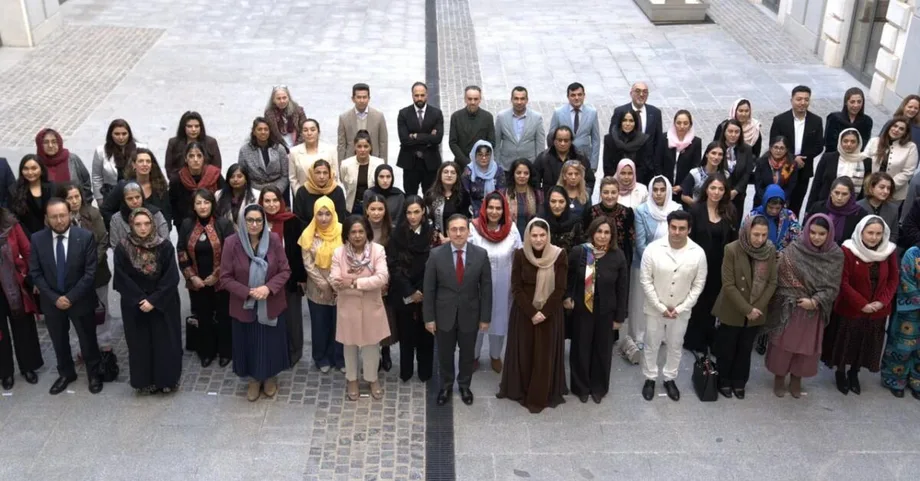
Madrid puts Afghan women at the centre of a two-day push for justice
Around 70 Afghan women's rights activists, former lawmakers, researchers, religious scholars, diplomats and United Nations officials gathered at Spain's foreign ministry in Madrid on Sunday 22 and Monday 23 November 2026 for the fourth HearUs summit, also known as Hear Our Voices, with one demand running through two days of panels: that the Taliban answer for what they have done to women and girls.
Contents
- Madrid puts Afghan women at the centre of a two-day push for justice
- One Million Voices, and Spanish money for a new investigative mechanism
- Why the word apartheid is a legal argument, not only a description
- 264 decrees, and nearly 20 million women living under them
- Fawzia Koofi: a political crisis, not only a humanitarian one
- Athletes, a mountaineer and a message from a Nobel laureate
- Two detained women, and a folder of family letters
- Inside Afghanistan, aid cuts close the last doors
- The court cases already under way
- What has not been settled, and what comes next
- Key Points
Spain's foreign ministry organised the meeting with Women for Afghanistan, the organization chaired by the former Afghan parliamentarian Fawzia Koofi. This year's theme was Afghan Women's Leadership in Achieving Justice and Peace Through Accountability. The first day belonged to Afghan Women's Peace Circles, where representatives of organizations run by women set shared priorities and looked for ways to work together. Monday's programme opened with the Spanish foreign minister and then split into four panels covering education and economic opportunity, international accountability mechanisms, Islamic perspectives on women's rights, and the place of women in decisions about peace and security.
The HearUs initiative began in February 2022, months after the Taliban returned to power in August 2021, and Spain has hosted every edition since it adopted a feminist foreign policy in 2021. Foreign Minister José Manuel Albares has opened all four summits.
Albares described Taliban rule as gender apartheid and told the room that Spain will never recognise the authorities in Kabul while they keep violating the fundamental rights of women and girls. He said the edicts amount to a system meant to make women invisible, shutting them out of education and employment and restricting their movement, expression and association. He told participants:
There can be no lasting peace without truth, without justice, without accountability and without women's participation.
He added that his government's rejection of the Taliban should not be confused with a rejection of Afghans themselves, and that Spain would keep sending humanitarian aid and stand behind international efforts to investigate abuses.
One Million Voices, and Spanish money for a new investigative mechanism
Two commitments from Madrid can be counted. Spain has made a financial contribution to the launch of a new independent United Nations investigative mechanism for Afghanistan, meant to document serious violations and preserve evidence for future proceedings, and the summit produced a framework document to press for accountability for human rights crimes in the country.
Katrín Jakobsdóttir, the former prime minister of Iceland, presented the other initiative, the One Million Voices for the Women and Girls of Afghanistan campaign, which aims to collect one million signatures. Albares signed it and chanted "For freedom and justice, for the women of Afghanistan." The campaign statement asks the United Nations and governments to refrain from recognising the Taliban, to tie diplomatic relations to improvements in women's rights, to expand humanitarian visas and safe transfer programmes for women at risk, to recognise gender apartheid in international law, and to create an international fund for women's education and employment.
Spain's foreign minister went further on the legal front. He said that during the negotiations on the Convention on Crimes Against Humanity, Spain will defend the inclusion of gender apartheid and will promote a stronger legal response to forced marriage, sexual and reproductive violence, and persecution on grounds of gender. He reaffirmed support for the International Criminal Court and the Rome Statute, which he said must be protected, and said Spain supports the work of the International Court of Justice.
"We are not going to forget what they do and we will not tolerate impunity for them," Albares said.
He also pledged that Spain would keep receiving Afghan exiles and described the country as a place from which they can speak freely, and he promised Afghan women that their situation would not drop off the international agenda.
Why the word apartheid is a legal argument, not only a description
Apartheid became a crime in international law through the 1973 convention aimed at racial domination in southern Africa. That treaty defines the practice as a system of oppression and domination by one racial group over another, carried out through laws, bans and routine violence. No treaty names gender apartheid, which is why campaigners and several governments argue that a new legal category is needed.
Putting the term into the Convention on Crimes Against Humanity would give prosecutors a name for a system that is built into law and administration rather than practised in isolated acts. That convention is still being negotiated, and Spain wants the definition written into the text it will discuss. Rights groups and UN experts have used the phrase for several years to describe the Taliban's decrees, which bar girls from secondary school and university, keep women out of most jobs, and limit where they can go and with whom.
264 decrees, and nearly 20 million women living under them
Pramila Patten, the UN Secretary-General's Special Representative on Sexual Violence in Conflict, said the Taliban has turned the exclusion of women into official government policy and has built a single legal and administrative framework for it. By June 2026, she said, the authorities had issued 264 restrictive decrees touching on human rights, 166 of them aimed specifically at women and girls.
Patten described Afghanistan as one of the most extreme cases in the world of systematic persecution of women, and said nearly 20 million Afghan women and girls live under a system designed to strip them of their independence and dignity.
"No other country has imposed such exhaustive and systematic restrictions on half of the population, based only on gender," she said.
She argued that the violations can be treated as crimes against humanity, and that documenting them and preserving evidence is essential if courts are ever to work with them. She also warned that the investigative mechanism will not deliver without political will, sustained support and money, and that funding shortages are already weakening programmes for Afghan women.
Accountability is not revenge," Patten said. "It is refusing to accept that there are people who are above the law.
She asked donors not to leave Afghan women without protection or resources, and said the evidence and the support networks built around them must not be lost.
Fawzia Koofi: a political crisis, not only a humanitarian one
Fawzia Koofi, who chairs the board of Women for Afghanistan and once sat in the Afghan parliament, said the country's situation is more than a human rights crisis or a humanitarian emergency. She called it a political crisis in which a minority holds power and about 43 million people are shut out of decisions about their own future, unable to say a word about where their country goes.
"They have questioned the existence of women," Koofi said of the Taliban, accusing the group of erasing women from public and social life.
Koofi also alleged that a recent Taliban measure has effectively permitted marriage for girls as young as 9. Whether the measure carries that legal effect has not been independently confirmed. She said child marriage existed in Afghanistan before August 2021, and argued that poverty and the absence of legal protection now put girls at greater risk, with some families marrying daughters off to raise money for their other children.
Citing conditions inside the country, she said 95% of Afghans live below the poverty line and depend heavily on humanitarian assistance. She urged donors to put organizations led by women at the front of aid programmes, saying they remain among the few sources of income and support available to women. She criticized the Taliban for expecting international donors to supply food while using the country's natural resources and revenues for themselves, and she criticized European governments for deporting Afghan asylum seekers while engaging with the Taliban, saying they should deal with the causes of displacement instead.
On the Taliban's system of government, she said it is "of the Taliban, by the Taliban and for the Taliban". Koofi warned that the crisis will not stay inside Afghanistan. "If we do nothing, within five years this situation will spill over our borders," she said, adding that it could reach Europe. She called for proceedings at the International Criminal Court and the International Court of Justice, and said political considerations should not stand in the way of justice for Afghan women.
Athletes, a mountaineer and a message from a Nobel laureate
Khalida Popal, former captain and co-founder of Afghanistan's women's national football team, said the Taliban erased the team from the country's sporting life after returning to power, but that players and advocates kept pressing international football authorities to recognise the team and let Afghan women compete again. She described the return of players to the pitch as a major achievement after years of advocacy.
The Taliban erased us. But we did not give up," Popal said. "If the opportunities are given, the platforms are given, you will see the real power of the women of Afghanistan.
Zakia Ahmad, an Afghan mountaineer, recounted how she drew strength from the situation of women at home when she doubted whether she could continue during her climb of Mount Everest. She said reaching the highest peak was more than a personal achievement and was a way to show what Afghan women can do despite the restrictions they face.
"Afghan women can do whatever they want," she said.
Navi Pillay, the 2026 Nobel Peace Prize laureate and a former UN High Commissioner for Human Rights, addressed the summit in a recorded video message. She drew a parallel with the struggle against racial apartheid in South Africa and said she was confident the campaign against gender apartheid in Afghanistan would succeed. Pillay praised Afghan women for documenting abuses, continuing their education through classes held at home, and speaking out in exile, and told them: "You are not victims waiting to be rescued; you are human rights defenders and agents of change."
The same weekend, Afghan journalist Khadija Amin's documentary "Where Are My Children?", about mothers separated from their children, won the Gender Equality Award at the 24th Zoom Festival in Igualada, Spain.
Two detained women, and a folder of family letters
On the sidelines of the summit, a women's rights activist handed Albares photographs of Bibi Sediqa and Mozhda Uzbek, two women reportedly detained by the Taliban, along with letters from their families, and asked him to help secure their release. The Taliban has not publicly commented on their cases, and no date has been given for any hearing.
Albares described the situation facing Afghan women as completely unacceptable and reaffirmed Spain's commitment to their freedom and security and to pursuing accountability for abuses. He said Afghan women should be able to speak freely from Spanish soil.
Inside Afghanistan, aid cuts close the last doors
UN Women's assessment of the crisis, published with the UN aid coordination office and partners, counts nearly 300 humanitarian health facilities closed or suspended, affecting more than one million women and girls. More than 193 focal points for survivors of violence against women have closed, affecting more than one million women and girls, and about 3.4 million women and girls in need are now unlikely to get water, sanitation and hygiene services. The agency puts the number of women and girls in Afghanistan at 22 million and says more than 100 edicts have been issued since 2021.
Sofia Calltorp, UN Women's chief of humanitarian action, described meeting a woman in Kunar who had suffered multiple miscarriages without access to health care, and displaced women facing a second winter after losing their homes to an earthquake, to fighting with Pakistan or to floods. She said the Taliban's edicts have removed the guardrails that once protected women from violence at home.
"We cannot accept this as normal," Calltorp said of the ways Afghan women keep finding to survive and support one another.
Susan Ferguson, UN Women's special representative in Afghanistan, said funding cuts have forced humanitarians to decide which women and girls receive support and which are turned away. "I urge all governments and other international donors to stand with us and with Afghan women and girls," she said. "Stay the course and increase, not cut, your support. Back these women."
Girls' education remains a measure of the loss. Some 2.6 million girls have been barred from secondary school, a figure UN agencies say will push more girls into child marriage and raise maternal deaths. Nearly eight in 10 Afghan women aged 18 to 29 are not in education, employment or training, and more than 10.7 million women and girls are estimated to need humanitarian assistance in 2026.
The court cases already under way
Accountability is not only a promise for the future. On 5 October 2026, judges at the International Criminal Court unsealed four arrest warrants against senior Taliban figures: Supreme Leader Haibatullah Akhundzada, Chief Justice Abdul Hakim Haqqani, and the ministers of education and higher education, Habibullah Agha and Neda Mohammad Nadim. The main charge is gender persecution, listed as a crime against humanity under article 7(1)(h) of the Rome Statute.
The warrants were issued on 8 July and 9 September 2025 and kept sealed until October 2026. The alleged crimes run from the Taliban takeover on 15 August 2021 to at least 20 January 2025. Legal scholars and activists met at the Afghan Embassy in Rome on 21 November to examine what the arrest warrants mean for future prosecutions and how testimony from Afghan women can support the cases.
Ten days before the Madrid summit, judges at The Hague closed two inquiries that had covered US troops and the Islamic State Khorasan group, leaving the Taliban case as the surviving line in the Afghanistan investigation, with the arrest warrants still in effect.
- 15 August 2021: The Taliban return to power and begin issuing edicts that restrict women and girls.
- 8 July and 9 September 2025: Pre-Trial Chamber II issues four arrest warrants against senior Taliban figures, which stay sealed.
- June 2026: The number of restrictive decrees reaches 264, including 166 aimed at women and girls, according to Pramila Patten.
- 5 October 2026: The arrest warrants are made public.
- 4 November 2026: UNESCO and UNICEF say more than 2.6 million girls have been barred from secondary school since 2021.
- 13 November 2026: Judges close the strands of the Afghanistan investigation covering US troops and ISIS-K.
- 22 and 23 November 2026: The fourth HearUs summit is held in Madrid.
What has not been settled, and what comes next
No date has been set for the negotiations on the Convention on Crimes Against Humanity that Spain wants to influence, so the push to write gender apartheid into international law has no timetable yet. The independent investigative mechanism Spain helped fund has only just started, and no first reports have been scheduled. The Guiding Framework for Afghanistan Accountability launched in Madrid is meant to coordinate legal and political efforts, without a published list of steps or deadlines.
Signatures for the One Million Voices campaign are still being collected, and the campaign's demands on visas, funding and diplomatic recognition depend on governments that have so far taken different approaches to the Taliban. Koofi's call for cases at the International Criminal Court and the International Court of Justice rests on proceedings that are at an early stage.
Albares closed his speech with a promise aimed at the women in the room. He said the future of Afghanistan belongs to them, and that without them there is no future for the country. The next test will be whether the documents, warrants and campaigns discussed in Madrid produce decisions rather than declarations.
Key Points
- Around 70 Afghan activists, officials and diplomats met at Spain's foreign ministry in Madrid on 22 and 23 November 2026 for the fourth HearUs summit.
- Foreign Minister José Manuel Albares said Spain will not recognise the Taliban while women's rights are violated and pledged to push for gender apartheid to be included in the Convention on Crimes Against Humanity.
- Spain made a financial contribution to a new independent UN investigative mechanism for Afghanistan and backed a framework document on accountability.
- UN official Pramila Patten said the Taliban had issued 264 restrictive decrees by June 2026, 166 of them targeting women and girls, with nearly 20 million women and girls affected.
- Fawzia Koofi said about 43 million Afghans are excluded from power and warned the crisis could reach Europe within five years.
- The One Million Voices for the Women and Girls of Afghanistan campaign was presented by Katrín Jakobsdóttir and signed by Albares.
- UN Women reports nearly 300 health facilities closed or suspended, more than 193 focal points for survivors of violence closed, and 2.6 million girls barred from secondary school.
- The International Criminal Court's four arrest warrants against senior Taliban figures, unsealed on 5 October 2026, remain in effect.