A growth forecast cut through 2028
S&P Global Ratings has lowered its growth forecast for the Philippines to 2.4% for 2026, down from the 2.9% it expected earlier, after weak public spending spread into wider domestic demand. The figure sits far below the government's target of 3.5% to 4.5% for the year. If it holds, 2026 will bring the weakest annual expansion since the pandemic, following growth of 4.4% in 2025.
Contents
- A growth forecast cut through 2028
- What the third quarter showed
- Third slowest in Asia-Pacific
- A fragile recovery, and the flood control shadow
- Timeline of a slowing economy
- Inflation is running hotter than expected
- How much higher will interest rates go?
- The budget race in Congress
- What could pull growth back up
- The rating backdrop
- What to Know
The cut, published in the agency's Economic Outlook Asia-Pacific, reaches beyond this year. S&P trimmed its 2027 forecast to 5% from 5.4% and its 2028 projection to 5.8% from 6%, while leaving 2029 unchanged at 5.8%. The 2027, 2028 and 2029 figures stay inside the government's 5% to 6% target for 2027 to 2030. The 2026 figure does not.
Louis Kuijs, S&P's chief economist for Asia-Pacific, and Vishrut Rana, a senior economist for the region, set out the reasoning behind the revision.
We lower our growth forecast for the Philippines as the effects of weak public spending are showing up in wider domestic demand.
The two economists added that confidence among Filipino businesses and households remains weak. A 2.4% expansion would mean the economy slows for a second year in a row and the government misses its growth target for a fourth consecutive year.
What the third quarter showed
Philippine gross domestic product grew 2.1% in the July to September period, the fifth quarter in a row of slowing growth, bringing average growth across the first nine months to 2.5%. That was the weakest quarter since the economy shrank by 3.8% in the first three months of 2021, when pandemic lockdowns were in force. Leaving aside the pandemic years, it was the slowest quarter in almost 17 years, since growth of 1.8% in the last three months of 2009.
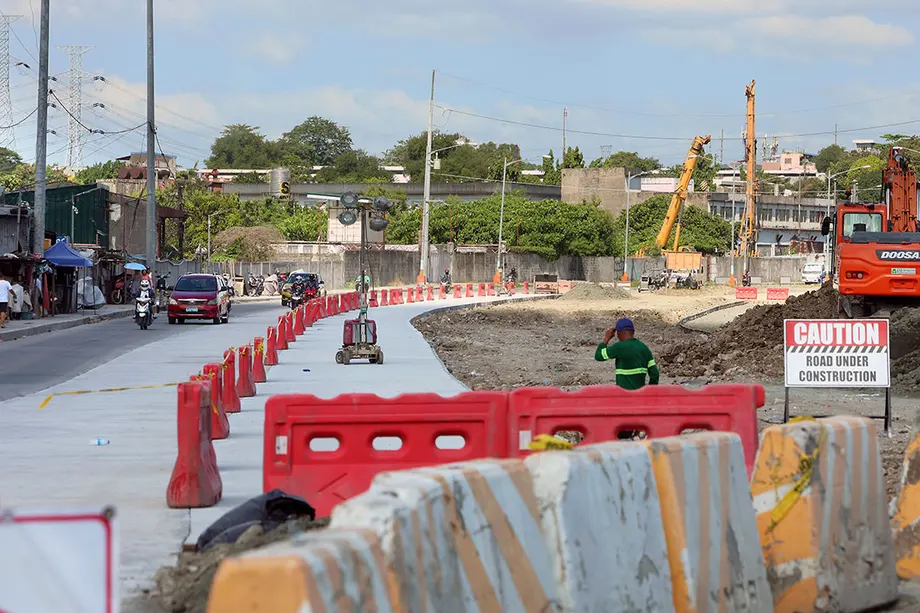
Gross domestic product measures the value of everything an economy produces. When the government buys less concrete, steel and labor for roads and flood control, construction firms earn less, their workers spend less, and the effect spreads to shops, transport and services. That chain is what S&P describes when it says weak public spending is showing up in wider domestic demand.
Third slowest in Asia-Pacific
At 2.4%, the Philippines would be the third slowest growing economy in the Asia-Pacific region this year, ahead of only Japan at 0.9% and Australia at 2.1%. S&P's regional ranking places it behind Taiwan at 12.2%, Vietnam at 9%, India at 7%, Malaysia and Singapore at 5.5% each, Indonesia at 5.4%, Hong Kong at 4.8%, China at 4.5%, South Korea at 3.7% and Thailand at 2.7%.
Among the economies S&P tracks in the region, the Philippines was the only one whose forecasts were cut for each of the next three years.
Our Asia-Pacific GDP forecast is still 4.4% for 2027, same as in September. We only made a material upward revision to our growth forecast for Hong Kong and a significant downward revision to the Philippines.
The regional figure frames the comparison. The Philippines is expected to grow far below the Asia-Pacific average of 4.4% in 2026 and only slightly above it in 2027.
A fragile recovery, and the flood control shadow
Deutsche Bank cut its Philippine forecasts as well, lowering its estimate for this year to 2.5% from 2.9% and its 2027 forecast to 4.8% from 5%. Junjie Huang, an economist at the German bank, described a recovery that is improving but still weak.
Q3'26 growth disappointed at 2.1% YoY, underscoring the fragility of the recovery. Growth should improve next year, but tighter financial conditions and subdued business and consumer confidence will constrain the rebound.
Huang pointed to governance as the central obstacle. Investigations into flood control projects that began in August 2025 uncovered anomalies, and the tighter review of public works that followed has slowed the release of funds.
Sentiment remains central to the recovery. Governance concerns have slowed public disbursements, with spillovers to private investment and household spending.
S&P's numbers show the scale of that drag. Infrastructure spending contracted in the second half of 2025 as stricter measures were applied to public projects, and growth for the full year fell to 4.4% from an average of 6.3% over the previous three years.
Timeline of a slowing economy
- August 2025: investigations begin into flood control projects, and public works slow.
- 2025: GDP grows 4.4%, down from an average of 6.3% over the previous three years.
- March 2026: energy prices surge after the Middle East war disrupts oil supplies.
- April 8, 2026: S&P revises the Philippine rating outlook to stable from positive and affirms its ratings.
- July to September 2026: GDP grows 2.1%, the weakest quarter in almost 17 years outside the pandemic.
- October 2026: the central bank raises its policy rate by 50 basis points to 5.5%, and inflation reaches 7.8%.
- December 17, 2026: the Monetary Board holds its final rate meeting of the year, and Congress aims to ratify the 2027 budget.
Inflation is running hotter than expected
S&P raised its inflation forecast for the Philippines to 6% for 2026 from 5.5%, and to 4% for 2027 from 3.6%. It held its projections for 2028 at 3.2% and 2029 at 2.9%. The agency pointed to energy costs spilling into other goods.
The increase in inflation because of high energy prices is generally dampened by policies to limit passthrough. Key exceptions include Australia, the Philippines and New Zealand, where fuel prices have risen sharply.
Deutsche Bank kept its own projections at 5.9% for this year and 4.2% for 2027, and described the central bank's forecasts as too pessimistic. Inflation accelerated to 7.8% in October from 7.2% in September, while core inflation, which strips out volatile food and energy prices, rose to 5.4% from 4.8%.
The Bangko Sentral ng Pilipinas expects inflation to average 6.1% by the end of this year, ease to 6% in 2027 and approach its target at 3.3% in 2028.
Huang said the sharp price increases of 2026 will make the inflation rate look lower a year later, without restoring what households lost.
High base effects from the 2026 price surge should mechanically lower year-ago inflation in parts of 2027, although households will continue to feel the cumulative loss of purchasing power. Weak demand should also constrain firms' pricing power.
He listed El Niño, energy costs and restrictions on food imports as risks that could push inflation higher, and warned that weather disruptions could weigh on harvests that are already low.
How much higher will interest rates go?
The central bank has been raising rates since April to stop price increases from feeding into wages and other prices. It has delivered 125 basis points of increases in total, taking the benchmark rate to 5.5%, the highest in almost two years. The October move alone was 50 basis points, larger than markets expected. A basis point is one hundredth of a percentage point.
Governor Eli M. Remolona, Jr. has said the central bank remains on a tightening path and will address the price pressures that threaten the recovery. The Monetary Board holds its last meeting of the year on Dec. 17.
Forecasters disagree on what happens next. S&P expects 50 basis points of further increases, taking the rate to 6% by the end of 2026, followed by cuts to 4.75% by the end of 2027. UBS Investment Bank expects 25 basis points in December and another 25 in the first quarter of 2027, also peaking at 6%, with room for cuts only in 2028. Deutsche Bank expects a pause in December and an increase of 25 basis points in February, depending on January inflation data.
October's jumbo 50-bp increase gives the BSP room to assess its cumulative 125 bps of tightening so far, before potentially acting again.
Huang added that the central bank's elevated 2027 inflation forecast, and its guidance that policy may not yet be tight enough, suggest the cycle is not finished. He said further increases are possible if price pressures broaden or inflation expectations worsen.
The budget race in Congress
Senate President Sherwin Gatchalian has ruled out a reenacted budget for 2027, saying the economy cannot absorb delays in passing the proposed PHP 7.2-trillion national spending plan. The Senate opened plenary debates on the budget with senators preparing for late sessions to finish within two weeks.
For us, a reenacted budget is not an option because our economy is bad. We need a fresh and new budget so that our economy will move faster.
Under a timetable discussed with Senate finance committee chairman JV Ejercito, the chamber targets a bicameral conference committee in the week of Dec. 13 and ratification before Dec. 17, so the bill can be sent to President Ferdinand Marcos, Jr. for signature. A reenacted budget keeps the previous year's spending plan in place, which freezes new programs and usually holds spending to old levels.
The calendar is crowded. About 35 presidential appointees must be processed by the Commission on Appointments before the Dec. 17 adjournment, including Cabinet secretaries, ambassadors and military officers facing promotion cutoffs. The impeachment trial of Vice President Sara Duterte is running at the same time. Gatchalian said senators are ready to give up their holiday break if talks with the House of Representatives stall, recalling that last year's impasse pushed ratification to nearly Dec. 29.
What could pull growth back up
UBS Investment Bank expects the Philippine economy to grow 5.1% in 2027, above S&P's 5% and Deutsche Bank's 4.8%. Grace Lim, the bank's senior ASEAN economist, said public investment is the reason.
We forecast growth to rebound to 5.1 percent in 2027. The improvement should be driven primarily by a recovery in public investment.
Public construction makes up about a quarter of total investment in the Philippines, Lim said, and UBS estimates that public construction alone could swing investment growth by roughly 12 percentage points between 2026 and 2027. The government has begun releasing funds and awarding infrastructure contracts, which creates room for projects to restart under stricter accountability rules.
Deutsche Bank sees support from two other sources.
Resilient IT-BPM and professional services activity, and recovering remittance growth should provide support. However, public spending plans need to translate into actual disbursements; further execution delays could prolong the squeeze on real incomes.
Official figures support the remittance case. Cash remittances reached a record US$35.6 billion in 2025, equal to 7.3% of GDP, and net foreign direct investment inflows reached US$7.8 billion. Gross foreign reserves stood at US$107.5 billion in March 2026, enough to cover about seven months of current account payments.
UBS also points to electronics manufacturing, if the global technology recovery raises shipment volumes rather than just prices, and to the Pax Silica initiative led by the United States on semiconductor and artificial intelligence supply chains. It treats that initiative as a medium-term opportunity rather than a driver for 2027.
The rating backdrop
Months before the latest forecast cuts, S&P took a more cautious view of the country's credit standing. On April 8, 2026, it revised its outlook on the Philippines to stable from positive and affirmed its BBB+ long-term and A-2 short-term sovereign ratings, a step explained in its April rating action. The agency cited the Middle East war and the effective closure of the Strait of Hormuz as risks to the country's external and fiscal position.
The ratings rest on the Philippines' growth potential and a strong external position, offset by GDP per capita that is lower than in most countries rated investment grade. S&P projected a general government deficit of 3.3% of GDP in 2026 and net general government debt of 45% of GDP in 2024, up from 26% in 2019, easing to 42.5% by 2029. Interest payments were forecast at 13.4% of government revenue in 2026.
The national government enacted a budget of PHP 6.8 trillion for 2026, an increase of 7.4% over 2025, with 38% set for social services and about 23% for economic services that include the Build, Better, More infrastructure program. The current account deficit was projected to widen to 4% of GDP in 2026 from 3.3% in 2025 as energy imports cost more.
At that point, S&P expected growth of 5.8% for 2026 and inflation of about 3.4%, and the central bank had held its policy rate at 4.25% at a meeting outside its regular schedule in late March. The forecast now stands at 2.4% growth and 6% inflation, with the policy rate at 5.5%. Banks remain a point of stability. S&P rates the Philippine banking industry's country risk at 5 on a scale where 1 is strongest and 10 is weakest, citing deposit funding, high liquidity and limited links to global markets.
Several pieces are still open. The final size and shape of the 2027 budget depend on the bicameral conference committee, the central bank's next move rests on January inflation data that has not been published yet, and the pace of public works disbursements will decide whether the recovery arrives on the schedule the forecasters describe.
What to Know
- S&P cut its 2026 Philippine growth forecast to 2.4% from 2.9%, below the government's 3.5% to 4.5% target, and lowered its 2027 and 2028 projections too.
- The economy grew 2.1% in the third quarter, the weakest in almost 17 years outside the pandemic, with an average of 2.5% across the first nine months.
- Deutsche Bank cut its 2026 forecast to 2.5% and its 2027 forecast to 4.8%, pointing to weak confidence after the flood control investigations.
- S&P raised its 2026 inflation forecast to 6% and its 2027 forecast to 4%, while Deutsche Bank kept 5.9% and 4.2%.
- The policy rate stands at 5.5% after 125 basis points of increases since April, and the Monetary Board meets on Dec. 17.
- UBS expects 5.1% growth in 2027, driven by a rebound in public construction, which is about a quarter of total investment.
- Congress aims to ratify the PHP 7.2-trillion 2027 budget before Dec. 17, with Gatchalian ruling out a reenacted budget.