A Constitutional Stalemate at the Highest Court
Arguments continued throughout the day at the Supreme Court on November 17, 2026, in a dispute over government employee trade unions. Around half a dozen lawyers, including former attorneys general and senior advocates, presented their arguments during the proceedings. At the end of the hearing, a bench comprising Justices Tek Prasad Dhungana and Chandra Bahadur Saru issued an order stating that the dispute appeared to involve a serious question of constitutional interpretation and should be referred to the Constitutional Bench. The order was issued, but the specialized Constitutional Bench to which the case was referred has not been constituted for weeks, creating an administrative paralysis.
Contents
This case marks the second dispute involving government employees trade unions to reach the Constitutional Bench. A separate writ petition on the same issue has already been registered and awaits a verdict, building on a legal battle that began after the government issued an ordinance amending the Civil Service Act, 2049, to abolish trade union structures. The Nepal Civil Service Employees Organisation central working committee, represented by petitioner Bhawani Dahal, challenged the removal. Previously, Justice Balkrishna Dhakal issued an interim order on August 26, 2025, noting that the ordinance had expired after sixty days without being presented to Parliament, which legally revived the older statutory provisions.
Dozens of other cases were pending before the Supreme Court specialized bench even before the latest dispute arrived. The backlog has grown significantly since the Gen Z protests of September 8 and 9, 2025, which forced then-prime minister KP Sharma Oli to resign and left the country under a caretaker administration. Following talks initiated by President Ramchandra Paudel, former chief justice Sushila Karki agreed to lead a transitional government on the condition that Parliament be dissolved immediately. Karki was appointed prime minister on September 12, 2025, and recommended the dissolution of the House of Representatives the same day.
Writ petitions challenging the parliamentary dissolution as unconstitutional began reaching the Supreme Court on September 14, 2025, with around 19 petitions registered. On October 29, 2025, a Constitutional Bench comprising then-chief justice Prakash Man Singh Raut and Justices Sapana Pradhan Malla, Kumar Regmi, Hari Prasad Phuyal, and Manoj Kumar Sharma held the first hearing and issued a show-cause order. Since then, the case has passed a series of dates without a substantive hearing, including six scheduled dates. A hearing set for July 29, 2026, before a bench consisting of Chief Justice Manoj Kumar Sharma and Justices Sapana Pradhan Malla, Binod Sharma, Sharanga Subedi, and Abdul Aziz Musalman could not take place and was postponed without an immediate new date. The case was subsequently listed for September 23, 2026, and the next hearing has been set for January 6, 2027.
A Stalled Bench and Mounting Petitions
As many as 246 petitions are currently awaiting hearings before the Constitutional Bench. The specialized bench has not been constituted since October 7, 2026, marking a stalemate that has lasted around six weeks. Chief Justice Sharma last formed the bench on October 7, but the session was adjourned after Justice Hari Prasad Phuyal recused himself from the proceedings. The Dashain holidays followed, and although the court resumed its work after the break, the Constitutional Bench was not reassembled. It was expected to resume hearings after the Tihar holidays ended on November 14.
Chief Justice Sharma has established a practice of constituting the Constitutional Bench only on Wednesdays. Under that schedule, the bench was expected to sit on November 18, 2026, which was the first Wednesday in the Nepali month of Mangsir. It did not convene. On that day, 263 cases were listed before 11 other benches. Chief Justice Sharma neither sat on a regular bench nor constituted the Constitutional Bench because of a previously scheduled program at the Judicial Academy, where he was due to deliver an address, leading him to opt out of the day's hearing.
The Constitutional Bench is a specialized judicial body established under Article 137 of the constitution to adjudicate disputes involving major questions of constitutional interpretation and state functioning. It comprises the chief justice and four other justices selected from a roster prepared on the recommendation of the Judicial Council. Before the adoption of the current constitution in 2015, constitutional disputes were handled by a special bench. Unlike ordinary cases assigned by drawing lots from all Supreme Court judges, the constitution authorizes the chief justice to select the four additional members for the Constitutional Bench.
Cases reach the Constitutional Bench in three distinct ways. A petitioner may request that a writ be heard by the bench upon filing. A regular bench may refer a case there through a formal order. Alternatively, the chief justice may assign a case to the specialized bench directly. The current roster comprises ten justices, including Chief Justice Sharma, Sapana Pradhan Malla, Kumar Regmi, Hari Prasad Phuyal, Nahakul Subedi, Sharanga Subedi, Abdul Aziz Musalman, Mahesh Sharma Poudel, Tek Prasad Dhungana, and Sunil Kumar Pokharel.
Disagreements Over Member Selection
The core of the current deadlock involves a sharp disagreement among Supreme Court justices over how the four members of the Constitutional Bench other than the chief justice should be chosen. Chief Justice Sharma maintains that the constitution explicitly empowers him to appoint the justices himself, arguing that deviating from this requirement would violate the constitution. Other justices favor selecting members on the basis of seniority, pointing to precedents set during the tenure of former chief justice Prakash Man Singh Raut, when the bench functioned only after justices agreed to select members from the roster by seniority.
A majority of the justices support extending the lottery system used to assign regular benches to the Constitutional Bench as well. Some justices argue that because the constitution grants the chief justice authority to select members, a full court decision cannot curtail that power. Chief Justice Sharma addressed his position regarding the impasse in statements to reporters.
The constitution says the chief justice must constitute the Constitutional Bench. How can the bench be formed by going beyond the constitution? Doing so could raise a legal question over whether the constitution itself has been violated.
Justices on the roster remain unconvinced that the deadlock will end soon. According to one roster justice, the delay stems from Chief Justice Sharma's lack of confidence in his ability to preside over the bench. Discussions have reportedly taken place between the chief justice and allied judges, but no collective initiative has been launched. Former justice Ishwar Khatiwada noted that disputes over the bench have persisted since its inception, with alternating periods of activity and inactivity. Khatiwada argues that the chief justice is responsible for the recurring obstructions and must initiate a resolution by adopting seniority-based selection.
Bijay Prasad Mishra, president of the Nepal Bar Association, stated that the chief justice has only two viable options: select justices through the lottery system or appoint them according to seniority. The Bar Association has urged the chief justice to resolve the impasse promptly to prevent further deterioration of the judicial backlog.
Controversies and Judicial Scrutiny
Disputes over bench composition have been compounded by recent controversies involving senior members of the judiciary. Supreme Court judges who previously stayed away from hearings following the public emergence of leaked WhatsApp messages linked to arrested middleman Inam Sapkota have begun returning to the bench. Chief Justice Manoj Kumar Sharma and Justice Hari Prasad Phuyal resumed hearing cases alongside newly appointed justices Dr Ratna Bahadur Bagchand and Gokarna Dangi. Police are investigating electronic devices seized from Sapkota, who is accused of operating as an intermediary.
Recovered messages included communications involving bank account details and conversations regarding detained individuals, such as Rohit Gupta. Laboratory details sent to the department also referenced Chief Justice Sharma, Bishwaraj Pokharel of Okhaldhunga, and Armed Police Force Inspector General Banshi Dahal. Justice Phuyal acknowledged meeting Sapkota at Hotel Himalaya after the messages became public. The disclosures prompted the Nepal Bar Association to form a committee to examine the judges roles, though a majority of lawyers declined to join it. Amid these questions, Sharma and Phuyal temporarily stepped away from hearing cases, while Justice Sharanga Subedi recused herself for a day.
Two additional administrative decisions under Chief Justice Sharma have heightened suspicion among judges. In one instance, a case against the Property Inquiry Commission, which had already reached a full bench, was withdrawn and reassigned to the Constitutional Bench. In another instance, questions were raised over the selection of a bench to hear the government employees trade union dispute, with suspicions that justices had been handpicked, leading to the cancellation of an interim order.
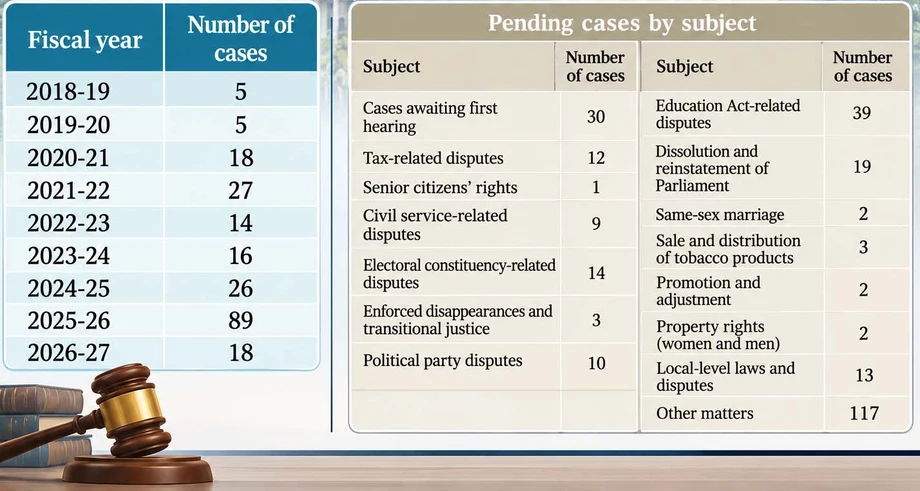
Pending petitions before the Constitutional Bench cover a wide range of legal issues stemming from legislative and political developments. Supreme Court statistics show that 246 petitions filed since the fiscal year 2018-19 remain pending. Among them, 38 have been pending for over five years, with the oldest being a writ petition filed by Surya Nepal Pvt Ltd against the Ministry of Health and Population on August 7, 2018. Approximately 30 cases have not reached even a first hearing after nearly a year of registration.
Chronology of Events
- 1976: Nepal enacted the Narcotic Drugs Control Act, establishing provisions for specified controlled uses that later influenced Supreme Court litigation.
- August 7, 2018: Surya Nepal Pvt Ltd filed a writ petition against the Ministry of Health and Population, which remains the oldest pending case before the Constitutional Bench.
- September 8 and 9, 2025: Gen Z protests forced then-prime minister KP Sharma Oli to resign, leaving a caretaker government and triggering widespread political change.
- September 12, 2025: Sushila Karki was appointed prime minister and recommended the immediate dissolution of Parliament.
- September 14, 2025: Writ petitions challenging the parliamentary dissolution began reaching the Supreme Court, with around 19 petitions registered.
- October 29, 2025: A Constitutional Bench held its first hearing on the dissolution petitions and issued a show-cause order.
- October 7, 2026: Chief Justice Sharma last constituted the Constitutional Bench before proceedings stalled following a justice recusal and holiday breaks.
- November 17, 2026: The Supreme Court joint bench of Justices Dhungana and Saru referred the government employee trade union dispute to the Constitutional Bench.
Comparative Legal Context
The paralysis of the Constitutional Bench affects a judicial system already strained by complex constitutional questions and administrative challenges. The 246 pending petitions fall into 14 broad categories, including taxation, senior citizens rights, civil service, elections, enforced disappearances and transitional justice, political parties, the Education Act, parliamentary dissolution and reinstatement, property rights, local government disputes, tobacco product sales, same-sex marriage, promotion and adjustment, and other constitutional matters.
Among the post-protest filings are 19 petitions challenging the House of Representatives dissolution, ten petitions concerning electoral ordinances introduced by the Karki government and subsequent ordinances issued under Balendra Shah, 39 petitions concerning disputes over the Education Act, and two petitions each concerning property rights and same-sex marriage.
This institutional gridlock contrasts with recent progressive rulings delivered by other Supreme Court benches. For instance, Justices Nahakul Subedi and Til Prasad Shrestha issued a binding mandamus instructing the government to establish rules for controlled cannabis cultivation within three months, addressing a statutory gap under the Narcotics (Control) Act, 2033 (1976), as detailed in Nepal Supreme Court Orders Rules for Controlled Cannabis Cultivation. Similarly, in local governance matters, the Supreme Court protected municipal financial autonomy by striking down a federal cabinet decision that divided house and land rental tax collection between federal and local authorities, reinforcing powers listed under Schedule 8 of the constitution, as examined in Nepal Supreme Court Draws Limits on Federal Power in Local Tax, Forest and Staffing Disputes. Furthermore, in personnel and privacy domains, the court addressed leadership controversies within law enforcement, such as the police command dispute involving Dan Bahadur Karki covered in Nepal Police Leadership Dispute Reaches Supreme Court as Karki Seeks Reinstatement, and protected citizen privacy by invalidating mandatory national identity card requirements for banking services in Nepal Supreme Court Orders Data Protection Law and Ends Sole Reliance on National Identity Card for Banking.
The Bottom Line
- Chief Justice Manoj Kumar Sharma has failed to constitute the Supreme Court Constitutional Bench for approximately six weeks, leaving 246 petitions awaiting hearings.
- The administrative stalemate stems from a fundamental disagreement between the chief justice and fellow roster judges over whether bench members should be appointed directly by the chief justice or selected via seniority and lottery systems.
- Recent controversies involving leaked WhatsApp messages linked to arrested intermediary Inam Sapkota have added tension within the judiciary, prompting temporary recusals and calls for internal inquiries.
- Pending cases before the specialized bench include challenges to parliamentary dissolution, trade union disputes in the civil service, education legislation, and property rights matters.
- Legal experts, including Nepal Bar Association president Bijay Prasad Mishra and former justice Ishwar Khatiwada, have urged the chief justice to resolve the impasse immediately to prevent further damage to the judicial process.