Thirteen More Languages Gain a Place in Government
Nepal's Koshi Province has brought a law into effect recognising 13 languages alongside Nepali for official government business, taking the total to 14. Chief Minister Hikmat Kumar Karki announced the measure on the 141st birth anniversary of Mahaguru Falgunanda Lingden, linking a change in public administration with the protection of community identities.
Contents
- Thirteen More Languages Gain a Place in Government
- How the Law Reached Implementation
- Why the Province Chose 13 Languages
- The Scripts Are Part of the Change
- What Has Changed at a Jhapa Ward Office?
- Local Governments Have Their Own Legal Route
- Lawmakers Debated Identity and Practical Use
- Rules and an Expert Group Will Support the Law
- Why the Announcement Honoured Falgunanda
- Key Points
The recognised languages are Maithili, Limbu, Tharu, Tamang, Magar, Bantawa, Urdu, Rajbanshi, Rai, Nepal Bhasa, Chamling, Sherpa and Santhali. Nepali remains an official language. The change gives the additional languages a legal place in government work, including the use of their designated scripts.
The decision reaches beyond the Language Commission's recommendation that Koshi use Maithili and Limbu for official business. The provincial government included another 11 languages to reflect the province's ethnic, linguistic and cultural diversity.
In Jhapa district, the practical change is already visible at Ward 5 of Shivasatakshi Municipality. Its office has announced that residents can use Maithili and Rajbanshi, alongside Nepali, for applications, recommendations and related services. That local example shows what recognition can mean for a resident approaching a government counter: being able to explain a request in a familiar language.
How the Law Reached Implementation
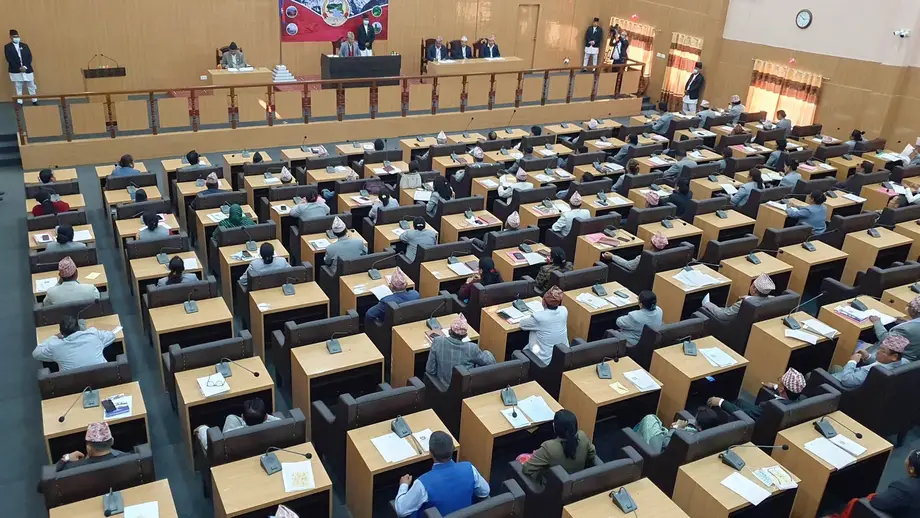
The provincial assembly unanimously passed the legislation after committee scrutiny and proposed changes from lawmakers. The Office of the Province Chief authenticated it on Kartik 11, identified as October 28 in the English calendar account. Karki subsequently announced its implementation on the occasion of Falgunanda's birth anniversary.
The main steps were:
- Shrawan 25, 2082, in Nepal's Bikram Sambat calendar: the language bill was registered in the provincial assembly.
- Ashwin 24: the assembly unanimously passed the bill following committee consideration.
- Kartik 11: the Office of the Province Chief authenticated the legislation.
- Kartik 21: the local service announcement in Shivasatakshi Ward 5 was reported.
- Kartik 25, identified as November 11: the provincial implementation announcement coincided with Falgunanda's birth anniversary and the designation of an annual Language Day.
Why the Province Chose 13 Languages
The Language Commission had recommended Maithili and Limbu for official government use in Koshi under Nepal's constitutional arrangements. The provincial legislation adopted a broader group, adding Tharu, Tamang, Magar, Bantawa, Urdu, Rajbanshi, Rai, Nepal Bhasa, Chamling, Sherpa and Santhali.
Social Development Minister Gita Timsina told the assembly that the selection included languages spoken by more than 1 percent of the provincial population. She presented the wider recognition as a way to give different language communities a sense of belonging in provincial government.
The numerical change is substantial: the law recognises 13 additional languages rather than the two recommended by the commission, an expansion of 11. Together with Nepali, the legal framework now covers 14 languages for official use.
For residents, official recognition concerns the language through which they can deal with public institutions. Speaking a language at home and using it in an application to an office are different activities. The legislation creates a legal basis for bringing more mother tongues into the second setting.
The Scripts Are Part of the Change
The legislation provides for the languages to be used in their designated scripts. A script is the set of written characters used to record a language. Including scripts makes the measure relevant to written government work as well as spoken communication.
The provisions identify the following language and script combinations:
- Maithili: Mithilakshar and Devanagari.
- Limbu: Sirijanga.
- Tharu: Devanagari.
- Tamang: Tamyig.
- Magar: Akkha.
- Bantawa: Kirat.
- Urdu: Arabic script.
- Rajbanshi: Devanagari.
- Rai: Kirat.
- Nepal Bhasa, also called Newar: Ranjana and Devanagari.
- Chamling: Kirat.
- Sherpa: Sambhota.
- Santhali: Ol Chiki.
The inclusion of both Mithilakshar and Devanagari for Maithili, and Ranjana and Devanagari for Nepal Bhasa, gives those languages more than one recognised written form within the framework. For offices handling documents, the script provisions are an important part of putting the law into practice.
What Has Changed at a Jhapa Ward Office?
Shivasatakshi Municipality's Ward 5 has begun using Maithili and Rajbanshi for government business alongside Nepali. Ward Chair Sikin Paswan announced the decision at a programme organised by the office, saying the ward has a substantial population speaking the two languages.
Paswan said the purpose was to allow local people to receive government services in their own languages. Applications and recommendation services are among the activities covered by the announcement. These are routine points of contact between residents and local government, making the change relevant to everyday administrative needs.
The ward chair also said employees could speak and understand all three languages, so he expected no difficulty in delivering services. His explanation identifies a practical advantage at this office: its existing staff already have the spoken language skills needed for the change.
Kamál Rajbanshi, central chair of the Rajbanshi Society Development Committee and a former member secretary of the National Foundation for Development of Indigenous Nationalities, welcomed the decision as historic and as a successful exercise of democracy. He also called for the protection of the languages and cultures of the Rajbanshi, Tajpuriya, Gangai, Dhimal, Koche and Meche communities.
Local Governments Have Their Own Legal Route
The provincial legislation also allows local governments to make local laws authorising official use of a national language spoken by a majority of people in their area. This gives municipalities and other local authorities a route for reflecting their own population's language needs.
The provincial and local provisions operate at different scales. The provincial framework recognises the 13 additional languages across Koshi, while the local provision connects language use to the population of a particular local jurisdiction and requires local legislation.
Shivasatakshi Ward 5 illustrates why local circumstances matter. Paswan pointed both to the presence of Maithili and Rajbanshi speakers and to employees who understand those languages. Other offices will need to match their service arrangements to the communities they serve and the language skills available to them.
For a resident, the most useful outcome is concrete: an office that can understand an application, explain a requirement and process a request in a language the resident uses confidently.
Lawmakers Debated Identity and Practical Use
Forty-two provincial lawmakers submitted 25 amendment proposals during consideration of the bill. Its eventual unanimous passage followed work by the assembly's Social Development Committee, which consulted stakeholders, linguists and Language Commission officials.
Committee Chair Gayanand Mandal told the assembly that language in government was a sensitive issue connected to linguistic diversity, identity and citizen rights. He said the consultations were intended to make the legislation practical and broadly acceptable.
The combination of amendments, consultation and unanimous approval shows that the measure went through more than a ceremonial endorsement. Lawmakers considered how to turn recognition of different communities into provisions that government offices could use.
Timsina described the legislation as an achievement for linguistic justice. In practical terms, that means giving more language communities a recognised place in the institutions that make decisions and provide services for them.
Rules and an Expert Group Will Support the Law
Timsina said the government would prepare the necessary rules and procedures to implement the legislation. Such documents set out the working details that offices need after a law establishes their authority and responsibilities.
The legislation also provides for a group of 19 experts chaired by the social development minister. Its assigned work concerns the protection, promotion and development of languages spoken in the province.
No provincewide timetable was announced for making services available in all 13 additional languages. The next practical steps identified by the minister are the preparation of rules and procedures, alongside the expert group envisaged in the legislation.
Shivasatakshi's experience points to one immediate implementation consideration: staff who already understand the relevant languages can begin using those skills in public service. The wider provincial programme must also accommodate the written scripts expressly included in the law.
Why the Announcement Honoured Falgunanda
Karki tied the implementation announcement to the 141st birth anniversary of Mahaguru Falgunanda Lingden, a national luminary and Kirat religious and social reformer. In his message, the chief minister recalled Falgunanda's work for truth, nonviolence, peace, equality and social harmony, as well as his opposition to discriminatory practices and harmful traditions.
Karki described languages as carriers of community identity, history, culture and civilisation. He said the disappearance of a language also means losing knowledge, traditions and cultural inheritance passed between generations.
The provincial government designated Kartik 25, identified as November 11 in the announcement, as an annual Language Day. Karki also said the government would work within its available resources to protect the languages, scripts, cultures and traditions practised in Koshi.
The policy therefore brings together two specific commitments: a legal place for more languages in government business and an annual occasion devoted to the province's linguistic diversity. Its everyday effect will take shape through the offices, staff and procedures that put those commitments into use.
Key Points
- Koshi has recognised 13 languages alongside Nepali for government business, bringing the total to 14.
- The legislation extends recognition beyond the Language Commission's recommendation of Maithili and Limbu.
- The law provides for designated scripts and allows local governments to authorise language use through local legislation.
- Shivasatakshi Ward 5 in Jhapa has begun using Maithili and Rajbanshi alongside Nepali for applications and related services.
- Implementation measures include rules, procedures and a proposed group of 19 experts chaired by the social development minister.
- Kartik 25 has been designated an annual provincial Language Day.