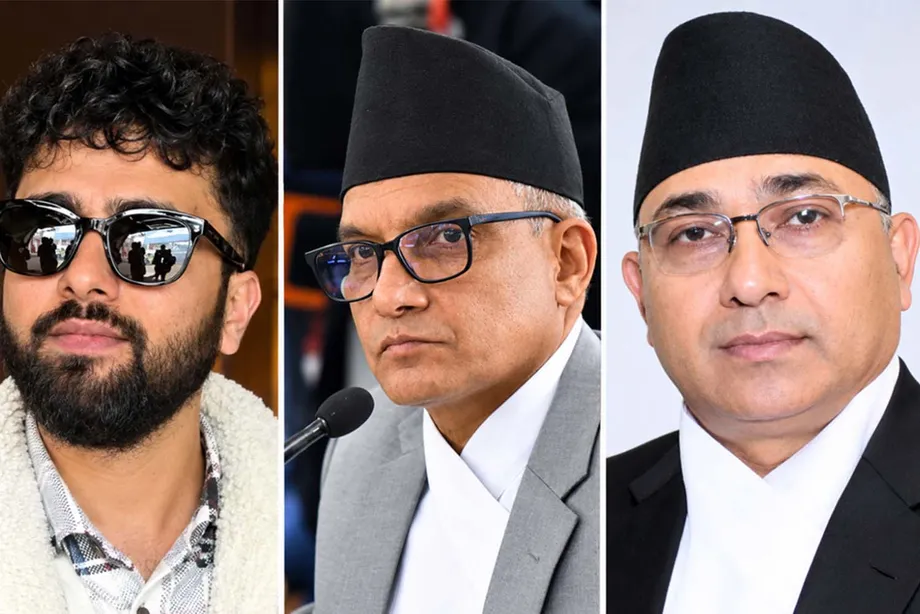
Judges seek scrutiny of their own court
Nepal's Supreme Court judges have called for an internal investigation into contacts between alleged intermediary Inam Sapkota and senior members of the judiciary, after disclosures about WhatsApp messages, a hotel meeting and alleged financial transactions brought Chief Justice Manoj Kumar Sharma and Justice Hari Prasad Phuyal under scrutiny.
Contents
- Judges seek scrutiny of their own court
- What happened inside the full court?
- The messages about Rohit Gupta's detention
- Phuyal says he raised the alarm
- From airport detention to a second court case
- Financial allegations and Sharma's denial
- Lawyers demand a credible investigation
- How could Parliament act?
- Political pressure meets existing court tensions
- Key Points
At an emergency full court meeting on Friday, judges proposed forming a committee within the judiciary to examine the allegations. Sharma and Phuyal presented their accounts, and the judges agreed to meet again on Monday for further discussion. The meeting ended with a proposal for an inquiry, rather than an announced decision establishing a committee.
The controversy centres on whether Sapkota used claims of access to Prime Minister Balendra Shah and other powerful figures to seek influence over public institutions. One reported WhatsApp exchange concerned businessman Rohit Gupta's detention: Sapkota allegedly asked Phuyal to dismiss a petition seeking Gupta's release, while Phuyal later said the court had ordered bail of Rs20 million.
Phuyal has acknowledged communicating with Sapkota and meeting him, while denying improper conduct or financial dealings. Sharma has denied knowing Sapkota, having direct or indirect contact with him, or involvement in the alleged transactions.
The judges met before drawing lots to allocate cases to benches, the groups of judges that hear and decide cases. After the discussion, they proceeded with the draw and regular hearings. The immediate institutional response therefore combined a demand for scrutiny with the continuation of daily court business.
Monday's discussion is the next scheduled step as judges, lawyers and political leaders press for answers about Sapkota's access to people holding public office.
What happened inside the full court?
Phuyal explained his dealings with Sapkota at the start of the meeting. He said Sapkota had approached judges using the prime minister's name and maintained that neither he nor the other judges had delivered decisions according to Sapkota's wishes.
Phuyal also said judges had informed the prime minister's secretariat about Sapkota, helping create the circumstances for his arrest. With both his own name and the chief justice's name publicly connected to the controversy, he supported an impartial inquiry from within the court.
Justices Nityananda Pandey, Meghraj Pokharel, Mahesh Sharma Paudel, Shrikanta Paudel and Sharanga Subedi were among those who spoke. Participants argued that the judiciary needed to examine the allegations itself, alongside whatever action Parliament might take.
The initial account described every justice except senior Justice Sapana Pradhan Malla as attending; further accounts also identified Justice Abdul Aziz Musalman as absent on leave. Malla was abroad. The proposed Monday meeting was intended to allow fuller discussion when all judges were present.
The messages about Rohit Gupta's detention
The reported WhatsApp exchange began with Sapkota sending Phuyal a screenshot concerning a habeas corpus petition involving Gupta, a former director of Himalayan Reinsurance. The petition challenged detention following a Special Court order.
A habeas corpus petition asks a court to examine whether someone is being held lawfully. It gives a detained person, or someone acting for them, a way to seek judicial review of their custody.
Sapkota, the alleged intermediary under investigation, reportedly invoked the prime minister while asking Phuyal to reject the petition:
Please stop this, sir. The prime minister is also interested in this matter. Please dismiss it.
Phuyal subsequently told Sapkota that a bench including him had found insufficient grounds to keep Gupta in detention and had ordered release on bail of Rs20 million. He reportedly shared a link to the order and proposed meeting at Hotel Himalaya in Pulchowk the following evening.
Bail allows release under conditions while legal proceedings continue. Phuyal's stated position is that the decision followed the merits of Gupta's case, rather than Sapkota's request.
Phuyal says he raised the alarm
Phuyal has acknowledged both the messages and a meeting at Hotel Himalaya, about two kilometres from the Supreme Court. He said Sapkota initially presented himself as someone conveying the prime minister's concerns amid rumours that some justices could face impeachment after Sharma's appointment.
According to Phuyal, he became acquainted with Sapkota through a senior official who was Sapkota's relative. Sapkota later began discussing pending cases, including the Nepali Congress leadership dispute and matters involving businessman Deepak Bhatta.
Phuyal said he and other justices became suspicious, discussed Sapkota's conduct and passed information and communications to the prime minister's secretariat. He also said concerns were reported to the police chief and army chief.
The proposed inquiry would need to reconstruct those contacts, including the timing of the meetings, messages and warnings to officials. That sequence matters because Phuyal's explanation rests on judges identifying a possible attempt at influence and alerting the authorities.
From airport detention to a second court case
Sapkota, 30, came under police scrutiny after investigators examining former chief justice Cholendra Shumsher Rana's phone reportedly found repeated calls between them. Police detained Sapkota at Tribhuvan International Airport on September 27 as he prepared to travel to India.
Investigators subsequently examined his electronic devices. They suspect he acted as an intermediary for people seeking favourable court decisions and officials seeking promotions, and are also examining possible money laundering links.
The main developments described in the accounts follow this sequence:
- May: Sharma became chief justice after the Constitutional Council passed over three more senior justices, including Phuyal.
- September 27: Police detained Sapkota at Tribhuvan International Airport.
- October 9: A bench comprising Phuyal and Justice Sunil Pokharel dismissed a petition filed by Sapkota's wife challenging his detention.
- Thursday: Details of the WhatsApp exchanges became public.
- Friday: Supreme Court judges discussed the controversy at an emergency full court meeting.
- Monday: Judges agreed to reconvene for further discussion.
Sapkota's wife, Kabita Pandey, brought the October 9 habeas corpus petition. Phuyal's participation in that decision has become another focus of scrutiny because of his acknowledged earlier communications with Sapkota.
Financial allegations and Sharma's denial
Documents reportedly recovered from Sapkota's phone and circulated publicly refer to alleged financial transactions associated with Sharma, Rastriya Swatantra Party lawmaker Bishwaraj Pokharel and senior Armed Police Force officer Banshiraj Dahal.
The records mention deposits totalling 198,333, with no currency specified, across three months, and a request for a further $7,500. Accounts in Nepal and the United States are mentioned, with payments reportedly directed to accounts held by Sapkota's relatives. The figures cannot meaningfully be combined without knowing the currency of the first amount.
Sharma has denied knowing Sapkota, having any direct or indirect contact with him, or participating in the alleged transactions. The ownership, purpose and recipients of the payments remain matters for investigation.
Dahal has already been dismissed following an investigation into his communications with Sapkota and a visit late at night to Rana after the former chief justice was taken into police custody.
Preliminary police findings reportedly extend the network of contacts to private secretaries of three former prime ministers, former senior police officers and other public officials. Communications involving Police Inspector General Dan Bahadur Karki have also been reported. Investigators are examining how Sapkota used those relationships.
Lawyers demand a credible investigation
The Nepal Bar Association, the national organisation representing lawyers, has called for an investigation with safeguards for both public accountability and the people accused. Its statement set out the standard it wants applied:
Sensitive matters of this nature must be investigated through a process that is evidence-based, impartial, credible and transparent.
The association called for legal action where wrongdoing is established, regardless of a person's position. It also said findings should protect the reputations of individuals and institutions where allegations are not substantiated, with everyone given an opportunity to present their account.
Former Supreme Court justice Balaram KC has urged either Parliament or the court to investigate. He proposed a committee that could include serving judges, bar representatives, former judges and civil society members, with authority to examine allegations involving the chief justice himself.
KC also criticised judges' meetings with apparent intermediaries and their public responses to the disclosures. His proposal would bring people from outside the serving judiciary into an inquiry, while the judges at Friday's meeting primarily discussed a committee within the court.
How could Parliament act?
Article 101 of Nepal's Constitution provides the impeachment route for removing a Supreme Court justice. That process differs from the Judicial Council's preliminary inquiries and investigations into complaints against district and high court judges.
Under Article 101(2), at least one quarter of the serving members of the House of Representatives can register an impeachment motion. Grounds include serious violations of the Constitution or law, misconduct, incapacity, or failure to discharge official duties honestly.
An Impeachment Recommendation Committee comprising 11 House members examines the grounds and can recommend impeachment after investigation. Passing the motion requires support from at least two thirds of all serving House members. The filing threshold therefore starts the process; the larger voting threshold determines removal.
Article 101(8) allows legal action over offences committed in office even after removal through impeachment. An internal court inquiry would serve a different function: examining conduct and producing findings, while Parliament holds the constitutional power to remove a Supreme Court justice through impeachment.
Political pressure meets existing court tensions
Prime Minister Shah and Rastriya Swatantra Party chair Rabi Lamichhane discussed the controversy during a meeting lasting nearly four hours at Lamichhane's Budhanilkantha residence on Wednesday. Accounts attributed to people familiar with the talks described disagreement over the pace of action, with Shah favouring an immediate response and Lamichhane seeking sufficient evidence before proceedings against individuals.
Party spokesperson Jagdish Kharel publicly said the prime minister and party chair remained in continuing discussion and that the party supported necessary reforms. Sudip Dhakal, the prime minister's adviser on policy, administration and good governance, said the government would proceed using powers granted by the Constitution and existing laws.
Dhakal also pointed to the government's agenda containing 100 measures for governance reform. Lawyer and Rastriya Swatantra Party lawmaker Yagyamani Neupane urged an impartial investigation into the judiciary and other institutions, with decisions based on evidence.
The controversy has reached a court already divided over appointments and administration. Sharma's appointment in May passed over three more senior justices without clearly stated selection criteria. Disagreements over judicial appointments, the Constitutional Bench, transfers and promotions had also strained relations.
Rana's removal from his home by police in September added another dispute. Police initially described it as an arrest, then said he had been moved for his safety. A subsequent full court statement condemned arbitrary executive action while promising to prevent external and internal influence in judicial proceedings.
Monday's meeting brings those institutional tensions together with specific allegations about messages, meetings and money. Judges will return to the practical issue raised on Friday: how to establish an inquiry capable of examining the conduct of the court's own leadership.
Key Points
- Supreme Court judges proposed an internal inquiry into contacts involving Inam Sapkota and agreed to meet again on Monday.
- Justice Hari Prasad Phuyal acknowledged messages and meetings with Sapkota, denied improper conduct and said judges alerted authorities.
- The reported messages concerned Rohit Gupta's detention; Phuyal said the court ordered bail of Rs20 million on the merits.
- Chief Justice Manoj Kumar Sharma denied knowing Sapkota or involvement in alleged financial transactions.
- Phuyal and Justice Sunil Pokharel rejected a detention challenge filed by Sapkota's wife on October 9.
- The Nepal Bar Association wants an impartial and transparent investigation, while Article 101 sets Parliament's impeachment procedure.