Demand for answers reaches Parliament
The Nepal Gen Z Front has demanded a parliamentary investigation into police entry into newsrooms and the detention of journalists in Kathmandu, calling for senior government officials and police commanders to explain who ordered the operation and under what law.
Contents
- Demand for answers reaches Parliament
- What brought police into the newsrooms?
- Conflicting explanations from the authorities
- The four demands for political parties
- Thapa calls for limits on executive power
- An earlier newsroom dispute returns
- Press freedom and the Gen Z movement
- A wider challenge over how government operates
- Key Points
In a statement issued Sunday, Front coordinator Rakshya Bam set out four demands, including a committee drawn from parties in the House of Representatives and a parliamentary effort to repeal or amend Section 47 of the Electronic Transactions Act. The Front said seeking to identify a news source by entering a newsroom interfered with freedom of expression and constitutional protections.
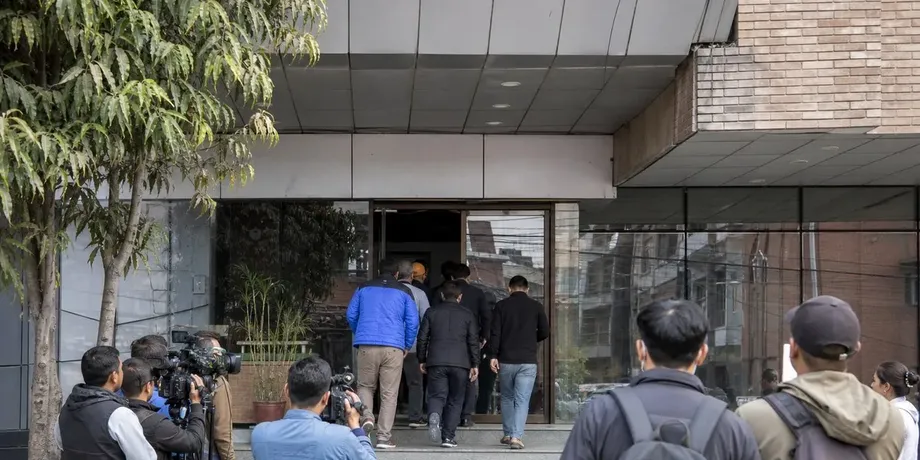
Police entered several newsrooms on Friday evening, detaining some journalists and attempting to detain others. The outlets had published stories about intermediary Inam Sapkota and Supreme Court justices. The subsequent release of journalists has left a dispute over responsibility, with the Prime Minister's Office denying involvement and opposition leader Gagan Kumar Thapa saying police statements pointed toward the prime minister's secretariat.
The Front argues that Parliament should investigate because the government agencies whose conduct is in question have failed to give clear answers. Its appeal puts responsibility on both governing and opposition parties, even while Parliament is not in session.
What brought police into the newsrooms?
The affected newsrooms had covered Sapkota's contacts with Supreme Court judges, including claims that he presented himself as someone close to the prime minister. Supreme Court Justice Hari Phuyal publicly acknowledged meeting Sapkota and said Sapkota had introduced himself to several justices as a person associated with the prime minister.
The Front described the police action as an attempt to identify a news source. For journalists, protecting a source can allow people with knowledge of sensitive matters to share information without immediately exposing themselves to pressure. Police entry into an office where reporters work therefore affects both the journalists present and people considering whether to speak to them.
The operation also involved more than a single encounter. Police arrived at multiple newsrooms at roughly the same time, making the coordination of those visits a central issue for any investigation. A parliamentary committee could examine who requested the visits, how instructions travelled through police ranks and what procedures officers followed.
The immediate sequence described in the accounts is:
- Friday evening: Police entered several newsrooms, detained journalists and attempted further detentions.
- Friday night, identified as Kartik 13 in Nepal's calendar: Police issued a second statement that Thapa later cited when alleging pressure from the prime minister's secretariat.
- After the intervention became public: The Prime Minister's Office said the prime minister had instructed the relevant authorities to release the detained journalists.
- Sunday: The Gen Z Front demanded a parliamentary inquiry, while Thapa pressed for accountability through parliamentary channels.
Conflicting explanations from the authorities
Deepa Dahal, press adviser at the Prime Minister's Office, said the office and the prime minister's secretariat were not involved and had received no prior information about the detention. She said the prime minister ordered the journalists' immediate release after learning of the incident.
The Front described a different part of the official response: the prime minister's secretariat expressed ignorance, the Home Ministry said it needed to learn more, and police denied making an arrest. Bam's statement accused those institutions of shifting responsibility among themselves.
Thapa, president of the Nepali Congress, challenged the secretariat's explanation. He said police headquarters had attributed the detention to interest from the Prime Minister's Office. He also said a second police statement issued Friday night referred to pressure from the secretariat of Prime Minister Balendra Shah, known as Balen. That description of the police statement is Thapa's account.
The identity of the person who authorised the operation, its legal basis, the exact number of journalists detained and the existence of any formal charges remain unclear. No date has been announced for establishing a parliamentary committee or publishing an investigation's findings.
The four demands for political parties
The Front wants parties to move beyond expressions of concern and use their parliamentary roles to obtain answers. Its proposal would bring officials from the political leadership and police command before the same inquiry, allowing lawmakers to compare their explanations.
The four demands cover political accountability, an investigation, consequences and changes to the law:
- Governing and opposition parties should state their positions and jointly press the home minister and police leadership to answer for the incident.
- A parliamentary inquiry committee involving parties represented in the House of Representatives should summon staff from the prime minister's secretariat, the home minister, the inspector general of police and the officers responsible.
- The committee should identify who ordered the detention and its legal basis, publish findings within a specified period and seek the strongest action against those responsible for violations of press freedom and human rights.
- Parliament should debate press freedom, make a clear commitment to protecting it and begin repealing or amending Section 47 of the Electronic Transactions Act.
A parliamentary inquiry is an investigation conducted by lawmakers rather than by the ministries or police being examined. The Front's argument is that officials facing questions about their own conduct should answer to a body outside their administrative chain.
The proposed committee would also need to examine whether officers followed the required procedures, whether political or other pressure shaped their actions and how simultaneous visits to different newsrooms were organised. Those findings would give Parliament a basis for deciding what further action to seek.
Thapa calls for limits on executive power
Thapa used a Sunday press conference at the Nepali Congress office in Sanepa to connect the newsroom intervention with a wider argument about the limits of government authority. He said the prime minister, ministers and police must all follow the law.
The Congress president described the difference between lawful government and the use of legal powers to impose political wishes:
There is a difference between the rule of law and ruling by using the law as a weapon. The rule of law does not mean only citizens must obey the law; the government must obey it too. The law applies to the prime minister, ministers and police alike.
For a reader outside politics, the issue is straightforward: government officials can investigate suspected wrongdoing, but they must use the powers and procedures assigned to them. A senior official's instruction still needs a lawful basis.
Thapa said the newsroom entry recalled the Panchayat era, Nepal's former system without competing political parties. He argued that police would have acted on instructions from superiors and alleged that a political order lay behind the intervention. He described the journalists' release as following widespread criticism.
Thapa also urged the governing Rastriya Swatantra Party, or RSP, to pursue the matter through its parliamentary organisation. He said a statement condemning misconduct was insufficient and called for an investigation with concrete results.
An earlier newsroom dispute returns
The current controversy has revived an unresolved allegation about vehicles being parked across media premises' gates on Ashar 29, 2083, in Nepal's calendar. People associated with the prime minister's secretariat were accused of involvement in that incident.
Thapa recalled that the RSP had issued a statement at the time and questioned whether anyone had faced action. The unresolved ownership of the vehicles and responsibility for placing them at the gates have become part of the argument for scrutiny outside the government.
The Front's present demand rests on a similar concern about accountability. It says a government investigation cannot ensure impartiality while the prime minister's secretariat, Home Ministry and police have not clearly explained their roles.
The Front also criticised the National Human Rights Commission for what it described as silence and inaction. The commission's responsibility to protect human rights makes its response part of the Front's concerns, alongside the conduct of the police and political leadership.
Press freedom and the Gen Z movement
Bam's statement said the intervention ran against the mandate of the Gen Z uprising, which sought to protect freedom of expression. The Front is presenting press freedom as a commitment arising from that movement, rather than a concern confined to journalists.
The proposed action on Section 47 of the Electronic Transactions Act gives the appeal a legislative dimension. Alongside establishing responsibility for Friday's operation, the Front wants lawmakers to reconsider a legal provision it has specifically identified for repeal or amendment.
Thapa separately said the younger generation's demand to end corruption was legitimate and that Congress supported it. He warned that disregarding legal procedures in the name of fighting corruption could create conditions for further abuse.
The Congress president put institutions at the centre of that argument:
A strong government does not mean a powerful prime minister. It means strong institutions, rules and laws. Once all these are strong, the prime minister becomes strong automatically.
A wider challenge over how government operates
Thapa linked the newsroom incident to other reported detentions and questioning of officials. He cited the director general of the Department of Irrigation and the chief of the Sunkoshi Marin Diversion Project being taken from their workplaces and questioned at the Prime Minister's Office.
He also recalled allegations that officials, including the head of the Commission for the Investigation of Abuse of Authority and Foreign Ministry staff, had been kept at the Prime Minister's Office for eight to nine hours over a passport printing controversy. He cited a construction contractor and a government secretary being taken into custody from their homes.
Thapa said the government could assign duties, discipline officials and prosecute corruption through established institutions. He called for impartial investigations rather than selective action, and said constitutional bodies must retain their independence.
Congress was willing to cooperate on good governance and debate policy with the government, he said. He also urged immediate attention to relief and recovery for people affected by disasters, and proposed dialogue with civil society, younger people and participants in the Bhadau 23–24 movement.
For the newsroom case, the immediate decision now rests with political parties: whether to turn calls for accountability into a parliamentary process that gathers explanations, publishes findings and identifies responsibility. The Front has asked them to begin that work despite Parliament's recess.
Key Points
- The Nepal Gen Z Front wants a parliamentary inquiry into police entry into newsrooms and the detention of journalists.
- The affected outlets had reported on intermediary Inam Sapkota and Supreme Court justices.
- The Prime Minister's Office denied involvement; Congress president Gagan Kumar Thapa said police statements pointed to pressure from the prime minister's secretariat.
- The Front wants senior political officials and police commanders summoned, findings published within a set period and action against those responsible for violations.
- Its demands include parliamentary debate on press freedom and repeal or amendment of Section 47 of the Electronic Transactions Act.
- No timetable has been announced for the proposed parliamentary investigation.