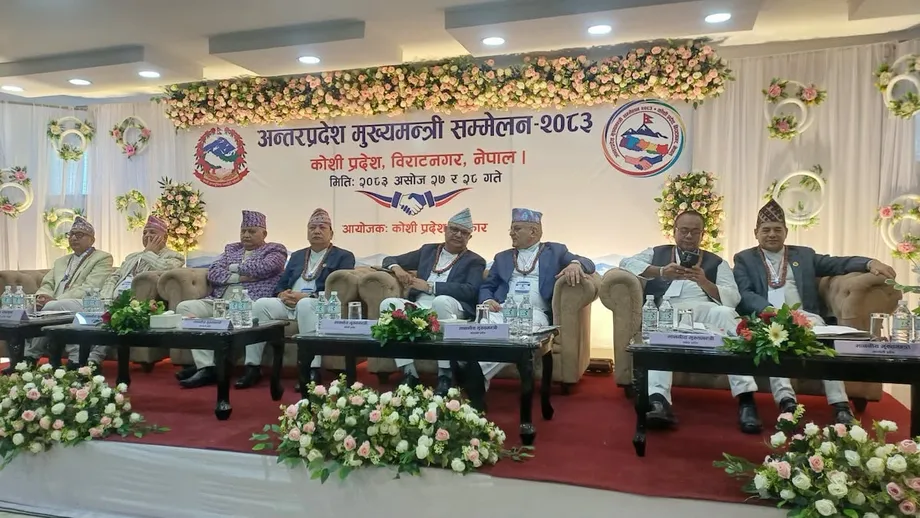
Six Chief Ministers Gather Over Powers Still Held at the Centre
Six of Nepal's seven chief ministers have gathered in Biratnagar to demand control over policing, public employees and financial resources, with Gandaki Chief Minister Surendra Raj Pandey saying 16 of 17 demands from an earlier provincial meeting remain unresolved. Even the partially addressed demand, permission to print driving licence cards, still leaves provinces dependent on the central printing department, he said.
Contents
- Six Chief Ministers Gather Over Powers Still Held at the Centre
- What the Constitutional Dispute Means
- Earlier Agreements Have Left a Long List Unfinished
- Police Responsibilities Without Provincial Command
- Staffing Delays Reach Inside Provincial Ministries
- Provincial Laws Meet Federal Restrictions
- Land Disputes Hold Up Specific Projects
- Funding Demands Differ Across Provinces
- Disaster Relief and Tourism Offer Shared Projects
- Provincial Performance Is Part of the Test
- Key Points
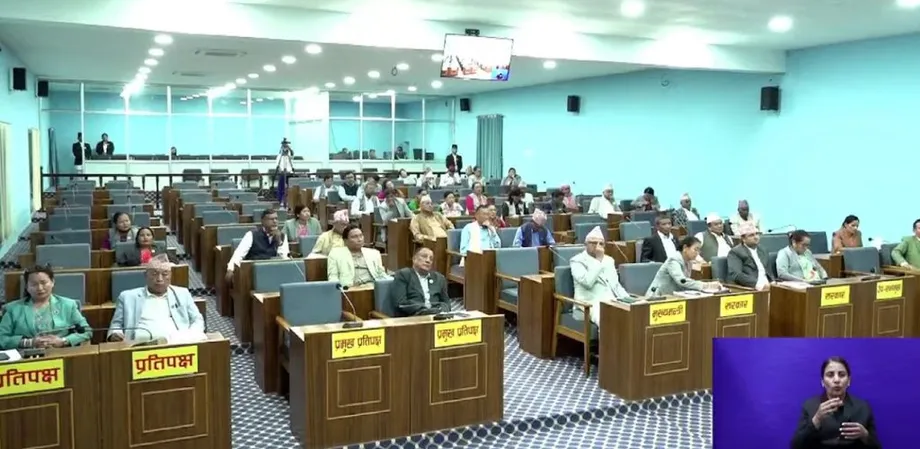
The conference in Koshi brings together the chief ministers of Koshi, Madhesh, Bagmati, Gandaki, Lumbini and Karnali. Sudurpashchim Chief Minister Khagaraj Bhatta is absent because of a provincial budget dispute, although his province is represented by its chief secretary. Federal government representatives are not attending.
The gathering is expected to conclude on Wednesday with a Biratnagar Declaration covering legal obstacles, financial powers and cooperation between provinces. Bagmati Chief Minister Kiran Thapa Magar said the declaration would establish a partnership forum for chief ministers. A joint disaster relief fund and a religious tourism circuit are also proposed, extending the agenda beyond demands directed at Kathmandu.
The central complaint is a gap between responsibility and control. Provincial governments run ministries, approve budgets, make laws and undertake development projects, yet their leaders say essential decisions about police deployment, senior staffing, land and revenue remain with the federal government.
The chief ministers are not presenting identical demands. Madhesh wants resources that reflect its population and service needs. Karnali and Sudurpashchim want greater weight given to difficult terrain, poverty and gaps in development. Their shared challenge is to turn those different priorities into a workable agreement, while explaining how provinces will improve their own performance.
What the Constitutional Dispute Means
Nepal's constitution divides government into federal, provincial and local levels. Article 232 provides that relations between them should rest on cooperation, coexistence and coordination. The chief ministers argue that this arrangement cannot function properly while laws and administrative structures leave provincial responsibilities dependent on central approval.
Koshi Chief Minister Hikmat Kumar Karki wants legislation to state more precisely which powers belong to each level. His concern is practical: an elected provincial government can be responsible for a service without having clear authority over the staff, assets or institutions needed to deliver it.
Karki, the host province's chief minister, described the gathering as a forum for improving federalism rather than a protest against a particular government. In remarks translated from Nepali, he called for clearer legal boundaries:
Now the law must clearly specify which powers belong to the federal government, which to the province and which to the local level.
Bagmati's Thapa Magar also argued that moving authority from Kathmandu to provincial capitals would not, by itself, meet the purpose of federalism. Citizens need access to government, policies shaped by local needs and public institutions that answer for their decisions. He identified overlapping responsibilities and weak coordination as obstacles, while rejecting mutual blame as a solution.
Earlier Agreements Have Left a Long List Unfinished
The Biratnagar meeting follows years of provincial conferences and submissions to federal leaders. Karki said many issues raised since 2075 in the Nepali calendar remain unresolved. Pandey wants the new conference to examine implementation of earlier agreements rather than simply produce another list.
The sequence includes the following meetings and planned steps:
- 2075: Chief ministers met in Pokhara, among the early efforts to coordinate provincial demands.
- 15 Asar 2080: A Pokhara meeting prepared a 17 point joint submission to the federal government.
- 16 Asar 2080: Provincial leaders raised their concerns at a National Coordination Council meeting attended by then Prime Minister Pushpa Kamal Dahal.
- 13 Poush 2080: A meeting in Hetauda prepared a separate nine point joint submission.
- 27 Asoj 2083: The Biratnagar conference opened, according to its published date.
- Wednesday following the opening: Participants are expected to issue the Biratnagar Declaration.
Pandey's account that 16 of 17 demands remain unaddressed means roughly 94 percent of that list is still outstanding. That measures the number of demands, not their relative importance or cost. His licence printing example also suggests that a formal transfer can remain incomplete if the province lacks the means to exercise it independently.
The chronology contains an inconsistency. Accounts describe the provincial experience as nine years or nearly a decade, while one dates the conference to 2083 and identifies the constitution as dating from 2072. Those descriptions do not align neatly, so the elapsed period should not be treated as a verified measure of implementation.
Police Responsibilities Without Provincial Command
Police adjustment, the process of assigning personnel and command responsibilities within the federal structure, is among the oldest demands. The chief ministers say provincial police have still not come under their control, leaving them unable to direct a security institution despite being expected to answer for public safety.
Madhesh Chief Minister Krishna Prasad Yadav linked this problem to the province's open border with India. He said the lack of police adjustment makes efforts to control smuggling and crime more difficult. He also called for the transfer of assets, equipment and records, arguing that responsibility without an operating structure cannot produce effective security management.
Pandey connected the same issue to disaster response. People seek help from provincial governments during floods and landslides, he said, but provincial leaders lack command over police, often the first force needed for rescue. His demand concerns protection of citizens rather than additional escorts or personal security for chief ministers.
Arjun Bik, who studies federalism in Nepal, cited religious tension in Kaptangunj, Sunsari, as an example of where provincial knowledge could have helped. He argued that a government based in nearby Biratnagar might have responded faster because it understood the local social setting. That is his assessment of how provincial command could work, not evidence that a different command structure would necessarily have prevented or resolved the incident.
Bagmati's chief minister wants the conference to consider formal legal pressure on the federal government over police adjustment. No specific court filing, hearing or binding implementation deadline has been announced in the accounts of the meeting.
Staffing Delays Reach Inside Provincial Ministries
Lumbini Chief Minister Chet Narayan Acharya said the Federal Civil Service Act remains pending in parliament. He argued that the delay has created uncertainty and damaged employee morale, while incomplete transfer of administrative powers has weakened provincial operations.
A civil service law determines how public employees are recruited, assigned, promoted and managed. For provinces, the dispute reaches into everyday administration: a ministry may have an approved programme but lack stable leadership or enough staff to carry it out.
Yadav questioned the continuing practice of the federal government sending secretaries to provincial ministries. He said there needs to be a clearer boundary between provincial autonomy and federal involvement in administration.
Gandaki has attempted a partial workaround. Pandey said the province created at least one position at the 11th employee level in each ministry through an organisation and management survey. The aim is to allow a senior provincial employee to keep work moving when a federal secretary has not arrived. He also complained that frequent transfers disrupt continuity even when secretaries are assigned.
This response shows both provincial initiative and its limits. Gandaki can strengthen staffing below the secretary position, but Pandey says it cannot independently appoint ministry secretaries under the current arrangement. The conference accounts give no date for passage of the federal civil service legislation.
Provincial Laws Meet Federal Restrictions
Pandey identified the Police Act of 2012, Education Act of 2028 and Forest Act of 2049, all dates in the Nepali calendar, as older laws invoked to restrict provincial action. He also listed land acquisition legislation among the obstacles. These are his descriptions of the legal barriers, rather than findings from a published judicial ruling.
Gandaki has already enacted measures in areas it considers within its authority. Pandey said its forest legislation was stopped in court because of a conflict with federal law. The accounts do not identify the case, court order or next hearing, leaving the precise legal grounds and timetable unresolved.
Other provincial initiatives have encountered similar difficulties. Gandaki's arrangements for branding and marketing domestic liquor are affected by federal excise provisions. Its law concerning cannabis cultivation for medicinal and industrial purposes also faces federal legal restrictions, Pandey said. Provincial passage therefore does not establish that these activities can proceed without further legal changes.
Disputes over stone, gravel, sand and mining rights have a financial consequence as well. Pandey said overlapping authority among the three levels limits the province's ability to collect revenue. A province may seek to fund more of its work locally, yet still depend on clarification of who can authorise extraction and receive the resulting income.
Pandey said Gandaki could no longer wait indefinitely for federal legislation and would continue making its own laws. His position brings the unresolved issue into focus: provincial initiative can test the boundaries of authority, but court intervention may leave implementation suspended rather than settle the broader division of powers.
Land Disputes Hold Up Specific Projects
Land acquisition offers some of the clearest examples of how administrative control affects projects that already have funding or a defined purpose. Pandey said Gandaki lacked land of its own even for provincial assembly and ministry buildings. The assembly site, he said, belongs to a former local development training institution and has been made available for use rather than transferred into provincial ownership.
At the Korala border crossing, the province allocated money for a structure to shelter tourists and travellers from wind and rain. According to Pandey, permission was initially refused because the land was registered to the federal customs office. The province eventually worked with the local government to build it as an emergency rescue centre.
He also said an apple zone project in Manang and Mustang, supported by an Asian Development Bank loan, could not be implemented because the necessary land was not obtained. The accounts do not state the loan amount, project budget or a revised completion date.
These examples distinguish lack of money from lack of authority. At Korala, the province had allocated funds but could not immediately use the site. For the apple project, financing support did not resolve access to land. Transferring spending responsibilities without settling ownership and approval procedures can leave programmes stalled before construction or production begins.
Funding Demands Differ Across Provinces
Karki put Koshi's annual internal revenue at about 4 billion to 5 billion Nepalese rupees, compared with less than 1 billion rupees in Karnali. On those figures, Koshi raises more than four times Karnali's internal revenue. The figures are estimates given by the chief minister, and no common fiscal year or detailed revenue breakdown is specified.
Karnali Chief Minister Mangal Bahadur Shahi argued that population alone is an inadequate basis for distributing money. A large territory with scattered settlements, difficult terrain and limited infrastructure can face high costs even when fewer people live there. Building a road or delivering services across remote areas requires spending that a simple count of residents may not capture.
Sudurpashchim's Bhatta similarly wants geographic difficulty, poverty and the province's development position to be major indicators in financial transfers. Although absent from Biratnagar, he expressed the same concern that allocations should reflect the cost of reaching underserved communities.
Madhesh presents a different pressure. Yadav said its large population is not matched by resources and health infrastructure. He cited fewer ventilator beds than in Bagmati, but gave no counts that would allow a numerical comparison. His demand is for transfers reflecting population and public service needs, alongside fair distribution of natural resources.
These positions need not be incompatible. Population measures the number of people needing services; geography affects the cost of reaching them; poverty and existing infrastructure indicate unmet need. The difficult negotiation is how much weight to give each factor. No agreed formula or revised allocation was announced at the opening of the conference.
Disaster Relief and Tourism Offer Shared Projects
Thapa Magar proposed a disaster management and relief fund involving all seven provinces. He referred to recent floods and landslides in Bagmati and surrounding areas that damaged highways, bridges and settlements, and said rescue and rehabilitation involved security bodies, civil servants and volunteers.
The proposal reflects a problem that does not stop at provincial boundaries. Damage to a highway or bridge in one province can interrupt travel and supplies elsewhere. A shared fund could create a means of contributing to joint responses, although the accounts give no proposed contribution amounts, management rules or date for establishing it.
Karki also identified climate change and weather related disasters as major challenges. He urged provinces to pursue joint investment and shared results alongside efforts to resolve legal disputes. Shahi called for stronger relations between provincial governments and assemblies, with experience exchanged across provinces.
Yadav presented two draft documents and proposed a tourism circuit connecting Janakpurdham, the Vivah Panchami festival and Mithila art with Barahakshetra and Ramdhuni in Koshi and with Lumbini. The idea would link destinations across several provinces rather than promote them separately. He also urged the federal government to stop creating new offices and transfer existing ones to provinces.
The tourism circuit, partnership forum and relief fund remain proposals or announced plans. None should be confused with a funded programme already in operation. Their practical value will depend on agreed responsibilities, financial commitments and implementation arrangements.
Provincial Performance Is Part of the Test
The chief ministers also acknowledged that federal restrictions do not explain every provincial weakness. Karki called for examination of budget management, delayed projects and the effectiveness of administrative spending. Acharya accepted that provinces have shortcomings of their own and need to correct them.
Pandey said provinces account for less than five percent of the combined administrative expenditure of all three levels of government. That claim concerns administrative spending, not their share of all public expenditure. No underlying accounts or fiscal period are identified, so it cannot establish a verified comparison of government costs.
Shahi argued that development and service delivery have improved under federalism, while unmet public expectations have created doubts about the system. His response was to call for work and facts that demonstrate results. The conference accounts do not give project totals or service indicators with which to measure that claim.
Pandey also placed responsibility on political parties. He said central leaders still decide provincial coalition arrangements, contributing to instability and limiting provincial independence within party structures. His criticism extended across parties rather than targeting only the current federal administration.
He said chief ministers had submitted written demands to Prime Minister Balendra Shah five to six months earlier without visible progress on staff coordination or authority transfers. He intends to seek another joint meeting after the conference. The immediate announced step is Wednesday's declaration; no federal response date or legislative timetable is given. The test will be whether it assigns concrete tasks and leads to action, while provinces account for the powers and money they already possess.
Key Points
- Six chief ministers are attending the Biratnagar conference; Sudurpashchim is represented by its chief secretary.
- Police adjustment, civil service legislation, land control and financial transfers are central demands.
- Pandey says 16 of 17 earlier shared demands remain unresolved.
- Madhesh seeks funding tied to population and services; Karnali and Sudurpashchim want greater weight for terrain, poverty and development needs.
- A chief minister partnership forum, joint disaster relief fund and tourism circuit are proposed.
- The Biratnagar Declaration is expected on Wednesday, but no binding federal implementation timetable has been announced.
- Provincial leaders also acknowledge the need to improve budgets, project delivery and administrative performance.