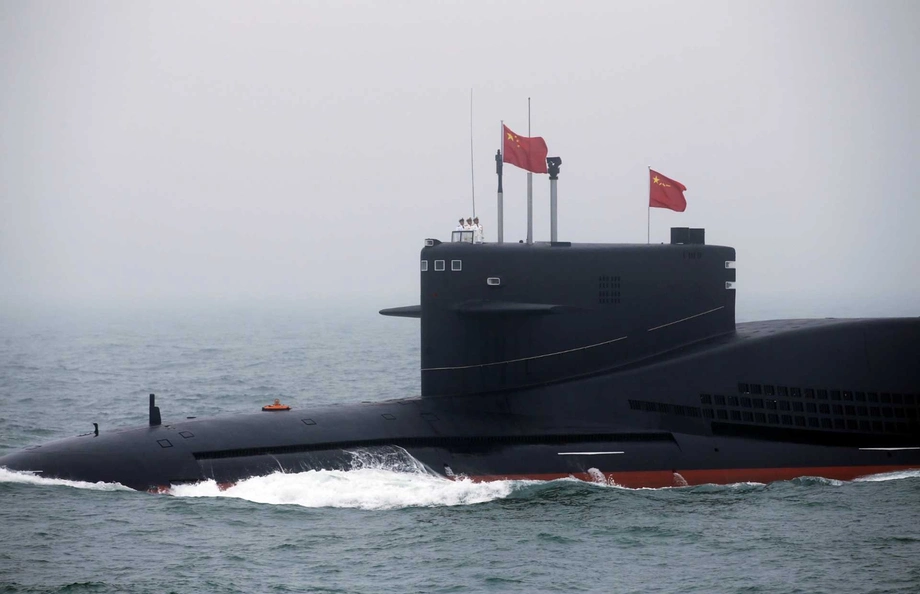
China Prepares to Launch New Type 09V Nuclear Submarine
The Chinese People's Liberation Army Navy is on the verge of launching what is likely its third Type 09V nuclear-powered guided-missile submarine, according to US-based think tanks the Institute for the Study of War and the American Enterprise Institute. A satellite image published on February 10, 2026, by the UK-based open-source intelligence platform Janes showed the navy preparing to launch the new vessel at the Bohai Shipbuilding facilities in Huludao, Liaoning Province. Naval News published detailed satellite photos showing the submarine in the flooded drydock, with inputs from author Alex Luck and HI Sutton. Open-source estimates indicate that commissioning this third Type 09V will bring the active guided-missile nuclear submarine fleet to between nine and 11 hulls. The submarine measures roughly 110 to 115 meters in overall length, with an estimated beam of 12 to 13 meters and a submerged displacement of 9,000 to 10,000 tons. This size is considerably larger than the approximately 7,000 tons of the narrower Type 09III-family boats that preceded it.
Contents
Expanding Production at the Huludao Shipyard
Chinese nuclear submarine construction occurs at the Bohai shipyard in Huludao, where new facilities have expanded production capacity significantly in recent years. The Eastern Assembly Hall was completed in 2019 with 12 assembly slots measuring 144 meters in length and 7.34-meter rail tracks, leading to a launch pontoon and drydock. Construction of the Southern Assembly Hall began in 2020 and appeared structurally complete by 2022, featuring eight assembly slots measuring 157.5 meters long and 32.5 meters wide on 7.34-meter rails. These facilities provide theoretical accommodation for 20 nuclear attack submarine hulls simultaneously. Between 2021 and 2025, China launched 10 nuclear-powered submarines totaling 79,000 tons, exceeding the United States output of seven boats totaling 55,000 tons during the same period. This activity reached a one-plus-two annual production rhythm in 2024 to 2025, matching the US Navy target for 2028. Up to eight guided-missile nuclear submarines of the preceding Type 09IIIB class were launched between mid-2022 and early 2026 at a rate approaching three launches annually.
Advanced Design Features of the Type 09V
The Type 09V incorporates several design innovations that distinguish it from earlier Chinese naval vessels. A prominent X-tail stern arrangement with very large control surfaces replaces the cruciform rudders used on previous Chinese nuclear submarines, improving maneuverability. This configuration resembles the arrangement observed on a smaller design at Wuchang Shipbuilding in Wuhan in 2024, termed the Zhou-class by American officials and Western media. The sail shows no visible external control planes, indicating the likely adoption of retractable hull-mounted bow planes instead of traditional fairwater planes. The submarine is expected to use a pump-jet propulsor, which is a shrouded propeller that reduces acoustic signatures during higher-speed transits where conventional propellers are more vulnerable to detection. Imagery shows an unfinished open compartment behind the dorsal sail consistent with the installation of a vertical launch system, with potentially enough space for 18 cells intended for anti-ship and land-attack cruise missiles such as the YJ-18. The visible high waterline and red-painted lower hull suggest reduced reserve buoyancy compared with earlier submarines, implying a potential single-hull or hybrid-hull construction.
Strategic Implications for the Western Pacific
The combination of a nuclear power reactor, pump-jet propulsor, and vertical launch system cells gives the Type 09V long-range cruise, stealth, and standoff strike capabilities appropriate for isolating Taiwan from outside military intervention. Submarines capable of launching anti-ship missiles hold an advantage in surface combat because modern anti-ship missiles outrange a surface fleet's organic anti-submarine warfare reach, allowing the submarine to fire from closer positions while reducing exposure to retaliatory strikes. US Rear Admiral Chris Cavanaugh, commander of the US Navy Pacific Fleet's submarine forces, stated that China would be able to produce 20 to 40 nuclear-powered submarines in the next decade. This transition supports naval strategies emphasizing asymmetric means to strike at sea lines of communication and complicates US sea control in the Pacific theater, although the US Navy retains critical advantages in undersea warfare.
Regional Responses to Naval Modernization
The expansion of China's nuclear-powered submarine fleet is prompting strategic adjustments across the region. Australia is actively pursuing a future fleet of nuclear-powered attack submarines under the AUKUS agreement, while Japan and South Korea have repeatedly discussed acquiring similar capabilities in recent policy debates. Seoul appears set to pursue its own nuclear attack submarine fleet, possibly in collaboration with the United States. Other countries unable to operate nuclear-powered designs are enhancing conventional submarine services and investing in airborne and sea-based anti-submarine warfare capabilities. These developments parallel broader regional security reforms, such as Japan's establishment of an independent foreign intelligence agency by March 2028 to counter rising tensions and foreign espionage, as seen when Tokyo sets a timetable for a new intelligence system. Similar supply chain and trade pressures continue to shape regional policies, comparable to how China and US Discuss tariff reductions during trade council meetings.
Key Points
- China is preparing to launch its third Type 09V nuclear-powered guided-missile submarine, spotted via satellite imagery at the Bohai Shipbuilding facility in Huludao.
- The submarine measures 110 to 115 meters in length, with a beam of 12 to 13 meters and a submerged displacement of 9,000 to 10,000 tons.
- Design features include an X-tail stern arrangement, a pump-jet propulsor, retractable hull-mounted dive planes, and a vertical launch system compartment.
- Between 2021 and 2025, China launched 10 nuclear submarines totaling 79,000 tons, outpacing the US output of seven boats totaling 55,000 tons.
- The new vessels support long-range undersea operations and strategic goals in the western Pacific, prompting naval counter-investments across the region.