National Assembly Approves Revised Electricity Law
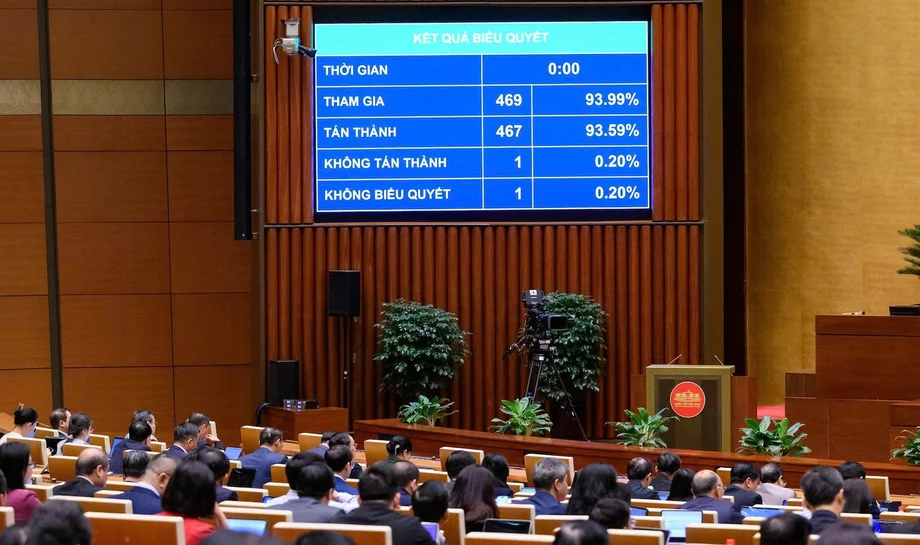
Vietnam took a major step toward reforming its energy sector when the National Assembly voted overwhelmingly to pass the revised Electricity Law. During the legislative session on November 21, 2026, exactly 488 out of 489 participating deputies voted in favor, representing a 97.80 percent approval rate. The newly amended legislation consists of three main articles, governing amendments, implementation terms, and transitional provisions, with the majority of the law scheduled to take effect on June 1, 2027.
Contents
- National Assembly Approves Revised Electricity Law
- New Roadmap for Residential Electricity Pricing by Time of Use
- Phasing Out Cross-Subsidies and Structuring Multi-Component Tariffs
- Strict Auditing Standards and Cost Adjustments
- Direct Power Purchase Agreements and Renewable Integration
- Timeline of Legislative and Energy Milestones
- Streamlining Investment Procedures and Investor Selection
- At a Glance
Government leaders and lawmakers designed the legislation to eliminate critical bottlenecks that have slowed power project development in recent years. Minister of Industry and Trade Lê Mạnh Hùng presented the final draft to the assembly, emphasizing that the legislative updates aim to accelerate energy investments and secure national power supplies while maintaining strict cost controls. Official details were published by the government in the ministry's report on the legislative proceedings. The legal framework establishes clear paths for competitive markets, modern pricing structures, and expanded renewable energy integration.
New Roadmap for Residential Electricity Pricing by Time of Use
Households across the country will eventually see changes in how their monthly electricity bills are calculated under the new law. Instead of relying solely on traditional tiered pricing systems, residential customers will face different rates depending on when they consume electricity. The legislation tasks the Ministry of Industry and Trade with drafting a formal roadmap to implement retail electricity prices divided into peak hours, off-peak hours, and normal hours for household consumers.
Minister of Industry and Trade Lê Mạnh Hùng explained that these changes will encourage citizens to shift heavy power usage away from periods when the national grid experiences peak demand. Officials noted that technical conditions and smart grid capabilities must be fully established before the time-of-use pricing takes effect for everyday households. Government agencies will determine the exact rollout schedule through subsequent decrees, ensuring that families have time to adapt their daily routines.
Phasing Out Cross-Subsidies and Structuring Multi-Component Tariffs
Electricity tariffs in the country are transitioning toward a market-driven mechanism managed through state regulation. The revised law mandates the gradual elimination of cross-subsidies between customer groups that do not yet participate in the competitive retail electricity market. Under the previous framework, industrial users often subsidized residential power costs, but the new rules ensure that pricing reflects actual supply costs more accurately.
Biểu giá bán lẻ điện, or the retail electricity price schedule, will also incorporate multi-component pricing models. Under this approach, industrial and commercial customers will see utility bills separated into distinct charges. These components include capacity charges, which pay for the availability of power generation and transmission, alongside energy charges based on actual electricity consumed. State budget allocations and legal financial funds will provide electricity bill support for vulnerable households and policy-backed beneficiaries during the economic transition.
Strict Auditing Standards and Cost Adjustments
Provisions within Article 52 of the revised law establish strict rules for adjusting average retail electricity prices in response to shifting global fuel markets and input costs. Utilities must base price revisions on actual operational expenses while securing reasonable profit margins to maintain and develop their business capital. The legislation dictates that any operational costs not fully covered within the average retail electricity price must undergo independent financial audits.
Minister of Industry and Trade Lê Mạnh Hùng addressed pricing transparency during legislative debates, noting that the average retail electricity price was lowered by 2 percent to 2,159.9037 Vietnamese dong per kilowatt-hour starting from November 1, 2026. According to data from Vietnam Electricity, the production cost of electricity reached 2,092.70 Vietnamese dong per kilowatt-hour in 2025. Requiring independent audits for uncovered expenses provides consumers with verifiable oversight, ensuring that utility companies cannot pass unreasonable financial burdens onto regular taxpayers or everyday power users.
Direct Power Purchase Agreements and Renewable Integration
The revised law establishes comprehensive legal frameworks for direct power purchase agreements, allowing large manufacturing and export enterprises to buy clean energy directly from renewable generators. Lawmakers added strict cost allocation principles to these direct contracts to ensure fairness. Participants must pay specific fees covering energy generation, transmission system services, and balancing cost settlements, preventing any financial transfer of system costs onto non-participating consumers.
Clean energy developers gain new investment protections through formal definitions for renewable energy certificates and energy storage systems. Independent electricity storage facilities and hybrid power plants now possess clear legal guidelines regarding grid connection, operation, and market participation. Furthermore, offshore wind power projects receive specialized regulatory pathways, requiring developers to complete marine surveys prior to selecting project investors while preserving national defense and maritime security.
Timeline of Legislative and Energy Milestones
- December 3, 2004: The original Electricity Law is passed by the National Assembly.
- February 11, 2020: The Politburo issues Resolution 55-NQ/TW outlining national energy strategy.
- October 2024: The National Assembly reviews the draft amendments during its eighth legislative session.
- November 1, 2026: Average retail electricity prices decrease by 2 percent to 2,159.9037 Vietnamese dong per kilowatt-hour.
- November 21, 2026: The National Assembly passes the revised Electricity Law with 488 out of 489 favorable votes.
- June 1, 2027: The revised Electricity Law officially takes effect nationwide, excluding specific offshore wind provisions.
- July 1, 2027: Specialized regulations concerning offshore wind marine surveys enter into legal force.
Streamlining Investment Procedures and Investor Selection
Bureaucratic hurdles that previously delayed major power infrastructure projects have been addressed through streamlined administrative rules. The legislation exempts certain priority power projects aligned with national development master plans from obtaining preliminary investment policy approvals. Minister of Industry and Trade Lê Mạnh Hùng clarified that eliminating this specific procedural step removes redundant evaluations without weakening environmental or land management oversight.
Regulatory frameworks governing investor selection distinguish between competitive bidding processes and direct approvals. Projects assigned without auctions include emergency power plants, grid expansions proposed by existing operators, and national security initiatives. For projects subject to competitive bidding, contractors must lock in pricing formulas and construction timelines within their official bid submissions, preventing subsequent renegotiations that could drive up consumer electricity bills.
At a Glance
- The National Assembly passed the revised Electricity Law on November 21, 2026, with an approval rate of 97.80 percent.
- The law will officially take effect on June 1, 2027, with specific offshore wind survey rules starting July 1, 2027.
- Residential electricity pricing will transition toward time-of-use rates featuring peak, off-peak, and normal hours when technical conditions permit.
- Cross-subsidies between customer segments will be systematically eliminated under a market-oriented pricing framework.
- Direct power purchase agreements incorporate transparent fee structures to prevent unreasonable cost shifts onto ordinary households.
- Independent financial audits become mandatory for any utility operational costs not covered under baseline retail electricity prices.