Trade turned the balance positive, while capital inflows lost strength
Indonesia recorded a $100 million surplus in its balance of payments in the third quarter of 2026, reversing a $900 million deficit in the second quarter. The improvement came as the current account deficit narrowed sharply, while the surplus from capital and financial transactions fell from $11.9 billion to $2.1 billion.
Contents
The figures, released by Bank Indonesia on Friday, November 20, show two different forces at work. Trade and other current account items improved, especially as exports excluding oil and gas earned more. At the same time, foreign investment flows weakened amid uncertainty in global financial markets and domestic politics.
The current account tracks money moving between Indonesia and the rest of the world through goods, services, income and transfers. The financial account records investment and other financial flows. In simple terms, Indonesia earned more relative to what it spent on current transactions, but foreign capital provided a smaller cushion than in the previous quarter.
The surplus is slim compared with the swings in the accounts behind it. The current account deficit fell by $10.6 billion, from $12.6 billion, or 3.4% of gross domestic product, in the second quarter to $2 billion, or 0.5% of GDP, in the third. That improvement helped offset the much smaller financial account surplus.
What narrowed the current account deficit?
Higher exports and prices for Indonesian commodities helped expand the surplus in trade excluding oil and gas. Stronger receipts from those sales brought more money into the country. The improvement came alongside a smaller deficit in oil and gas trade, as imports of those fuels declined.
Services and income also helped. More international visitors narrowed the deficit in services, which includes spending on travel. The deficit in primary income fell because payments of returns to foreign investors were lower than in the second quarter. Secondary income, which includes transfers between residents and people abroad, remained in surplus at a broadly similar level.
These changes matter because the current account combines more than exports and imports of goods. A country can sell more goods abroad and still face a deficit if it pays more for services or investment income than it receives. Indonesia's third quarter showed improvement across several of those components, though the account remained in deficit.
Why was the financial account surplus smaller?
The $2.1 billion surplus in capital and financial transactions was supported by direct investment and other investment. Direct investment remained in surplus, which Bank Indonesia said reflected continued investor confidence in the country's economic prospects and investment climate.
Other investment also returned to surplus after a deficit in the second quarter. One support was net withdrawals by Indonesian residents of cash and deposits held abroad. That movement brought funds back into the country, though it does not represent the same kind of commitment as a new factory or other long term business investment.
Portfolio investment, which includes holdings such as shares and bonds, remained in deficit. Bank Indonesia pointed to lower foreign inflows into domestic government debt as uncertainty in global financial markets increased. The distinction helps explain why a financial account can remain positive even as one important category of foreign investment weakens.
The scale of the change is substantial: the financial account surplus dropped by about $9.8 billion from the prior quarter. The second quarter figure is reported as $11.9 billion in the main comparison, while some accounts round it to $12 billion. One account gave the second quarter balance of payments deficit as $9 million rather than $900 million; the $900 million figure is the comparison used in the central bank reporting described here.
How do stock market figures fit the picture?
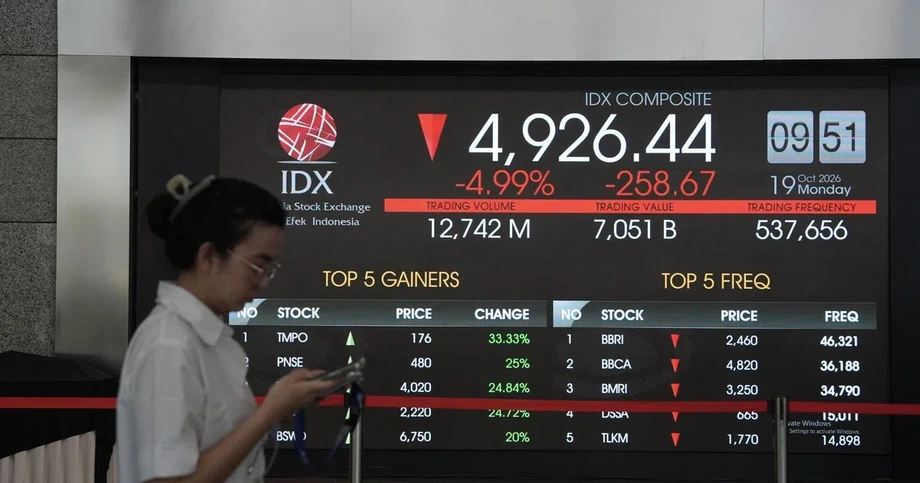
Trading data for the week of November 16 to 20 showed foreign investors were net sellers of Indonesian shares. Their cumulative net sales on the Indonesia Stock Exchange reached 100.235 trillion rupiah during 2026, including net sales of 947.41 billion rupiah on November 20.
Over that week, the Jakarta Composite Index, known as the IHSG, fell 3.71% to 5,146.326. The exchange's market value declined 3.56% to 8,725 trillion rupiah from 9,047 trillion rupiah the week before. Average daily trading value fell 47.90% to 12.347 trillion rupiah, even as the average number of transactions rose 3.60% to 1.39 million.
Share sales are not the same as the full financial account: the account also includes bonds, direct investment and other flows. Still, the selling trend in shares sits alongside the central bank's account of reduced foreign inflows into domestic bonds. The market strain follows the November rate increase to 6% and previous rupiah market intervention as Indonesia faced pressure across its currency and financial markets.
What do reserves say about the country's buffer?
Indonesia's foreign currency reserves stood at $146.3 billion at the end of September. That amount could cover 5.4 months of imports, or 5.2 months of imports plus payments on government external debt. Both measures exceed the commonly used international benchmark of about three months of imports.
Reserves give a country a pool of foreign currency that can help meet overseas payments and support stability when markets are unsettled. The figure provides a measure of available protection, while the balance of payments shows the flows entering and leaving during a period. The third quarter's small surplus and the reserve stock therefore describe different parts of Indonesia's external position.
Bank Indonesia said it expects the balance of payments to remain supported through the end of 2026. It expects the current account deficit to stay low, helped by demand from trading partners and prices for key export commodities. It also expects the financial account to remain in surplus, with domestic financial returns and the economic outlook continuing to attract foreign capital.
What should readers watch next?
The central bank's forecast depends on two conditions moving in Indonesia's favor: demand for exports and continued interest in domestic financial assets. A decline in commodity prices or weaker demand from trading partners could reduce export earnings. Continued global market uncertainty could also limit foreign investment, particularly in bonds.
Those pressures connect trade performance with financial stability. Stronger goods exports can bring in foreign currency, while investors' decisions affect demand for rupiah assets and the flow of funds across borders. The third quarter showed that trade gains can improve the national balance even when portfolio flows are strained, but the small overall surplus leaves little room for a reversal in either trend.
Bank Indonesia said it would strengthen policy coordination with the government to support the balance of payments and external resilience. No specific future meeting or policy deadline was given in the figures released on November 20.
Key Points
- Indonesia recorded a $100 million balance of payments surplus in the third quarter, after a $900 million deficit in the second.
- The current account deficit narrowed from $12.6 billion to $2 billion, helped by goods exports, lower oil and gas imports, tourism and smaller income payments.
- The financial account surplus fell from $11.9 billion to $2.1 billion, with portfolio investment still in deficit as foreign bond inflows weakened.
- Foreign investors recorded net share sales of 100.235 trillion rupiah during 2026 through November 20.
- Reserves reached $146.3 billion at the end of September, covering 5.4 months of imports or 5.2 months of imports and government external debt payments.