Diplomatic opening comes with demands to stop the violence
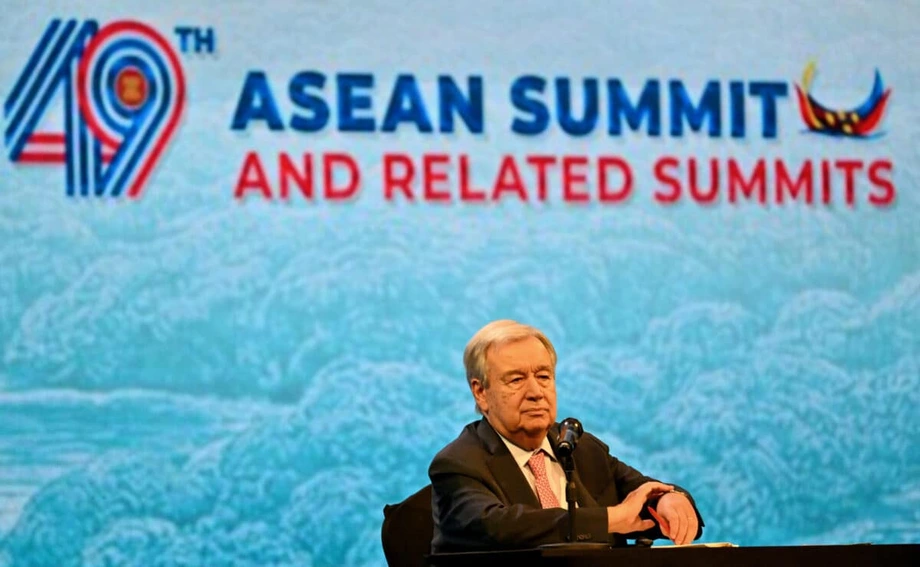
UN Secretary-General Antonio Guterres backed renewed engagement with Myanmar's military backed government in Manila on November 16, 2026, while demanding an end to violence in a country where more than 16 million people need humanitarian assistance and over four million have been displaced.
Contents
- Diplomatic opening comes with demands to stop the violence
- What ASEAN changed, and what remains restricted
- A peace plan agreed in 2021 still sets the terms
- Why Thailand is pushing for more contact
- Millions need help as air attacks threaten civilians
- Political prisoners remain central to the demands
- Rohingya protection and a court judgment approach
- What would count as measurable progress?
- UN diplomacy will continue alongside ASEAN's effort
- Key Points
His remarks followed a November 15 decision by the Association of Southeast Asian Nations to pursue gradual, conditional engagement with Myanmar. The 11 member bloc kept restrictions on political representation at its summits and foreign ministers' meetings, while opening a route toward restoring those places if Myanmar makes sustained, concrete progress on its peace commitments.
Guterres, speaking at a news conference alongside the ASEAN meetings, said talking to parties in a conflict remained necessary. He set out the limits of that approach:
Engagement is not appeasement.
Myanmar's military seized power in February 2021, removing the elected government led by Aung San Suu Kyi. The crackdown on protests that followed helped turn a political crisis into a wider civil war involving the military, democracy resistance forces and ethnic armed organisations.
The new diplomatic opening comes just days before a major legal deadline. Human Rights Watch says the International Court of Justice is scheduled to deliver its judgment on November 19 in the case brought by Gambia against Myanmar over alleged genocide against the Rohingya.
For civilians, the immediate stakes are food, shelter, protection from air attacks and access to medical care. ASEAN's decision makes improvements in those conditions central to Myanmar's possible political return, rather than offering an immediate invitation to its leaders.
What ASEAN changed, and what remains restricted
ASEAN leaders described their policy as calibrated engagement through a phased approach tied to progress. In plain terms, diplomatic contact can expand in stages as conditions inside Myanmar improve.
Myanmar remains an ASEAN member. The restrictions concern who may represent it at the bloc's most senior political meetings. At the Manila gathering, Myanmar was represented by its Foreign Ministry director-general for ASEAN affairs, rather than its president or foreign minister.
The November 15 decision retained the exclusion of political leaders from summits and foreign ministers' meetings until meaningful progress on the peace plan. It also allowed participation in other sectoral ministerial bodies, which deal with particular areas of regional cooperation.
Leaders encouraged individual ASEAN countries to engage relevant parties in Myanmar in consultation with the ASEAN chair. This gives members room to pursue talks while keeping those efforts connected to the bloc's common policy.
Philippine Foreign Secretary Ma. Theresa Lazaro said discussion of Myanmar's return to the key meetings would be left to Singapore, which assumes the ASEAN chairmanship in 2027. The practical decision in Manila was to keep the restrictions while setting out a conditional route toward their removal.
A peace plan agreed in 2021 still sets the terms
ASEAN's Five-Point Consensus remains the framework for resolving the crisis. Adopted in April 2021, it calls for an immediate end to violence, constructive dialogue among all parties, mediation by an ASEAN special envoy, humanitarian assistance through the bloc's humanitarian centre, and an envoy visit to meet the parties concerned.
The plan links security, relief and politics. Civilians need fighting to stop so they can receive help safely. Negotiations need to include the people and organisations involved in the conflict if a settlement is to hold.
Philippine President Ferdinand Marcos Jr., who chaired the Manila summit, has acknowledged insufficient progress. At the May summit, he said he had seen no progress in Myanmar. In November, he called for a more practical approach that responds to conditions inside the country.
The main steps leading to the Manila decision were:
- February 2021: The military overthrew Myanmar's elected government.
- April 2021: ASEAN adopted its Five-Point Consensus.
- Late 2021: ASEAN excluded Myanmar's political representatives from summits and foreign ministers' meetings.
- July 12, 2026: ASEAN foreign ministers met Myanmar's foreign minister in Bangkok.
- November 15, 2026: ASEAN retained the restrictions and endorsed conditional engagement.
- November 16, 2026: Guterres backed engagement while demanding an end to violence and abuses.
Why Thailand is pushing for more contact
Thailand has led efforts to expand diplomatic contact, particularly since coup leader Min Aung Hlaing assumed the civilian presidency earlier in 2026 following elections rejected by monitors as lacking credibility. A new title for the military leader has been followed by a wider campaign to rebuild regional ties.
Laos, Thailand, Cambodia, Vietnam and Malaysia have hosted Min Aung Hlaing during the year. Thailand also helped organise the July talks between Myanmar's foreign minister and his ASEAN counterparts, and Thai Prime Minister Anutin Charnvirakul supported Myanmar's return to full regional participation during Min Aung Hlaing's August visit.
Thai Foreign Minister Sihasak Phuangketkeow explained Bangkok's reasoning in Singapore on November 5. He argued that meaningful policy discussions require a participant able to convey Myanmar's position:
We believe it's crucial to have someone at the table who can really talk on policy issues because engagement requires that they have someone who can really convey to us the position of Myanmar.
Other ASEAN governments have sought concrete improvements before easing political restrictions. Singapore Prime Minister Lawrence Wong said on November 15 that Myanmar's eventual return should be accompanied by progress in humanitarian assistance, dialogue and reducing violence. The Manila compromise accommodates more contact while preserving those conditions.
Millions need help as air attacks threaten civilians
Guterres told reporters that more than 16 million people needed humanitarian assistance and over four million had been displaced. The UN's 2026 humanitarian plan puts the number needing assistance at 16.2 million. He identified aerial bombardment as the leading cause of civilian casualties.
Other humanitarian estimates give a wider range for displacement: figures attributed to the UN Human Rights Council put the number above 3.7 million, while human rights groups cited 5.2 million. The council also projected that more than 12 million people faced acute hunger or severe food insecurity.
At the ASEAN-UN Summit, Guterres called for civilian protection and access for relief workers. The United Nations' account of his remarks records his appeal:
Human suffering has reached epic proportions. I call on all parties to protect civilians, uphold international law and allow safe, sustained and unhindered humanitarian access.
Humanitarian access means allowing aid workers and supplies to reach people safely and regularly. Guterres said assistance should flow immediately and unconditionally, regardless of which side controls the territory where people live.
ASEAN called for its humanitarian coordination centre, the AHA Centre, and other relief organisations to reach communities that have not received assistance. Leaders also urged an end to attacks on civilians and civilian infrastructure, alongside a lasting nationwide ceasefire to support relief and political dialogue.
Political prisoners remain central to the demands
Guterres reiterated calls by the UN Security Council and General Assembly for the immediate and unconditional release of everyone arbitrarily detained, including Aung San Suu Kyi. Her continued detention remains a central issue in efforts to open an inclusive political process.
Human Rights Watch, in its November 11 statement, said authorities had arrested more than 32,000 people for opposing military rule and that at least 2,300 had reportedly died in custody. More than 6,600 of those arrested were women. The organisation documented sexual violence against detained women and dangerous restrictions on pregnancy and childbirth care.
Figures attributed to the UN Human Rights Council recorded 8,122 civilians killed, including 1,791 women and 1,078 children; the Assistance Association for Political Prisoners recorded more than 8,600 deaths and 32,406 arrests by security forces as of the Friday before the summit.
The UN Independent Investigative Mechanism for Myanmar has also reported evidence of deliberate aerial attacks, arbitrary detention, torture and sexual violence by the military. The mechanism gathers and analyses evidence for use in legal proceedings.
John Sifton, Asia advocacy director at Human Rights Watch, urged governments to increase pressure on the military leadership:
Governments should be increasing pressure on the junta to end its attacks on civilians, lift restrictions on humanitarian aid, and begin credible dialogues about transitioning to civilian rule.
Rohingya protection and a court judgment approach
Nearly 1.2 million Rohingya refugees are living in camps in Bangladesh, according to Guterres. Most arrived after the military crackdown in Myanmar's Rakhine State in August 2017.
Guterres said the Rohingya still awaited accountability and conditions for a safe, voluntary, dignified and sustainable return. Those terms mean refugees should choose whether to return, be protected when they do, and have a realistic chance to rebuild their lives.
The secretary-general also set out the responsibility of countries receiving people who flee Myanmar:
Until these conditions are met, States have a duty to protect those fleeing violence and persecution.
The November 19 judgment scheduled in Gambia v. Myanmar concerns Myanmar's responsibility under the Genocide Convention. That treaty requires countries to prevent and punish genocide.
A separate process at the International Criminal Court concerns individual criminal responsibility. In November 2024, its prosecutor requested an arrest warrant for Min Aung Hlaing over alleged crimes against humanity involving the deportation and persecution of Rohingya in 2017. Human Rights Watch said judges had not publicly decided on that request.
What would count as measurable progress?
Lazaro, who also serves as the ASEAN chair's special envoy to Myanmar, said ending violence would be the first test. Continued bombing and displacement, she said, showed that more needed to be done.
Simon Tay, chairman of the Singapore Institute of International Affairs, proposed practical benchmarks: regular ASEAN access to Suu Kyi and other political prisoners, a commitment to stop violence in areas the government claims to control, and priority for aid along the Myanmar-Thailand border.
Moe Thuzar, senior fellow and Myanmar Studies Programme coordinator at the ISEAS Yusof Ishak Institute, said the approach required a way to measure results:
A progress-based approach is premised on what and how progress can be measured.
ASEAN senior officials are to continue discussing assessment criteria and a longer tenure for the bloc's special envoy. No date has been announced for restoring Myanmar's full political representation, and detailed public benchmarks have yet to be agreed.
Singapore takes over the chairmanship in 2027, followed by Thailand in 2028. Greater continuity between chairs could help sustain negotiations that currently pass between different national envoys each year.
UN diplomacy will continue alongside ASEAN's effort
Guterres said UN Special Envoy Julie Bishop would continue engaging stakeholders, particularly ASEAN, to seek an end to violence, create room for inclusive dialogue and support the Five-Point Consensus.
The UN chief described the Manila gathering as his final ASEAN-UN Summit before leaving office at the end of 2026. He also praised ASEAN's work on a South China Sea Code of Conduct and its support for the durability of the 2025 Cambodia-Thailand ceasefire.
Myanmar presents a harder test after years of stalled commitments. The immediate measure of the new policy will be whether diplomatic contact produces fewer attacks, wider aid access, releases from detention and talks that include the country's competing political and armed forces.
Key Points
- Guterres backed engagement with Myanmar while demanding an end to violence, unrestricted aid access and the release of arbitrary detainees.
- ASEAN retained restrictions on Myanmar's political representation at summits and foreign ministers' meetings.
- Any gradual political return is tied to sustained, concrete progress on the Five-Point Consensus.
- More than 16 million people need humanitarian assistance, and over four million have been displaced, according to Guterres.
- Human Rights Watch says the ICJ judgment in Gambia v. Myanmar is scheduled for November 19.
- Singapore assumes the ASEAN chairmanship in 2027, with detailed progress benchmarks still under discussion.