Wheelchair queues draw scrutiny on flights to Canada
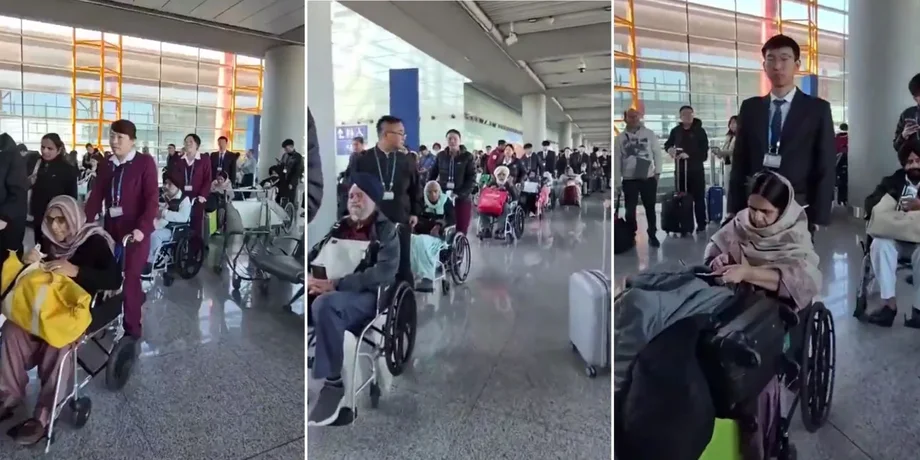
Videos reportedly filmed at Beijing Capital International Airport on November 9 and 10 show lines of passengers in wheelchairs being pushed by ground staff before flights said to be bound for Vancouver and Toronto. Witnesses alleged that some flights during busy periods had as many as 20 passengers receiving wheelchair assistance, prompting accusations online that a service intended for people with limited mobility was being used to bypass queues.
Contents
- Wheelchair queues draw scrutiny on flights to Canada
- What the videos and witnesses describe
- What Beijing Capital actually offers
- Why walking and wheelchair assistance can go together
- Booking deadlines differ between the airport and airline
- What heavy demand means for passengers and staff
- Similar allegations have surfaced elsewhere
- Checks would need to account for different mobility needs
- Key Points
Neither the airport nor the airlines involved have confirmed improper use. Neither has issued a confirmed account of the videos, the requests shown or any investigation into alleged misuse. The passengers' individual assistance needs, the number of requests on the flights shown and the identities of the airlines involved remain unconfirmed.
The debate has focused on claims that some passengers later walked through Canadian airports, collected luggage, cleared customs and visited duty free shops. Yet the official rules for wheelchair assistance describe several different levels of mobility. Air China's ground wheelchair service, for example, explicitly serves passengers who can board an aircraft and reach their seats independently but need help moving through terminals or across the apron.
That definition puts a practical question at the centre of the controversy: what help does each passenger need at each stage of a journey? Beijing Capital's airport service and an airline's booked assistance also operate under different arrangements, with different application deadlines. Understanding those details matters both to passengers seeking help and to airport staff managing demand.
What the videos and witnesses describe
The footage circulating online shows ground staff moving a line of wheelchair users through the airport. Witnesses said passengers receiving assistance used designated channels and boarded ahead of other travellers. Some described similar scenes as common at airports in China, while others questioned whether all those requesting help needed it.
Witnesses also alleged that some passengers who used wheelchairs before departure moved independently after reaching Canada. Online comments turned those claims into jokes about a "medical miracle", while others called for checks at boarding gates or random checks after landing.
The reported sequence is:
- November 9 and 10: Videos were reportedly recorded at Beijing Capital, involving passengers said to be travelling to Vancouver and Toronto.
- After arrival in Canada: Witnesses claimed some passengers walked independently and carried out ordinary airport activities.
- After the clips circulated: Online discussion focused on possible queue avoidance and suggestions for tighter checks.
The accounts have brought attention to how assistance is allocated during busy departures. They also place people whose mobility needs may be less visible under public scrutiny.
What Beijing Capital actually offers
Beijing Capital International Airport's special passenger services page lists free wheelchair accompaniment for eligible passengers who have limited mobility, meet the conditions for air travel and have not requested an airline's special assistance service.
The airport separately offers wheelchairs to borrow free of charge for passengers with limited mobility. It also lists an accompaniment service covering the arrival or departure process for eligible special passenger groups. Those services sit within a broader programme that includes assistance for older travellers, people with disabilities and pregnant passengers.
The airport asks passengers to make reservations at least 24 hours before departure. That advance notice gives the airport a request to plan around, rather than leaving all arrangements until a traveller reaches the terminal.
Accounts of the controversy have also described a policy allowing passengers with special needs to obtain help without presenting proof, citing privacy and dignity as the reasons. The airport's published service description sets out who qualifies, what help is available and when passengers should book. Its stated purpose is to make travel easier for people who face difficulties moving through the airport.
Why walking and wheelchair assistance can go together
Air China's wheelchair booking rules offer a concrete explanation of the different needs that airport assistance can cover. The airline says necessary guidance and assistance are free for eligible passengers who are fit to fly but have limited mobility.
Its ground wheelchair category covers people who can board and leave the aircraft themselves and move into or out of their cabin seats independently. These passengers may still need a wheelchair for distances inside the terminal or movement across the apron, the area where aircraft park.
A second category, boarding wheelchair assistance, serves people who cannot independently board or leave the aircraft but can move into and out of their seats inside the cabin. A third category includes a narrow wheelchair for movement inside the aircraft for passengers without independent mobility.
These categories describe different tasks, rather than a single division between people who walk and people who use wheelchairs. A passenger may manage the short distance to an aircraft seat while needing help with the much longer route through a terminal. Air China's rules make that possibility part of the service's design.
Booking deadlines differ between the airport and airline
Air China's notice generally requires requests for ground, boarding and onboard wheelchair services by 16:00 local time at the departure point on the day before the flight. Passengers whose wheelchair service has been approved must reach the check in counter at least two hours before the scheduled departure.
Beijing Capital's airport service instead asks for at least 24 hours of notice. For a hypothetical flight leaving at 10:00, the airport's requested booking point would be 10:00 the previous day, while Air China's general deadline would be 16:00 that day. A traveller therefore needs to follow the rules of the service being requested.
Air China's listed ground and boarding wheelchair arrangements apply to qualifying flights that it operates between the departure and destination points, including flights with an intermediate stop. Its notice says connecting journeys are not supported through those particular booking arrangements, and return journeys or tickets with several flight segments require separate applications for each segment. The onboard wheelchair category has additional restrictions on eligible routes and airports.
These rules are useful for passengers planning assistance, although Air China's policy is presented here as an example of published airline arrangements. The airline has not been identified as an operator of the flights shown in the videos.
What heavy demand means for passengers and staff
Air China says the number of special service applications accepted on a flight may be limited and asks passengers to check actual availability. Its notice gives no single numerical ceiling applicable to every flight. The witness claim of as many as 20 wheelchair users on some busy departures therefore sits alongside a booking system that already allows for service limits.
A wheelchair request involves more than reserving a chair. The airport's accompaniment service and the airline's different assistance categories can require staff to help passengers through particular parts of the departure or arrival process. A line of passengers waiting together can represent a substantial amount of work concentrated around one departure.
Air China's safety instructions also define what the accompanying employee can do. The wheelchair is for the passenger alone. Passengers must not hold an infant or child while being pushed, and staff providing wheelchair assistance cannot simultaneously look after children or carry luggage. Bags exceeding the relevant cabin allowance must be checked.
For travellers, this means wheelchair assistance is a defined mobility service with booking conditions and practical limits. For operators, knowing whether a passenger needs terminal transport, help boarding or assistance inside the cabin is central to assigning the right support.
Similar allegations have surfaced elsewhere
Claims about unusually high wheelchair demand extend beyond Beijing. Accounts concerning routes between India and North America have put requests at as much as 30% of passengers, with nearly 100 requests alleged on a single flight. Those figures concern other routes, while the Beijing accounts describe as many as 20 users on some departures.
Frontier Airlines chief executive Barry Biffle has also described suspected misuse in the United States. In an interview, he cited flights with 20 passengers using wheelchairs to board but only three needing them on arrival. His example illustrates the kind of departure and arrival difference that has attracted attention in Beijing, although the services passengers need can vary across the stages of a journey.
The wider discussion has referred to the United States' Air Carrier Access Act and China's Measures for the Administration of Air Transportation for Persons with Disabilities. Both are named in accounts of the debate over access and medical documentation. Their full requirements, exceptions and application to particular journeys require more detail than the broad claims circulating online.
China's measures, published by the Civil Aviation Administration of China, apply to domestic and international air transport operated by carriers established under Chinese law. For the journeys described from Beijing to Canada, that scope covers flights operated by such carriers, rather than every flight simply because it departs from China. The operators of the flights shown remain unconfirmed.
Under the measures, eligible passengers with disabilities must receive the prescribed facilities, equipment and special services free of charge, including wheelchairs and assistance boarding and leaving aircraft. Carriers generally may not refuse carriage because of disability. Article 15 permits a medical certificate requirement only when a passenger needs medical oxygen during the flight or the carrier has reasonable grounds to believe the passenger cannot safely complete the journey without additional medical assistance. Article 29 generally requires priority boarding and departure from the aircraft at a different time from other passengers for eligible passengers and their companions.
Article 9 sets specific limits for passengers who have no companion during transport but would need help in an emergency evacuation: two on aircraft with 51 to 100 seats, four with 101 to 200 seats, six with 201 to 400 seats and eight with more than 400 seats. Above those numbers, companions must be added at a ratio of one to one, with the number of passengers with disabilities ordinarily capped at twice the listed limit. Organised groups may be accommodated in greater numbers with one companion per passenger and appropriate measures by the carrier. Outside those provisions, carriers may not refuse eligible passengers merely by invoking a limit on the number of passengers with disabilities. A reported total of wheelchair users therefore does not, by itself, establish whether those specific limits apply or have been exceeded.
Accounts of the debate describe the United States' 1986 Air Carrier Access Act as prohibiting requests for medical or disability certificates. The material available here does not establish its detailed requirements, exceptions or application to the Beijing-to-Canada journeys, so that description does not establish which rules governed the requests shown.
For the Beijing controversy, the most concrete published guidance is the airport's description of eligibility and Air China's explanation of assistance categories. Both place limited mobility at the centre of access to the service.
Checks would need to account for different mobility needs
Online proposals for checks at boarding gates and after landing reflect concern about the fair use of staff time and equipment. Applying those suggestions would require operators to account for the differences already built into wheelchair services, including passengers who can walk short distances and those who need help boarding.
Air China's notice also separates assistance arrangements from medical fitness to fly. It advises passengers requesting a wheelchair because of illness or injury to consult a doctor before travel. Some passengers with medical conditions must satisfy additional transport requirements, and people unable to sit safely in a standard aircraft seat may need an approved stretcher arrangement.
The airline retains the right to make a transport decision at check in or boarding based on the passenger's condition and actual flight operations. Those provisions concern safe carriage, while the wheelchair categories identify the movement assistance a passenger needs.
Beijing's viral clips have made wheelchair allocation a public issue. The practical task for airports and airlines is to match assistance to passengers' needs while managing staff, equipment and departure schedules. Their published rules already recognise that a person can need a wheelchair for one part of a journey and move independently during another.
Key Points
- Videos reportedly filmed on November 9 and 10 showed wheelchair queues at Beijing Capital before flights said to be bound for Vancouver and Toronto.
- Witnesses alleged that some passengers walked independently after arrival. Neither the airport nor the airlines involved has confirmed misuse or issued a confirmed account of the videos, the requests shown or any investigation into alleged misuse.
- Beijing Capital offers free wheelchair borrowing and qualifying assistance, with reservations requested at least 24 hours before departure.
- Air China's ground wheelchair category expressly includes passengers who can board independently but need help moving through the airport.
- Air China generally requires wheelchair requests by 16:00 the previous day and approved passengers to reach check in at least two hours before departure.
- Airline assistance categories distinguish between help in the terminal, help boarding and movement inside the aircraft.
- China's disability air-transport measures cover domestic and international flights operated by Chinese-established carriers, require prescribed assistance free of charge and restrict demands for medical certificates to specified circumstances.
- The available material does not establish the detailed requirements, exceptions or application of the U.S. Air Carrier Access Act to the Beijing-to-Canada journeys.