A rare ornament survives an ancient robbery
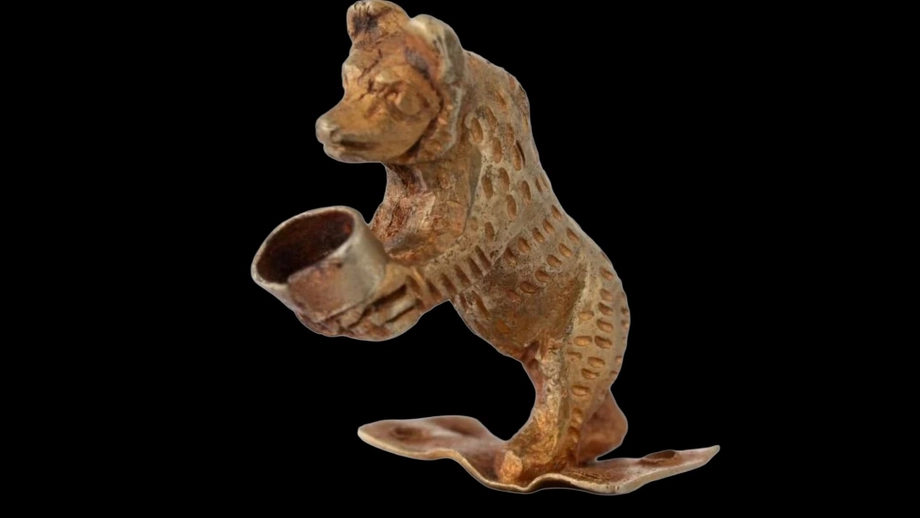
A small cast gold bear has emerged from a looted burial mound in Almaty, Kazakhstan, where archaeologists also found bones that may belong to four adults and three children. The discovery brings together two unusual finds: an animal ornament described by museum officials as unique in Kazakhstan and a possible group burial much larger than expected for a mound of its size.
Contents
Archaeologists from the Almaty Museums Association recovered the figurine during emergency excavations at the Karagaily burial ground in Nauryzbay district, supported by the city administration. Preliminary dating places the mound in the fourth to third centuries BC, during the Saka period, roughly 2,200 to 2,400 years ago.
The bear stands upright on its hind legs, holding a short, potlike vessel between its front paws. Small holes in its base suggest that someone once sewed it onto fabric, leading researchers to propose that it decorated a ceremonial headdress.
The mound measures approximately 25 to 26 metres across and about 2.5 metres high. Ancient thieves left a pit roughly three metres deep, yet pottery fragments, human remains and the gold ornament survived. The bear reportedly lay about four metres below the surface, deeper than the recorded looting pit.
What the little bear reveals
The figurine combines a recognisable animal with a deliberate pose: a bear standing upright and grasping a vessel. Its flat base has small attachment holes, providing the main physical clue to how it was worn.
Researchers interpret those holes as points through which thread could pass to fasten the ornament to cloth. The proposed headdress survives as an archaeological interpretation of the attachment system; the discovery consists of the gold figure rather than a complete decorated head covering.
Lyazzat Sagyndykova, director of the Almaty Museums Association, described the find's rarity and its possible value for comparing ancient cultures:
"The bear figurine is unique in Kazakhstan. No similar finds have previously been discovered. This find allows us to trace cultural parallels across Eurasia, from the Black Sea region to the Altai," she said.
The bear's symbolic meaning remains unknown. Researchers will need to compare its shape, pose and method of attachment with other ancient ornaments to better understand the choices made by its maker and wearer.
Seven people in a mound usually built for one or two
The human remains may prove as valuable to understanding Karagaily as the gold. Preliminary examination suggests that four adults and three children were buried in the mound, although anthropologists still need to establish the exact number and whether the burials happened together or at different times.
Marat Nurpeisov, a senior researcher at the Almaty Museums Association, explained why the possible total attracted attention:
"The unusually large number of human remains in a single mound is of particular interest, as such burials are atypical for Kazakhstan. Mounds of a comparable size were generally intended for the burial of one or two people," he said.
If the preliminary count of seven is confirmed, the mound would contain more than three times the two people at the upper end of the usual range Nurpeisov described. Its size alone would therefore give a misleadingly simple picture of how many people were placed inside.
Ancient looting scattered bones and objects, making the original burial arrangement harder to reconstruct. Anthropologists, specialists who study human remains, are expected to examine the bones to help distinguish individuals and clarify the circumstances of their burial.
How much did the thieves leave behind?
The looters dug a substantial opening into Karagaily, disturbing pottery and other material. Fragments of Saka pottery remained scattered through the site alongside the bones and gold object.
Sagyndykova's account places the bear roughly 13 feet, or four metres, down, compared with a looting pit about 10 feet, or three metres, deep. She explained that thieves can overlook objects hidden from view or beyond the area they excavate.
Karagaily sits inside an active cemetery. The museum association has described endangered archaeological sites as a priority as construction spreads across Almaty. Emergency archaeology involves investigating a site facing a risk of damage or loss so that objects and information about their surroundings can be recovered.
The team reached a burial layer described as arranged according to Saka funeral customs. Recording where bones, pottery and ornaments lie is central to reconstructing such a burial, especially when an earlier intrusion has moved parts of it. At Karagaily, the surviving material gives researchers a chance to investigate a grave that had already suffered extensive disturbance.
A bear joins a wider tradition of gold animals
The Saka were ancient nomadic communities associated with the grasslands of Central Asia and the wider Eurasian steppe. Animal imagery appeared on their clothing, jewellery and ceremonial objects. Karagaily adds an unusual bear to a regional record that already includes other animals rendered in gold.
At Almaty's Kok-Kainar burial ground, archaeologists discovered a small leopard figurine in 2014. That site dates to the fourth century BC, and the leopard has also been interpreted as a headdress ornament. It provides a nearby comparison for the practice of attaching a sculpted animal to headgear.
The famous Golden Man burial at Issyk, also called Esik, offers another comparison. Descriptions of its headdress ornament identify the animal differently: several call it an ibex, a wild mountain goat, while the account accompanying the bear discovery also describes it as a sheep.
Issyk lies about 50 kilometres east of Almaty. Excavations in 1969 and 1970 uncovered an undisturbed side burial beside a central grave that had been looted. The surviving burial contained more than 4,000 gold objects, an iron sword and dagger, a bronze mirror and vessels. These finds supported the reconstruction of an elaborate costume with a tall headdress decorated with animals.
Eastern Kazakhstan supplies further examples. An undisturbed teenage archer's burial discovered at Eleke Sazy in 2018 contained elaborate gold decoration, including about 2,000 tiny gold beads, roughly one millimetre across, sewn onto shoes. Bird shaped headdress plaques came from another burial at the same archaeological complex. Together, these discoveries show the range of animals and attachment techniques available for comparison with the Karagaily bear.
Almaty's excavations before the discovery
The museum association's work at Karagaily follows several years of investigations across Almaty. It received a special licence in 2022 allowing it to conduct independent archaeological excavations in the city.
The sequence of discoveries shows both the richness of the surviving burials and the repeated damage caused by ancient robbery:
- In 2022, an undisturbed Saka warrior burial in Alatau district yielded fragments of a sword decorated with gold, gold animal ornaments, silver objects and human remains. It was dated to the fifth to second centuries BC.
- In 2024, another mound in Alatau district produced human bone fragments, bronze fastening elements and nails.
- In 2025, researchers discovered an ancient looters' tunnel in another Early Iron Age mound and examined its structure, damage and state of preservation.
- In 2026, emergency excavations at Karagaily recovered the gold bear, pottery fragments and remains provisionally attributed to seven people.
Researchers have also investigated the Boraldai Saka Burial Mounds Archaeological Park. Specialists from Italy and France participated in geophysical surveys, which use instruments to examine features beneath the ground. Such surveys allow teams to study buried structures before deciding where excavation may be useful.
From the burial ground to the museum
Karagaily's finds are undergoing study while archaeological work continues. The planned anthropological examination is intended to clarify the burial population and circumstances, while the objects require cleaning, preservation, dating and comparison with similar finds.
The preliminary date of the fourth to third centuries BC places the mound within a broad period. Further study may help refine the chronology and explain how the gold ornament fits into the burial's history.
The most valuable artifacts are expected to enter the Almaty Museum's permanent exhibition after investigation and scientific analysis. No date for their public display has been announced.
For visitors, the bear would offer a close view of how an ancient craftsperson turned gold into a small, expressive figure. The bones and pottery will supply a different part of the story: who was buried at Karagaily, how the mound was used and what survived after thieves disturbed it.
Key Points
- Archaeologists found a small cast gold bear at the Karagaily burial ground in Almaty's Nauryzbay district.
- The mound is provisionally dated to the fourth to third centuries BC and had been looted in antiquity.
- Attachment holes suggest the bear was sewn onto fabric, possibly as a ceremonial headdress ornament.
- The remains may represent four adults and three children, an unusually large number for a mound of this size.
- Anthropological study and artifact analysis are continuing, with important finds expected to go on display at the Almaty Museum.