Secure salaries, uncertain research budgets
Government contracts account for 30% of research and development activity at the Korea Institute of Industrial Technology, and 80% of that contracted work comes from the industry ministry. Those figures put the institute near the centre of a difficult transition: South Korea is dismantling a system that made researchers compete for projects to pay their salaries, while institutes are trying to preserve the money and ministry partnerships needed to carry out their work.
Contents
- Secure salaries, uncertain research budgets
- Why South Korea is replacing PBS
- What the replacement system will fund
- Industrial support faces a funding squeeze
- Construction research encounters overlapping priorities
- How ministries will help choose research missions
- Businesses and researchers seek safeguards
- More autonomy means changing daily rules
- A shared AI platform adds another transition
- Key Points
The government wants institutional grants to cover all personnel costs by 2030. Vice Science Minister Koo Hyuk-chae has also set out a broader funding shift, raising the institutional grant share from 35% in 2024 to 80% by 2030. Stable salaries are meant to give scientists more time for sustained research and less reason to chase numerous small contracts.
Research institutes now face a practical problem. Much of their work serves ministries other than the Ministry of Science and ICT, which oversees the reform. Restrictions on government contracts could affect those assignments before a replacement funding arrangement is settled.
The industrial technology institute is discussing solutions with the science and finance ministries, but says no clear arrangement has emerged. The Korea Institute of Civil Engineering and Building Technology has raised a related concern: its new research programmes could overlap with transport ministry priorities, prompting that ministry to redirect funding elsewhere.
The science ministry says it will prepare guidelines by the end of the year, reflecting conditions at individual institutes. It has also said a proposed 20% limit on government contract work will not be applied uniformly. The central task is to connect salary reform with decisions about who commissions research, who pays for it and who takes responsibility for completing it.
Why South Korea is replacing PBS
The Project Based System, known as PBS, was introduced in 1996 to encourage competition and improve research results. Under it, scientists at government funded institutes secured external projects that helped cover their personnel costs.
The science ministry says external contracts have financed about 45% of personnel costs. Researchers therefore had a strong reason to keep winning assignments, including relatively small projects that offered immediate funding rather than the time needed to pursue a larger scientific goal.
Government figures illustrate the scale of that fragmentation. National research and development spending rose from 3.7 trillion won in 1999 to 31.7 trillion won in 2023, while average investment per project increased from 310 million won to 390 million won. Total spending grew about 8.6 times, compared with roughly 26% growth in funding per project.
The reform aims to move institutes away from collecting contracts to sustain payrolls and toward planning research around their public missions. An institute working on industrial production, for example, would develop a sustained research programme instead of having its direction shaped mainly by whichever calls for proposals it could win.
What the replacement system will fund
The new structure has two main tracks. Basic research programmes will build the knowledge and capabilities that belong to an institute's core role. Strategic research programmes will support larger, longer research efforts tied to national missions.
Some externally commissioned projects will move into the strategic track as existing contracts end over a transition lasting five years. The government intends to cover all personnel costs through institutional grants by 2030, with personnel expenses fully separated from project funding after the phaseout.
Koo's targets describe two different parts of an institute's finances. The planned 80% institutional grant share concerns the broader funding structure. The 100% target concerns personnel costs. Institutes would still have work to finance beyond salaries, including the activities required to deliver research and public services.
On Jeong-seong, head of the science ministry's research institute innovation support team, described the intended change in planning authority at an October 1, 2025 public hearing in Daejeon:
Whereas previously specialist agencies under each ministry planned projects and invited applications for their implementation, after the reform the institutes themselves will both plan and carry out the work.
That gives institutes a larger role in choosing how to meet government needs. It also makes agreement between ministries essential, because the science ministry administers the reform while other ministries continue to need the research.
Industrial support faces a funding squeeze
The Korea Institute of Industrial Technology shows why a single contract limit could have uneven effects. It has six units carrying out functions delegated by the government, all of which perform government commissioned work.
One is the National Ppuri Industry Center, which supports foundational manufacturing industries. Its responsibilities include managing programmes that help companies install automated equipment and supporting specialised industrial complexes. Such assignments involve delivering an established public service as well as conducting research.
The institute says government commissioned work represents 30% of its research and development activity, with industry ministry projects accounting for 80% of that portion. On those figures, industry ministry assignments represent about 24% of its total research and development activity.
A uniform limit could therefore affect work that another ministry still expects the institute to perform. Moving salary costs into institutional grants would address staff pay, while the delegated programmes would still need budgets and an agreed route for commissioning them.
The science ministry says it will consider institutions with historically high shares of contracted work, including the industrial technology institute, the Korea Basic Science Institute and the Korea Railroad Research Institute. It is also preparing a process to incorporate the views of ministries that commission their services.
Construction research encounters overlapping priorities
The Korea Institute of Civil Engineering and Building Technology faces a different problem. Much of its research responds to the needs of the Ministry of Land, Infrastructure and Transport. Its strategic research proposals are therefore likely to cover subjects already included in that ministry's research roadmap.
The institute fears that the transport ministry could redirect research budgets previously assigned to it toward organisations under the ministry's own supervision. The institute says it has been planning defensively, avoiding subjects the transport ministry is already pursuing.
That creates a tension within the reform. Institutes are being asked to develop programmes around their distinctive capabilities and government needs, yet close alignment with another ministry's priorities can become a reason to avoid a subject.
The construction institute has called for coordination by the science ministry or the National Research Council of Science and Technology, known as NST. A workable arrangement would identify the institute's responsibilities, connect them to the relevant ministry's objectives and settle the funding route before programmes begin.
Both the construction and industrial technology cases concern the same operational question: how an institute can continue serving a ministry when the financial mechanism supporting that relationship changes.
How ministries will help choose research missions
The science ministry's October 2025 policy draft proposed a council spanning ministries to identify public research missions and decide which institutes should undertake them. A planning process based on ministry needs is scheduled to apply from the 2027 budget.
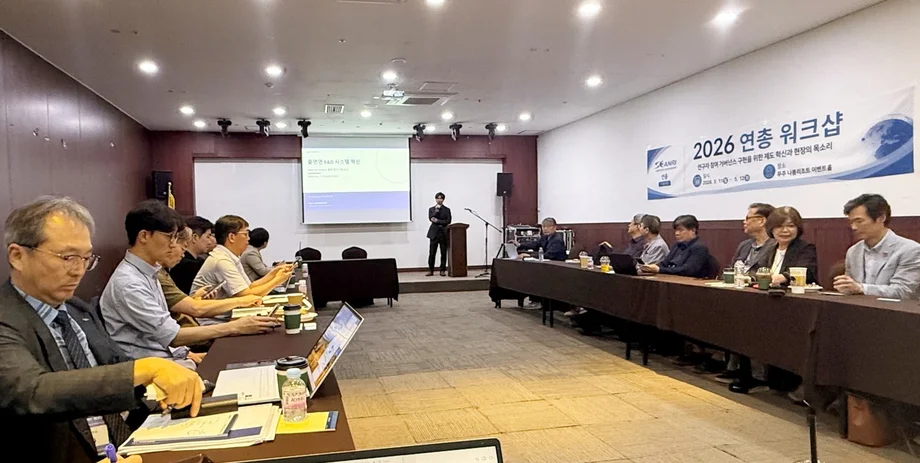
The draft also proposed a strategic research support centre within NST. At a later workshop in Muju, Jeon Jeong-cheol, head of NST's strategic research support team, described a programme comprising 77 projects with a budget of 366.6 billion won.
The planning exercise collected 349 requests from government and 208 from industry, a total of 557. NST grouped those requests into 56 strategic missions and arranged expert reviews of 146 proposals from institutes. Jeon described the reviews as consulting intended to improve planning, rather than a process focused on rejecting proposals.
The challenge is to turn requests for individual projects into broader research goals. Jeon said many government requests still arrived at the level of specific tasks. Under the intended model, ministries would set policy objectives and institutes would translate those objectives into scientific and technical programmes.
The main milestones are:
- 1996: PBS was introduced to strengthen competition for research projects.
- October 1, 2025: The science ministry presented its draft policy direction at a public hearing in Daejeon.
- 2027 budget: A planning procedure based on ministry needs is scheduled to begin.
- By 2030: The government aims to finance all personnel costs through institutional grants and raise the broader institutional grant share to 80%.
- After the phaseout: Personnel costs are to be fully separated from project funding.
Businesses and researchers seek safeguards
Smaller companies could feel the effects if institutes concentrate resources on large national programmes. Kim Sang-gil, a division head at the Korea Industrial Technology Association, warned that businesses needing immediate technical help or research tailored to a particular problem could find fewer accessible routes to assistance.
That concern connects directly to the industrial technology institute's delegated functions. Support for factory automation and manufacturing clusters involves responding to practical business needs, sometimes on a shorter timetable than a major strategic programme.
Kim Chang-wan, a professor at Chung-Ang University, raised a related governance concern at the October hearing: taking strategic research demand from ministries could preserve institutes' dependence on those ministries. He called for the science ministry to coordinate the system as a whole.
Researchers at the Muju workshop also questioned how basic research would be protected, how much authority institute heads would gain and whether evaluation work would become heavier. Jeon said a policy adopted the previous December committed to maintaining basic research budgets.
Kwon Hyu-sang, vice president of the federation representing scientists and engineers at public research institutes, proposed independent researcher councils. The aim is a permanent channel for scientists to discuss research conditions and policy, alongside the existing structures for management and employment matters.
More autonomy means changing daily rules
Lee Mi-hye, former president of the Korea Research Institute of Chemical Technology, has proposed a Korean research autonomy law. Her argument is that stable grants must be accompanied by freedom to use resources effectively.
At a science policy forum, Lee cited Germany's research freedom framework, which she said was tested in 2009 and formally implemented in 2012. She described greater financial, staffing and operational autonomy for the Helmholtz, Max Planck, Fraunhofer and Leibniz research organisations.
Her proposals for South Korea include allowing institutes to transfer money between budget categories, carry unused funds into a later year, make more staffing and pay decisions themselves, and enter contracts with fewer approval steps. She also advocated judging institutes through responsibility for results rather than detailed approval before each action.
The government's policy draft addresses some administrative burdens. It proposes combining institutional management and research programme evaluations, and replacing reports exceeding 1,000 pages with performance reports of no more than 30 pages supported by data. It also includes higher starting pay and bonuses of up to 120 million won for selected outstanding researchers.
Staff retention gives those proposals urgency. NST figures discussed in researchers leaving public institutes recorded 155 voluntary departures in 2025, including 137 people in their 30s and 40s. That group accounted for 88.4% of departures, showing how much experienced talent the institutes must retain while rebuilding their research system.
A shared AI platform adds another transition
NST is also developing a National AI Science Research Center, provisionally known as NAIS, to connect data, computing resources, models and specialist staff across institutes. Jeon described it alongside the strategic research changes as a second major part of the new research system.
The proposed centre would provide common infrastructure, while individual institutes would apply it in their own scientific fields. In practical terms, a central team could supply computing power and shared data standards, while a laboratory working on materials or biology would adapt those resources to its research.
The plan presented at the workshop targeted a launch in the second half of that year, beginning with about 50 people. Expansion to around 100 after 2030 was under consideration. Jeon also identified unreliable AI answers, bias and the expense of graphics processing units as risks that the operating model must address.
The AI proposal adds another demand for coordination during the funding transition. Institutes will need room to pursue their own scientific priorities while agreeing on shared infrastructure and its costs. Across both reforms, the practical test is whether scientists gain dependable resources and more time to conduct research, while ministries and businesses retain access to the work they need.
Key Points
- South Korea aims to cover all personnel costs at government funded research institutes through institutional grants by 2030.
- The broader institutional grant share is intended to rise from 35% in 2024 to 80% in 2030.
- Institutes serving other ministries fear gaps in programme funding as government contracts are restricted or converted.
- The science ministry says a proposed 20% contract limit will not apply uniformly across institutes.
- A process based on ministry needs is scheduled to shape research planning from the 2027 budget.
- Researchers and industry representatives want safeguards for basic research, scientific autonomy and practical support for smaller businesses.