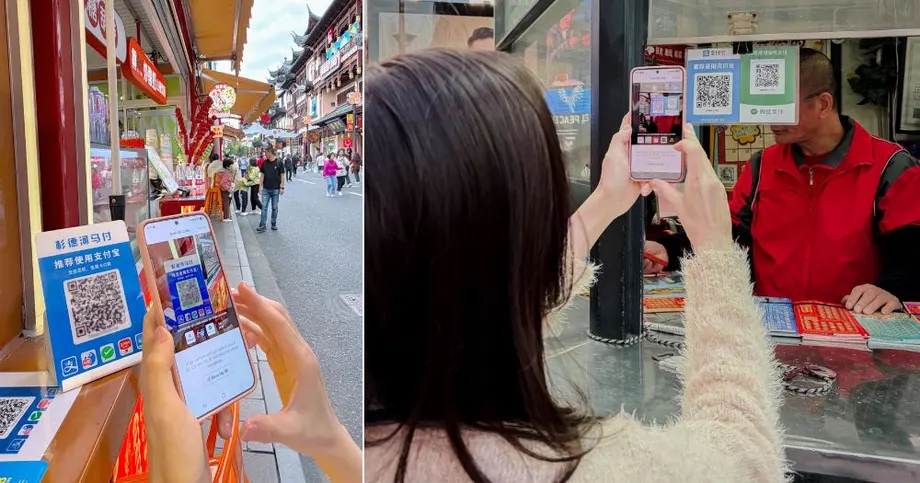
Three million users gain wider access at China checkouts
More than three million DBS PayLah! users can now pay at over 100 million Alipay and Weixin Pay partner merchants across mainland China, following an expansion announced by DBS Bank on November 12, 2026. The service covers retailers including Pop Mart and Songmont, alongside restaurants and neighbourhood shops.
Contents
- Three million users gain wider access at China checkouts
- How the two payment options work
- What changes for merchants and travellers
- Merchant codes and personal codes work differently
- How the cashback offers fit together
- China travel growth gives the expansion a larger audience
- Regional connections and the next dates
- Key Points
The partnerships with Ant International and TenPay Global let customers pay in either of two ways: scan a merchant's QR code with PayLah!, or display a payment code in the app for the merchant to scan. Customers can make these purchases without downloading another payment app.
DBS says the expansion, together with its existing UnionPay connection, makes it the first and only Singapore bank to support both ways of paying across China's three major QR payment networks: Alipay, Weixin Pay and UnionPay.
Customers pay no additional transaction fee. Before confirming a purchase, they can see the amount in Chinese yuan, the applicable exchange rate and the equivalent cost in Singapore dollars. The exchange rate may include currency conversion costs, so the Singapore dollar amount displayed is the useful figure for checking a purchase against a travel budget.
How the two payment options work
PayLah! users need to update their app to version 7.4.0 or the latest available version to access the new functions. People without a DBS or POSB bank account can also use PayLah!.
At a merchant displaying a supported QR code, a customer opens PayLah!, selects Scan, scans the code and enters the purchase amount in Chinese yuan. The app displays the applicable exchange rate and the converted Singapore dollar amount before the customer confirms payment.
At a checkout where staff scan the customer's payment code, the customer opens PayLah! and selects My QR to generate the code. This gives merchants another way to accept the payment using their existing checkout equipment.
A QR code is a square pattern that a phone camera or scanner can read. In these transactions, it carries the information needed to connect the customer and the merchant through the payment network. Supporting both scanning methods lets PayLah! work with different checkout arrangements, from a small shop displaying a code to a retailer using a scanner.
What changes for merchants and travellers
Ant International and TenPay Global provide the connections behind the expanded Alipay and Weixin Pay acceptance. For travellers, the practical change is being able to use a familiar Singapore app at a much wider range of Chinese businesses.
Calvin Ong, head of the Consumer Banking Group at DBS Singapore, said the partnerships allow customers to pay while merchants continue using their existing arrangements:
Our partnerships with Ant International and TenPay Global bring together the best of our payment ecosystems, giving DBS PayLah! users the freedom to pay across China and merchants are not required to change how they operate.
The merchant examples show the range of purchases covered. Customers can use the service at participating Pop Mart and Songmont outlets, while acceptance also extends to everyday spending at restaurants and neighbourhood stores.
DBS describes the China expansion as covering more than 100 million Alipay and Weixin Pay partner merchants. It also gives a separate figure of more than 70 million merchants in its wider Alipay+ and UnionPay QR network worldwide. Those figures describe different network coverage, with no combined count of unique merchants given.
Merchant codes and personal codes work differently
The new PayLah! connection is designed for payments to participating merchants. A traveller paying a guide, an individual or a small seller using a personal collection code may need a different route.
DBS introduced a related service in June 2026 through DBS Remit. Customers can first transfer money into their own Alipay or Weixin wallet, then use that wallet to make the payment. This involves funding a wallet before spending, rather than making the merchant payment directly through PayLah!.
The type of code presented at checkout therefore matters. A small business may use either a merchant payment arrangement or a personal collection code, and the direct PayLah! service described in the announcement applies to the merchant arrangement.
For purchases made directly through PayLah!, DBS describes its exchange rates as competitive. Customers still need to look at the rate and final Singapore dollar charge shown in the app. A payment can carry no additional transaction fee while its exchange rate includes a conversion cost.
How the cashback offers fit together
DBS is running two cashback promotions from November 16, 2026, to January 31, 2027. Eligible customers can combine them to receive up to S$6 on one transaction, subject to the separate qualification rules and redemption limits.
The first offer gives up to S$3 cashback on the first eligible overseas QR payment by a user who has not made an overseas QR payment through PayLah! in the preceding 12 months. There is no minimum spend, and 20,000 redemptions are available each month.
This offer covers the new China connections as well as existing PayLah! QR services in Malaysia, Thailand, Indonesia and Taiwan. The 12 month condition means eligibility depends on a customer's recent overseas payment activity, rather than simply whether the person has just installed PayLah!.
The second offer gives S$3 cashback on a customer's first eligible Alipay+ QR payment of at least S$6. This promotion has a limit of 16,000 redemptions during the campaign.
Some descriptions of the second offer refer to an Alipay QR transaction, while the more detailed promotion information specifies Alipay+. Customers seeking both rewards need a transaction that qualifies under both offers, including the S$6 minimum and the relevant payment connection.
For example, a qualifying purchase of exactly S$6 could earn S$6 cashback if the customer meets both sets of conditions and redemptions remain available. The combined reward would equal the purchase amount in that example. Customers qualifying only for the Alipay+ offer could receive S$3 on the same purchase.
The redemption limits also affect the value of the promotion. The first offer has a monthly allocation, while the second has one allocation for the campaign. A customer must meet the payment conditions while places remain available to receive the relevant cashback.
China travel growth gives the expansion a larger audience
China's National Immigration Administration recorded 11.6 million foreign visitor trips from July to September 2026, an increase of 15.6% from the same period a year earlier. Singapore was among the top 10 countries for foreign visitor arrivals during the quarter.
Using the published growth rate, the comparable total for July to September 2025 was approximately 10 million trips. That puts the increase at roughly 1.6 million trips over a year. The figures count trips, so a person visiting more than once can contribute more than one arrival.
The payment expansion arrives as more foreign visitors are travelling to China. For PayLah! users, its immediate value is at the point of purchase: the same app can handle payments at participating stores across three major Chinese QR networks, with the currency conversion visible before confirmation.
For merchants already accepting the supported payment methods, the arrangement brings access to visiting PayLah! users without requiring a change to how they collect payments. DBS identifies that compatibility as a central part of its partnerships.
Regional connections and the next dates
China joins a wider set of destinations where PayLah! connects to local QR payment networks. Existing connections include Malaysia's DuitNow, Thailand's PromptPay and Indonesia's QRIS.
DBS announced Taiwan acceptance in October 2026. There, customers can pay at participating shops displaying the Taiwan QR Code acceptance mark, known as TWQR, or payment notices carrying that label.
The wider Alipay+ and UnionPay network also reaches participating merchants in markets including Australia, Hong Kong and South Korea, as well as parts of Europe, Latin America and the Middle East. The expansion builds on a UnionPay QR connection established in 2022.
UOB announced plans on November 12 to introduce China QR payments through its UOB TMRW app before the end of 2026. Its planned partners include NETS, Alipay+, UnionPay International and Weixin Pay, with intended coverage of more than 100 million acceptance points and no administrative fee. UOB gave no exact launch date.
The sequence of launches and promotion deadlines is:
- 2022: PayLah! established its UnionPay QR connection.
- June 2026: DBS introduced transfers through DBS Remit into customers' own Alipay or Weixin wallets.
- October 2026: DBS announced PayLah! acceptance at participating TWQR merchants in Taiwan.
- November 12, 2026: DBS announced immediate PayLah! access to Alipay and Weixin Pay merchant QR payments in mainland China.
- November 16, 2026: The two DBS overseas QR cashback promotions begin.
- By the end of 2026: UOB plans to launch its China QR payment service.
- January 31, 2027: The DBS cashback campaign ends.
Key Points
- More than three million PayLah! users can pay at over 100 million Alipay and Weixin Pay partner merchants in mainland China.
- Customers can scan a merchant's QR code or display their own payment code for scanning.
- Users should update PayLah! to version 7.4.0 or the latest available version.
- Payments carry no additional transaction fee, while the exchange rate may include conversion costs.
- The direct payment expansion covers merchant codes. DBS Remit provides a separate route for funding a customer's own Alipay or Weixin wallet.
- Eligible customers can receive up to S$6 cashback on one transaction from November 16, 2026, to January 31, 2027, subject to conditions and redemption limits.