A day of remembrance with a practical purpose
North Korean leader Kim Jong Un visited the Chinese border city of Dandong on October 24, 2026, nine days after a new road bridge opened between the two countries. His trip combined a tribute to Chinese soldiers who fought in the Korean War with talks about expanding trade and travel across their shared border.
Contents
- A day of remembrance with a practical purpose
- Why the memorial mattered
- Senior officials carried messages between the leaders
- A bridge moves from delay to use
- The dates behind the visit
- A factory stop points to domestic priorities
- China ties deepen alongside the Russia relationship
- Washington remains part of the debate
- What comes after Dandong
- Key Points
Wang Huning, a member of the Chinese Communist Party's highest leadership body and chairman of its top political advisory body, accompanied Kim at the Memorial Hall of the War to Resist US Aggression and Aid Korea. Chinese Foreign Minister Wang Yi also attended. Kim later inspected a vehicle factory and returned to North Korea by road across the New Yalu River Bridge.
China's Foreign Ministry, in its account of the visit, connected the crossing directly to plans for more exchanges between people and greater economic cooperation. Wang said Beijing wanted to use the bridge's opening to bring practical benefits to both countries.
The timing brought together two anniversaries: 76 years since Chinese forces entered the Korean War and 65 years since China and North Korea signed their Treaty of Friendship, Cooperation and Mutual Assistance. It also followed visits between Kim and Chinese President Xi Jinping in September 2025 and June 2026.
Kim's sixth visit to China, and his first in 13 months, lasted a single day. Its itinerary joined wartime remembrance, senior political talks, a factory inspection and a newly usable border crossing, giving the relationship both a historical setting and an economic agenda.
Why the memorial mattered
Dandong was a departure point for Chinese forces sent to fight alongside North Korea during the 1950–1953 Korean War. Kim arrived on the eve of October 25, the anniversary China observes for its intervention.
Both national anthems played during the ceremony at the memorial tower. Honor guards carried a flower basket to the platform, where Kim adjusted its ribbon before participants observed a silence for fallen Chinese soldiers.
The ribbon carried a message from Kim, North Korea's ruling party general secretary and chairman of its State Affairs Commission, honoring the Chinese People's Volunteers:
We will forever remember the martyrs of the Chinese People's Volunteers.
Inside the museum, Kim viewed wartime artifacts and historical photographs, including an image of his grandfather, North Korean founder Kim Il Sung, with Mao Zedong. He presented a commemorative plaque featuring a historical photograph of Kim Il Sung and a handwritten inscription dated October 24, 2026.
Kim said North Koreans would remember fighting alongside the Chinese people and pass gratitude for China's wartime support to future generations. The ceremony placed that shared history at the center of the visit, at a time when Pyongyang has also been strengthening its partnership with Moscow.
Senior officials carried messages between the leaders
Wang conveyed greetings from Xi and said the visit would strengthen political trust and cooperation. The Chinese Foreign Ministry said he called for closer strategic communication and coordination to protect the two countries' sovereignty, security and development interests.
Kim asked Wang to pass his greetings to Xi and wished success to the forthcoming fifth plenary session of the Chinese Communist Party's 20th Central Committee. A plenum is a meeting of the party's central leadership to discuss major policy and political matters.
Xi did not meet Kim during the Dandong trip. Wang, China's fourth-ranking official, hosted a banquet under Xi's instructions, according to the North Korean account. Kim's delegation included Foreign Minister Choe Son Hui, his sister and senior party official Kim Yo Jong, and other leading party and government figures.
Kang Dong-wan, a professor of North Korean studies at Dong-A University, said the memorial visit's purpose helped explain the arrangements:
As Kim sought to express gratitude to China and reaffirm bilateral friendship, a meeting with Xi was not the main purpose of the visit in the first place.
Hong Min, a senior research fellow at the Korea Institute for National Unification, also pointed to the approaching party plenum as possible scheduling context. He said the attendance of Wang Yi and other senior officials responsible for foreign affairs showed the importance Beijing attached to the occasion.
A bridge moves from delay to use
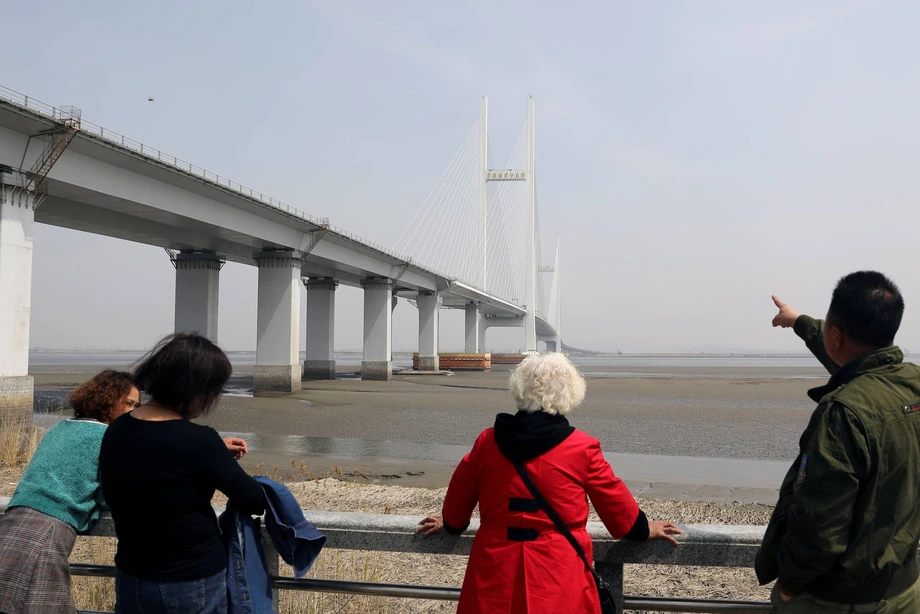
The New Yalu River Bridge, also called the New Amnok River Bridge, connects Dandong with Sinuiju in North Korea. The crossing has four lanes and extends roughly three kilometers.
China and North Korea agreed to build it in 2010. Construction finished in 2014, but the bridge remained unused for about 12 years because connecting roads and customs facilities on the North Korean side were missing. It opened on October 15, 2026.
Kim's motorcade journey departed from his customary use of a train for foreign travel. On his return, Wang and other Chinese officials accompanied him to the bridge's midpoint, where the two men posed for photographs. Kim expressed hope that the crossing would connect both the countries and their people more closely.
Wang's economic message gave the journey a practical purpose. Roads and customs facilities allow vehicles, goods and passengers to pass through a border, making them essential parts of any effort to increase exchanges. Beijing and Pyongyang have not announced trade targets, traffic forecasts or detailed operating arrangements for the crossing.
Yang Moo-jin, a distinguished professor at the University of North Korean Studies in Seoul, interpreted Kim's use of the route as a personal commitment to expanding trade and economic cooperation. Hong said the ability to make a visit within a day could also make senior consultations easier to arrange.
The dates behind the visit
The Dandong trip followed several developments in diplomacy and transport. Together, they show how the October visit fitted into a longer effort to renew contacts and open routes to North Korea's neighbors.
- July 11, 1961: China and North Korea signed their Treaty of Friendship, Cooperation and Mutual Assistance.
- 2010: The two countries agreed to build the New Yalu River Bridge.
- 2014: Construction of the bridge was completed, followed by years of delay before use.
- September 2025: Kim visited Beijing for a military parade.
- June 2026: Xi visited North Korea, a trip both governments presented as a major step in their relationship.
- September 7, 2026: North Korea and Russia opened a road bridge across the Tumen River.
- October 15, 2026: The New Yalu River Bridge opened.
- October 24, 2026: Kim visited Dandong and returned across the new crossing.
The two road bridge openings came 38 days apart. They give Pyongyang additional routes toward both China and Russia as it seeks closer economic relations with its two neighbors.
A factory stop points to domestic priorities
Kim's afternoon itinerary included a visit to Dandong's Huanghai bus factory. China's official account described a tour of production workshops and briefings on operations. The North Korean account said he examined different products and wished the factory's technical staff and workers success.
The stop added an industrial element to a visit dominated by diplomacy and remembrance. Buses and vehicle production concern transport, manufacturing skills and factory organization, all practical areas for a country seeking to develop local industry.
Yang Gab-yong, a senior research fellow at the Institute for National Security Strategy, connected the factory visit to North Korea's Regional Development 20×10 Policy. That program seeks to develop local industries, making manufacturing experience from China relevant to Pyongyang's domestic plans.
Neither government announced a bus purchase, a production agreement or a transfer of technology during the visit. The concrete activity was Kim's inspection of the factory, alongside the broader pledge to expand practical cooperation.
China ties deepen alongside the Russia relationship
China remains North Korea's largest trading partner and a major international supporter. Their 1961 treaty commits either country to provide immediate military and other assistance if the other suffers an armed attack and enters a state of war.
Kim specifically mentioned the treaty's 65th anniversary during his talks with Wang. He thanked China for its longstanding support and described prospects for cooperation as broad. Wang pointed to the September 2025 and June 2026 exchanges between the leaders as the basis for further development.
North Korea has meanwhile deepened military ties with Russia over the past two years, including deploying troops there. The new Tumen River road crossing adds an economic connection to that relationship.
Kang interpreted the memorial visit as an effort to renew attention to China after a period when Pyongyang's partnership with Moscow had become more prominent. Michael Bosack, founding director of the Parley Policy Institute and a former UN Command official, said the June Kim-Xi summit had begun a shift toward giving China a larger place in North Korea's public messaging.
Lim Eul-chul, a professor at Kyungnam University's Institute for Far Eastern Studies, viewed the Dandong trip as a way for Kim to strengthen his diplomatic position with support from both neighbors. The bridge openings and the memorial ceremony served different purposes within that approach: expanding connections while renewing political ties.
Washington remains part of the debate
US President Donald Trump's planned regional visit in November and the forthcoming Asia-Pacific Economic Cooperation summit in Shenzhen prompted speculation about possible talks with Kim. Kim made several visits to China during his diplomacy with Trump in 2018 and 2019.
Joung Eun-lee, director of the North Korea Research Division at the Korea Institute for National Unification, thought possible dialogue with Washington may have been among the subjects discussed in Dandong. She pointed to Kim's personal attendance and the presence of both countries' foreign ministers.
Lim offered a different assessment, saying it was highly unlikely that a potential meeting with Trump had been discussed. Hong also saw little indication connecting the visit to preparations for renewed talks with Washington. Neither government announced a Kim-Trump meeting or included US dialogue in its account of the Dandong discussions.
Hong nevertheless interpreted the ceremony as carrying a message to Washington about the durability of the China-North Korea relationship. The Korean War ended with an armistice in 1953, an agreement to stop fighting rather than a peace treaty, leaving the peninsula's security arrangements unresolved.
What comes after Dandong
The next scheduled political event was the Chinese Communist Party's fifth plenum, described as running from Monday through Thursday after the visit. November's APEC summit and Trump's expected regional travel would follow.
For Dandong and Sinuiju, the most immediate development is the usable road crossing. Wang publicly tied it to more trade and travel, while Kim's journey gave the bridge a prominent political endorsement. The scale of activity through it will depend on the arrangements the two governments put into practice.
The visit's main commitments were to preserve political ties, expand practical cooperation and maintain strategic communication. Kim's itinerary made those aims visible through three concrete stops: the memorial, the factory and the bridge.
Key Points
- Kim Jong Un visited Dandong on October 24, 2026, for a single day of commemorations, talks and a factory inspection.
- Wang Huning accompanied Kim, conveyed greetings from Xi Jinping and called for expanded trade and exchanges.
- Kim returned across the New Yalu River Bridge, which opened on October 15 after about 12 years of disuse.
- The visit marked 76 years since China's Korean War intervention and the 65th anniversary year of the bilateral friendship treaty.
- Closer ties with China are developing alongside North Korea's expanding military and economic relationship with Russia.
- No meeting between Kim and Donald Trump was announced.