Cambodia scores 36.6 out of 100 as regional weaknesses persist
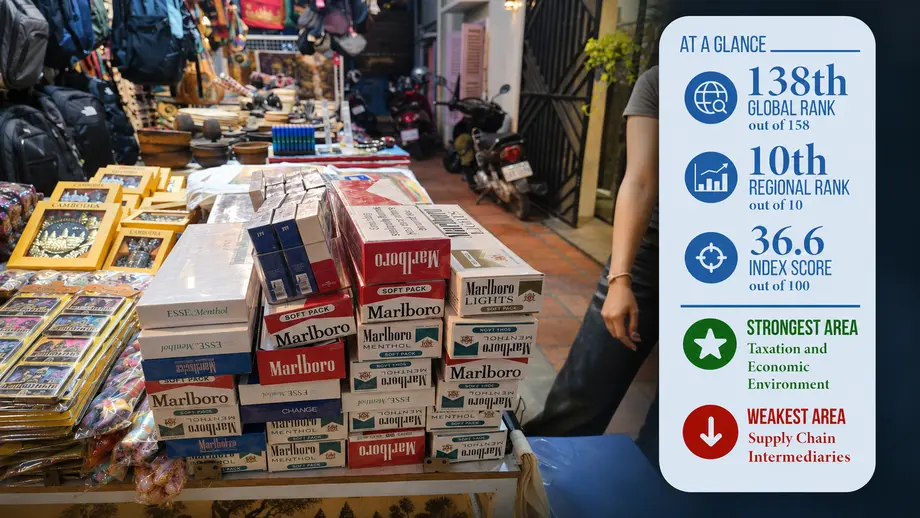
Cambodia ranks 138th among 158 countries in the Transnational Alliance to Combat Illicit Trade's 2025 Illicit Trade Index, scoring 36.6 out of 100 and placing last among the 10 ASEAN economies assessed. Its score is 13.3 points below the global average of 49.9, with the assessment identifying limited capacity and resource constraints among the challenges facing Cambodia, Laos and Myanmar.
Contents
- Cambodia scores 36.6 out of 100 as regional weaknesses persist
- How Cambodia compares with its neighbours
- What the index measures
- Why the strongest borders still need support
- How counterfeit goods exploit ordinary trade routes
- Online platforms face calls for enforceable rules
- Shared customs information is a central recommendation
- Free trade zones and delivery networks need accountability
- From the 2025 index to ASEAN's 2045 ambitions
- Key Points
The ranking features in a regional assessment commissioned by the EU-ASEAN Business Council and announced on November 10, 2026. It finds that Southeast Asia's strongest controls are at customs and borders, while its weakest protections concern the businesses and networks that store, move and sell goods.
For Cambodia, the findings put attention on the route products take through warehouses, transport operators, online marketplaces and delivery networks. Counterfeit goods and other illegal products can travel through the same infrastructure used by legitimate businesses, making responsibility along that route a central concern.
TRACIT's 2025 Illicit Trade Index measures countries' policy, legal and regulatory capacity to combat illicit trade. Higher scores indicate stronger controls. Cambodia's 36.6 compares with 44.8 for Laos and 40.9 for Myanmar, its two nearest regional peers at the lower end of the assessment.
The index gives Cambodia an aggregate score, while the regional findings describe broader weaknesses across ASEAN. The detailed contribution of each policy weakness to Cambodia's position is not set out in the regional assessment. Its practical message is that stronger border procedures need support from effective controls throughout the trading system.
How Cambodia compares with its neighbours
Singapore leads the assessed ASEAN economies at 29th globally, followed by Indonesia at 39th and Thailand at 56th. Vietnam ranks 61st, the Philippines 69th and Malaysia 72nd. Laos is 100th, Myanmar 117th and Cambodia 138th. None of the 10 assessed economies reaches the global top 20.
ASEAN's collective score is 49.7, according to the EU-ASEAN Business Council's regional findings announcement, issued from Manila. That is just 0.2 points below the global average of 49.9, but 14.7 points behind the 64.4 average for economies in the Organisation for Economic Cooperation and Development. The Asia Pacific average is 50.9.
Cambodia sits 13.1 points below ASEAN's average. The distance between its score and the regional figure matters because ASEAN's near-average result combines countries with very different levels of capacity. A regional average can sit close to the global benchmark while individual members face much larger gaps.
What the index measures
TRACIT builds the index around six categories: taxation and the economic environment; regulation and enforcement; criminal activities that enable illicit trade; trade, customs and borders; supply chain intermediaries; and indicators covering particular sectors of illicit trade.
The categories contain 37 indicators and 69 smaller measures. Each category receives equal weight, and the six category scores are averaged to produce a country's total on a scale from zero to 100. This means that performance across the trading system matters, including areas away from the border.
Denmark leads the 158 countries with a score of 76, while Yemen has the lowest score at 25.7. No country scores above 76. Even the strongest performer therefore falls well short of the maximum under TRACIT's framework, which assesses the strength of protections against illegal trade.
Why the strongest borders still need support
ASEAN scores 67.4 in Trade, Customs and Borders, its strongest category. Its weakest category, Supply Chain Intermediaries, scores 32.7. The gap between them is 34.7 points, showing how much regional performance changes between border controls and oversight of the networks surrounding them.
Supply chain intermediaries are the businesses and services between a producer and a buyer. They include online marketplaces, postal networks, express couriers, maritime operators and businesses working in free trade zones. Nine of the 10 assessed ASEAN economies perform poorly in regulating these channels.
Jeffrey Hardy, TRACIT's director-general, said the region needs to extend its attention beyond customs checkpoints:
"Asean cannot secure international trade by focusing only on what happens at the border," Hardy said.
A shipment can pass through several businesses before reaching its buyer. TRACIT's recommendations therefore focus on identifying who handles goods, tracking their movement and assigning responsibility at each stage. Border inspections and oversight of sellers, carriers and storage locations serve different parts of that task.
How counterfeit goods exploit ordinary trade routes
Counterfeit goods present a particular challenge in the global index. Countries average 44.1 for controls against trade in counterfeits, and customs data identify more than 100 countries with characteristics associated with being a source of such goods. TRACIT also describes a method that makes detection harder: shipping components separately and assembling the counterfeit product after arrival.
Individual parts or raw materials may appear legitimate when customs officials inspect them. Once combined at their destination, they can become a product falsely presented as belonging to a genuine brand. Detecting this activity requires authorities to understand connected shipments and businesses as well as inspect finished products.
Cambodia appears among the countries listed in TRACIT's discussion of this component shipment challenge. For enforcement agencies, the practical concern is the relationship between goods, their handlers and their final use. A parcel inspected in isolation may reveal less than information connecting the supplier, importer and assembly operation.
Consumers face related risks when illegal goods reach ordinary shops or digital platforms. The assessment identifies counterfeit goods, illicit medicines and illegal pesticides among products distributed through online commerce. These categories require different checks, but each depends on authorities being able to trace a product and act against the people selling it.
Online platforms face calls for enforceable rules
Online marketplaces, social media and private messaging channels have expanded the routes through which illicit products reach buyers. TRACIT calls for common regional standards requiring platforms to verify sellers, screen and block illegal listings, and impose penalties on repeat offenders, including permanent bans.
Suriya Padmanaabhan, TRACIT's director of programmes and the report's principal author, described the limits of dealing with individual advertisements after they appear:
"Removing an illicit listing is far from creating a safe and secure marketplace for online shoppers," Padmanaabhan said.
Seller verification means checking who is behind an account. Rules for repeat violations address the risk that a trader returns with another listing or account after an earlier removal. Together, these measures shift attention from a single advertisement to the business operating behind it.
The assessment points to initiatives already under way in the region. The Philippines has an e-commerce memorandum of understanding involving platforms and rights holders. Vietnam has seller verification and repeat violation rules, while Malaysia is developing stronger platform accountability requirements. TRACIT presents these as possible foundations for wider regional action.
Shared customs information is a central recommendation
TRACIT recommends closer oversight of goods in transit and transshipment. Goods in transit pass through a territory on their way elsewhere; transshipment involves transferring cargo between transport services during its journey. Both require authorities to track movement and know which operator is responsible.
Shared customs risk profiles would help countries exchange information about products, routes and trading methods that warrant closer inspection. The aim is to give officials useful information before a suspicious shipment moves through another part of the region.
The report also calls for customs intellectual property recordation systems that can work together across ASEAN. Such systems let rights holders register information about their brands and products with customs. Connecting them would help officials in different countries identify suspected counterfeits using compatible information.
Free trade zones and delivery networks need accountability
Free trade zones, postal networks and logistics operators receive particular attention because they can provide opportunities to conceal or reroute illegal goods. TRACIT calls for clearer responsibility within these channels, alongside stronger checks on the businesses handling shipments.
The global index shows how weak some of these controls are across countries. Within the Supply Chain Intermediaries category, the average score is 26.1 for e-commerce frameworks, 21.8 for free trade zone commitments and just 3.8 for postal security. Cybersecurity preparedness scores much higher, at 72.0. These are global figures; ASEAN's combined score for the category is 32.7.
The difference points to distinct enforcement tasks. Protecting computer systems requires one set of capabilities, while checking sellers, tracing parcels and supervising goods stored in trade zones requires another. Governments need rules and operational capacity for the physical movement of products as well as their digital sale.
TRACIT also recommends including measures against corruption in national plans to combat illicit trade. The regional agenda combines those measures with coordination among governments, customs authorities, law enforcement agencies and private businesses, all of which hold different pieces of information about a shipment.
From the 2025 index to ASEAN's 2045 ambitions
The figures come from the 2025 Illicit Trade Index, while the regional findings were announced on November 10, 2026, and released at the Regional Intellectual Property Summit on Enforcement. Keeping those dates distinct helps explain why a regional announcement in 2026 cites an index labelled 2025.
- 2025: TRACIT's Illicit Trade Index ranks Cambodia 138th of 158 countries, with a score of 36.6.
- November 10, 2026: The EU-ASEAN Business Council announces the commissioned regional findings from Manila.
- 2045: ASEAN's Vision 2045 provides the longer horizon for deeper economic integration, resilient supply chains and a trusted digital economy discussed in the assessment.
Hardy linked stronger protections against illicit trade to the benefits ASEAN seeks from closer integration:
"Illicit trade undermines the economic and social benefits that Asean integration is intended to deliver," Hardy said.
For Cambodia, the immediate policy focus is concrete: more effective enforcement, stronger oversight of the businesses moving and selling goods, and better information sharing with neighbouring authorities. The recommendations give direction, but the announcement provides no timetable for Cambodia to introduce particular measures or for ASEAN to adopt common platform rules.
Key Points
- Cambodia ranks 138th of 158 countries and last among the 10 ASEAN economies assessed, scoring 36.6 out of 100.
- ASEAN scores 49.7, compared with a global average of 49.9 and an OECD average of 64.4.
- The region's strongest category is customs and borders at 67.4; its weakest is supply chain intermediaries at 32.7.
- Nine of the 10 assessed economies perform poorly in regulating intermediaries such as marketplaces, couriers and logistics operators.
- TRACIT calls for shipment tracking, shared customs information, connected intellectual property systems and enforceable platform rules.
- The regional findings were announced on November 10, 2026, using rankings from the 2025 index.