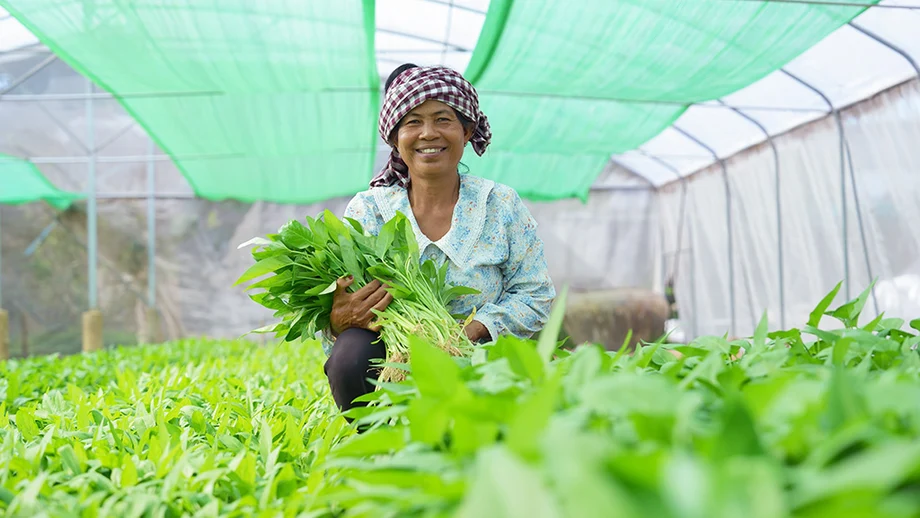
A $112.3 Million Effort to Protect Rural Livelihoods
The Asian Development Bank has approved $72 million in financing to help about 200,000 smallholder farmers in Cambodia withstand natural disasters, improve access to markets and expand economic opportunities for women. Together with partner funding and Cambodia's contribution, the Smallholder Resilient Economic Development Sector Project will receive $112.3 million.
Contents
- A $112.3 Million Effort to Protect Rural Livelihoods
- How the Financing Fits Together
- Why Women Are a Central Priority
- Water and Roads Address Different Parts of the Same Problem
- Training Extends Beyond Crop Production
- Grants Target Dependence on Imported Supplies
- Preparing Communities Before Disaster Strikes
- What the Project Is Intended to Change
- Key Points
The project will cover 186 communes across seven provinces that ADB identifies as highly vulnerable to natural hazards. Its main construction targets are to modernize irrigation systems serving an additional 7,000 hectares of farmland and rehabilitate 190 kilometers of access roads. Training, grants and community disaster planning will accompany those improvements.
Women are central to the project because they make up 51% of Cambodia's agricultural labor force, according to ADB, yet face limited access to financing, support and economic opportunities. The program aims to give them a greater role both in earning income and in deciding how their communities prepare for disasters.
Cambodia's rural areas are home to 59% of the population. Heatwaves, droughts and floods can damage crops and infrastructure while cutting farmers off from buyers. For households that depend on farming, the consequences can reach beyond a lost harvest to reduced earnings and difficulty obtaining enough food.
How the Financing Fits Together
ADB's $72 million package consists of a $57 million concessional loan and a $15 million grant from the Asian Development Fund. A concessional loan offers more favorable borrowing terms than ordinary commercial lending, although it still requires repayment. A grant does not require repayment.
Regional and international partners, together with Cambodia's government, will provide another $40.3 million. That brings the project's combined financing to about 56% more than ADB's own package.
The financing is divided as follows:
- ADB: a $57 million concessional loan and a $15 million Asian Development Fund grant.
- ASEAN Infrastructure Fund: $23 million in cofinancing.
- Green Climate Fund: a $10 million grant.
- Japan Fund for Prosperous and Resilient Asia and the Pacific: a $3 million grant, financed by Japan's government through ADB.
- Government of Cambodia: a $4.3 million contribution.
The three amounts explicitly identified as grants total $28 million. The Asian Development Fund supports countries most in need of assistance, while the Japanese contribution is being channeled through a fund administered through ADB.
The financing combines spending on shared infrastructure with support for farmers and communities. Irrigation and roads address physical obstacles to production and sales; training, grants and local planning address the skills, resources and preparation farmers need to use that infrastructure effectively.
Why Women Are a Central Priority
Women account for just over half of Cambodia's agricultural workforce, but ADB says their access to finance, support services and income opportunities remains limited. The project seeks to address those constraints while supporting businesses led by women.
Yasmin Siddiqi, ADB's country director for Cambodia, described investment in women and other smallholder farmers as a way to strengthen rural economies and protect communities exposed to extreme weather.
"Investing in smallholder farmers, particularly women, is essential for boosting the rural economy and supporting poor communities that are most vulnerable to extreme weather events," said Siddiqi.
Women will also be involved in local decisions and development programs. That gives the project two connected objectives: improving access to economic opportunities and increasing women's participation in decisions about community needs, disaster preparations and development priorities.
ADB expects this approach to support more inclusive agricultural value chains. In plain language, a value chain is the connected work of producing, moving and selling farm goods. Making it more inclusive means helping people who face barriers, including women and underserved communities, participate in those activities and earn income from them.
Water and Roads Address Different Parts of the Same Problem
Modernized irrigation systems are intended to serve an additional 7,000 hectares of farmland. Irrigation supplies water to fields rather than leaving crops dependent entirely on rainfall. In areas exposed to drought and heat, access to water is a practical part of helping farmers manage difficult growing conditions.
The road component will rehabilitate 190 kilometers of access routes. Those connections matter after production as well as before it: farmers need routes to reach buyers, obtain supplies and travel to jobs. A harvest has less economic value to a household if it cannot reach a market.
ADB says the road improvements are intended particularly to connect women and underserved populations with markets, employment and other opportunities. The project therefore links the condition of rural infrastructure to the income people can earn, rather than treating road repairs as an isolated construction task.
The planned coverage is specific, but several details remain unspecified: the seven provinces are not named, and no construction timetable, completion date, farmer application process or grant eligibility rules have been announced. Those details will determine where and when households can access support.
Training Extends Beyond Crop Production
Farmers will receive technical support and training in crop production, horticulture, poultry, insect farming and aquaculture. Horticulture includes growing fruit, vegetables and other garden crops. Aquaculture means raising fish or other aquatic organisms.
The range of activities extends the project beyond a single crop or farming method. It allows support to cover both plants and animals, with the stated aim of helping farmers adopt practices that can better withstand natural hazards.
Training and infrastructure serve different needs. An irrigation improvement supplies a physical resource, while technical assistance helps farmers develop the skills to manage production. The project brings both together, alongside access roads that connect agricultural activity with buyers and employment.
Grants Target Dependence on Imported Supplies
Farmers will also be offered grants intended to reduce dependence on imported fuel and fertilizers. ADB presents this support as part of protecting rural livelihoods from both disasters and global economic shocks.
Fuel and fertilizer connect local farming costs to international markets. When imported supplies become more expensive or harder to obtain, farmers can face higher production costs even if weather conditions at home are favorable. Reducing dependence on those supplies is therefore a different form of protection from improving irrigation or preparing for floods.
The grant component adds financial support to the project's training program. Farmers may need resources as well as knowledge to change their practices. The stated objective is to help them become less exposed to disruptions while strengthening their ability to continue farming through difficult conditions.
Preparing Communities Before Disaster Strikes
Women and vulnerable groups will participate in developing and implementing local early warning and disaster response systems. Early warning systems alert people to approaching hazards; disaster response arrangements organize what communities do when danger arrives.
Community resilience planning will also cover the management of natural hazards and disaster risks. Resilience, in this context, means being better able to prepare for a shock, cope with it and recover afterward. The project applies that idea to farms, infrastructure and local decision making.
Heatwaves, droughts and floods can affect more than one part of rural life at once. A household may face damage to production while also losing access to roads or markets. Combining community planning with irrigation, transport improvements and farm support addresses those connected pressures.
ADB also includes healthier diets among the project's objectives. That places household food needs alongside agricultural production and income. The intended result is a rural economy in which families are better able to earn a living and maintain access to food when conditions deteriorate.
What the Project Is Intended to Change
For the approximately 200,000 farmers targeted, the project combines several forms of support: water for more farmland, repaired market connections, technical skills, grants and stronger local disaster preparations. Each addresses a different point at which extreme weather or an economic shock can disrupt a farming household.
Women are intended to benefit across those activities, rather than through a single separate component. ADB's approach links their participation in agriculture with access to business opportunities and a voice in community decisions.
The central task is to turn the financing into those practical improvements across 186 communes. The announced targets provide concrete measures of delivery, especially the additional land served by irrigation and the length of roads rehabilitated, alongside the broader goals of stronger food systems and more secure rural livelihoods.
Key Points
- ADB approved $72 million for Cambodia's Smallholder Resilient Economic Development Sector Project.
- Partner funding and Cambodia's contribution bring total financing to $112.3 million.
- The project targets about 200,000 smallholder farmers in 186 communes across seven provinces.
- Plans include irrigation for an additional 7,000 hectares and rehabilitation of 190 kilometers of access roads.
- Women, who account for 51% of the agricultural labor force, are a central priority for economic support and local decision making.
- Training, farmer grants and disaster planning will accompany the infrastructure improvements.