A 3.13 voting gap brings a new constitutional warning
Japan's Supreme Court ruled on November 11, 2026, that the July 20, 2025, Upper House election took place in a state of unconstitutionality, finding that a maximum 3.13 gap in the weight of votes had become intolerable after years of stalled reform. The court rejected requests to invalidate the election, leaving its results in place.
Contents
The largest disparity was between Kanagawa and Fukui prefectures. Kanagawa had 3.13 times as many registered voters per elected representative as Fukui. In practical terms, a Kanagawa voter's share of representation was less than a third of a Fukui voter's share.
Chief Justice Yukihiko Imasaki presided over the Supreme Court's Grand Bench, where 10 of the 15 justices supported the finding. Five considered the election constitutional. The decision resolved 16 lawsuits brought by two groups of lawyers seeking to overturn election results across Japan.
The ruling marked the first time the Supreme Court had found an Upper House election in a state of unconstitutionality with a maximum disparity below 4.00. Its previous such finding concerned the 2013 election, when the gap was 4.77. The latest judgment puts renewed pressure on the Diet, Japan's parliament, to change how representation is distributed.
What unequal voting weight means
Kanagawa and Fukui illustrate the problem at the centre of the cases: when one representative serves far more voters than another, each voter has a smaller share of representation. The constitutional concern is equality in the value of each person's vote.
The comparison uses voters per representative, rather than simply the total population of each prefecture. If an elected representative serves 3.13 times as many voters in one constituency, each voter there has about 32 percent of the representation enjoyed by a voter in the constituency at the other end of the comparison.
The maximum gap increased from 3.03 in the 2022 election to 3.13 in 2025, even though the election used the same framework. That was an increase of 0.10, or about 3.3 percent relative to the earlier ratio. Election commissions defending the system argued that the widening was small.
The majority examined both the size of the inequality and parliament's response over time. Its conclusion reflected frustration that the gap was growing again after earlier changes had reduced it.
Why parliament's stalled response mattered
The Supreme Court had already urged action in its 2023 judgment on the 2022 Upper House election. It described correcting the disparity as an urgent task and called for consideration of a fundamental review of the electoral arrangements.
By the 2025 election, the maximum gap had widened and further corrective legislation had failed to take shape. The Grand Bench said parliament was repeating broadly similar arguments while the need for action was becoming more pressing.
The Supreme Court, explaining the majority's assessment of the Diet's response, said efforts to reduce the disparities had:
stalled
The court also described the 3.13 gap as:
hard to ignore
About a decade had passed since legal changes introducing combined constituencies. The majority acknowledged that electoral reform takes time, but concluded that the continued imbalance had reached a level serious enough to raise constitutional concerns. The passage of time and the lack of further progress helped explain why a ratio close to those previously accepted now produced a different judgment.
How earlier reforms changed the numbers
Japan revised its election law ahead of the 2016 Upper House vote, combining Tottori and Shimane into one constituency and Tokushima and Kochi into another. Joining these less populated prefectures was intended to reduce the difference in voting weight between constituencies.
Both combined constituencies remained in place for the 2025 election. The historical figures show a substantial reduction after the earlier elections, followed by a gradual widening:
- 2010: The maximum disparity was 5.00. The Supreme Court found the election in a state of unconstitutionality.
- 2013: The gap was 4.77, again producing a finding of a state of unconstitutionality.
- 2016: Following the introduction of combined constituencies, the gap was 3.08. The court found the election constitutional.
- 2019: The disparity fell to 3.00, and the election was found constitutional.
- 2022: The gap rose to 3.03. The election was found constitutional, but the court's 2023 judgment urged further reform.
- July 20, 2025: The next election used the same framework, with the maximum disparity reaching 3.13.
- November 11, 2026: The Supreme Court found the 2025 election in a state of unconstitutionality while rejecting requests to invalidate it.
The 2025 ratio was about 34 percent lower than the 4.77 recorded in 2013. Yet the court reached the same constitutional classification. Its reasoning placed weight on the durability of reform and parliament's response to earlier warnings, alongside the numerical gap itself.
Why the election results remain in place
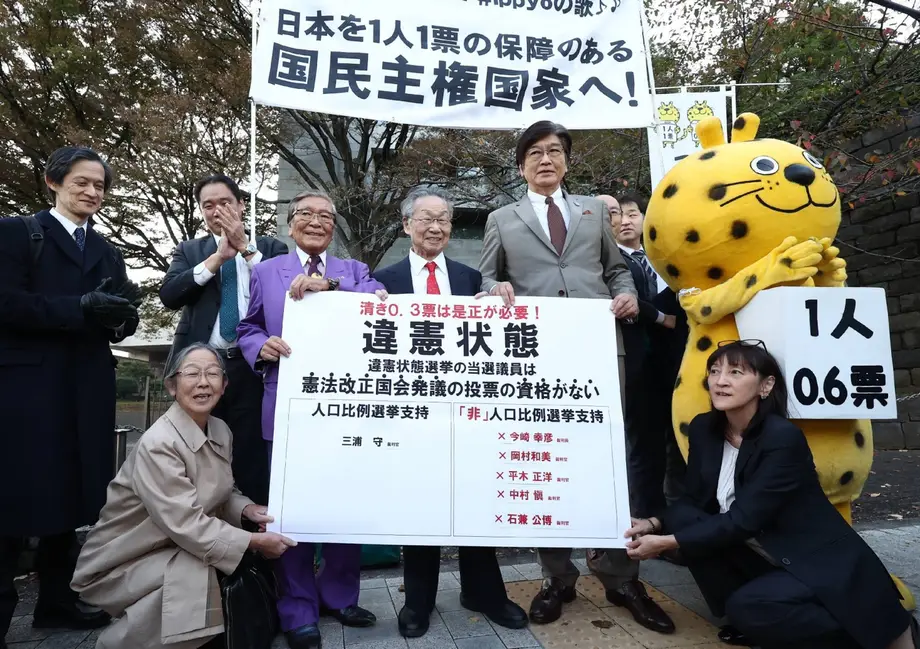
The lawyers sought a stronger outcome than the court granted: invalidation of the election. They argued that voters were being treated unequally and that parliament had allowed the disparity to increase rather than correcting it before the vote.
Japanese election litigation distinguishes between a constitutional election, an election conducted in a state of unconstitutionality, and a finding that the electoral arrangements are unconstitutional after parliament has failed to respond within a reasonable period. The middle category identifies a level of inequality that requires correction while allowing the court to consider the time and discretion parliament needs to act.
The Grand Bench stopped at that middle category. In explaining its decision, it took account of its constitutional findings for the three preceding Upper House elections, whose maximum disparities ranged from 3.00 to 3.08.
For voters and elected representatives, the immediate result is concrete: the 2025 election stands. The court's decision directs attention toward changing the arrangements for future elections. No timetable for corrective legislation was given.
What divided the judges and the parties
The five justices who considered the election constitutional gave greater weight to the time needed for parliament to agree on reform and secure public understanding. Their position reflected the difficulties of deciding how constituencies and representation should change.
Election commissions, which were defendants under the Public Offices Election Act, argued that careful consideration of difficult issues and constraints had prevented reform from being completed. They maintained that parliamentary discussions were continuing and that the modest increase in the ratio left the system within constitutional bounds.
The lawyers challenged both the unequal treatment of individual voters and the absence of corrective action. They urged the court to require an allocation of seats in proportion to population and argued that the 2025 election should be declared unconstitutional and void.
The lower courts had also divided. Of the 16 high court judgments preceding the Supreme Court's decision, 11 found a state of unconstitutionality and five found the election constitutional. The Supreme Court majority ultimately placed greater weight on the continuing imbalance and the lack of sufficient progress in parliament.
What changes for voters and lawmakers
The July 2025 election had already changed national politics through the ruling coalition's majority loss in the Upper House. At that time, Prime Minister Shigeru Ishiba's Liberal Democratic Party and its coalition partner Komeito lost control of the chamber. The Supreme Court's rejection of invalidation leaves those election results standing.
Kanagawa voters continue to face the representation gap identified in the judgment until the electoral arrangements change. Fukui sits at the opposite end of the calculation, with fewer voters per representative. Any parliamentary response must address how seats are distributed among constituencies and how much inequality the system continues to produce.
The combined constituencies introduced before 2016 provide a concrete example of the kind of structural change previously used to reduce the gap. Those changes brought the maximum ratio down from the levels recorded in 2010 and 2013, but subsequent elections show that the improvement did not continue.
Parliament now faces a sharper judicial warning than it received after the 2022 election. The majority's central message is that an earlier reform, followed by years of similar discussions, has left an inequality requiring renewed action. The election remains valid, while responsibility for correcting the system rests with lawmakers.
Key Points
- The Supreme Court ruled on November 11, 2026, that the July 20, 2025, Upper House election was conducted in a state of unconstitutionality.
- The maximum voting disparity was 3.13 between Kanagawa and Fukui, up from 3.03 in 2022.
- Ten justices supported the finding; five considered the election constitutional.
- The court rejected requests to invalidate the election, leaving its results in place.
- The majority criticised stalled parliamentary efforts about a decade after reforms introduced combined constituencies.
- This was the first such finding for an Upper House election with a maximum disparity below 4.00.