A suspended dam returns to the center of Myanmar's conflict
Myanmar's military authorities are seeking public backing for the US$3.6 billion Myitsone hydropower project while threatening legal action against people who obstruct it, bringing a dispute over electricity, land and Chinese investment back to the headwaters of the Ayeyarwady River.
Contents
- A suspended dam returns to the center of Myanmar's conflict
- What officials promised at Myitkyina University
- Who would receive the electricity?
- One dam within a much larger river scheme
- How the restart effort gathered pace
- Protests spread from riverbanks to student campaigns
- Support meetings take place under threat of prosecution
- Earthquake safety and river damage drive opposition
- Displaced families face another uncertain move
- China's role connects the dam to the war
- Key Points
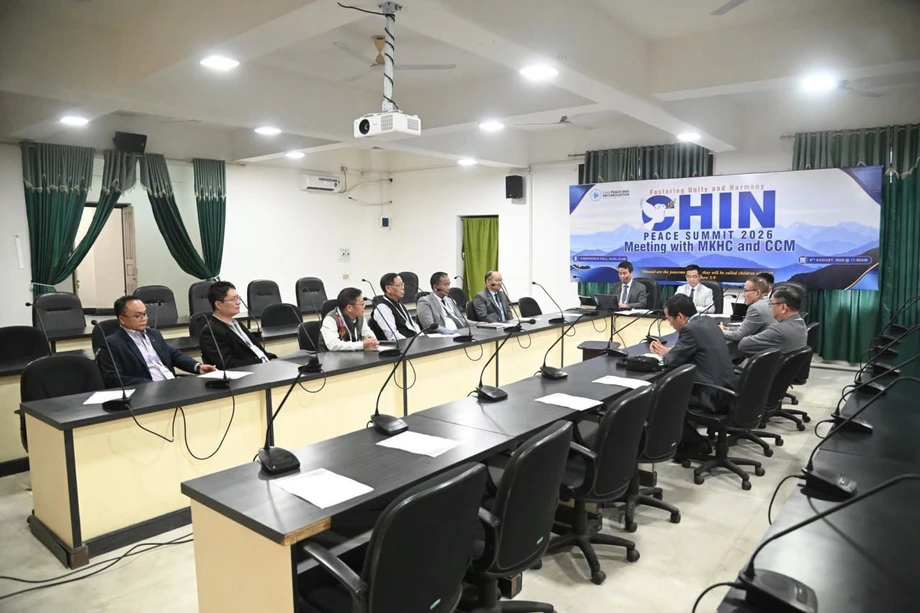
At a February 20 meeting attended by 1,480 residents at Myitkyina University, officials promised electricity for domestic use, jobs, compensation and a dam designed to withstand an earthquake of magnitude 8. Outside official gatherings, protesters have demanded permanent cancellation of a project suspended in 2011 after widespread public opposition.
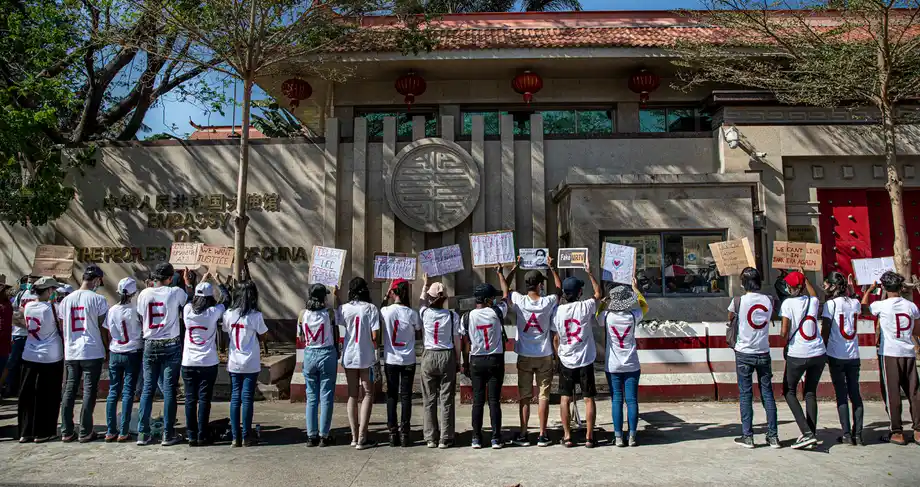
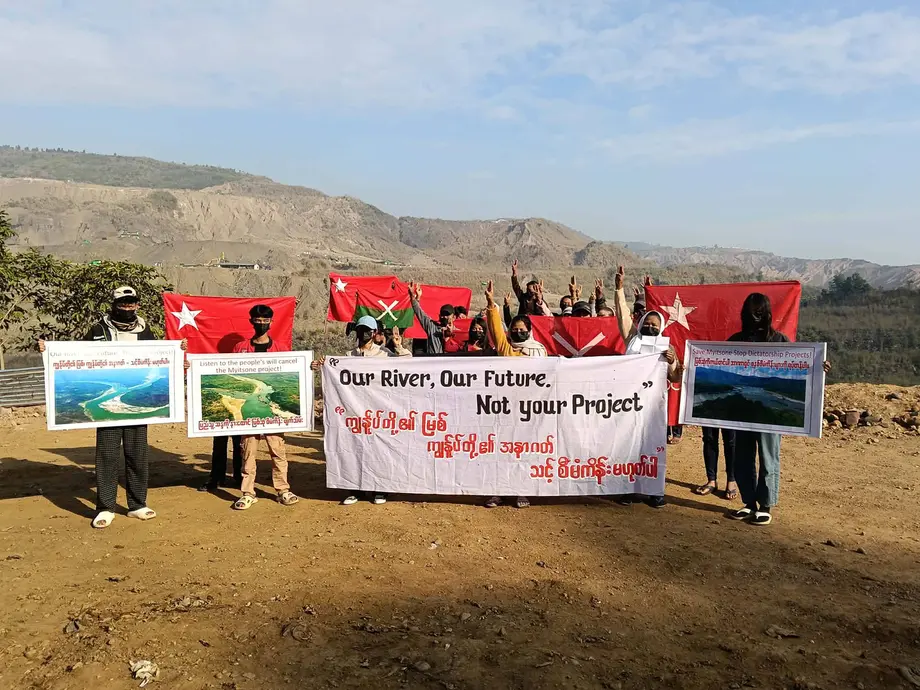
Forty members of the Hpakant Township based Hmawhlae and Hsengtaung strike columns, working with the General Strike Coordination Body, held an outdoor protest near the project site on a Wednesday. They carried banners rejecting the dam and the military's election plans, despite the danger of a crackdown.
Phoe Kyaw, leader of the Hmawhlae Strike Column, said the protest opposed Chinese pressure to restart construction. He urged people to keep speaking out against the military:
"If we the people don't speak out, the military has been corrupt from the beginning and they'll continue to be corrupt," he said.
The dispute now reaches beyond whether Myanmar needs more electricity. Residents face decisions about relocation, the future of a culturally important river junction and whether they can safely challenge a project backed by military authorities. The junta describes local participation as essential to success, while residents and rights groups describe pressure to accept a decision they oppose.
What officials promised at Myitkyina University
U Tin Aung San, chairman of the Electricity and Energy Development Commission, led the February 20 delegation. The Ministry of Information's account of the meeting says he presented the Ayeyarwady Myitsone-Myitnya Basin hydropower project as a way to meet national electricity demand and improve employment and living conditions.
Tin Aung San said power generated by the project would give priority to domestic consumption. Kachin State would use the electricity it needed, with surplus supplies shared with other states and regions. He also said hydropower projects generally take five to 10 years to develop, making advance planning necessary.
Officials asked residents to support implementation, saying success depended heavily on local backing and participation. The meeting included presentations on water management, earthquake engineering, dam monitoring, flood protection and relocation.
The delegation also distributed solar equipment and household goods worth 100 million kyats, together with 100 MRTV satellite television sets. A local committee established to support the project was instructed to coordinate with government bodies and help residents receive assistance connected with rehabilitation and corporate social responsibility programs.
Who would receive the electricity?
Tin Aung San's promise to prioritize Myanmar's electricity needs sits alongside a very different description of the project's planned allocation. The Institute for Strategy and Policy-Myanmar, or ISP-Myanmar, says China is to receive 90 percent of the electricity and Myanmar 10 percent.
ISP-Myanmar also gives an ownership split of 80 percent for Chinese interests, 15 percent for Myanmar and 5 percent for Asia World Company. The project has been described as a joint venture involving China's state owned SPIC Yunnan International Power Investment Co., Ltd., Myanmar authorities and investors connected with the military.
The February presentation left the relationship between the promised domestic priority and the stated export allocation unresolved. Revised contractual terms and a firm construction restart date have not been made public in the announcements described here.
The distinction matters directly to households and businesses. A large generating station can produce electricity while sending much of it elsewhere under a sales agreement. Residents asking what they would gain need to know how much power would reach Myanmar's grid, where transmission lines would carry it and what customers would pay.
Vice Senior General Soe Win, the junta's deputy leader, has argued that hydropower is the cheapest option. He cited production costs of 82 kyats per unit for hydropower, compared with 171 kyats for solar, 215 kyats for coal and 235 kyats for natural gas.
Using those figures, hydropower costs less than half as much per unit as solar. Those are the costs cited by Soe Win; household bills would also depend on transmission, distribution and the prices authorities set for consumers.
One dam within a much larger river scheme
Myitsone stands at the meeting of the Maykha, also called the N'Mai Kha, and Malikha, or Mali Hka, rivers north of Myitkyina. Their waters form the Ayeyarwady, Myanmar's principal commercial river, which runs for more than 2,000 kilometers through the country.
The broader development is commonly described as seven dams with combined capacity of about 20,000 megawatts. A more detailed project description lists six sites totaling 19,099 megawatts, including 6,000 megawatts at the Myitsone dam itself. The differing site counts are part of the public descriptions of the scheme.
A megawatt measures generating capacity, meaning how much power a plant can supply at a given moment. The amount of electricity produced over a year also depends on river flows, operating conditions and how often the equipment runs.
On the figures in the detailed description, Myitsone would account for about 31 percent of the broader scheme's capacity: 6,000 megawatts out of 19,099. Understanding that scale helps explain why announcements about the Myitsone dam and the wider river basin project can describe different quantities of electricity.
The coalition opposing construction describes the proposed dam as 139.5 meters high and 1,310 meters wide, with a reservoir that could flood an area comparable in size to Singapore. For nearby communities, the footprint of the reservoir is as immediate a concern as the generating capacity.
How the restart effort gathered pace
The project began in 2009 under Myanmar's previous military government. President Thein Sein suspended it in 2011 following public opposition, but it was never formally canceled. Campaigners now want permanent termination rather than another pause.
The military's renewed push has developed through committees, negotiations with China, public meetings and warnings against obstruction:
- 2009: Work began on the original project involving Chinese investment and Myanmar's military government.
- 2011: President Thein Sein suspended the project after widespread opposition.
- April 24, 2024: The military announced a steering body for the Ayeyarwady Myitsone-Myitnya Basin project.
- September 2025: After the military chief's visit to China, authorities described discussions on advancing Myitsone, oil and gas pipelines and the Mandalay-Muse railway.
- December 16, 2025: Soe Win announced an agreement with China to resume the project, while authorities warned of prosecution for obstructing approved developments.
- February 20, 2026: Tin Aung San led the public presentation at Myitkyina University.
The military also formed a high level oversight committee in late August before Soe Win's December announcement. These administrative steps have been accompanied by efforts to gather visible local support.
A local support committee held consultations with regime officials on April 3 and reportedly organized at least 10 public meetings over three months. A wider account of the promotion campaign describes more than 20 rallies across Myitkyina, Putao, Danai and Monghnyin townships.
Protests spread from riverbanks to student campaigns
More than 60 Myitkyina residents gathered beside the Ayeyarwady on January 10, Kachin State Day, to oppose the restart. Participants called on the Kachin State chief minister and the Kachin Independence Organisation, or KIO, to protect the confluence and prevent construction.
About 80 people joined another protest in the Myitsone area on April 29. On May 6, a coalition of 49 civil society organizations and activists issued a joint statement rejecting the restart and accusing the authorities of pursuing economic profit without public consent.
University students and other young people in Myitkyina also held a campaign on May 25, led by Kachin Human Rights Watch. Their demand was complete cancellation. Participants described the confluence as a sacred natural landmark for Kachin communities and the origin of a river on which people across Myanmar depend.
Phoe Kyaw said further demonstrations would follow the strike columns' protest. He argued that construction could not succeed without public acceptance and said the KIO shared the view that the project required the people's consent.
Naw Bu, spokesperson for the Kachin Independence Army, the KIO's armed wing, separately said resistance forces would stand with Kachin people against the revival plans. The opposition National Unity Government, an administration formed by opponents of military rule, also announced its opposition on January 6.
Support meetings take place under threat of prosecution
The National Defence and Security Council's December 16, 2025 order warned that individuals or organizations opposing or obstructing approved projects without "sufficient evidence" could face prosecution under existing laws. Myitkyina residents have described fear of arrest and persecution for speaking publicly against Myitsone.
Ma Sai Mai, director of Kachin Human Rights Watch, said authorities were pressuring reluctant residents to attend events promoting the project. She warned that forcing the issue during political instability and armed conflict could increase tensions.
Seng Mai of Kachin Human Rights Watch described similar pressure on residents and people displaced by fighting:
"Junta-appointed authorities are organizing public meetings with local residents in Myitkyina and Waingmaw, as well as IDPs who have fled the ongoing conflict in the upper Myitsone region, to coerce them into supporting the project. At the same time, they have issued threats that anyone opposing the Myitsone project will face legal action," Seng Mai said.
IDPs are people displaced within their own country. Some families being asked to support the dam have already fled fighting, making decisions about land, assistance and relocation especially difficult.
The government's position is that it values public wishes and needs cooperation. Residents describing fear at consultation meetings present a different picture: attending a gathering or remaining silent can happen because people feel unable to challenge military officials.
Earthquake safety and river damage drive opposition
The proposed dam site is reported to lie 25.4 kilometers from the Sagaing Fault, a major fracture in the Earth's crust where movement can cause earthquakes. Its proximity has made earthquake safety a central issue in the public dispute.
At the February meeting, electricity minister U Nyan Htun said the dam would be built to designs capable of withstanding an earthquake of magnitude 8. Earthquake and engineering geology specialist Dr. Aye Lwin discussed earthquake resistant reservoir designs, the Sagaing Fault and examples of dams near faults.
Officials also described instruments for monitoring dam safety, quality checks and emergency planning. U Khin Zaw, director general of the Irrigation and Water Utilization Management Department, presented the government's case on technical safety, flood protection and effects on fish and Ayeyarwady dolphins.
Earthquake magnitude measures the size of an earthquake. The shaking experienced at a dam also depends on the distance from the rupture, local ground conditions and the structure's design. Residents concerned about a reservoir above their communities therefore have a direct interest in the engineering assessments and emergency arrangements.
Opponents also fear changes to water flows, fishing and agriculture. The National Unity Government has warned that trapping sediment could damage farmland downstream in the Ayeyarwady delta. Sediment is the soil and other material carried by a river; it helps replenish land used for farming.
Seng Mai of Kachin Human Rights Watch explained why the campaign extends beyond Kachin State:
"We are not opposing this massive Myitsone project solely for the benefit of Kachin State or our local region. People living all along this river rely on it for fishing, agriculture, livestock, and other essential water needs," Seng Mai said.
Displaced families face another uncertain move
Residents say people from about six villages, including Tang Hpare and Mali Yang, were forced to relocate for the original project. Kachin Human Rights Watch gives a larger count of nearly 11 villages evacuated and resettled to Aung Myin Tha and Maliyan. A 2013 independent environmental impact assessment estimated that approximately 12,000 people were displaced and their homes and land forcibly seized.
Those accounts describe a legacy of lost land and disrupted livelihoods that predates the current restart campaign. Some residents want the project canceled so they can return home permanently and work freely on their own land.
At the February meeting, U Min Naung discussed compensation, relocation and the use of farmland and land management laws. Officials also instructed the local committee to help protect employment opportunities during rehabilitation.
Families face practical questions that go beyond a compensation payment: whether replacement land can support farming, whether fishing remains possible and whether they can reach markets. Residents have also described restrictions around the project area that interfere with everyday activities, including retrieving grazing cattle.
Before the coup, the confluence attracted visitors and provided income for local people. Residents say extensive gold mining has since damaged the surrounding environment and river channels. The proposed dam would add another major change to a place already affected by extraction and war.
China's role connects the dam to the war
The junta's reliance on Chinese diplomatic support and military supplies has deepened suspicion that restarting Myitsone is part of an exchange for Beijing's help. Protest leader Phoe Kyaw framed his opposition in those terms, accusing the project's Chinese backers of exploiting Myanmar's natural resources.
China has also used border pressure, trade access and weapons supplies to influence the wider conflict, helping the military recover some territory. The renewed dam campaign follows that expansion of China's support for Myanmar's military, which has linked Beijing's economic interests with the junta's efforts to consolidate power.
For the authorities, Myitsone offers a large electricity project and a way to advance a major Chinese investment. For protesters, the same project brings fears that decisions about their river and homes are being made through negotiations in which they have little influence.
The immediate conflict is between a government campaign for cooperation and a public campaign for cancellation. Engineering promises, domestic electricity commitments and compensation proposals address parts of the dispute. Residents also want the freedom to decide whether the project should proceed at all.
Key Points
- Myanmar's military authorities are pushing to revive the US$3.6 billion Myitsone project, suspended in 2011.
- Officials promised domestic electricity priority at a February 20, 2026 meeting attended by 1,480 residents.
- ISP-Myanmar describes an allocation sending 90 percent of the project's electricity to China.
- Protesters, students and a coalition of 49 civil society organizations and activists have demanded cancellation.
- A December 16, 2025 order threatened prosecution for opposition or obstruction without sufficient evidence.
- Major concerns include earthquake safety, displacement, river flows, livelihoods and public consent.