TSMC powers a third day of sharp gains
Taiwan's benchmark TAIEX jumped 1,545.23 points, or 3.62%, to 44,257.15 on Wednesday, November 11, 2026, as record October revenue and a higher dividend sent Taiwan Semiconductor Manufacturing Co. shares up 4.81%. The index finished at its highest level of the session, recording its sixth largest closing point gain.
Contents
- TSMC powers a third day of sharp gains
- Record revenue and a larger dividend lift TSMC
- How much of the selloff has been recovered?
- Buying spreads beyond the largest chipmaker
- Circuit boards and fiberglass attract strong demand
- Robotics and software join the advance
- Domestic institutions buy as foreign selling slows
- Government support meets nearby selling pressure
- Company results and a delisting remain in focus
- Key Points
The advance was the third consecutive session with a gain exceeding 1,000 points, following a week when the market suffered its largest weekly point decline. Since Friday's close, the TAIEX has recovered 4,555.51 points, helped by the National Financial Stabilization Fund's announcement of its tenth market intervention and restrictions on short selling.
TSMC contributed about 880 points, roughly 57% of Wednesday's index gain. Buying also spread to circuit boards, electronic materials, financial companies and smaller technology businesses. Foreign institutional investors nevertheless remained net sellers, while trading value fell from the previous session.
The Taiwan Stock Exchange put the total market value of listed companies at NT$144.97 trillion. For investors, the day's central development was a rapid recovery in prices alongside stronger company revenue figures, but with domestic institutions supplying much of the buying while foreign investors continued reducing their holdings.
Record revenue and a larger dividend lift TSMC
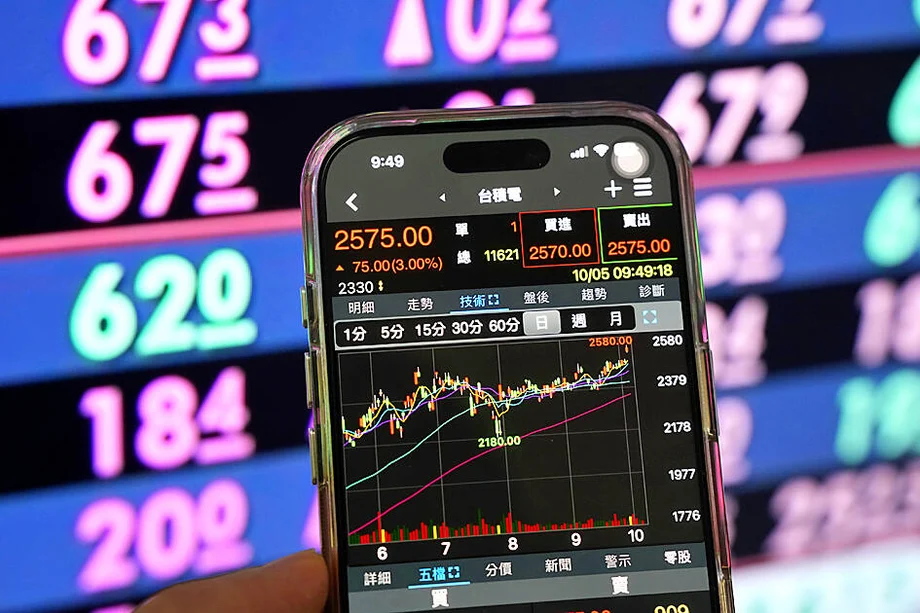
TSMC closed up NT$110 at NT$2,395 after announcing October consolidated revenue of NT$586.89 billion, a monthly record. Revenue rose 14.7% from September and 59.7% from October a year earlier.
The chipmaker's revenue for the first 10 months reached NT$4.485617 trillion, up 43.3% from the same period a year earlier. Its third quarter earnings per share were NT$29.43, while the board approved a record quarterly cash dividend of NT$9 per share, compared with NT$7 for the second quarter. That is an increase of about 28.6%.
A cash dividend gives shareholders a payment for each share they own. TSMC's increase means an investor holding 1,000 shares would receive NT$9,000 rather than NT$7,000 for the relevant quarterly distribution, before any applicable taxes.
Alex Huang, an analyst at Mega International Investment Services, attributed the buying to both the sales announcement and the larger payment to shareholders. He connected October's revenue growth to demand for artificial intelligence applications.
The October sales reflected robust global demand for AI applications," Huang said. "The raised cash dividend payout encouraged investors to pick up the stock soon after the market opened.
TSMC accounts for more than 40% of the market's total value, giving its share price exceptional influence over the TAIEX. The index weights companies by market value, so a move in a very large company has more effect than the same percentage move in a small one.
How much of the selloff has been recovered?
The TAIEX traded between 42,708.05 and 44,257.15 on Wednesday. Its close brought it back above both 43,000 and 44,000, extending the recovery after the government authorized support on November 6.
The sequence shows how quickly market conditions changed:
- November 6: The TAIEX closed at 39,701.64, down 4.51% for the day. The stabilization fund authorized its tenth intervention after trading ended.
- November 9: New Financial Supervisory Commission measures took effect, including tighter short selling requirements.
- November 10: TSMC announced record October revenue and board approval for the higher quarterly dividend.
- November 11: The TAIEX closed at 44,257.15, bringing its three session gain to 4,555.51 points.
The rebound follows the November 6 intervention authorization, issued after the index had fallen about 20.55% from its annual peak of 49,968. The preceding week erased 5,510 points, or 12.19%.
Measured against that weekly point loss, the subsequent 4,555.51 point recovery restored about 82.7%. The index remained 5,710.85 points, or approximately 11.4%, below the annual high. Those figures explain why a dramatic rebound can coexist with substantial losses for investors who bought near the peak.
Buying spreads beyond the largest chipmaker
MediaTek rose 4.18% to NT$3,990 and contributed roughly 75 points to the TAIEX. AIchip Technologies gained 6.73% to NT$3,650, while United Microelectronics added 3.48% to NT$104.
Other major technology companies advanced more modestly. Foxconn, also known as Hon Hai, edged up 0.21% to NT$242. Delta Electronics gained 1.57% to NT$1,295 after reaching its daily upper price limit in each of the preceding two sessions. ASE Technology Holding rose 1.98% to NT$617.
Asustek Computer gained 2.04% to NT$902, and LITE-ON Technology rose 2.36% to NT$239. Asia Vital Components, which makes cooling equipment, climbed 8.96%, while Jentech Precision Industrial added 7.51% to NT$6,225.
Financial shares supplied another source of support. The financial sector index rose 2.46%, with Fubon Financial gaining 4.25% to NT$159.50, Cathay Financial advancing 2.73% to NT$113, and Yuanta Financial adding 3.04%.
Transport and materials companies joined the rally. EVA Airways gained 3.14% to NT$47.60 after October revenue reached its second highest monthly level. China Airlines rose 3.41% to NT$151.50. Nan Ya Plastics climbed 8.30% to NT$313, contributing about 53 index points, while Formosa Chemicals & Fibre rose 2.80% to NT$73.50.
Circuit boards and fiberglass attract strong demand
Taiwan Glass, Glotech Industrial and Fulltech Fiber Glass closed at their daily upper price limits as investors bought companies linked to electronic grade fiberglass cloth. The companies had reported strong October sales as demand increased for the material.
Fiberglass cloth helps form the supporting structure inside printed circuit boards. These boards hold electronic components and provide the electrical connections between them. Demand for more advanced computing equipment can therefore reach businesses making basic materials as well as chip designers and manufacturers.
Dynamic Holding, Apex International, Wus Printed Circuit, Iteq, Tripod Technology and Microcosm Technology also reached their daily upper limits. Tripod's earnings per share for the first three quarters reached NT$24.96, exceeding its result for the whole previous year. Unimicron Technology rose 4.35%, and Elite Material gained 3.09%.
Passive component companies also attracted buyers. These businesses make parts such as resistors and capacitors, which regulate electrical current or store electrical energy. Holy Stone Enterprise and Viking Tech reached their daily upper limits, while Kaimei Electronic, Tai-Tech Advanced Electronics, Hua Jung Components, Leatec Fine Ceramics, Prosperity Dielectrics and Ever Ohms Technology gained about 4% to 5%.
APCB rose 10% to NT$35.75, its highest level in five years. A daily price limit caps how far an individual share can rise or fall in a session, meaning a stock that reaches the ceiling may finish there even while buyers continue seeking shares.
Robotics and software join the advance
Robotics shares drew buying after Apple unveiled HALO, a system designed to help humanoid robots perform tasks autonomously. Taiwan Benefit, Usun Technology, Ying Han Technology and Taiwan Takisawa Technology closed at their daily upper limits.
Hiwin Technologies, Hiwin Mikrosystem, Aurotek, Asia Optical, Apex Dynamics and Tuchman Robot also finished higher. The buying extended the day's technology rally beyond semiconductors and the equipment used in data centers.
Information services companies posted a cluster of strong gains. Ares International, NewSoft Technology, Azion, Dimension Computer Technology, Information Technology Total Services, Acer Synergy Tech, High Performance Information and Changing Information Technology all reached their daily upper limits.
The market for shares traded over the counter also advanced. Its index rose 3.35% to 344.11 on turnover of NT$204.465 billion. Combined turnover across that market and the main exchange reached about NT$1.054 trillion.
Domestic institutions buy as foreign selling slows
The Taiwan Stock Exchange recorded net foreign institutional selling of NT$766.44 million on the main board. That was much smaller than the previous session's NT$34.117 billion, a reduction of approximately 97.8%.
Investment trusts bought a net NT$14.765 billion, extending their buying streak to 21 sessions. Proprietary traders, which trade using their firms' own money, bought a net NT$6.257 billion. Together with foreign activity, the three major institutional groups recorded net buying of NT$20.256 billion.
The foreign selling streak was counted at 10 sessions in the institutional trading breakdown, with cumulative net sales of NT$830.5 billion; another market tally put the streak at nine sessions. Both placed Wednesday's small net sale within a longer period of foreign withdrawals.
Foreign investors also held a net short position of 104,271 Taiwan index futures contracts, up from 103,473 in the preceding session. A short futures position can gain value when the index falls and can also serve as protection for shares an investor continues to hold.
Main board turnover totaled NT$849.17 billion, about US$25.78 billion, down roughly 17.6% from NT$1.03 trillion in the previous session. Another published trading figure was NT$846.195 billion, while a tally including trading at fixed prices after the regular session reached NT$850.572 billion. The central concern raised by analysts was that prices were recovering while regular session trading value was declining.
Government support meets nearby selling pressure
The National Financial Stabilization Fund has statutory funding capacity of NT$500 billion. Its November 6 authorization allowed its executive secretary to deploy money according to market conditions. The initial purchase amount and buying timetable were not announced.
The Financial Supervisory Commission also raised the short sale margin requirement from 90% to 130%, lowered the limit on margin short sales and relaxed collateral rules. Short selling involves selling borrowed shares in the hope of buying them back more cheaply. Requiring more collateral makes such trades more expensive to maintain.
Kuo Ching-wei, an analyst at Cathay Securities Investment Advisory, said only two of the fund's nine previous interventions coincided with a market bottom. His historical calculation showed average index gains of about 6% after five trading days, 4% after 20 days and 3.3% after 60 days.
Kuo identified easing foreign selling, a halt in Taiwan dollar depreciation and declining margin balances as conditions he would watch for a more durable recovery. Margin balances track borrowing used to buy shares. A reduction can ease the pressure created when falling prices force investors to provide more collateral or sell.
Jung Yi-shen, deputy general manager of Chi Far Securities Investment Consulting, placed the first resistance zone between 45,000 and 46,000. Resistance describes an area where selling may increase, including from investors seeking to exit positions bought at higher prices. From Wednesday's close, that zone was about 1.7% to 3.9% higher.
Huang pointed to the TAIEX's moving average over 20 trading days at 45,144 and potential resistance for TSMC near NT$2,450. A moving average smooths daily price changes to show the recent trend. He warned of a possible pullback as the index approached that level.
Company results and a delisting remain in focus
Hsiao Hui-chung, portfolio manager of the Allianz Taiwan Dam Fund and Allianz Taiwan Technology Fund, attributed the recent correction to policy uncertainty, valuation adjustments and capital reallocation. He said demand for investment in AI infrastructure remained intact, while cautious sentiment could keep share prices volatile.
Operating figures offered further detail on that demand. Quanta Computer's October revenue rose 104% from a year earlier, Hon Hai's increased 46%, and Delta Electronics' grew 30%. Investors will next have opportunities to assess company outlooks at briefings scheduled for Thursday, November 12, including those of Hon Hai, Asustek, Wistron and Pegatron.
Microelectronics Technology moved in the opposite direction from the broader market. The microwave and satellite communications equipment maker opened at its daily lower limit of NT$6.66 after announcing Tuesday that its net worth had turned negative and that its shares would be delisted from the Taiwan Stock Exchange on December 21.
Negative net worth means a company's recorded liabilities exceed its assets. For shareholders, the immediate issue is the announced removal of the shares from exchange trading, a concrete company event amid a market session dominated by rising prices.
Key Points
- The TAIEX rose 1,545.23 points, or 3.62%, to 44,257.15 on November 11, its sixth largest closing point gain.
- TSMC gained 4.81% after record October revenue of NT$586.89 billion and approval of a NT$9 quarterly dividend per share.
- The index recovered 4,555.51 points over three sessions, restoring about 82.7% of the preceding week's point loss.
- Domestic institutional buying outweighed foreign net selling of NT$766.44 million, while main board turnover declined.
- Analysts identified potential selling pressure between 45,000 and 46,000 points.
- Major company briefings are scheduled for November 12, while Microelectronics Technology announced delisting for December 21.